
Are you a fan of classic, serious all-terrain vehicles like the Land Rover Defender or the Mercedes G-Wagon? Are you of the opinion that everything was better in the old days, that the new Defender is far too comfortable, and that the G-Wagon has become a status symbol for people with no interest whatsoever in its off-road capabilities? In both cases (and especially the latter) you have my sympathy, and I’m therefore very happy to say that this week, we’ll lay your worries to rest by talking about not only a new car, but actually a new brand: Ineos and its new Grenadier. And before going any further, let me thank reader John who made me aware of this new machine!

In the unlikely event that Ineos rings a bell, it’s most probably not as a car company but rather as a chemical business, or indeed a road cycling team. It was founded by majority owner and long-term Defender fan Sir John Ratcliffe who may well have been one of the least happy people when the old Defender had to go and was to be replaced with, in his view, a chick city SUV.
When it became clear that there wouldn’t be a “real” successor to the Defender and after Jaguar Land Rover had refused to sell the rights to the original Defender to Ratcliffe, in 2016 he instead approached long-term Ineos employee Dirk Heilmann, today CEO of Ineos’ car business, telling him he wanted to create a true Defender successor. Seven years later I think we can safely conclude that Ratcliffe and Heilmann succeeded, making the Grenadier the closest thing to what a more offroad-focused Defender successor would have looked like!
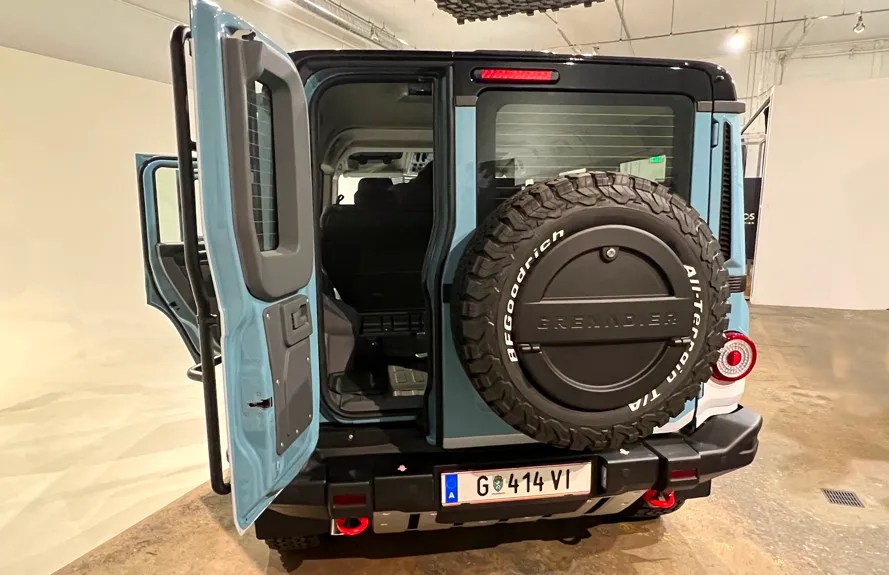
So what is then the Grenadier, built since 2022 in France in the old Smart factory in Hambach, close to the German border? Starting on the outside, there is no doubt that what you’re looking at is a Defender at heart, however with subtle differences and improvements. An example are the lateral roof windows that have been replaced with bars to which various pieces of kit can be attached. An even better one is the trunk or rather rear luggage door that has been split into a smaller and a larger part, so that for small items you only need to open the smaller door. Otherwise the Grenadier comes in a few different body styles and trim levels, but what they all have in common is a body with short overhangs, sharp angles and large windows. It’s practical, provides a great overview of the car, and has a strong resemblance to the you-know-what.
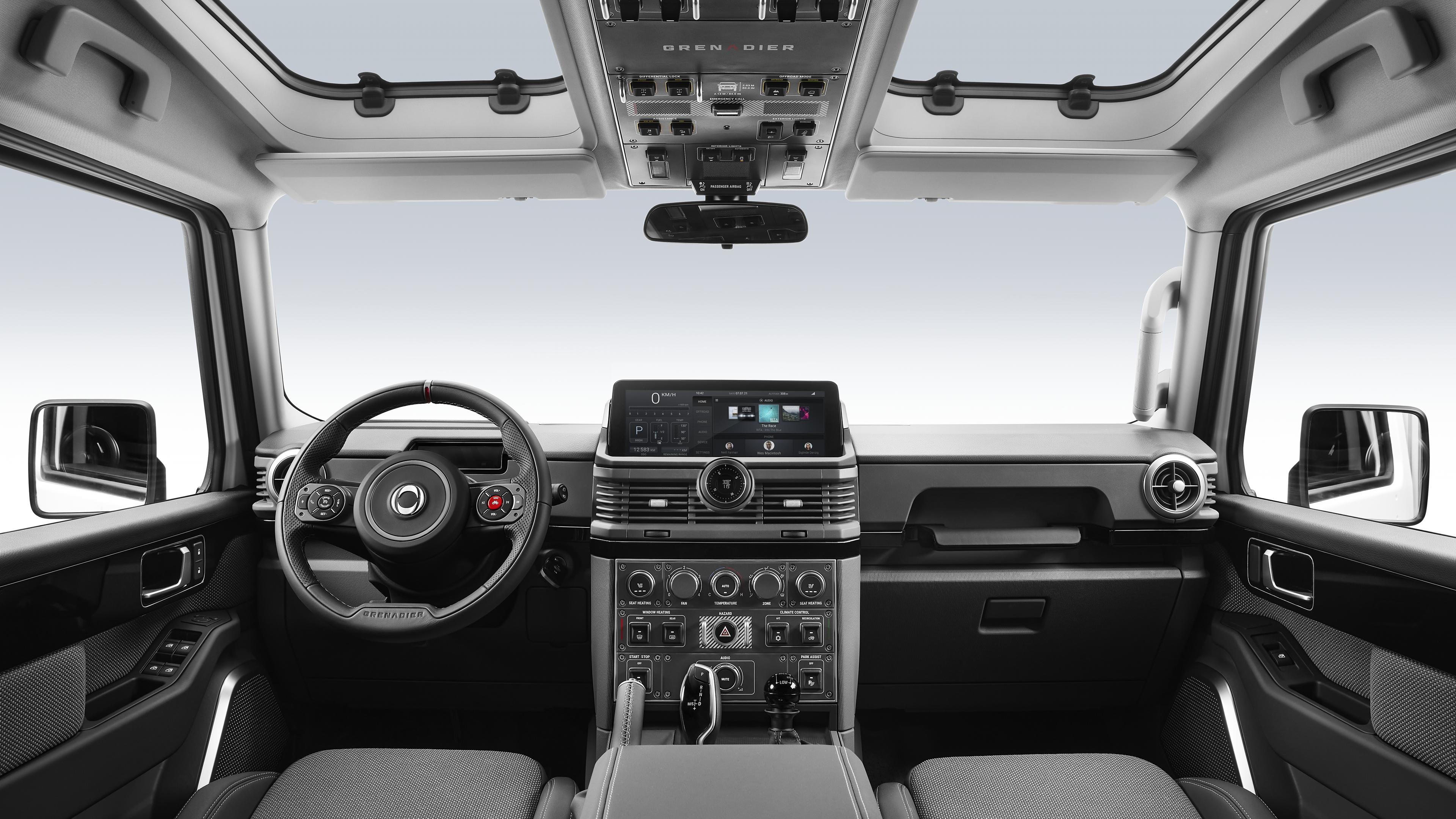
The utilitarian aspect is carried over to the inside which is dominated by a very large, center console. Apparently Ineos have looked at trucks and airplanes when designing the different buttons and switches, and consequently created an interior without shiny surfaces to touch, preferring controls of a size that allows you to operate them with your gloves on. The infotainment screen above the center console is actually a touchscreen, but one that can also be operated by a control in the middle. The unit allows you to save off-road maps on it for when you leave the beaten path, but also offers practicalities like Android Auto and Apple Car Play. A bit strange is of course the absence of a gauge cluster, and also the switches next to your head, which may be cool but are probably quite difficult to read off when driving…
All Grenadiers will have one of two six-cylinder BMW engines, either a diesel with 249 hp or a petrol with 285 hp. These are coupled to an eight-speed auto box from ZF and permanent all-wheel drive with as standard a central differential. Helping ensure the Grenadier is used as intended is also the fact that both axels are rigid, meaning on-road comfort risks being rather limited. The Italian supplier Carraro is otherwise specialized in axels for agricultural machines and trucks, which can clearly be seen on the size of that central differential…. You have been warned! Both engines will need to work hard though as the Grenadier weighs in excess of 2800 kg, some 600 kg more than a new Defender 110.
The launch of the Grenadier was delayed by Covid, having initially been planned for 2021. However, the company started taking pre-orders last that year and now, it has established a network of sale points, or rather agents, in different European countries and the US. The process is for clients to order their Grenadier directly over the website, and then pick it up at an agent who also acts as service point. And even if the price has increased from that initially planned and advertised, the car, given how capable it is, remains quite a bargain. In Europe a well-equipped Grenadier will come to EUR 90-100.000. By coincidence, that’s more or less aligned with the new Defender, so at least that have that in common…

It’s not everyday that a new car brand is launched and certainly not one that builds true terrain vehicles rather than yet another EV. Somehow however, compared to some others, there doesn’t seem to be any doubt that Ineos will succeed. Ratcliffe is a dedicated man able to secure the financing, but he has also surrounded himself with a team of experienced car people, making the whole setup look very promising.
That said, recent tests indicate that the Grenadier is by no means a perfect car. To name a few things to be aware of before you sign on the dotted line, the steering is very much set up for offroad use, meaning there’s close to no self-centering on road. I’ve already meantioned the weight, which obviously means it’s quite thirsty and generally cumbersome, and it also has a terrible turning circle of around 13.5 metres, 2 metres more than the Defeinder. Differentials are manual, not electronic like in modern terrain cars, adding to the complication. This is explained by Ineos’s wish to create an analogue car – but does it really make sense to ignore modern technology when it improves things? Buyers will need to be the judges of that.
The plan is to produce 40-50.000 cars per year, which given what we know so far seems reasonable, and should they succeed, you can count on further body styles and perhaps also engine options being added to the range. There’s thus little doubt that the Grenadier is the real thing when the going gets really tough. The question is perhaps if it’s also the real thing on the road… Expect to see fewer around than that shiny G-Wagon or the new Defender, but as a Grenadier owner, every time you cross one of those, both of you will know who’s the real king!
 The Thrill of Driving
Pingback: The sand pile is crumbling – The Thrill of Driving