
When you think of the British car industry, “legendary” is perhaps not the first word that comes to mind. Or at least, most UK legends are so because of their beauty (think Jaguar E-Type), their elegance (pick your favourite Bentley or Rolls), or for that matter, their quirkiness (the Reliant Robin anyone?). There’s really only one British car that has become a true legend not in any of the above, but actually in sales numbers. It’s not big, it’s very clever, and it was in production for over 40 years. This week we’ll look closer at the legendary Mini, with a particular attention to those that also had Cooper in their name.
As so often, it turns out that automotive development is closely tied to geopolitics. Had we not had the Suez crisis in 1956, when Egyptian president Nasser decided to nationalize the Suez channel and through that, cause surging fuel prices, then the British Motor Corporation (BMC) would probably never have developed the Mini. The crisis however led to a strong demand for smaller, economic cars, and so Alec Issigonis, an engineer at BMC, set about developing a new car concept with front-wheel drive and a small, transversal four-cylinder engine.

The engine , taken from the Austin A30 was of course not a particularly exciting one, but the ingenuity of the construction was impressing. By notably positioning the gearbox under the engine so that it could use the engine’s oil for lubrification, placing the cooler between the engine and the left front wheel, using a space-saving rubber suspension and small, 10-inch wheels, Issigonis built a car that although it wasn’t longer than three meters, still had room for three people in comfort (as defined back in the 50’s…). The initial 34 hp the small, 1-litre engine produced certainly didn’t set any records in acceleration, but again, it was seen as adequate at the time, especially since the car only weighed 600 kg.
We’ll stop here for a second to introduce the Cooper Car Company, set up after WW2 by Charles Cooper and his son John. Cooper was specialised in building high performance cars for racing and motor sport, from F1 to rally cars, and notably counted Stirling Moss among their clients. The Mini was thus quite far off the regular business of Cooper, but as the engineer he was, Charles quickly saw the rally potential the small, light Mini could have. Beginning in 1961 therefore, the company started producing the Mini Cooper with an increased engine size and more power, not realizing at the time that they had built not only. a great rally car, but actually the favourite car stars wanted to be seen in in the early 60’s.
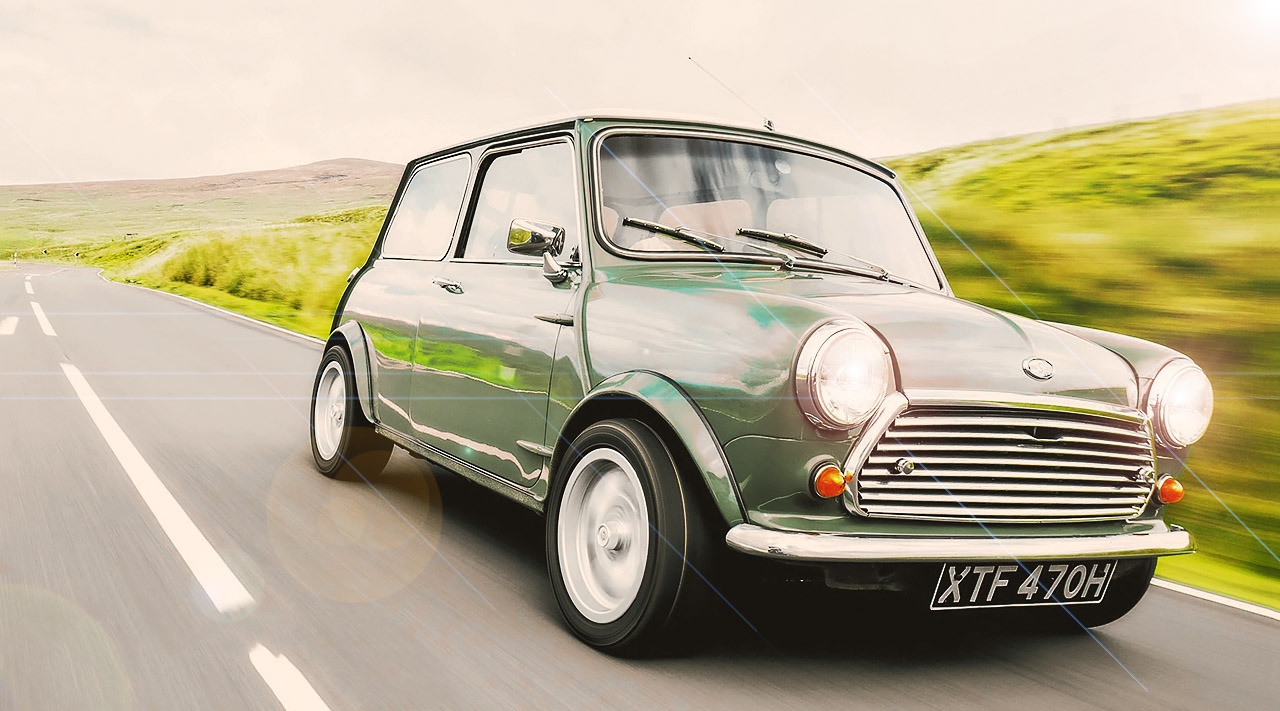
The Mini Cooper won the Monte Carlo rally four years in a row from 1964 through 1967 and a bunch of other rallies around the world as well, with as principal assets its light weight and small size. It has also starred in over 20 movies, often exhibiting its rally talents, and nowhere more famously than in the original version of “The Italian Job”. If ever there was a true gokart feeling in any car, this is surely the one, with each one of the small wheels placed very much in the four corners. As said, pretty much every star and wannabe in the 60’s wanted to be seen in a Mini, preferrably a Cooper, so that when BMC discontinued the production of the Cooper in the 1970’s, the Cooper Car Company continued to produce it as demand remained strong.
This is also where the story becomes a bit blurry, as is often the case with British cars from this era. It’s not fully clear when production of the Cooper went over from BMC to the Cooper company, neither when the latter stopped producing it. It’s also not fully clear how a Cooper looks as some of them, but not all, came with the characteristic stripes, but of course it didn’t take much for the owner of a regular Mini to fit some stripes on his car and call it a Cooper. And there are, or at least were Coopers out there with no stripes at all, for the true modest ones.

The original Cooper boosted the paltry 34 hp of the standard Mini to a more respectable 55, and the Cooper S, introduced in 1967, all the way to 70 hp. That made the still sub-700 kg car good for a top speed of 145 km/h, and considering how close to the ground you sit and the 10″ wheels you roll on, that’s really plenty. There’s another peculiarity of the Mini which is worth noting, being the angle of the steering wheel, that is almost horizontal and more reminiscent of a bus than of a car. This was made necessary through the design as it allowed more legroom in the front, but it made the driving experience slightly peculiar.
There have been more special versions of the Mini than anyone can remember during its 40 years of production. As safety standards evolved and improved, that had its effects on the Mini as well, but otherwise, improvements are really mainly in terms of comfort and elegant or sporty looks, depending on the versions. The most famous, luxurious ones of these include the Park Lane and the Mayfair, whereas among the sportier ones, the gold striped 1250 GT with a 1.25 litre engine was the most powerful standard version of the Mini produced. Over the 40-year production run, a total of 5.3 million Minis would be built.
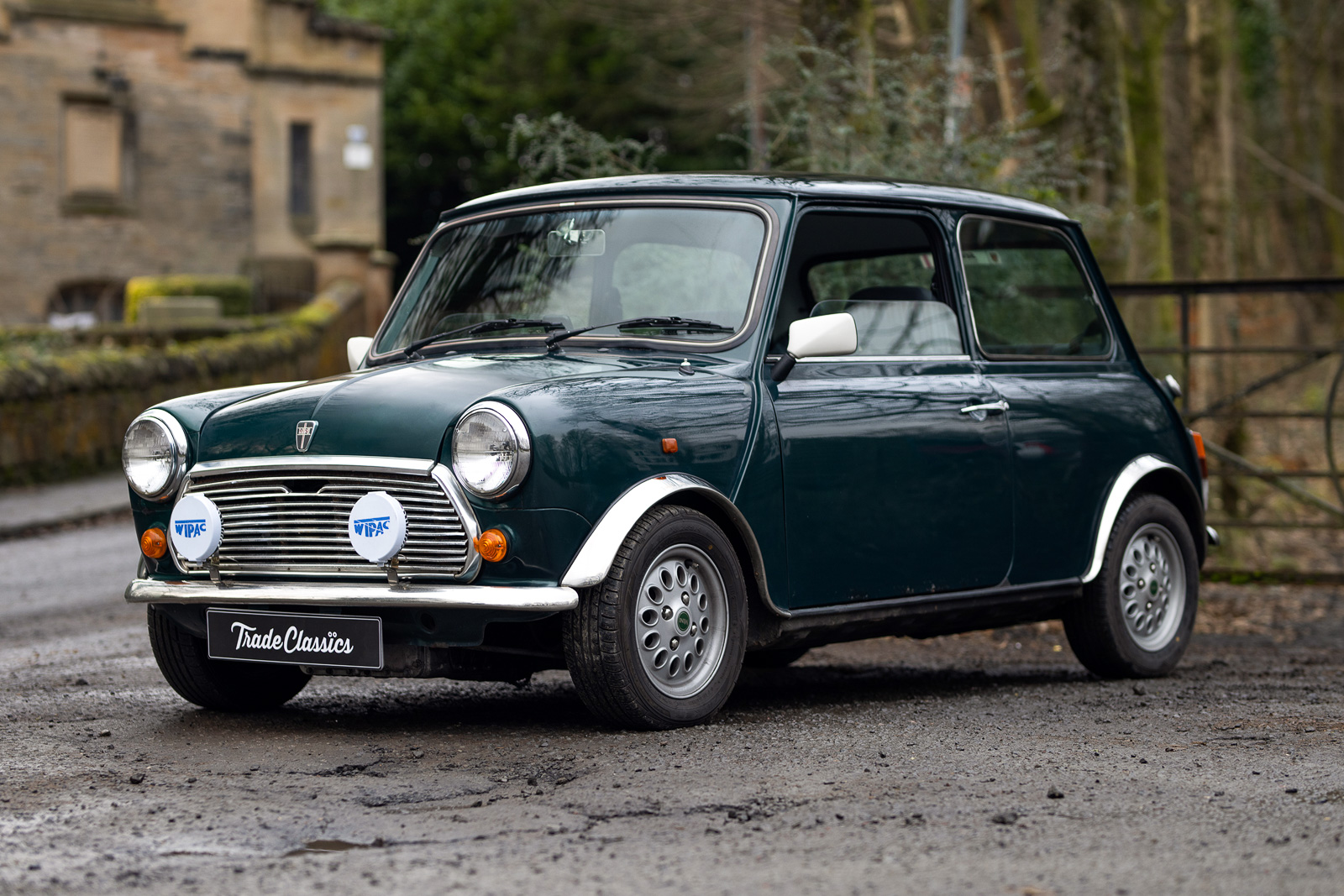
And yet, and I’m inclined to again refer to what’s typical of British cars from the 60’s and 70’s, not many of these remain, and those that do have started to climb in price so that you today will have to pay from EUR 20.000 and upwards for a car in decent shape, and probably a few thousand more for a good Cooper. The car’s construction is very simple and there’s no doubt that its main enemy is rust, rust and, well rust. Next to that, the originality of the car is something to pay attention to and of course, also making sure that if you pay for a Cooper, that’s indeed what you get!
Of course 20-25.000 is a lot for a three-meter car from the 60’s, with limited comfort, even more limited power, and even if there’s enough space for four adults, they really can’t bring much more than a shopping bag for luggage. On the other hand, the modern city cars now being developed often don’t have room for more than two, hardly have more luggage space, and certainly are nowhere close to the character of an original Mini. That’s not even a difficult choice!
 The Thrill of Driving