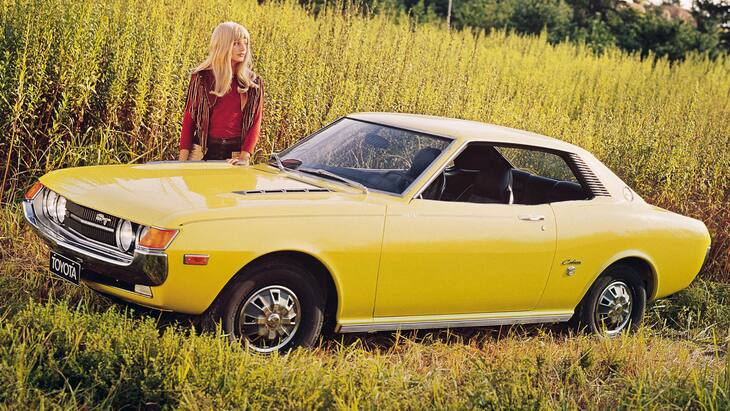
If there’s one thing that is even less featured on this blog than American cars, it’s those from the land of the rising sun. In the case of the US, this is explained by this not being my area of expertise. In the second, its frankly because of a lack of interest. Having said that, Toyota sells about 10 million cars per year and although it’s the biggest Japanese brand by a margin, it’s certainly not the only one. Surely there must be something to write about in those numbers ?
Honestly, these days I’m not so sure. There is the Nissan GT-R we’ve talked about, and then of course the Honda NSX, which however isn’t even close to reaching the cult status the original NSX has these days. The Lexus LC is a cool-looking thing, but as so many Japanese cars, it feels like it lacks personality. And then there’s of course a bunch of hot hatches, mostly from Honda, but if you’re into those, chances are you’re not reading this blog in the first place.

Last week however I saw a Japanese car I haven’t seen in a long time and which certainly. has personality. It reminded me of the time when Japanese cars were much less present on Western streets then they are today, meaning the early 70’s (which in turn reminded me of how old I am…). In an effort to change that, and especially to enter the US market, Toyota launched the car I’d just seen, the original Celica, in 1970.
Celica is Latin and means “celestial”, which I guess is the direction Toyota wanted sales to go. And over the coming years, they would be proven correct as the Celica became a very popular sports coupé. However, none of the later series had the charm of the first one, which was of course also Japan’s first try at, if not a muscle car, then at least a cool looking pony car!

Back in Tokyo in the late 60’s, Toyota’s engineers realized that the only cars they had that could come in question for exports to the US and Europe had too small cabins for a normal Western male, and too small engines for their liking. If they ever wanted to make it big on the other side of the ocan, especially the US, that would have to change, and the Celica was Toyota’s first try at doing that.
The Celica was based on the Toyota Carina, perhaps not the best reference in the world if you want to build a sports car, and also a car with which the first Celica shared a few too many parts. But when it launched in the US in 1971, it was considerably cheaper than the Ford Mustang, which certainly helped. That said, it also offered far less under the hood, with a paltry, 1.9 litre four-cylinder, delivering a rather poor 90 hp, coupled to a four-speed manual box. Neither a six-, nor an eight-cylinder was anywhere in sight.

The original Celica’s looks are both unique as in the angle of the headlights, to the pony car body, also called “coke bottle styling” bridging the 60’s and 70’s. You can spot quite a few US cars in its lines, which is probably no coincidence. It’s also a car along the ladies’ shoe principle, i.e. compact on the outside but roomy on the inside, and this at a time when the Mustang was gaining both in weight and size, but not in power.
Then of course it was also Japanese, meaning it didn’t break, and actually it was the first Japanese car to be fully assembled on an automatic assembly line. It had an independent suspension and disc brakes all around, and of course it was rear-wheel drive, so that even with only 90 hp, if you knew what you were doing, it was happy to swing its tail. That’s all the Westerners needed to know to start buying Celicas in increasing numbers.
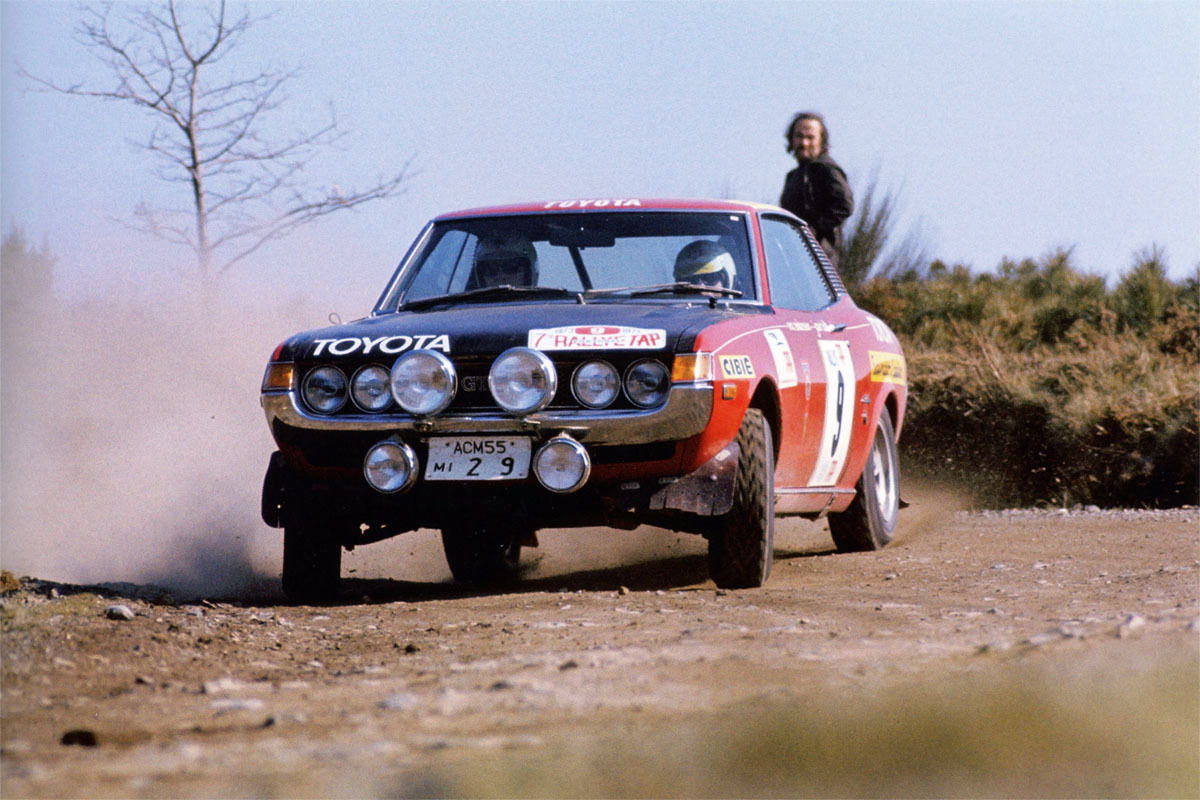
Swinging its tail in fast corners is also what the Celica started doing on the world’s rally stage, and would continue to do long after the first series. The Swede Owe Andersson was the first to drive a Celica, and he did it so well that he later founded Toyota’s European rally team, something that certainly helped sales especially on the European side of the Atlantic. Of course, later version of the Celica would become both more powerful and all-wheel drive, and make it big on the worlds’ rally scenes.
Going back to the original car however, the first series had a few different trims to choose from, and the engine evolved ever so slightly over the years until the first facelift in 1975, gaining in volume and thereby power, but only to a bit over 100 hp. The Celica was thus never a very powerful car, but as the 70’s moved into the oil crises, that was also not the priority for many buyers. In that sense, it came at the right time, partly explaining its success. The total production number of the first series is uncertain, but over 150.000 cars were sold both in 1972 and 1973, not bad for Toyota’s first try at a sports car in the West!

Yet as so often, there’s a big question mark around where all these cars have gone today. Sure, build quality was certainly better than rust protection even on a Toyota in the 70’s, and a fair number have simply rusted away. Given its low price, quite a few will also have ended up with young buyers better at fitting a rear spoiler than a new engine, or for that matter, at driving. That doesn’t mean they didn’t try though…
That said, around something like EUR 20.000, you can still find one of the original Celicas if you look carefully. And please do look carefully, meaning going for one with as few skirts and as little plastic as possible, as you never know what hides underneath. Ideally the car should also be complete in terms of parts, because finding spare parts for a Celica from the early 70’s could be “very difficult”, as the Japanese would put it. But if you find the right car, what you’ve then bought yourself is arguably both the coolest Japanese car from the 70’s, as well as its only pony car!
 The Thrill of Driving