
As we start off 2024, I want to update you on a change that you will soon notice on the blog, namely that I will no longer keep up the weekly posting frequency. My rather hectic work life is one reason for this change, but another is also a certain pressure to come up with interesting content and write about it on a weekly basis, as the time from one Sunday to the next can be awfully short sometimes!
My priority has always been, and will continue to be, to bring you well thought-through, quality content written in a way I’m comfortable with, and on that I will never compromise. From now on however, that means posting less frequently, and in the meantime, give you time to look through the several hundred posts written so far, that you can find on the blog. I hope you’ll enjoy the reading!
____
With that out of the way, for the first post of the year we’ll go to Bavaria and look at a car that I believe is well on its way to become a modern classic. Design-wise, it stands out compared to basically everything, in what many would say is a cool and certainly a quirky way. It’s so rare that you probably haven’t seen one in quite some time, and it also brings a number of traditional qualities associated both with the thrill of driving and BMW! It became the first “test” car I drove this year, and boy was it a good start!

I’m of course talking about the BMW Z3 Coupé, a car on which opinions have been divided since its launch in 1998. The coupé was part of the Z3 family, with the Z3 convertible as its older and more popular sibling. The convertible was launched three years earlier, in 1995, as a more luxurious alternative to the Mazda Miata that had shown the potential for modern, two-seat roadsters in the years before.
The Z3 convertible may well have been a neat little two-seater, but it was far from a rigid one, which is what tends to happen when you cut the roof off the car, as many convertible owners will know. It was notably for this reason that a bunch of engineers down in Bavaria got together in their free time and started to develop a coupé concept to complement it.
The shooting break shape that resulted wasn’t met by acclamation by management but was half-heartedly given the go ahead, and the fact that BMW never really stood behind it certainly explains the low production numbers and why it’s so rare today. What it did achieve however was certainly to make the wobbly Z3 convertible more rigid – actually 2.6 times more, making it one of the stiffest cars on the market at the time!
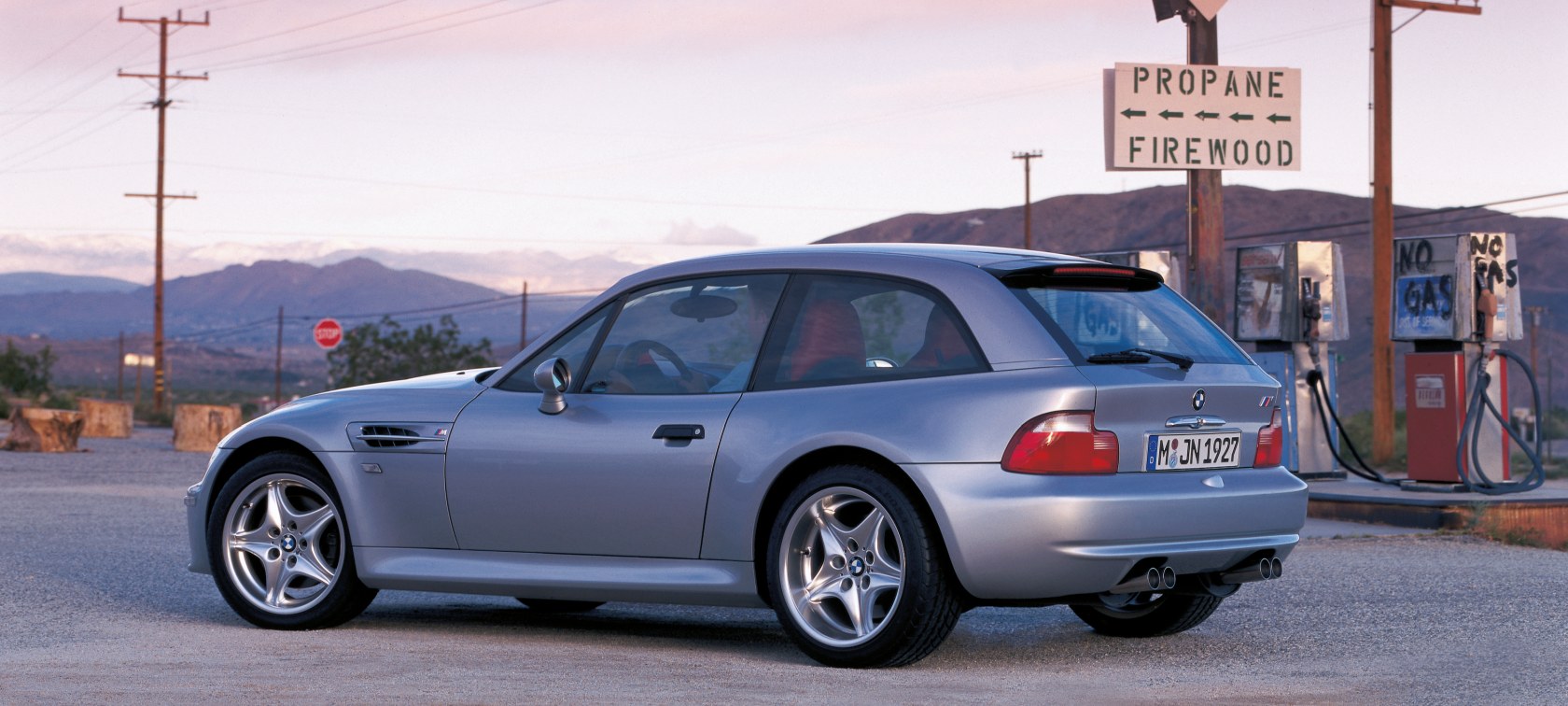
All Z3 coupés were rear-wheel drive and equipped with six-cylinder engines under the long, front hood. The base version initially had BMW’s 2.8 litre straight six putting out 192 hp, which was increased to 3 litres and 231 hp in 2000, in connection with the only smalle face-lift during the short production run of the car. The M Coupé had the E36 and E46 M3 engines, as we’ll see below.
Herein also lies the reason why BMW didn’t support the new coupé whole-heartedly. Especially the M version sat a bit too close in the line-up to the shining star, the M3, with which it was also price-wise on par. This was also the reason why for a bit of a step-motherly treatment of the Coupé in some instances, for example never getting the six-speed manual box from the E46 M3, having to settle for the simpler, five-speed box.
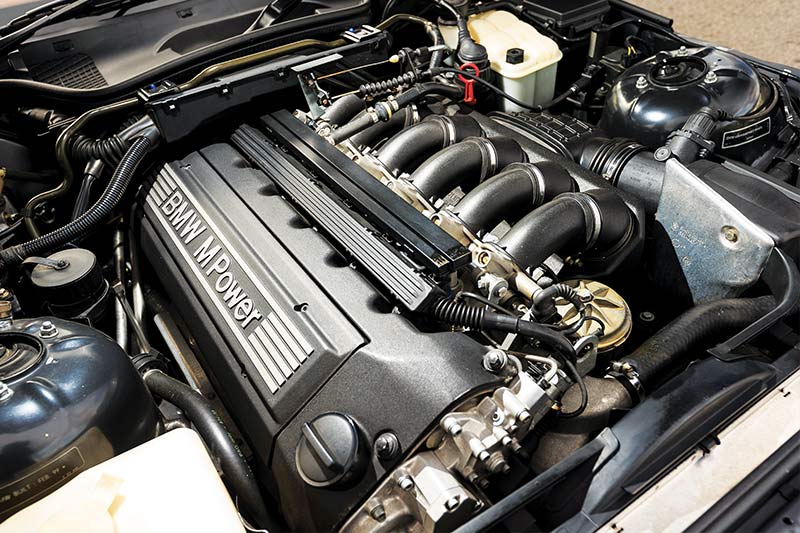
The base model’s straight six engine was shared across all coupés produced both for the US and Europe. In the M Coupé however, the US version up until 2000 had the S52 engine from E36 M3, whereas the European version had the so called S50 engine. The benefit was more power (315 hp vs 240 hp in the US version), the downside a more complicated build requiring more maintenance and adjustments. From 2000, all M Coupés shared the 320 hp strong straight-six from the E46 M3, an engine that also requires a fair bit of maintenance, notably with individual valve adjustments.
The Z3 series was BMW’s first car line completely built in the US, correctly judged as the main market for the convertible. However, the coupé didn’t see much success there either. Apart from BMW’s positioning issues in the model range and the divisive design, competition was of course harsh at the price-point, both since you could get an M3 for the same money, and also since that money would also buy you quite a lot of car from other brands. In the end, only some 17700 coupés were built in total across the three versions 2.8i, 3.0i, and M Coupé, to be compared to the more than 170.000 BMW sold of the convertible, i.e. 10 times as many.
As I neared the 3.0 litre coupé I drove earlier this week, I couldn’t remember when I had last seen one. I’m in the camp of those who have always liked the “sports shoe” design, also since it looks like nothing else on the road. That it also has some benefits becomes clear as soon as you open the glass tailgate and find a surprisingly large luggage area, and also on the inside, which ample space for two. The car in question was a 2000 model with the 3.0 litre straight-six, a manual box and around 110′ km on the clock. It was in good, if not mint condition.
Two other things become noticeable before you turn the key. Firstly, the Coupé is quite a small car, only four metres long, and only weighing around 1400 kg, around 150 kg less than the E36 M3. Secondly, everything in the inside of course comes from the 3-series. Except for the colors that is. Thankfully, “my” car had a unicolor beige leather interior, but quite a few cars have bi-colored creations mostly in red-black or blue-black, which must have been seen as cool 25 years back – at least in Germany.

The drive that followed quickly put a smile on my face. The 231 hp from the 3-litre six are plenty for the small car, and boy is that engine a peach! So well-sounding, smooth at every speed, and very happy to rev far beyond what you should do on summer tires in January rain at 4 degrees… The balance is exquisite, no doubt helped by the rear-wheel drive, and you can basically drive the car like a hot hatch, should you want to.
The chassis is definitely stiff enough, and there we no squeeks anywhere in the car. The manual gearbox could be tighter and the steering more direct, then again, this is a 25-year old car. That said, a 911 from the time is definitely more precise (but also more expensive). In summary, the Z3 Coupé is a car you fell at home in very quickly, that is a joy to drive on a daily basis, and that is both comfortable and practical enough for longer trips for two.
The reasons I see this as a pretty sure bet for a coming classic is of course all of the above. The Z3 Coupé is rare, has a design that stands out, a great engine, rear-wheel drive, and although the non-M Coupés could be had with an auto box, most are manual, and they are the ones you should go for. ideally in combination with the optional, glass sunroof, that help lighten up the cabin.

Price-wise, a good regular Z3 Coupé will still be yours for EUR 25.30.000, whereas you pay roughly twice that for the M Coupé, meaning it’s already trading in classic car territory. Interestingly, that means that the M Coupé still costs roughly the same as an E36 or E46 M3. It is however not only lighter, but also far more rare, and at least for two, also more practical. To me, it’s also way cooler.
It wouldn’t be my choice however, because that would be the version I drove, i.e. the 3-litre coupé. Power is plentiful, the design is roughly the same, and there’s really no reason to pay double for the M Coupé, also in view of higher maintenance. But at EUR 25-30.000 for a 3-litre Z3 Coupé, you really can’t go wrong. A good sports shoe is always useful, and this one is arguably the coolest one around!
 The Thrill of Driving