
In my last post, I discussed the ultra-rare MVS Venturi, one of many attempts from typically small manufacturers, this time in France, to challenge the traditional sports car monopoly of the big ones, one of them obviously being Ferrari. The same week, a good friend in London mentioned a car from a similar period that I had never heard of, which doesn’t happen very often. Surprisingly, this wasn’t another small sports car manufacturer, but rather one of the first luxury SUV’s from Ferrari’s home country Italy. So in this current thread of ultra rare cars most of us have never seen, meet the Rayton-Fissore Magnum!
Of course Italy has much more of a sports car than an SUV tradition, with the latter being quite a recent phenomenon through cars like the Alfa Romeo Stelvio, Lamborghini Urus and Ferrari Puros…. oh sorry, that’s of course anything but an SUV. And then there was of course the one that counts like the first, the monstrous Lambo LM002, built between 1986 and 1993. However, the LM002 was actually one year too late to count as the first, as that honor goes to the Rayton-Fissore. It takes another prize as well, which is that of completely failing as a brand, in spite of having a car that time-wise came right at the point when SUV’s started to become popular, and not being without attraction points, as we shall see.

The brand had its roots in the small coach-building family Fissore, and it was established by a niece in the family together with her husband in 1976. As far as I’ve been able to determine, the Magnum was the only car ever to appear under the Rayton-Fissore brand, and it was originally intended as a military vehicle, built on a chassis from the Italian truck manufacturer Iveco who also supplied the differential and the brakes. Not very glamorous perhaps, but as a small manufacturer Rayton had to buy in most parts, from the drive train to the interior, from other brands. The first cars were certainly not luxurious, especially as they were powered by the slow and unrefined diesels of the time.
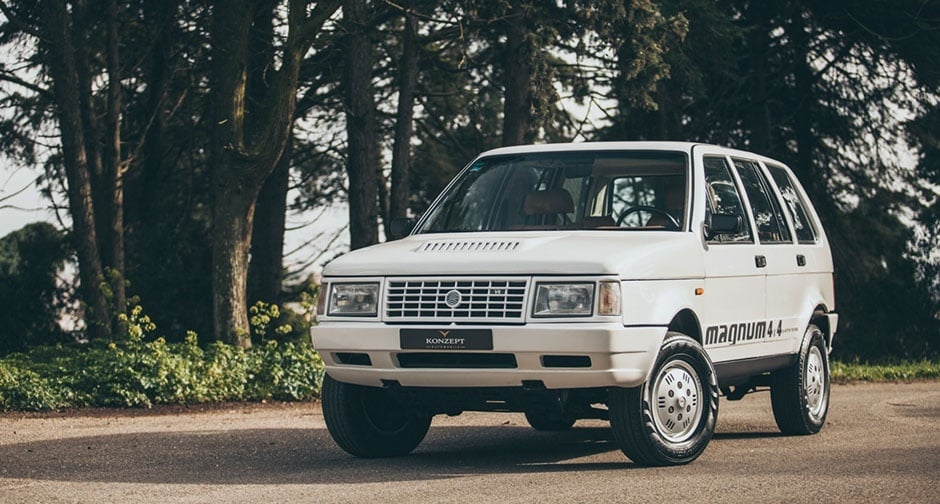
Rayton however had bigger plans for the Magnum, and whereas in Europe, the Magnum was available with a variety of engines, from diesels to the same V6 that was used in the Alfa Romeo GTV6, things were different in the US. For the top version that Rayton entered the US market with, they had bought the 5-litre V8 from Ford which also powered the Mustang at the time, and slapped a supercharger on it. Not very Italian perhaps, but tried and tested!
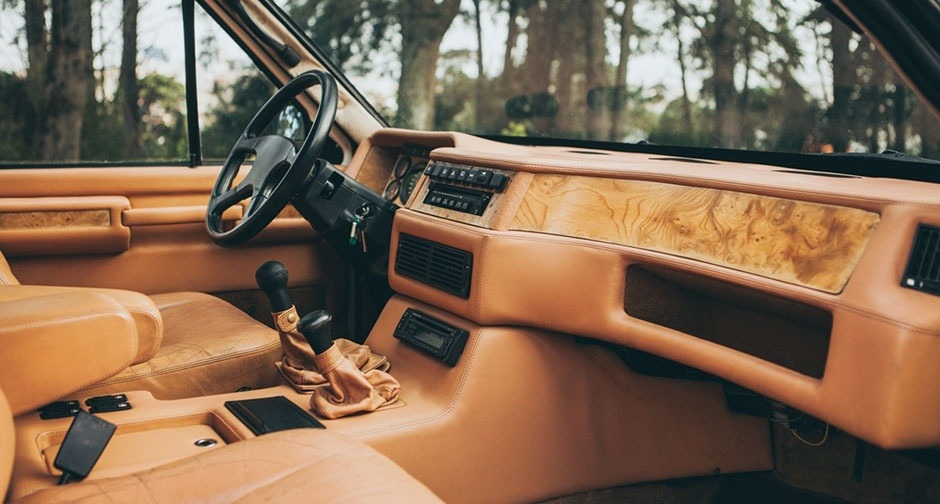
The Rayton was thus sold both in the US and in Europe, but the only version ever intended for the other side of the pond was the top luxury V8 version. And whereas the chassis may have come from Iveco, the interior certainly didn’t. The V8 Magnum was an ocean of leather, wood, and for the time, high-end interior equipment. You see a lot of similarities to the Maserati Biturbos from the same period, Maserati also being part of the Fiat family. That’s the family where Rayton found other parts such as switches and parts as well, making for a bit of a contrast with the luxury of the rest. But there is no doubt that no brand, not even Range Rover, had an SUV with an interior as luxurious as the Rayton at the time!
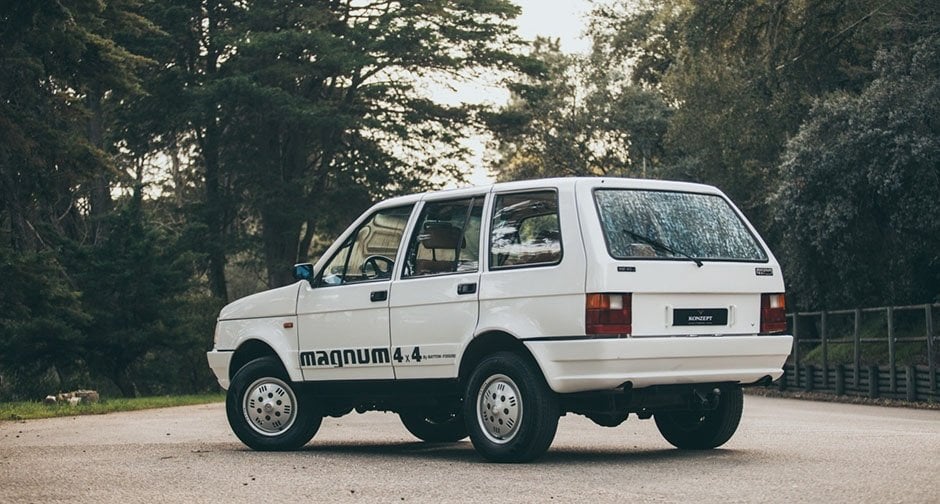
The Magnum was designed by Tom Tjaarda, one of the leading designers at the time with cars like for example the Saab 900 and the De Tomaso Pantera under his belt. He created what looks very much like an 80’s design, however with front and backlights that quite obviously came from some other car and don’t really fit the body. Neither did the minuscule side mirrors, for that matter. What he succeeded in was however the famous lady’s shoe design, i.e. a car that was larger on the inside than it looks. The Magnum was all of two metres wide – not remarkable today, but very much so in the 80’s. This made for a very roomy cabin, with notably room for three grown adults in the rear.
Rayton entered the US market in 1989 and had then renamed the car the Laforza. Rather incredibly, they would build it until 2003, i.e. for close to 20 years, by which time Rayton had gone through at least two restructurings, engines during a period had come from BMW, and the final assembly had at times been handled by Pininfarina. In 20 years however they never managed to crack into neither the US, nor the European market, in spite of the SUV segment gaining in popularity.
One reason was certainly the looks, that weren’t to everyone’s taste. Another was probably the fact that a car from an unknown brand with a relatively basic Ford V8 cost as much as a Range Rover, but had turn signal sticks from Fiat (not that Range Rover was a wonder of quality at the time, but at least it had brand recognition). Then there was the weight: at more than 2.3 tons, the Magnum/Laforza was very heavy for the time, no doubt also because of those truck parts from Iveco. The combination of weight and a truck chassis both made the Laforza quite slow and also gave it a relatively harsh ride, not really in tune with the luxury profile Rayton wanted the SUV to have.

In spite of a very long production time therefore, the best estimates for how many Rayton’s were built talk about a few hundred Magnums and less than a thousand Laforzas, most of them sold in the US. How many have survived until today is also unclear, but there’s a US owners’ club that estimate there are still around 50 cars in the US. I’ve never seen one live, neither there nor in Europe, and doubt I ever will. There’s also not a single one currently for sale, at least in Europe. Whether it’s worth looking for one is of course up to you, but there is a bit of a trend currently in early SUV’s becoming more popular. If that’s your thing, the Rayton is no doubt the most exotic of them all!
 The Thrill of Driving