
Back in April of 2022 (almost three years ago, time does really fly!), I did a piece on the Opel Manta, a European sports coupé from the 60’s that has a huge following in Germany and notably also served as inspiration for a movie by the same name. At the time, I remember thinking that for the story of German sports coupes from the 60’s and 70’s to be complete, I would need to add another car to the mix as well, namely the Ford Capri. After all, if you ask true Capri fans, they’ll tell you not only that it was Europe’s first pony car, but also that explaining its history is difficult, since it goes into your attitude to life. As if that wasn’t a good place to start?
The success of the Ford Capri is difficult to overstate, as between 1969 and 1986, more than two million cars were built. But the Capri story doesn’t start there. As readers of a slightly older vintage may remember, Ford already had a car called the Capri under its American Lincoln brand. And Ford in the UK had also developed a 2+2 coupé called the Capri, based on the Ford Consul. None of those were however the “real” Capri. Instead, the story of the first European pony car really starts in the US in 1964, with the success of a certain Ford Mustang.

Shortly thereafter, Ford in Germany and in the UK (regrouped to Ford Europe), seeing the enormous success the Mustang had had in the US, put some 200m Deutschmarks (DM) on the table and started developing the Capri coupe, with the Ford Cortina as basis. A big part of the success was in the design; not only was the US-inspired Capri with its long hood and short rear end pleasant to look at in a pony car kind of way, but it was also quite roomy, offering enough space for four and (at least some) of their luggage. As we all know everything was smaller back in the day, including both people and their luggage, and the fact that quite a few family fathers could thus opt for a flashy Capri rather than a more boring car, lay the ground for the sales numbers early on.
Between 1969 and 1986, the two million Capris that were sold would come in three series. The Mk1 actually represented half of the whole production, selling in more than 1.1 million units until 1974. The cheapest version was positioned very much on price, with a base version being squeezed in just at 6.995 DM, and marketed as a true sports car for under 7.000 DM. You should put a big question mark around the sports car thing however, given the car had a 1.3 litre four-pot delivering no more than around 50 hp and needing not 10, not 20, but all of 24 seconds to reach 100 km/h.
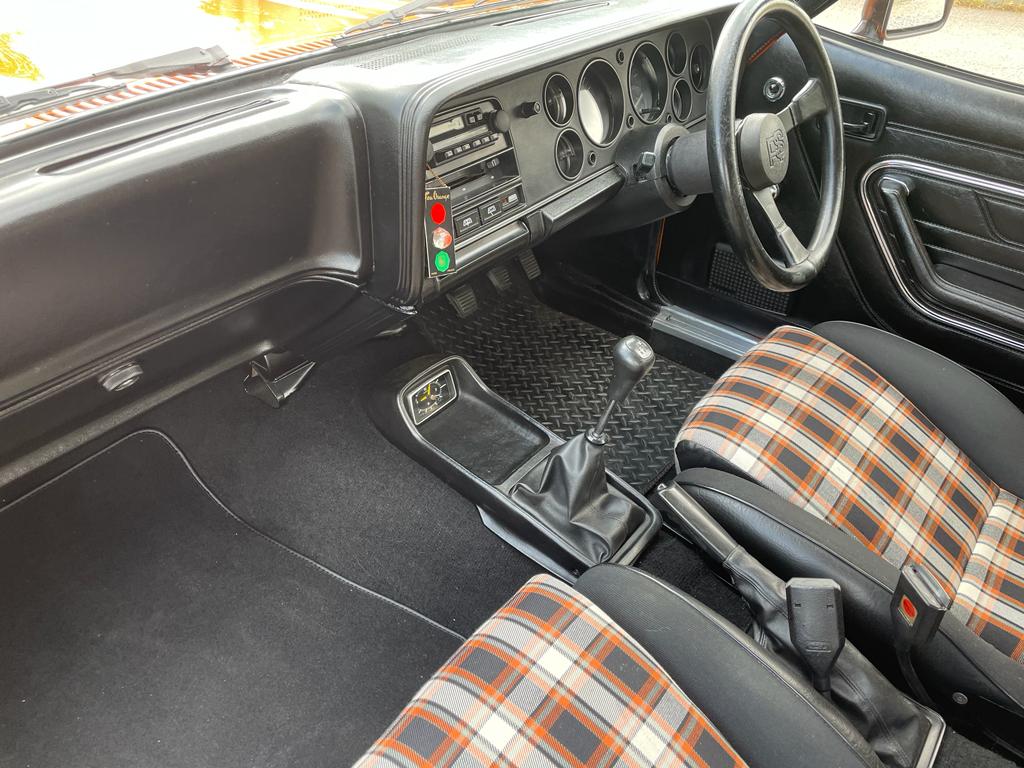
At the other end of the spectrum for the German-built cars (which constituted a clear majority) were however also a 2-litre and a 2.3 litre V6 (later 2.6 litre), delivering 90 and 125 hp. Two optional sport packages called GT and R added various sporty design touches, but in the first series, it was only the V6 cars that had the most important of them all: the bulge in the hood! With sales numbers starting to drop in 1974, it was time for a revised Mk 2 version, which was however not much more than a cosmetic update of the Mk1, with most mechanical parts remaining unchanged.
Correctly identifying many buyers as not that sporty, Ford softened the suspension on the MK2 and a revised rear end improved the practicality with a larger rear window and boot cover. Something far more debatable and typically not ageing very well was the vinyl roof many cars came with. The MK2 premiered in 1974 in the middle of the first oil crisis, which became clear when you look at the sales numbers of the 3-litre V6 that was now available as the top engine: only 188 cars with that engine were sold the first year in all of Germany!

The third series, which for some reason was officially referred to as Mk2 ’78, was again mostly a cosmetic exercise, trying to make the Capri 80’s chic. Under the body, the early 70’s technology was however still very present, including the rigid rear axle with leaf springs. By the end of production in 1986, that made the Capri the last car in Germany to be built with such an antiquated suspension, hardly something to write home about. The fact that the top version was now quite luxurious and available with an automatic transmission and a 2.8-litre V6 putting out 160 hp was then more so!
If you have some space left in your garage and a strong urge to fill it with a Capri, you’ll be happy to learn that contrary to its bigger brother, the Mustang, the European pony car can be had for not much money at all. If you except the sleepy 1.3 litre engine, good cars can be had for around EUR 25.000. The later series are more difficult to find, but actually less expensive. In between, you’ll find a lot of tuned cars, both optically and mechanically, that you will want to steer very clear of. I’d go for the first series with the biggest engine possible, thus combining purity with power. That’s the best attitude to life I can think of!
 The Thrill of Driving
“What a brilliant take on the Ford Capri! This article captures not just the car’s history but also the attitude and spirit it represents. A fascinating read that brings the Capri’s legacy to life—well done!”