How Mercedes ruined the E-class

Ok, time for some serious Mercedes-bashing. Long-time readers of this blog know that I’m a Mercedes driver for family purposes since many years, currently so in the form of a 2013 E 63 AMG Estate, so as a loyal customer I feel I’m entitled to some bashing, especially after some quite serious disappointments on various drives with the new E-class (well, it’s been around since 2017, but that’s still new in my book). The conclusion is quite simply that in a few crucial aspects, Mercedes have built a worse car than its predecessor. Here’s my take on why:

Looks: I guess this one’s debatable but I still haven’t found anyone who finds the new E-class particularly beautiful. The design is kind of uninspired, lacking distinctive features, angles and curves. Now you may claim it’s not the only one (A6 anybody?), but that doesn’t make it any better. The higher in the model range you go, the more obvious it becomes. The new E 63 quite simply doesn’t look the part.
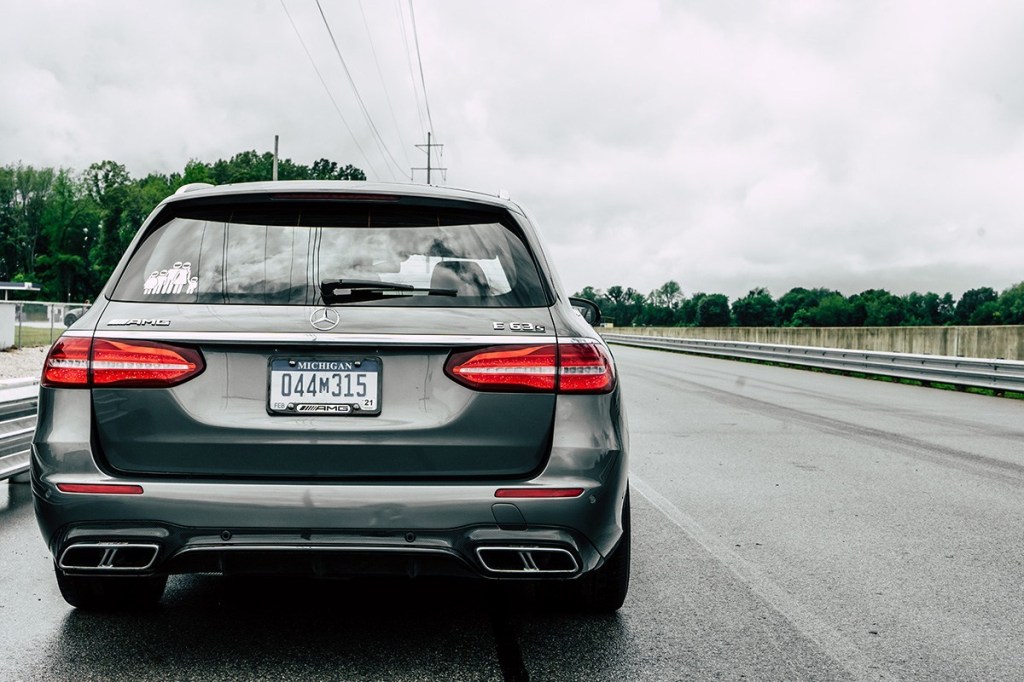
Thankfully there are still four pipes, because otherwise it would be really hard telling the difference to an E220….

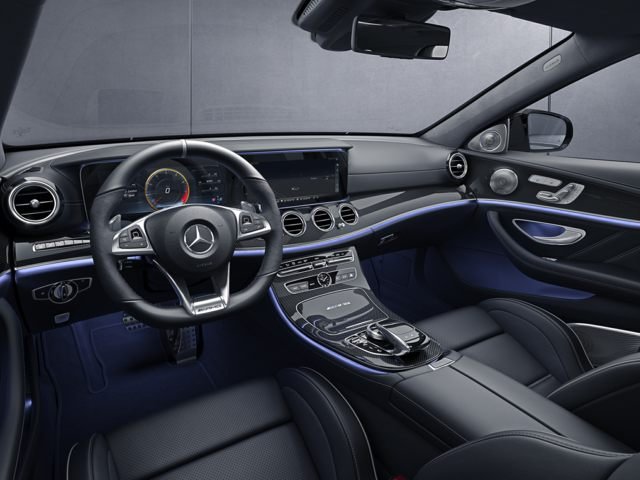
Interior quality: the new dashboard has a nice, floating look, with much more choice of materials and looks than the old one (not to mention the dozens of available interior light colours…). The problem is that most of these materials look kind of – cheap. The first person to say so in this family was actually not me but my 19-year old daughter. The quality-feel is also so-so, and not on par with the very solid interior in my 2013 car. Finally some plastic parts that I guess Mercedes doesn’t think you’ll pay attention to, for example the lower parts of the doors and the rear part of the centre armrest, are more reminiscent of the plastic in an old Hyundai than a Merc.

Luggage space: if like us you have two children and a dog cage, there’s basically no other estate that does the trick – the sloping roof line of an A6 or a 5-series make it hopeless to load bulky items like a cage, and still have enough luggage space. Now that the E-class also has a sloping roof line, the cage still fits, but you lose some space vs the old model. It’s still bigger than a 5-series, but in absolute terms it’s a step backwards. And let’s be honest: for many of us, luggage space was a critical factor in opting for an E-class rather than a 5-series.

Back seat: incredible but yes, in the car we’ve all ridden as a taxi, they’ve actually managed to mess up the back seat. It took me three dealers to get confirmation of something that was very obvious as soon as you sat down, but the new E-class has a shorter rear seat bank, meaning you sit with your legs in a steeper angle and lack thigh support. On an 8-hour vacation drive through Europe, that will make quite a difference.

Infotainment: saving the best for last, it’s no secret that for some reason I fail to understand, Mercedes until recently have been far behind competitors in infotainment solutions. Earlier this year the supposedly market-leading MBUX system was launched and is now featured in various models from the A-class to the new GLE and GLS. The problem is, with the E-class having been launched in 2017, you still have the older system (as you do, by the way, if you spend EUR 200.000 on the new G63 which only preceded MBUX by a few months), and will do so until the first face lift sometime next year. This means the screens lack touch functionality. Instead, Mercedes offers you the option to operate them in three ways: over small pads on the steering wheel, on a pad on the centre console, or on a small wheel below that same pad. Having driven a couple of cars a few hours each, I can only say that this remains quite confusing and very counter-intuitive. I felt myself constantly reaching for the screen, then remembering, then going to the control on the steering wheel, then not finding the right menu, then going back to the centre console etc. I guess you figure it out with time, but it’s simply not good. On a brand level, it’s also quite incomprehensible that you get the latest system in an entry A-class but not in top of the line cars until three years later!

U can’t touch this

The E-class is still a great car – but it’s not as great a car as it used to be. Most people probably won’t care and just order a new one when the lease runs out, but given you’re nerdy enough to read this blog, chances are that like me, you do care. You don’t need to agree with me though, and if you don’t, feel free to say so!

The E-tron – impressive or not?

The E-tron is becoming an increasingly frequent sight on the streets of Zurich and elsewhere. I had the opportunity to study the car in detail at the recent Geneva Salon (check out my video here) and found it a bit difficult to get my mind around: sure, impressive in build quality and good-looking, but that has nothing to do with it being electric and everything to do with it being an Audi. But for the rest?

If you’re a bit cynical, but only a bit, you could say it’s taken Germany’s leading car manufacturers (Mercedes will join the electric SUV party in the coming months with the EQC, a car very similar to the E-tron) seven years since Tesla’s first Model S, and four years since the Model X, to bring out alternatives in the form of cars with less range, less room and, especially critical, far less charging points at present.

Starting with the range, Audi claim an optimal value (also called WLTP range) of 417 km, but are honest with the fact that it’s a distance you’ll only achieve with the AC turned off and ideally neither passengers, nor speed. A more realistic range – in optimal conditions, meaning neither too hot, nor too cold – is, according to multiple tests, somewhere around 300-350 km, and in winter, you can deduct around 30%, bringing you down to as little as 200-250 km per charge. This still supposes driving very legally. The Model X in its latest configuration has an unrealistic WLTP range of 505 km, probably meaning around 400 km in reality, and thus 300 km in winter. Not great, but around 1/3 better.

A short range means you will be charging quite often. Audi will tell you that the E-tron has the mechanical ability to charge up to 350 Kwh, which is more than twice as fast as a Tesla Supercharger (150 Kwh). That’s however in the future, as such chargers are not around yet. Audi is a member of Ionity, a collaboration of leading European car manufacturers currently building charging stations with charging power of up to 150 Kwh across Europe, power-wise on par with Tesla’s supercharger. But in all of Europe, there’s currently not more than 20 such stations. That leaves you with the other 90.000 or so charging stations which are part of the European electric car “roaming” network and that E-tron owners can use (against payment by an E-tron credit card), but the vast majority of those have a charging power of 22 Kwh at most, in many cases even less. Charging an E-tron to 80% at a rate of 22 Kwh means three hours charging time. Taking as example a 600 km holiday drive from Zurich to the French Riviera, there are seven Tesla supercharging stations along the way. With an E-tron, it would mean at least one three-hour stop, and thus more than 2 hours longer travel time – for a six-hour drive.

In terms of interior space, the advantage of Tesla’s swollen egg form is that it offers lots of room, and that its luggage compartments back and front are both roomier, as is the passenger space. An Audi Q7 is much roomier than an E-tron, which more resembles a Q5 space-wise.

So where does this leave us? If space, range and charging times are all irrelevant, then the E-tron is probably the better car – as it should be, given Audi is an established, leading manufacturer and not a Californian startup. But all else is not equal, meaning it’s taken Germany’s leading car brands more than five years to bring out a car that is only almost on par with Tesla, but with a charging network that is comparable to what Tesla offered more than five years ago. That is not very impressive, to say the least.

How near the brink is Tesla?

Elon Musk was full of praise for Tesla at the launch event of the Model Y last week, starting off with a (not very new) perspective of where Tesla and electric cars stood 10-11 years ago when Tesla built their first car, as compared to today. At the time the world was obviously in the midst of the financial crisis, when some rather large car makers in the US went bankrupt and had to be rescued. Given Tesla’s Q4 -18 and 2018 full year numbers are known, I believe it’s justified to have a closer look at to what extent Tesla in 2019 is comparable to some of those companies in 2008. Unfortunately, this is not that far-fetched if you listen less to Elon and look more at hard numbers.

The Model Y, completing the slightly imperfect S-3(E)-X-Y range

Tesla had current assets of USD 8.3bn at the end of 2018, of which USD 3.8bn in cash. With liabilities at 10bn, the working capital ratio is a negative -1.7bn. The current ratio, i.e. assets over liabilities, comes out at 0.84, and the so called quick ratio, i.e. cash over liabilities, at 0.46. However in Q1 -19, Tesla made a 0.9bn bond payment, thereby bringing the two above ratios to 0.74 and 0.39 respectively. This is where it gets interesting to look at a company like General Motors during the financial crisis, when at the time of bankruptcy the two ratios stood at 0.6 and 0.3. As a further comparison, today the average for the car industry is at 1.36 and 1.2. An established company such as BMW comes in at 1.18 and 0.96, a “new” car brand such as Chinese Geely, at 1.09 and 0.94. There are thus many billions between the car industry at large and Tesla’s current numbers.

It’s also important to remember that a part of Tesla’s cash position is for cars not yet delivered (down payments etc.), and thus not cash in the proper sense. Finally, car sales are still the only meaningful income for the company, with energy sales making up only around 0.3bn per quarter.

SEC darling Elon Musk

Tesla is currently cutting costs by closing its re-sellers and moving to online sales, but savings achieved there will mainly go to reduce prices in the US, where state subsidies to electric cars are about to end. So when Elon announces the launch of the Model Y (and if you want to move directly to the actual showing of the model Y, you can skip a lot of bla-bla to around 27.30 minutes in to the video), completing the slightly imperfect S-E(3)-X-Y range, one can’t help but wonder where the development money will come from. Or will Tesla’s model range effectively end with the slightly less subtle S-E(3)-X?

Petrol- or Mobility- Head

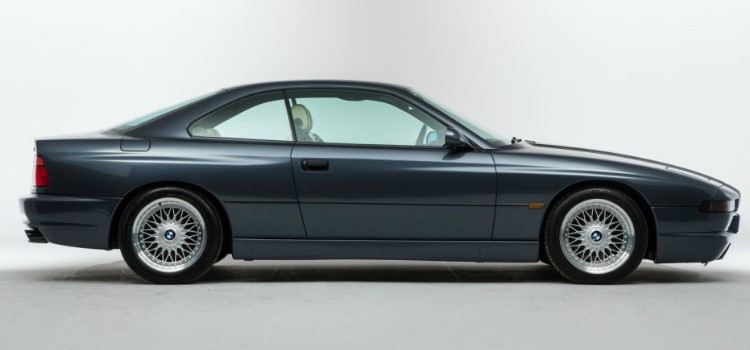
The other day I saw the new BMW 850M on the street, which I thought was interesting at best. The lines, creases and folds make it a good looking and aggressive car but, sadly, I must admit it did not get me that excited. Adrian van Hooydonk, head of design at BWM said “The 8 opens a new chapter in BMW’s design language.” But what about the heritage? I remember back when the (old) 8 series came out in the early 1990s…. From a design point of view, it was an evolution of the 635CSI and the pillar-less windows still make it extremely cool looking, even by today’s standards. It seems the new car is just an aggressive wrapping of metal around current (and future) legislation? Change the badge and it can be anything…. Kia? Toyota? Cherry Automotive?

BMW 850M

Enough about design, what about the engineering aspect?  Ah yes, a hand-me-down 4.4L twin turbo V8 that is used in most of the sporty BMW models…. The original 850 had a naturally aspirated V12 …. Did you read that correctly?  A VEE TWELVE!  An engine bespoke to the flagship model.  The 4.4L TT V8 is powerful and I am sure the new BMW will be quick.  And I am also sure that it will be filled with tech such as autonomous driving aids, connectivity, and interior lighting that can reflect your current mood.…. But I do not care about that.  That sounds more like an IT geek’s wet dream than that of a petrol head. 

BMW 850 CSI

I am not having a go specifically at BMW, as most major car makers today think efficiency, economies of scale and profits, but it struck me for the first time: is a modern petrol head a mobility head? Do they care more about the mobility and tech than the engineering?  Is it only horsepower and 0-100 times and aggressive lines that make a car cool?  As amazing as the new BMW 8 series is, I cannot help feeling that this will be the dream of the IT department rather than someone who is really into cars, engineering and driving.  Am I wrong? Old? Outdated?

I would much rather have an 850 CSI with a V12 up front, manual transmission and rear wheel drive!

Infotainment confusion

There was a time when an infotainment system was something you ticked in the options list when ordering your car without thinking much about it. Whether it was called iDrive (BMW), Comand (MB) or something else, systems were rather similar – and rather limited in their capabilities.

This all changed with Tesla’s giant screen and new standard for in-car entertainment, and it has kept (and will keep) changing ever since. At the same time, manufacturers’ understandable wish to bring the latest to market has also created different standards between brands, but actually also between similar models of the same manufacturer, that you’d better be aware of;

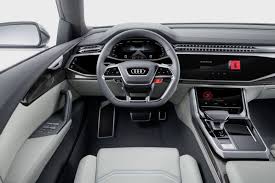
  • Buy a new Audi Q8 (left) and you’ll get two very fancy touch screens on the center console, handling almost all in-car functions at the price of a lot of fatty fingerprints. Buy a new Q7 (right) and you will still get the old-looking navigation screen on the dashboard, and traditional controls for seat heating and ventilation. It’s not a wild guess that the A7 will get the dual screens in the next facelift, but it’s not yet the case.

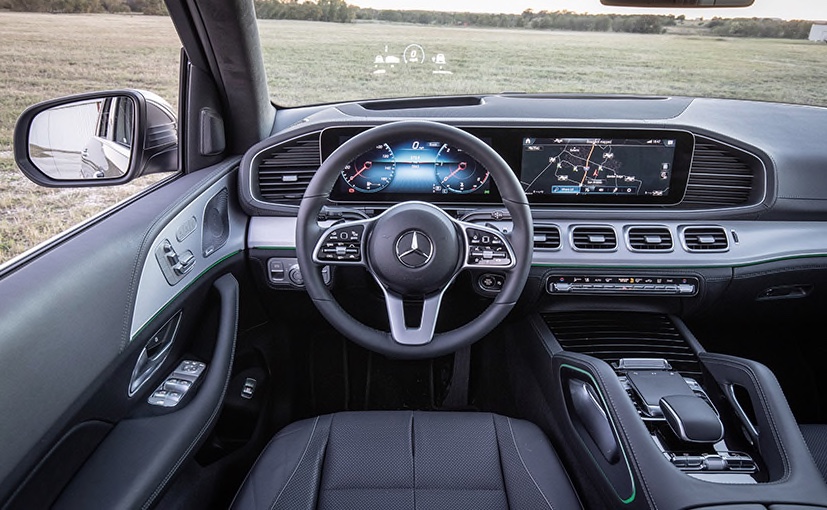
  • In Stuttgart it’s even more confusing: buy the brand new Mercedes GLE (left) and you will get the new, double 12-inch screens with touchscreen functionality through the MBUX software. Buy the new E-class (right) and the screens will look exactly the same but will not yet have MBUX and thus no touch functionality.

Speaking of MBUX (and the latest BMW iDrive), this latest update also gives you the option to talk to your car, starting with the catchy phrase “Hey Mercedes/BMW”. I’ll let you judge for yourself if that’s a drawback or not…

So in other words, if you’re in the market for a new or recent pre-owned car, this has implications. As a seller in 3-4 years of your 2018 Q7, you’ll most probably be punished financially for having a car with that old-looking, single screen. But as a buyer, you will have a great negotiating position already today if you prefer physical, non-fatty buttons that you can locate with your fingers without looking away from the road, and you buy a car for driving rather than talking to it.