The V10 is dead – long live the V10!

To borrow from John Cleese in the legendary Monty Python scene from the animal shop with the dead parrot, the V10 is no more. It has ceased to be and gone to meet its maker, and for all those of us who felt it was something truly special, that’s obviously very sad news. That said, there’s a bit of a delay in this post given production of the last V10 engine took place in late 2024, but if you haven’t gone into mourning yet or perhaps hadn’t realized it, the time has definitely come to do so. Let’s therefore look back into what made the V10 so special, the most prominent street cars that featured it, and, should you decide to help preserve the V10 for coming generations, which cars you should consider!

The V-shaped, 10-cylinder engine has been around far longer than many people think. Its roots go back to the 1940’s, but its history in street cars is far shorter, starting in the early 90’s. In the era when naturally aspirated engines were still the way to go, the V10 became a good alternative for when a V12 was too big and heavy, but a V8 wasn’t powerful enough. It produced more power than a V8 and often also ran smoother with less vibrations. And whereas it was less powerful than a V12, it typically had more torque, and was obviously also smaller and lighter. And then there was of course the sound that many still consider unequalled. I won’t even try to describe it in words, but let’s just say that if you’ve heard a V10 in higher rev’s, you’re not likely to forget it!

The V10 era was arguably the best sounding in modern F1 racing!

V10’s were also the main engine used in F1 during two decades. They appeared in the late 80’s after FIA’s ban on turbo engines, when manufacturers during a couple of years used everything from V8’s to V12’s (imagine that today…), Notably thanks to its greater efficiency and lower weight, the V10 then became the F1 engine of choice in the late 90’s and the first half of the 00’s, when all cars ran V10’s in what’s probably the best sounding period of F1 history. The fun ended when FIA made the small, 2.4 litre V8’s mandatory in the mid-00’s, making V10’s became a thing of the past.

In terms of street cars, surprisingly few brands have featured them in their line-up. The first was Chrysler in the 10-cylinder Viper. In the true American spirit of there being no substitute for cubic inches, the V10 was developed from the Chrysler V8 to which two extra cylinders and an aluminum block from Lamborghini were added. The initial version displaced no less than eight liters, putting out 400 hp, which in subsequent versions would increase to 8.3 liters at most, and over 500 hp.

The gigantic Viper V10 looks good, and sounds even better!

BMW also built a V10 engine, however only one, which was featured in the E60 5-series and the E63 6-series from the (Chris) Bangle-era between 2000-2005. At 507 hp, the 5-litre engine was the most powerful, naturally-aspirated engine BMW has ever built, and also one of the most high-revving V10’s ever produced. Importantly it also featured in the 5-series station wagon called E61, the only M-wagon ever built until the current M3 and M5 Touring, and perhaps the most collectible of the three models today.

The brand family that made the V10 most famous is however Audi-Lamborghini. Audi bought the Italian brand from Sant’Agata in 1998, and when the Gallardo was presented five years later, it was with the same base V10 engine that would be featured in the Audi R8 a few years later, from 2009 onwards. It displaced 5 litres in the Gallardo and 5.2 litres in the R8, but with a similar power output at around 520 hp in both. To round it all off, both cars were also available with a manual gearbox. And whereas the R8 later also came with a V8 option, the Gallardo was ever only available with the V10, as was its later replacement, the Huracan. The special version Huracan STJ, presented in 2024, would be the last production car to feature the V10, in its final form delivering all of 640 hp.

The Lamborghini Huracan STJ – a worthy end to an era!

Whatever you think about our coming electrification or lack thereof, the probability of the V10 making a comback is slim, to say the least. So if you want to add an example of this wonderful engine to your garage, you’ll have to look at pre-owned cars. Should you? The answer is a resounding yes, as long as you know what you’re doing. BMW’s V10 wasn’t directly derived, but borrowed heavily from the early 00’s F1 engine the company ran, meaning it’s at heart a race engine and needs to be serviced accordingly. That may be obvious if you buy an R8 or a Huracan. Somewhat unfortunately however, as you’re able to buy both the V10 M5 and (especially) M6 for below EUR 50.000, all buyers don’t realize that. Just as little as previous owners may have.

Therefore, buying a more recent and certainly more expensive R8 or Huracan is probably a safer bet, but as always, if you do your homework properly, nothing fundamental speaks against a BMW V10 either, or a Gallardo for that matter. Personally, I would park an early Gallardo in my garage and make sure it’s a manual. It may have been Lambo’s first mass-produced car, but it was certainly also the best. Now ask yourself when you last saw one? Exactly. Especially in manual form, the Gallardo is certainly a coming classic, with a design language that is as much early 00’s as it gets.
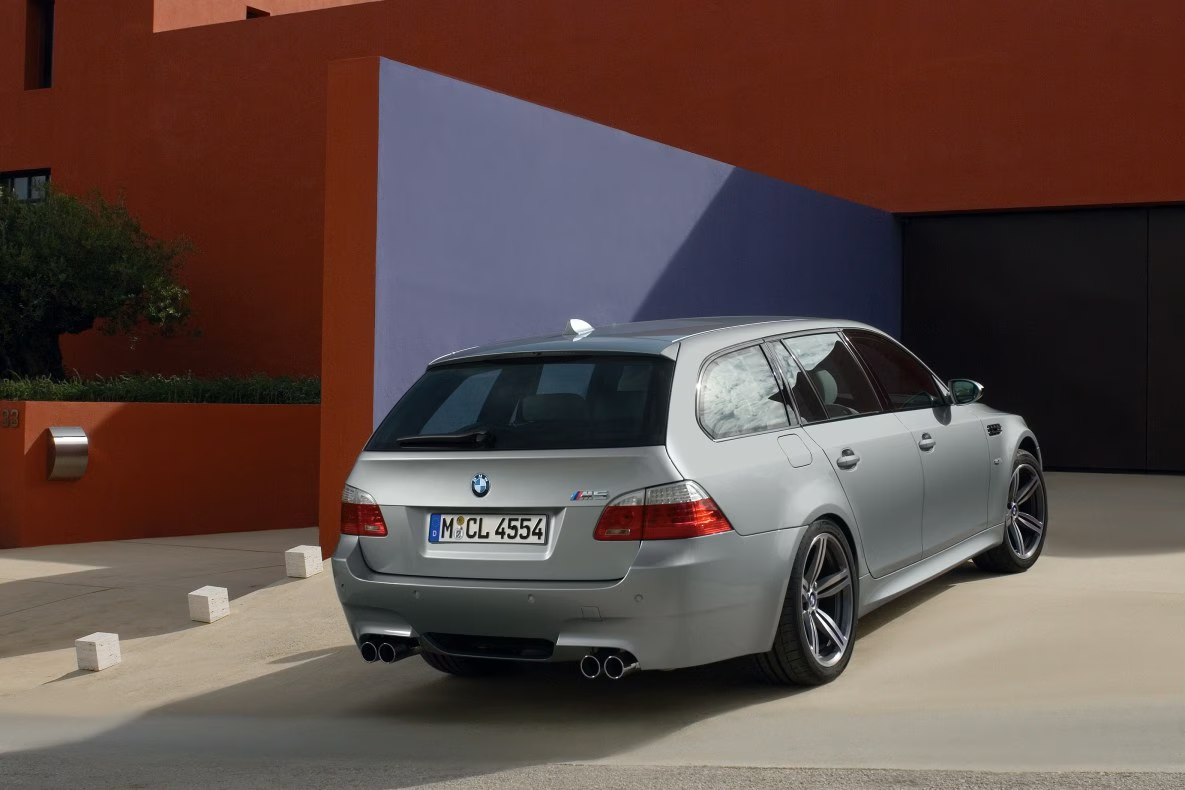
The E61 M5 Touring – one cool family car!

That said, you can’t really fault anyone buying an R8 or a Huracan either – far from it. And the guy that packs his family and luggage into an M5 Touring with a V10 up front before heading south for the summer vacation will obviously always be a hero. The V10 options may thus be few, but they’re all great, so there’s clearly hope that this wonderful engine will live on for many years to come!

The Audi R8 – Vorsprung durch Racing!

As we start 2023 I thought we should do so with the Audi R8 – a true legend in the sports-supercar segment, one that was mentioned in my post just before Christmas on the best sports car for 130‘, but which in my view deserves its own post. There’s a number of reasons for this: firstly, the production of the oldest supercar in the market has come to an end and the replacement, given it’s electric, will be a completely different car. Secondly, with relatively minor design updates during its long production run, early R8’s still look as modern as they did the first day. Finally, given that long production run, it’s not difficult to find an R8 for far less than the arbitrary 130’ I had set as limit in my other post, which is very good news!

The final version of the R8 before retirement

Audi’s transformation from the very boring brand it had been in the 70’s and 80’s to the far more exciting brand it would then become started on one hand in the rally series in Europe with the success of the Audi Quattro, on the other with the marketing people in Ingolstadt thinking up the slogan “Vorsprung durch Technik”, translating into something like “advantage through technology”, which would become Audi’s signum. The ambition was to establish the brand as a competitor mainly to BMW and Mercedes through technological advances, something that would shape mainly the engineering but also the design of Audi cars over years to come. The R8 when it came out in 2007 was at that point no doubt the clearest expression of that ambition!

Actually, claiming that the R8 only goes back to 2007 is not fully correct. The first R8 is more than 20 years old and was the result of the same management team in Ingolstadt wanting to build further on that racing success Audi had had in the 80’s by developing a car for the 24-hour Le Mans race, given that’s the only European sports car race that gets any attention in the US, a market Audi was very keen on. The original car called R8R was pretty much a failure in this regard as it never did well in the race, but its successor, now called only the R8, would go on to win Le Mans five times and in the first year 2000, claiming all three podium places.

Other than the mid-mounted engine and the overall look, nothing else is really the same…

With that success in the bag, Audi presented a first prototype for a road car already in 2003, which would then developed to the final car that would be introduced in 2007. The similarities between the prototype and the finished car are obvious to see, basically meaning that the R8 design is 20 years old, but looks like it could have been presented yesterday! Sales opened in the autumn of 2006 and the first year’s production was sold out in a few weeks, pretty impressive since the competition among naturally aspirated sports cars at that time was quite fierce. There was notably the brand new Aston Martin Vantage and of course the far less expensive Porsche 911, to name but a couple. The R8 was much more expensive than a 911 and if you asked the folks at Audi also far more of a supercar, however one that could be used everyday. Clearly buyers were convinced!

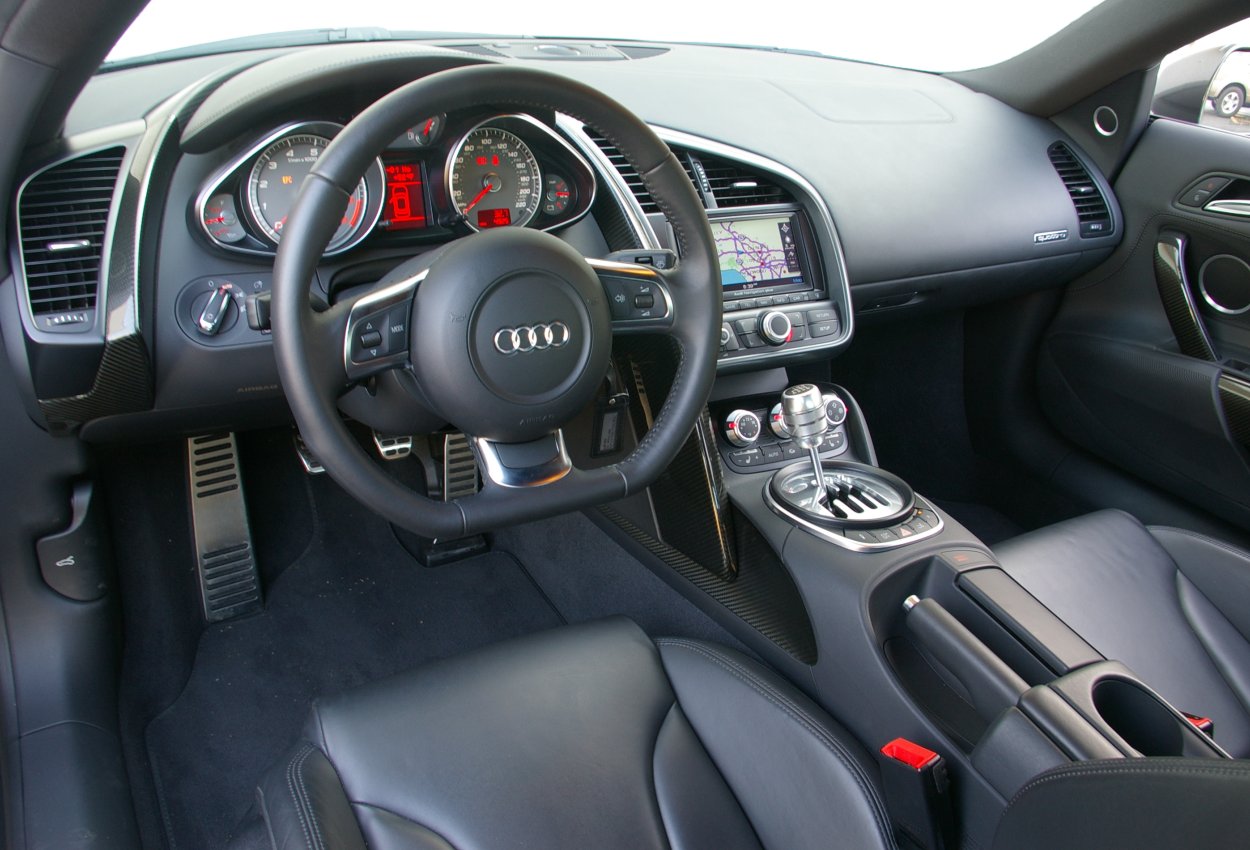
The R8 is a close sibling to the Lamborghini Gallardo with the two cars sharing everything from the aluminium chassis to (later) the V10 engine. At the launch in 2007, the R8 was available with a naturally aspirated, 4.2l V8 that revved all the way to 8′ rpm and produced 420 hp. The sound isn’t like anything out of Sant’Agata, being much more and perhaps a bit too discreet. Still, it’s refreshingly natural! At 1600 kg the car wasn’t a lightweight but the 4.5 seconds it needed to 100 km/h were very respectable 15 years ago. The gearbox was either a six-speed manual in an open gate shift which is the highlight of the rather dull interior which mahy consider the low point of the car, or a semi-automatic called R-tronic, the predecessor of the later S-tronic that would be introduced in 2012. The first series R8 was only available as four-wheel drive, however with a far more 30-70 rear-biased quattro system than was usually the case at Audi.

A functional but maybe slightly boring interior, with the gate shifter being the highlight!

In 2009 the wonderful 5.2l V10 then made it into the R8. Audi’s marketing team liked to introduce it as a Lamborghini engine but this was of course the same engine that had previously been featured in both the S6 and the S8, so its origins were really from Audi. It increased power by another 100hp, thereby bringing the 0-100 time to below 4 seconds. Both engine versions now also became available as convertible and in 2011, the R8 GT came out, limited at 333 coupes and 333 convertibles. The GT was 100kg lighter, 10% more powerful and had various other revised settings making it more of a real GT car. Various other tweaks brought the more powerful V10 Plus in the final year of the first series, before the all new second series was introduced in 2015.

The second iteration of the R8 may have been an all new car but even though it’s far more angular than the rounded lines of its predecessor, there’s no doubting the family heritage. The V8 was now gone, as was the manual gearbox. Depending on year the V10 would produce a little less or a little more than 550 hp and just like for the first series, there would be a 333-example GT series of what was to be the final R8. Unfortunately that last GT looks a bit like the last version of the Countach, in the sense that it has so many wings and skirts (all in carbon of course) that you barely see the brilliant lines of the original design. The second series would also be available as pure rear-wheel drive.

The dry sump engine sits deep and is visible through the transparent hood

Over the full production run since 2007 Audi sold close to 40.000 R8’s, far less than for example a 911 but almost three times more than its sibling, the Gallardo. By Audi measures, there’s no doubt the R8 was a success. Neither the engineers, nor the marketing people at Audi would like the 911 comparison, seeing the R8 as far more of a supercar. Indeed, if there was ever a supercar with everyday usability, this is the one – provided your everyday usage isn’t dependent on carrying lots of stuff around, as space is rather limited, even in the supercar segment. The 911 comparison is however relevant from a servicing perspective, and the Audi people most probably have nothing against that being mentioned. A well maintained car will be much closer to a 911 than anything from Ferrari or Lamborghini in service costs.

If an R8 is your thing, the first decision is whether you prefer the rounded lines of the largely analogue first series or the more angular and much more digital experience the second series gives. Other than the design, the other point to pay attention to is the steering, being hydraulic on the firs series and electronic on the second, and there being no really set opinion on which is best. A first series car will give you the option of the less legendary but more economical V8, but if you go for a pre-2012 car, then definitely go for a manual since the R-tronic is not a pleasant experience and those cars also hold their value far less well.

A 2008 car, to me still the best-looking!

Rather than picking up that 130′ car i wrote about a few weeks ago, I would probably go for the basic version, meaning a first series V8 with a manual gearbox. Those start at around 50/60′ USD/EUR for really nice cars, which is very attractive indeed! The V8 is not as exciting as the V10 and doesn’t sing as much, but it looks just as good through the transparent cover and the extra 30′ a manual V10 costs aren’t worth it if you ask me. I’d try to find a car that had the interior options which were quite useful in making it feel a bit more exclusive, such as the extended leather package and some carbon pieces. Equipped in that way, with a solid service history and in a “non-controversial” color, odds are that such a car will continue to hold its value very well indeed. Of course the GT cars of both the first and second series will do so as well, as will the rear-wheel drive cars of the second series, however at a much higher entry price.

The R8 is a great piece of modern supercar history. It’s probably the most approachable and usable supercar out there, and it’s a great expression of how “Vorsprung durch Technik”, that’s accompanied Audi throughout the years was a combination of technology and design. In its cheapest, first series, manual V8 version, it’s definitely the best iteration of a manual, naturally aspirated, everyday supercar!