Street finds – the Fiat X1/9!

It’s not only the times that are a’changin, as Bob Dylan noted long ago, but last week in central Europe, very much the weather as well. We thus went from several weeks of wonderful summer days and late dinners on the terrace, to 12-13 degrees C and rain. Luckily things are set to improve, however to something more reminiscent of autumn by the looks of it, so I guess I was very lucky to spot a surprisingly exotic street find just before the weather change – the nowadays very rare Fiat X1/9. It’s no doubt a car that is best enjoyed in the summer, but it’s also a great testament to Bob Dylan’s changing times, as we’ll see!

Angular body, engine right behind the seats and thus perfect weight distribution!

The Fiat X1/9 is also very much the flashy family member in an otherwise quite boring group of 60’s and 70’s Fiat cars. It’s the successor to the Fiat 850, a four-cylinder, 60’s creation that looked like a bun (although to be fair, the Spider looked better than the coupé…). But it also belongs to the Fiat 128 family where the rights to the four-door sedan were later sold by Fiat to Soviet Lada, and which most therefore associate with old east-west spy movies.

Contrast both of those with the very futuristic X1/9, and it’s not only the model name that stands out. The angular design with the pop-up headlights was a design that would be if not copied, then definitely repeated in many other 70’s cars, such as the Lotus Esprit and of course the Lamborghini Countach. The X1/9 didn’t look anything like the rest of the family, but somewhat surprisingly Bertone had still designed all siblings, proving design houses can have good and less good days.

Pop-up headlights were of course a must in the 70’s!

As spectacular as the looks was the fact that the engine was right behind the seats, making the X1/9 Fiat’s first mid-engined car. Unfortunately though, that engine came from the boring part of the family, meaning at the launch in 1972 a 1.3 liter, 4-cylinder with a very modest 75 hp, coupled to a 4-speed manual box. In 1980 that grew to 1.5 liters, another 10 hp and five gears. Of course, at around 900 kg it’s fair to say that they X1/9 was a light-weight, but I think we can safely conclude that it looked about five times faster than it really was. That was of course especially true in the US, where emission regulations made the engines even weaker than in Europe.

It wasn’t only emission standards that became strict on in the 70’s, the same was very much the case for safety, again especially in the US. Fiat had actually built the X1/9 with North America in mind and had thus tried to adapt to the coming rules during the development process. Thanks to the mid-mounted engine and the targa body rather than a full convertible, the X1/9 was one of very few cars had no problem complying with what became the new US safety standards.

This gave Fiat’s faltering US a welcome boost, especially since the small coupé was far cheaper than other, somewhat comparable sports cars. Everything was going swell until the mid-70’s when those safety standards were developed further, forcing Fiat to fit what must be the ugliest bumpers in automobile history to the X1/9. Luckily these were later re-adapted to what can be seen on my street find, which is most probably a US import. Around 165.000 X1/9’s were produced in total between 1972 and 1988, and no less than 3/4 of those were sold in the US.
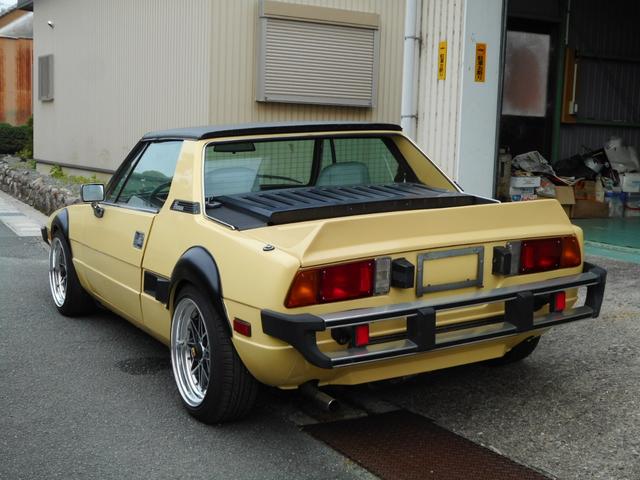
The garden hedge – ugliest bumper ever seen!

As observant readers may have noticed on the first picture, the logo isn’t that of Fiat, but rather of designer Bertone. The reason is to be found back in 1982, when Fiat wanted to discontinue the X1/9 and pull out of the US market, and Bertone therefore bought the rights and continued to produce the car in its name all through 1988. Not much changed on the car in the last years but Bertone would improve both equipment and materials, making the Bertone-branded cars such as the one I saw, the most attractive ones.

So what about the changin’ times? Quite obviously, it’s the concept of a sports car weighing in at less than a ton, making even a small, 1.5 litre engine with less than 100 hp if not plenty, then at least enjoyable enough. This is obviously very far from where we are today and if it sounds like your thing, you may think that with 165.000 cars produced, finding one will be easy. That’s however not the case as very few have survived – estimates talk about less than 1.000 cars in the US. Few are thus up for sale, but those that are tend to come in around EUR 15-20.000 in Europe.

Cars from 1980 had five speeds and (slightly) more power

The only question left to solve is then that around the name, because for a company who have typically been naming cars with real names or with numbers relating to the engine size, how did X1/9 come about? It turns out that prototype cars at Fiat were called X1, with the second number indicating the prototype in the order it was developed counting from a certain start date. The small Autobianchi A112 was for example called X1/2 as prototype, and the X1/9 was thus prototype number nine. It was however the only model to retain the prototype name in actual production and why that was, no one seems to know. But who cares? With the wind in your hair and the humming of a four-cylinder right behind you, you’ll have better things to think about!
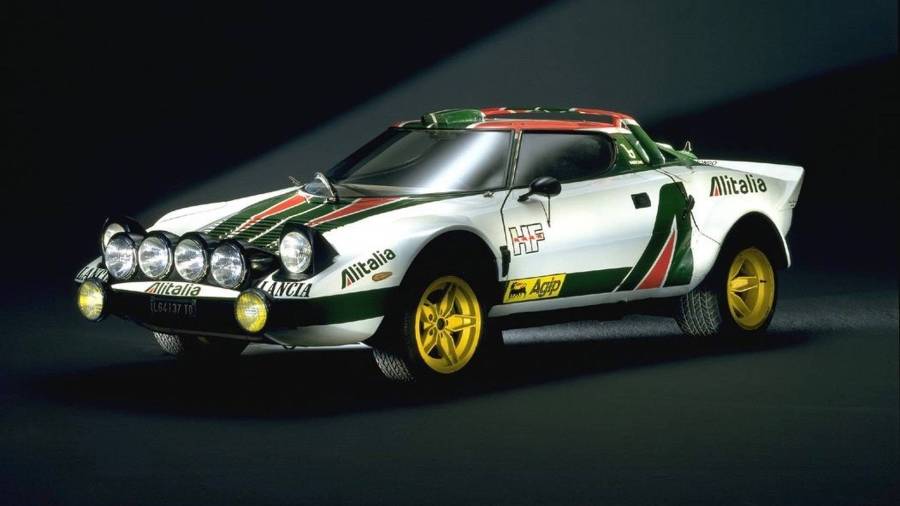
The unique Lancia Stratos!

If competition between car makers has been a trait of the automobile industry for as long as anyone can remember, it’s probably only in Italy that competition between car designers was just as fierce. The two dominant houses in Italian car design are of course Pininfarina and Bertone, both having employed legendary designers through the years who have in turn been responsible for some of the most beautiful car creations to come out of Italy. Usually one of the two big houses would be the main partner for a certain brand, but there was certainly nothing hindering the other one from trying to gain market by various means. Thank God for that because otherwise, the legendary Lancia Stratos would probably never have seen the light of day.

Lancia had historically mostly collaborated with Pininfarina in designing its models, with Bertone eagerly watching from the sidelines. In the late 60’s however, Bertone saw an opportunity as it was obvious that the ageing Lancia Fulvia was up for replacement. Bertone’s gave its legendary designer and our old friend Marcello Gandini, the man behind notably the Lamborghini Miura and Countach, the task of drawing a car that completely broke with the Fulvia and would signal the advent of a new, modern era. So he did, and it was so convincing that the Lancia bosses decided to show the prototype at the Turin Auto Salon in 1970. Gandini was subsequently commissioned with designing the production car that would come to market a couple of years later.

Gandini’s original Stratos prototype was…special!

The Stratos’ predecessor, the Fulvia coupé, had been used on the rally scene in the 60’s with some success, and Lancia saw rally as a way to position the brand as a sporty alternatively notably the the siblings from Fiat. This meant that unlike basically any other rally car at the time (or for that matter, thereafter), the Stratos was developed exclusively with rallying in mind, and not as a civilian car later converted to rally usage. You don’t need to look at the car for long to see this was the case, and also that this was a completely new design language that would follow Gandini notably to the Countach. The ultra short wheelbase of only 2.2 metres carries a body with minimal overhangs but with a big, sweeping front screen giving the driver great visibility. The engine was mid-mounted in the ultra low, rear-wheel drive car, getting in and out of which it is not an exercise suitable for any kind of daily driving. Looking at the Stratos today, it’s surprising how small it really is at 3.7 metres and around 900 kg. Lancia did however have to comply with the rules for any rally car at the time, namely that 500 so called homologation cars for street usage had to be built and sold along side the rally cars themselves.

How most of us remember it – on a clay road in some southern rally!

During the development of the Stratos, Lancia had considered various engines for the car, but the one they really wanted was the 2.4 litre V6 that Ferrari was using in the Dino. After long negotiations, rumour has it that Enzo Ferrari himself agreed to deliver the 500 engines necessary for the homologation of the Stratos. However, after the first 10 engines or so the deliveries suddenly dried up, with Ferrari claiming various production issues. It wasn’t until Lancia threatened to replace the Ferrari engine with another motor that they finally started coming in. Strangely enough, that also coincided with the end of production of the Dino, which Enzo had of course seen as a competitor to the Stratos… In the homologation street cars the engine produced 190 hp, in the rally cars performance was typically between 300-400 hp thanks to a big, old-school turbo. With the car being rear wheel drive, it’s an understatement to see that the Stratos was difficult to drive, but for those who mastered it, it was one hell of a car!

The Stratos premiered in the world rally championships in 1974 and went on to win the title straight away, as it did in 1975 and 1976 as well. It won both the Swedish Rally on snow, and the African rally on clay in the same period. There’s little doubt it would have gone on to win further titles had Lancia let it, but by this time Fiat had taken the somewhat strange decision that the Fiat 131 Abarth, a not very futuristic car that few will remember and that didn’t see much success, would be the rally car (and Fiat thereby the rally brand) in the Torino car family. The last major title the Stratos won was therefore the Monte Carlo Rally in 1977, although private teams continued to race the car and having success doing so after that. Of course Lancia came back on the rally scene a few years later with the Lancia Delta Integrale, that we looked at in an old post from 2015, but that’s another story.

The quite minimalistic interior of the homologation cars

There’s been various initiatives over the years to revive the Stratos, some of which have made it to some of the big car shows, but none of which have so far made it all the way to production. The most promising one was designed by, hold on to your chair now, Pininfarina and not Bertone, although it was, let’s say heavily inspired by the Bertone-designed original. It was built on a Ferrari 430 chassis and was to be built by a company called Manifattura Automobili Torino (MAT). It was shown at the Geneva Auto Salon in 2018, but the project then died off, apparently not because of Covid but rather because of Ferrari vetoing it, unclear why. I included it in my overview of the auto salon back then in a post you can find here.

The Stratos was thus a truly unique car, and to me, one of the coolest cars around to this day. It’s also uniquely small, uniquely focused on rally and if not uniquely, then at least very successful. It’s also a uniquely difficult car to find today should you want one. With 500 built in the early 70’s that’s perhaps no surprise, especially since many of the buyers certainly thought of themselves as hidden rally talents. As I write this in the middle of February, there’s not a single car on the market anywhere in Europe, nor in the US (which is less surprising since the Stratos never made it officially there). The Stratos will thus remain a rally legend for poster walls or these days Youtube, but what a car it was!