The world’s best EV? Driving the Taycan 4S

In a post back in August that you can find here. I made a very unscientific comparison of the depreciation of EV’s vs traditional ICE cars. The conclusion was on one hand that EV depreciation is indeed as bad as it feels, but also that ICE’s depreciate quite heavily as well and seemingly, far more so than they used to. I’m pretty certain that most of you reading this blog agree that “peak car” is pretty far behind us, and the conclusion from the comparison therefore seemed to make the case for hanging on to your existing jewel for a while longer.

That said, the thought has been nagging me that I may be missing out on something. After all, billions after billions has gone into the development of this new car concept referred to as of EV’s, and these cars cost half a fortune as new. Surely it must have led to something that is the next step in automobile development? To me, the car my thoughts have focused on is the Porsche Taycan, hailed by many as the best EV out there, and no doubt the best-looking.

When talking about the Taycan, like most people I initially preferred the station wagon. With time though, the sedan has kind of grown on me and today, I find it at least as stylish as its equally good looking EV sibling, the Audi e-tron. As mentioned in the post back in August, although prices have started to stabilize, there’s definitely still deals to be made, so when I saw a well equipped Porsche Taycan 4S being advertised by a Porsche dealer close to me for CHF 64.000, from an original price of close to CHF 180.000 four years ago, I figured it was worth checking out.
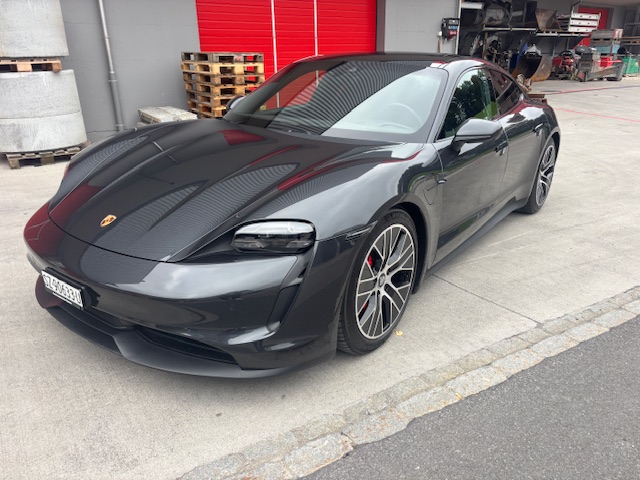
It definitely has the Porsche look!

Given this is not an EV blog, it’s perhaps useful to remind us of the history of the Taycan. It was launched as a 2020 model in late 2019, initially as Turbo and Turbo S (leading to a pretty meaningless discussion on how on earth they could be called Turbos when they didn’t have one…), later complemented by the 4S and the entry level only called Taycan. The station wagon was launched a year later on an extended platform, either as a sleek wagon or as Cross Turismo with a slightly more rugged look. At least here in Zurich, it’s the Cross Turismo you see most of on the road.

The Turbo and Turbo S came with the so called Performance Plus battery as standard, a 93 KwH pack giving them a theoretical range of around 430 kms. The 4S however came with a smaller, 79 KwH pack as standard, with the larger pack being optional. Given the smaller battery pack only has a realistic range of around 350 kms, that option is pretty critical for having any kind of secondary value on your Taycan. The good news is however that all Taycans run on an 800V platform, meaning charging times are among the best in the business. The bad news, which depending on where you live is pretty bad indeed, is that they’re not compatible with the Tesla superchargers.

The boot space behind the relatively small opening is not very big

The Taycan 4S I tested at my local Porsche center came from one previous owner with around 60.000 km on the meter. Importantly, given the many electronic issues many Taycans suffered from initially, the car was Porsche Approved with a 12-month guarantee. As can be seen, it was dark grey on black and quite well equipped with the larger battery package. In this configuration, it weighed in just shy of 2.600 kgs, without driver… The exterior colour suited the car well, but the black interior made the whole thing a bit somber. That said, black is the best colour if you want to hide plastics of which the Taycan’s interior has a lot, although they seem to be of better quality than on some other brands.

Walking around the car (which was parked next to a 992.1 on one side and my BMW 540i Touring on the other), it was easy to see that the Taycan was far more comparable in size to my Beamer than the 911. Checking the numbers later, it’s actually 2 cm longer than the G31 BMW at just under 5 metres, and 10 cm wider, at just under 2 metres width. Sitting behind the wheel, you also have a feeling of a big car.

They’re plenty of space in the front, far less so in the back, and not very much at all in the boot, although the Taycan has a relatively useful frunk to complement it. The interior otherwise looks nice and feels well put together, and given how well its screens are laid out and how good the tactile response is, to my surprise I didn’t miss physical buttons. Screens will never be better, but in the Taycan it’s at least almost as good.

A fine interior. Lots of plastic, but overall a solid feel.

Taking off means pressing the start button left of the steering wheel where traditionally the Porsche key should sit, and then a lever on the right hand side. The immediate feeling which, was then confirmed over the following drive, is again that of a big car that it takes some practice to place correctly. It feels very well balanced between front and rear, no doubt helped by the low center of gravity, but it’s nothing you throw into a corner like a 911. The steering is ok, although those complaining about the steering on the 991 generation that I mentioned in my post on the 911 Turbo S would be apalled by it, as it feels very synthetic and not that precise. I’d claim the steering in my 540i is better overall.

Even though the car is heavy, the 563 hp from the two electric engines (520 hp with the smaller battery pack) are plentiful, and no one needs more power than this. Unlike most EV’s, Porsche also uses a two-speed auto box sitting on the rear axle, with a short first gear to preserve the full acceleration and a longer second gear for higher top speed than a one-speed box would allow for. This also makes the electric engines run more efficiently as high speeds, saving energy – which again makes you wonder why the very sleek car doesn’t have a better range? The box is only noticeable when it shifts under hard acceleration, but that’s also what Porsche wants, trying to give the Taycan more of a mechanical feel.

The technical setup of a Taycan. An advanced – and heavy – thing…

The talented engineers in Zuffenhausen have also chosen a different braking and regeneration (regen) setup than most EV’s, again trying to make the Taycan feel more like a “normal” car. If you lift off the accelerator, the car will only coast (roll freely) with no regen, and thus no braking. When you brake however the regen kicks in fully, so that it’s only under heavy braking that you use the actual brakes. I would say that whether it was regen or actual braking, this is where you really feel how heavy the car is. The braking is solid enough, but it feels like the brakes have to work pretty hard to bring all of the 2.6 tons to a standstill. The km’s left in the range did however climb a little after some pretty heavy braking, so I guess it works.

This leads to the same conclusion as always with EV’s, that weight is the elephant in the room. My 540i station wagon weighs just under two tons or around 600 kgs less than the Taycan, a difference which roughly equals the weight of the battery pack. The Taycan is a fine car that drives really well for an EV, but it’s no sports car, and whoever calls this an electric 911 doesn’t know what they’re talking about.

Then again, that’s probably not a fair comparison given it has four seats and a decent luggage space. So what do you compare it to? To keep things simple and staying with BMW, if you want a sports car, an M3 or an M4 of a similar age are of similar size and price. They have about 100 hp less, but also weigh close to a ton (that’s 1000 kgs!) less. And if it’s more the GT aspect you’re after, a 4-series coupe in an equally stylish body will do the job with less power, but also far less weight. Of course there are other comparable models from Merc, Audi and others, and all are in the same price range.

As an example, a 4-series grand coupe is yours for even less money. In every aspect a better car.

Would I consider a Taycan? If for some reason I was forced to buy an EV, a used one like the one I drove would probably be a good choice. Whoever paid more than EUR 180.000 for it initially must be out of their mind or really convinced they were saving the planet (which, talking about EV’s, boils down to the same thing…). Therefore, unless someone forces me, I’ll just note that although impressive, the Taycan doesn’t move the needle neither in automobile terms, nor in Prosche terms. It’s not better, and much less spacious than my G31 540i Touring of the same age, or other comparable ICE cars.

The only needle the Taycan moves is that of the scale, and no weight-loss medicine beyond plastic is on the horizon for EV’s. That’s a nut even Porsche can’t crack. Driving the Taycan did one thing for me – it put the nagging feeling that I may have missed out on something to rest. When I take the trouble to test drive a car, I usually come away with a general feeling that it’s more exciting or better than my, by all means excellent 540i. The Taycan was the exception to the rule.


Heading for a fall

Is the European, and especially the German car industry heading for a fall? As we enter the new year, it’s a good time to ask the question. Why? Because the full turn towards electric, the inability to sell EV’s without subsidies, bringing cars to market that nobody wants and a whole block of new brands from China undercutting the market are all part of what I believe will be a very bleak future for European manufacturers, unless a change of strategy happens pretty soon. Let’s dig in.

With financial conditions turning for the worse in the last couple of years and inflation making a rather spectacular return, it’s no big surprise that consumers think twice about capital expenditures such as getting a new car, especially when there’s so much insecurity as to what the future of mobility will look like. And what goes for consumers also goes for states, especially when those in Europe have a whole set of geopolitical worries to think about, and spend money on.

With the US pulling back, Europe’s bill for Ukraine will keep increasing

Therefore, in their infinite wisdom, European politicians in various countries have decided to scrap or heavily reduce subsidies on new EV’s. This is not because they’ve read this blog and come to better thoughts, at least I don’t think so. Rather, they probably believed their own propaganda and that everyone had bought fully into their electrical mantra, so that subsidies were no longer needed. Oh how wrong they were…

According to EV-Volumes.com, a database tracking worlwide EV sales, the sales growth rate has fallen from over 100% YoY to around 10% in the last two years. And let’s remember this is starting from a low base, so that when Ola Källenius, Mercedes-Benz CEO says like he did a few weeks ago, that Merc’s EV sales in the last year grew by 70%, it really doesn’t mean that our streets are crowded with EV’s from Stuttgart.

But wait you’ll object, haven’t you told us that the Tesla Model Y and 3 are among the bestselling cars even in Europe? Yes I have and indeed they are, but this is a sign of Tesla doing this right rather than a general market trend. We’ll come back to that a bit later, however anyone doubting the correlation between EV sales and subsidies can look back to a I wrote piece back in 2018 using the example from Hong Kong.

The word “subsidy” is missing after Hong Kong in the title…

In April of 2017, EV subsidies on more expensive cars like Tesla were removed in Hong Kong, and during the rest of the year, sales dropped from almost 3.000 sold in the one month of March of that year, to a few dozen during the remaining nine months. And then Hong Kong went over to China who are very keen to subsidize the EV sector in general, so now sales have short up again. That same mechanism is exactly what we’re now seeing in Europe.

As we start 2024, EV’s still make up less than 2% of the European car fleet. That’s how big what the press likes to describe as “tremendous success” really is, and that shows you how very far we still have to go if the EU is serious about its ban on combustion cars in 2030. It’s also a bit of an issue if, as an automaker, you’ve committed yourself to go all-electric, and then produce cars that in value for money are frankly so awful that they shouldn’t have made it to market in the first place.

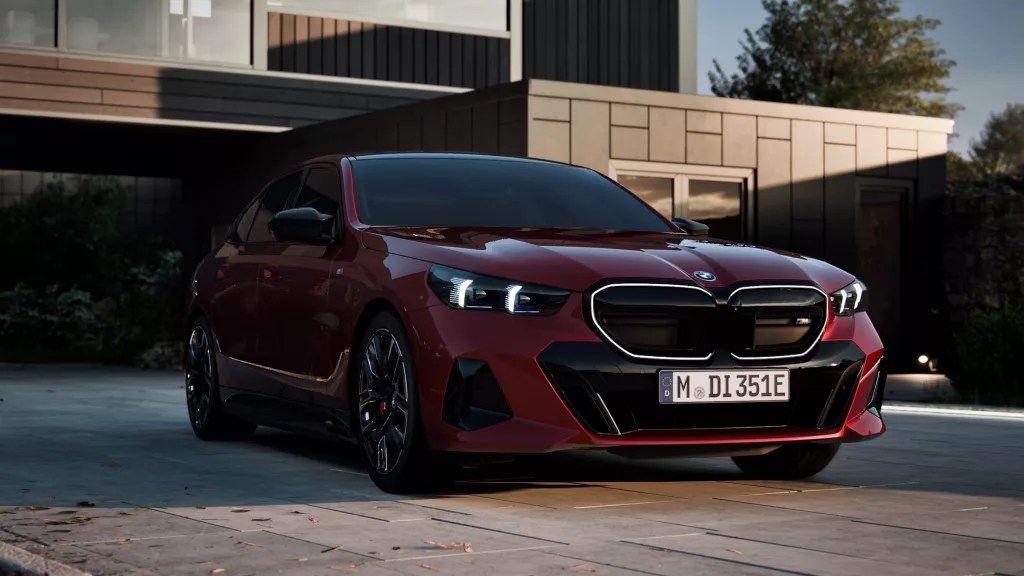
BMW has just presented the top-of-the-line new electric 5-series called the i5 M60. The new 5-series generation is over five meters long, or as big as a 7-series used to be, to offer enough room for the electric version’s battery pack. That pack also means the EV version weighs in at over 2.300 kg, around 500 kg or half a ton more than the combustion version of the same car. In spite of that it only has an 80 KwH battery, meaning a realistic range of something like 250-400 km depending on driving style, season and conditions.

It really looks far better than it is…

The inside is nice as it should be, however quality-wise, the previous generation that I drive myself is as superior as a Merc S-class is to an EQS. The increased use of cheap materials is of course to save weight, and instead electric gimmicks like games and movies are the new selling points, supposed to keep you entertained while you’re charging. For all this, the i5 M60 with options will cost you around EUR 150.000, or almost double of what the diesel version of the same car costs – which as said, weighs half a ton less, has a range of about 900-1000 km on one tank and takes two minutes to refuel.

If you think that really is a lot of money you’re completely right, but it’s still less than you’ll need to buy the new Lotus Eletre, which in its cheapest version starts roughly there and goes up to a rather incredible EUR 200.000. It’s an even bigger car, Range Rover-like in size, as gimmicky and plasticky as the Beamer on the inside, but with even more range issues and an efficiency loss vs. a Tesla of over 50%. It also has an infotainment system heavily over-estimating the remaining range, creating a real possibility that you’ll be stranded with an empty battery.

These are two rather awful examples, but at least they look rather stylish and have an excellent wind drag coefficient (or CW-factor) of below 0.30, which is obviously critical for an EV. So what does Mercedes do? It’s preparing to give us an EV version of the G-class, called the EQG, that will launch in 2025 at prices above USD 150.000. The current G-class has a wind drag factor of 0.54, but I’m sure Mercedes will bring that down to below 0.30, right?

And here I thought a low drag coefficient was important for EV’s. Silly me!

In the year 2024, no one in their right mind should put up this much money to buy a BMW they can drive 300 km, or for that matter, give 200.000 to an English manufacturer with less than a stellar reputation for a car that cannot be relied on to tell you how far you still have to go. It’s frankly both embarrassing and scary to see that in the decade they’ve had to prepare for what they knew was coming, leading car manufacturers still can’t manage to build a car that is better, or range-wise not even as good, as a 10-year old construction from Tesla, costing half the money.

Tesla on the other hand are doing great, and models Y and 3 are now established as some of the best-selling cars in Europe. They may look the same as they always have, but constant efficiency improvements mean that on a technical level, they’ve maintained the distance to other manufacturers. Also and critically, the strategy to launch a functioning charging network themselves rather than relying on governments, was a genius move. This is still a factor that heavily hinders sales in some markets, especially when many park in the street and can’t charge overnight.

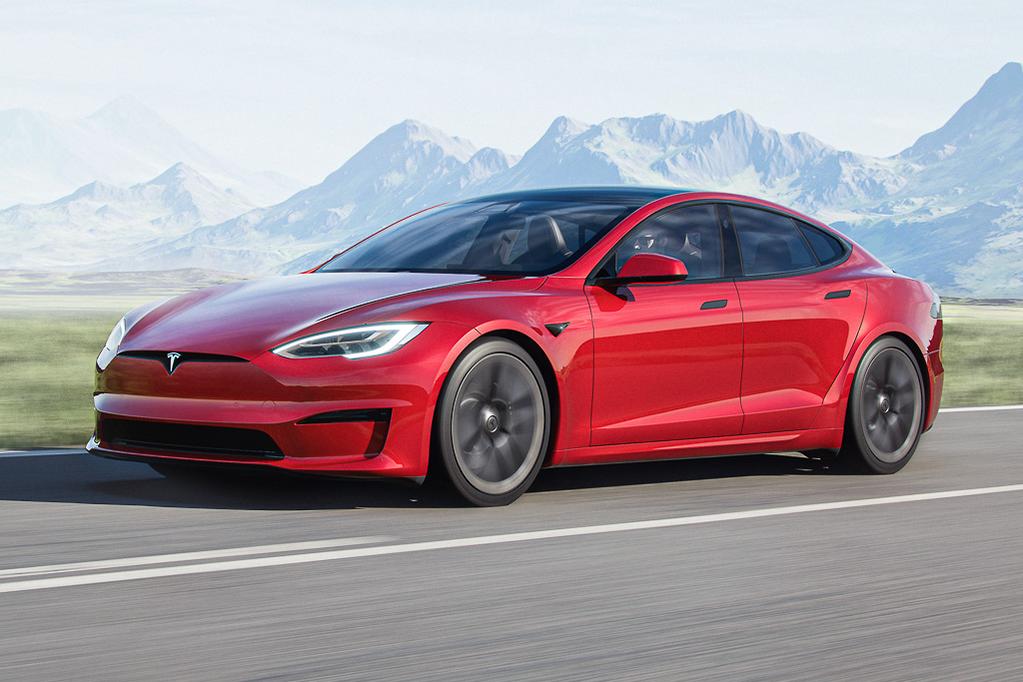
Tesla proves that there can indeed be a demand for EV’s if the packaging, price and range are reasonable. A Tesla Model S was never a luxury car, but at its current price point and with considerably more range than the three examples given above, if I were to buy an EV today, it’s the only one I would consider.

10 years old and still ahead of a pack that still haven’t figured it out

Of course not everything is about luxury cars, and the bulk of sales is of course in lower segments. But of course, cars there may be cheaper but they’re certainly not better than the top of the line, rather the contrary. Also and increasingly, the competition in these lower segments doesn’t come from the US, but rather from China, as a number of Chinese EV makers are now entering Europe, with an increased number of cars on our roads.

They’re of course cheaper than both Teslas and European EV’s, also thanks to very generous, Chinese state subsidies, and the almost complete integration of the production line, from the mines in Africa over the battery production in China, to the finished car, is of course a far more efficient way to produce. To this, you should also add a 1.5 billion domestic market, meaning they definitely have scale in their favor.

The cars themselves are, at least so far, inferior products. But exactly how inferior? In terms of range, they’re pretty close to European EV’s not only in the luxury segment but overall. In terms of build and ride quality they’re getting there, especially since this is much easier than for a traditional car, given EV’s score points not primarily on how it drives, but rather on how much it costs and how many gimmicks it has.

They’re coming for us…

In summary therefore, EV sales are stalling, subsidies are being removed, and the Chinese undercut European manufacturers in price. Surprisingly enough, all of these seem to have been fast asleep at the wheel for the last years. And at the end of this decade, we’re supposed to stop producing combustion cars, which still made up 80% of car sales in 2022 and are thus, you have to think, what people want to buy.

If Europe wants to keep a car industry in the future, manufacturers need to start building cars that people want, which make economic sense, and that can differentiate themselves against Chinese imports. That probably means leaving a large part of the lower EV market to the Chinese, and instead reverse the full electrification strategy, rather reverting to diesel and petrol hybrids, in a mix with modern, non-polluting diesels.

Manufacturers will tell you EU politicians haven’t given them any choice, and this is all policy. But policy can be influenced and if they want to have a brand at all in a few years, they should probably get in a car (preferably not an EV), drive over to Brussels and make the case for why the current strategy and timetable for the phasing out of combustion cars is a death threat to the industry and thereby to the one million people it directly employs.

In view of the mass protests against fuel prices by farmers in Germany in the last weeks, which have now spread to France, that might actually be an argument these people are inclined to listen to. At least they wouldn’t be able to claim that they hadn’t been warned.

The last nail in the e-coffin

This week we’ll put the nail in the coffin of any dreams of personal car electrification in the coming years. That may sound drastic, but regular readers of the blog will remember I did my first post on the subject almost two years ago and have followed that up a couple of times, notably last summer, at a time when we were all living in the world where markets were good and Putin was, well not in Ukraine. On one hand things have thus changed in a way which is highly significant notably for EV’s. On the other I came across some really astounding facts a couple of weeks ago, the silence on which is very surprising. But if the media won’t tell you about it, then I guess I will, and although it may sound pompous, I really do think this seals the fate for the worldwide EV roll-out our Western politicians want to see over the coming years. Let’s dig in.

There are around one billion 450 million cars in the world or if you prefer, roughly one car per five world inhabitants (although it rather splits like three in our developed world garages and non in many developing countries). Almost all these cars are powered by a combustion engine, the basic principle of which is identical to the one invented around 150 years ago. That resounding success is of course helped by constant developments and improvements, but even more importantly, by the fact that the fuel needed to power it has been, and continues to be, plentiful. Put differently, had we reached peak oil a long time ago, it’s reasonable to think that the development of alternative fuels would have started earlier.

An E-Type V12 is a particularly fine example of the combustion engine!

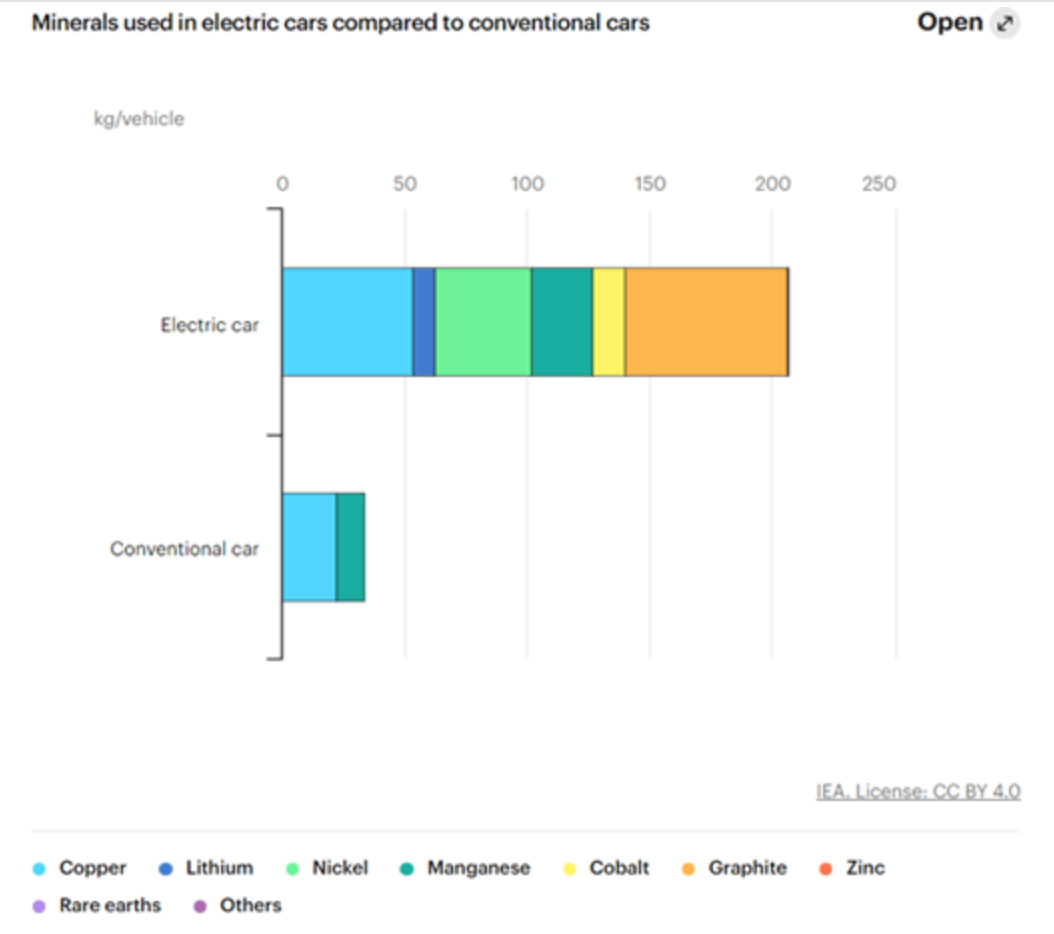
The skepticism I’ve long held to our electrical future has nothing to do with the cars themselves (although most, after you’ve pushed the pedal to the metal a few times, are about as interesting as watching paint dry, but that may change as more come to market – maybe). Rather, this comes from the massive issues related to EV battery production, the less than convincing carbon footprint they have, and the geopolitical implications of where the necessary metals are located. But actually, you don’t even need to go there, because in addition to all this, there’s the simple fact that there isn’t enough of the materials needed for the electrical future to be realized. In other words, the alternative to the combustion engine is finally here, and it’s not a bad one, but the world doesn’t have enough “fuel” to power it on a massive scale. And yet, whilst concrete plans are drawn up for a ban on combustion engine cars, no one talks about it.

Never ever forget this picture – and apologies for the bad quality.

We’re told we should replace all our traditional cars with EV’s as quickly as possible. Let’s say we’re slightly less ambitious and content with 500 million EV’s as a first step. After all, that’s about 480 million more EV’s than are on the road today and maybe we don’t need all of those 1.45 billion cars going forward (that would actually be a fair assumption…). To supply batteries for that number of cars would require mining a quantity of energy minerals equivalent to about three trillion smartphone batteries. That’s equal to over 2,000 years of mining and production for the latter. And even if that through some miracle were to happen, it would still only eliminate 15% of the world’s oil consumption.

We would of course in addition have to mine whatever is needed for the solar panels, windmills and electrification needs of industry that should happen in parallel. Naturally, this assumes that all the countries from which we get these metals pose no political or moral issues, and continue to happily supply us with everything we need. No reminder is probably needed that one of the two most important of these countries is Russia which is currently engaged in a war in Europe and actively turning eastwards and away from us. Another one is the Congo, where children work in mines under inhumane conditions to extract 70% of the world’s cobalt production. Lithium on the other hand mainly comes from south America, notably Bolivia, with severe consequences for the local ground water supply.

Lithium extraction in Bolivia. Not really great for the local ground water…

Given however electrification is the chosen and from what you hear, the single way of development, the logical consequence should be to have increased mining high on the agenda. Without that, where are the metals supposed to come from? Of course that’s not what happens, especially not in the Western hemisphere. Our politicians much prefer to travel by private jet to a climate summit (COP 26) in a developing country (Egypt) to lecture other developing countries on their usage of fossil fuels, only to negotiate more oil and mineral deliveries from the same countries when the lights go out. Around 400 private jets brought the dignitaries of this world to COP in October this year and as an example, Germany imported eight times more coal from South Africa in 2022 than in 2021. We’ve rather let the Chinese invest in new mines, preferring not to get our hands dirty.

The hypocrisy is truly hard to believe, But it doesn’t stop here. Few countries have been as vocal about human rights abuses in connection with the football World Cup in Qatar as Germany, and emotions were running high when its team wasn’t allowed to wear rainbow armbands during the games in defense of LGBTQ rights. As we know now, that didn’t prevent the German government from signing a natural gas deal with Qatar for the coming 15 years at the same time as the German team tried to qualify for the quarter finals – without multi-colored bands around their arms…

Some of the more than 400 jets that brought world leaders to Egypt at the COP26

This last example serves to highlight a crucial point of which we’ve been reminded a few times already, and will certainly be reminded of many more times this and next year: when energy gets scarce, there’s a risk of people not being able to heat their homes or industry needing to shut down because of lack of electricity, then every single politician will do what it takes to keep the lights on, be it with dirty energy and, as I suspect will increasingly happen, be it in spite of sanctions as well. That’s also when EV’s become more of a problem than a solution.

Let’s summarize the facts that should be obvious by now;

1) We don’t have enough storage or mining capacity to extract the rare metals needed to produce batteries anywhere close to the scale needed for the electrification of the world’s auto fleet. As a concrete number, a single large EV battery pack of 500 kg can require up to 250 tons of earth being moved to produce sufficient ore to extract the quantities of metals required.

2) There is currently (meaning at least for the coming five years) no alternative battery technology to replace our metal-based batteries, and there are no other metals that are as efficient as the ones currently used. EV enthusiasts will often point to cobalt quantities being reduced given how problematic its production is. It is however substituted with nickel, mostly coming from Russia, not with other types of metals. Any other type of metal would make the battery less efficient. And even if you could argue that nickel from Russia is better than cobalt from the Congo, it’s really an improvement on the margin, not more.

The carbon emissions in the black smoke behind this cobalt mine aren’t verified…

3) There is no reliable way to trace the full carbon footprint of an EV. Estimates vary widely and will continue to do so, and how could it be any different when in some instances you’re required to dig out 250 tons of earth in some of the poorest countries of the world, under conditions we don’t want to know about? No one has even tried to measure the climate impact of cobalt extractions in the Congo, and that’s probably a good thing. However, based on 50 academic studies, the estimated emissions to produce one single EV battery range from eight to 20 tonnes CO2. That’s before it’s been driven a single meter, and the higher end of that range is comparable to the emissions from a conventional car during its full lifetime.

4) In a world where electricity is scarce, EV’s for personal driving will not be prioritized. Here in Switzerland, the government’s energy emergency plan tells us not to use streaming services in times of crisis, or not to wash our laundry above 40 degrees. In the US, California has seen more power cuts this year than ever before. Under any of those scenarios, how likely is it that you’re allowed to charge your EV as much as you want? And when an EV charge costs almost as much as filling your tank as has been the case in the UK in some places this year, where’s the incentive?

5) Finally, and although nothing really points at it, perhaps a bit of common decency and morality will come in to the public discussion, pointing to the fact that children in the Congo work in mines under terrible conditions to produce the metals needed for feel good Westerners to drive Teslas. Or that over 90% of the solar panels on our roofs are produced by Uighurs in Chinese prison camps, their only crime being to be Uighur? If fast fashion isn’t the way to go for the clothes we buy, then EV’s most certainly aren’t for our driving!

Therefore, batteries in their current shape or form are not the way forward, and current electrification plans for our auto fleet simply won’t happen. That doesn’t mean that the combustion engine in its current form will be there forever, but that’s a story for another day. Until then, enjoy your conventional car – as long as you do, you’re doing the world a service!

EV’s don’t save the climate – far from it

“They should all buy an old Defender instead – no car is more sustainable given none has even close to the same lifetime,” laughed the guy next to me at a dinner party quite a few years back. Electric mobility was still young and our discussion had been on Tesla and the future of EV’s in general. In my first post for the year I promised to write less about EV’s going forward as this isn’t the main point of interest for you, dear readers. I will stay true to that promise but before closing out, I actually feel the need to set the record straight on a few things related to electric mobility and sustainable transportation, that somehow never make it into the headlines. All that glitters is not gold, a saying that is definitely applicable to EV’s, but where hard facts are often surprisingly difficult to come by. I’ve tried and suggest we look behind the glossy ads at some facts on electric cars before moving on to happier topics!

The older a car is, the more sustainable it becomes, so this is unwise…

Let me start by saying that I have nothing against EV’s. It’s an interesting technology with far greater efficiency than traditional petrol (3x) and diesel (2x) engines. The immediate and permanent torque is a thrill everytime you experience it, and battery research is progressing fast, with the first solid state batteries perhaps hitting production in 3-4 years. This would be a further boost to the whole EV market given the far greater efficiency and shorter charging times. That’s all great. The issue however is that EV’s are marketed in ads with blue skies and green pastures as the clean alternative to petrol cars. Unfortunately, that’s not true – and quite far from it.

Polestar, Volvo’s EV company, did something very unusual a few weeks ago. They came out and told the world how many kilometres the electrical Polestar 2 needs to be driven to achieve a CO2 advantage over a regular, petrol XC40. The issue comes from the fact that whereas the two cars are similar in construction, producing the battery pack in an EV is a real CO2 bomb. The Swedish Environmental Agency has calculated that a mid-sized car battery pack, such as the one you find in a Polestar 2, causes around 17.5 tons of CO2 emissions during its production, which, as Volvo reported, is equivalent to roughly 78.000 kms in a petrol XC40. So in other words, only from then onwards are you actively contributing to lower CO2 emissions. In a Tesla or other EV with a larger battery pack, the number is even higher. Conservatively assuming 100.000 kms and looking quickly at the 165 Model S currently for sale in Switzerland, only 20% have more than that on the clock, meaning 80% are in other words still in “CO2 deficit” as compared to traditional cars. By the time most of them reach the required mileage, they will have changed owners once or twice.

A Model S battery pack with a total of 15 modules

So far, this is all based on the assumption that the electricity you charge your EV with is clean, so that no further emissions are caused once the car hits the road. That of course depends on where you live. Here in Switzerland where roughly 60% of energy comes from water and around 30% from nuclear (with in other words less than 10% coming from renewables), it usually is. The same is generally true for the Nordics and France, a champion of nuclear power (71% of the energy mix) and renewables (23%). In the US, more than 50% of electricity still comes from fossil fuels and in Germany, while the mix includes a whopping 46% of renewables, there is also close to 40% of coal and natural gas (and where exploration of the latter is currently causing a little-discussed environmental catastrophy in Siberia…). The reason for this is Germany’s decision to close nuclear plants, something many other European countries have decided to do as well in the coming years. In some rather large countries therefore, being sure the electricity that goes into your EV is clean is not a given, and will be conditional on your country investing a heck of a lot in renewables over the coming years. Germany’s “Energiewende” has so far cost north of EUR 500bn and has still not managed to lower total emissions, so this will take time – and money.

This would be a really clean, but not very efficient, energy source…

Next to emissions there is also the really dark part of the story, namely metals and other materials of the battery pack. In terms of environmental concerns the two really problematic ones are graphite and cobalt. 54 kgs of graphite go into every Tesla Model S, typically produced in China, but no one can tell you the environmental impact of its production as there are no conclusive studies on this. That itself is rather noteworthy, but those having looked at it all seem to agree that it’s a pretty dirty business with significant emissions of various bad stuff. As for cobalt, we all have a few grams of it in our mobile phones, but in a typical EV there is 5-10 kgs. Looking just at Tesla’s production of around 500.000 EV’s in 2020, that’s a whopping 2.500-5.000 tonnes of cobalt for the cars built in 2020 alone, usually originating in Congo, one of Africa’s poorest countries that makes up 60% of global cobalt production, with Chinese mining companies being the largest operators. The human cost of these mines has been highlighted many times, as has the pollution of water systems, displacement of villages and miserable working conditions. It’s a very sad story, unlikely to change in the short term.

A cobalt digger in Congo, Not a picture you will see in an EV brochure (Source: Washington Post).

Traditional cars pollute and our efforts should no doubt focus on reducing all types of emissions (CO2 and other) of the transportation sector. EV’s are however not the simple solution they are portrayed to be. As per today, from an environmental point of view, a large majority of EV drivers would have done the planet a greater service had they bought a conventional, used car, and that will remain the case for quite some time. As the world moves towards more renewables, electric mobility will improve on the whole, but without fundamental progress to our battery technology, some serious issues will remain. Therefore, as an example, it’s a bit sad how little alternative, clean technogies such as fuel cell / hydrogen cars are discussed.

Until we get there, don’t buy the old Defender my table neighbour suggested, as that generation of diesel engines is quite a dirty bunch. Do however by yourself a relatively modern used car and for some of the money you save, a good bike for shorter transport. It will both be better for the planet than a new EV, and also contribute to your fitness while saving you quite a lot of money!