The V10 is dead – long live the V10!

To borrow from John Cleese in the legendary Monty Python scene from the animal shop with the dead parrot, the V10 is no more. It has ceased to be and gone to meet its maker, and for all those of us who felt it was something truly special, that’s obviously very sad news. That said, there’s a bit of a delay in this post given production of the last V10 engine took place in late 2024, but if you haven’t gone into mourning yet or perhaps hadn’t realized it, the time has definitely come to do so. Let’s therefore look back into what made the V10 so special, the most prominent street cars that featured it, and, should you decide to help preserve the V10 for coming generations, which cars you should consider!

The V-shaped, 10-cylinder engine has been around far longer than many people think. Its roots go back to the 1940’s, but its history in street cars is far shorter, starting in the early 90’s. In the era when naturally aspirated engines were still the way to go, the V10 became a good alternative for when a V12 was too big and heavy, but a V8 wasn’t powerful enough. It produced more power than a V8 and often also ran smoother with less vibrations. And whereas it was less powerful than a V12, it typically had more torque, and was obviously also smaller and lighter. And then there was of course the sound that many still consider unequalled. I won’t even try to describe it in words, but let’s just say that if you’ve heard a V10 in higher rev’s, you’re not likely to forget it!

The V10 era was arguably the best sounding in modern F1 racing!

V10’s were also the main engine used in F1 during two decades. They appeared in the late 80’s after FIA’s ban on turbo engines, when manufacturers during a couple of years used everything from V8’s to V12’s (imagine that today…), Notably thanks to its greater efficiency and lower weight, the V10 then became the F1 engine of choice in the late 90’s and the first half of the 00’s, when all cars ran V10’s in what’s probably the best sounding period of F1 history. The fun ended when FIA made the small, 2.4 litre V8’s mandatory in the mid-00’s, making V10’s became a thing of the past.

In terms of street cars, surprisingly few brands have featured them in their line-up. The first was Chrysler in the 10-cylinder Viper. In the true American spirit of there being no substitute for cubic inches, the V10 was developed from the Chrysler V8 to which two extra cylinders and an aluminum block from Lamborghini were added. The initial version displaced no less than eight liters, putting out 400 hp, which in subsequent versions would increase to 8.3 liters at most, and over 500 hp.

The gigantic Viper V10 looks good, and sounds even better!

BMW also built a V10 engine, however only one, which was featured in the E60 5-series and the E63 6-series from the (Chris) Bangle-era between 2000-2005. At 507 hp, the 5-litre engine was the most powerful, naturally-aspirated engine BMW has ever built, and also one of the most high-revving V10’s ever produced. Importantly it also featured in the 5-series station wagon called E61, the only M-wagon ever built until the current M3 and M5 Touring, and perhaps the most collectible of the three models today.

The brand family that made the V10 most famous is however Audi-Lamborghini. Audi bought the Italian brand from Sant’Agata in 1998, and when the Gallardo was presented five years later, it was with the same base V10 engine that would be featured in the Audi R8 a few years later, from 2009 onwards. It displaced 5 litres in the Gallardo and 5.2 litres in the R8, but with a similar power output at around 520 hp in both. To round it all off, both cars were also available with a manual gearbox. And whereas the R8 later also came with a V8 option, the Gallardo was ever only available with the V10, as was its later replacement, the Huracan. The special version Huracan STJ, presented in 2024, would be the last production car to feature the V10, in its final form delivering all of 640 hp.

The Lamborghini Huracan STJ – a worthy end to an era!

Whatever you think about our coming electrification or lack thereof, the probability of the V10 making a comback is slim, to say the least. So if you want to add an example of this wonderful engine to your garage, you’ll have to look at pre-owned cars. Should you? The answer is a resounding yes, as long as you know what you’re doing. BMW’s V10 wasn’t directly derived, but borrowed heavily from the early 00’s F1 engine the company ran, meaning it’s at heart a race engine and needs to be serviced accordingly. That may be obvious if you buy an R8 or a Huracan. Somewhat unfortunately however, as you’re able to buy both the V10 M5 and (especially) M6 for below EUR 50.000, all buyers don’t realize that. Just as little as previous owners may have.

Therefore, buying a more recent and certainly more expensive R8 or Huracan is probably a safer bet, but as always, if you do your homework properly, nothing fundamental speaks against a BMW V10 either, or a Gallardo for that matter. Personally, I would park an early Gallardo in my garage and make sure it’s a manual. It may have been Lambo’s first mass-produced car, but it was certainly also the best. Now ask yourself when you last saw one? Exactly. Especially in manual form, the Gallardo is certainly a coming classic, with a design language that is as much early 00’s as it gets.
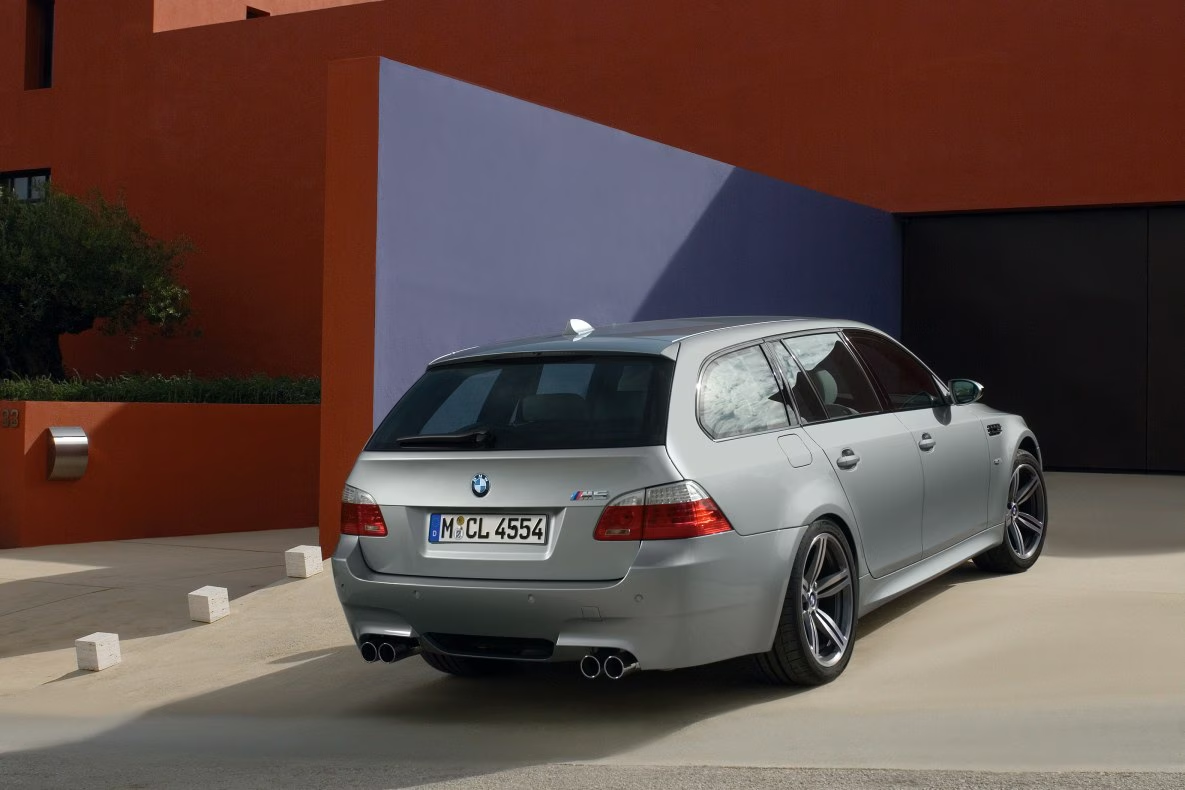
The E61 M5 Touring – one cool family car!

That said, you can’t really fault anyone buying an R8 or a Huracan either – far from it. And the guy that packs his family and luggage into an M5 Touring with a V10 up front before heading south for the summer vacation will obviously always be a hero. The V10 options may thus be few, but they’re all great, so there’s clearly hope that this wonderful engine will live on for many years to come!

Baby Enzo comes of age!

There’s a lot of talk among car bloggers and vloggers (me included) about the concept of “real”, in the sense of for example “which is the last real this-and-that?”. These days it often has to do with partial or full electrification, where the last “real” car is understood as the last version before that happened. You only need to wind the clock back a few years however for the debate to have been between naturally aspirated and supercharged, and before that, analogue and digital. I could go on but I think it’s already clear that this is a discussion that’s been going on maybe not since the car was invented, but definitely for a long time (assisted steering? who needs that? Naa, the predecessor was definitely the last “real” car they offered!).

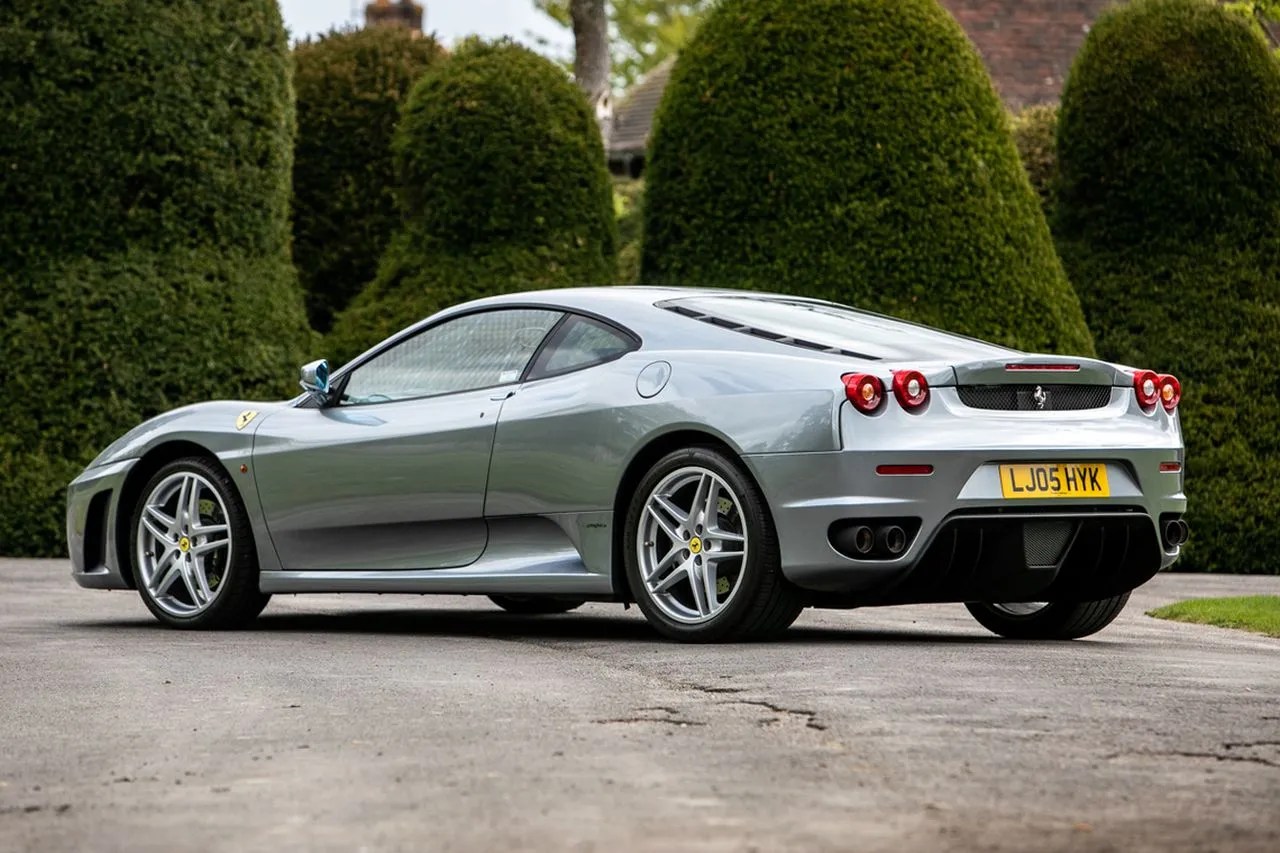
I believe to know that most of those reading this blog will have lived through at least the three stages described above, meaning mechanical/analogue vs digital, naturally aspirated vs supercharged, and petrol vs hybrid/EV. I also think that many of you have a preference for the first world in those three categories. Which is why this week, I thought we’d talk about the last “real” Ferrari corresponding to the above brief in the sense of it being (mostly) analogue, very much naturally aspirated, and definitely only running on gasoline! It also happens to be one of my all-time favourites from Maranello one of the most beautiful cars they ever built. As if that wasn’t enough, today it’s even a bit forgotten, and hence bit of a bargain: ladies and gentlemen, I give you the Ferrari F430!

A beautiful, compact and timeless design by Pininfarina

It was in 2004 that the F430 was presented to the world as the F360’s successor and sales started the year after. This was important for Ferrari since the competitors in Sant’ Agata had launched the Lambo Gallardo, a much more powerful car than the F360, in 2003. The nervousness only lasted until 2005 though, as the F430 was a true competitor to the Gallardo. Outside the changes compared to the F360 could be considered as a major facelift, but they were changes that took the already beautiful F360 to the next level. And obviously, not only the looks did so, but very much the powertrain as well!

Most noticeable are of course the Enzo rear lights, knowing the Enzo had been introduced two years before and is obviously the main reason the car was often referred to as “baby Enzo”. There’s other details as well though, notably the side mirrors that are held by thin arms such as not to interrupt the air flow to the air intakes on the rear aisles. On the driver side the mirror cap also has the very cool “F430” inscription. Inside the car, the step-up in quality from the F360 is very clear to see. The F430 is still analogue to the extent that it doesn’t have any screens, but a bit depending on the optional extended leather package, the interior feels very high quality. Some people insist on the optional bucket seats but the standard seats not only look better, they also offer enough hold and more comfort and thus fit most people absolutely fine.

The F430 is a Ferrari that doesn’t need to be red!

If the looks can be considered a facelift rather than a full re-design, there were definitely other quite revulationary news on the mechanical side. The wonderful 4.3 litre V8 was a completely new engine replacing the 3.6 litre one in the F360 that could be traced all the way back to the Dino. Weighing only 4 kgs more than its predecessor but putting out 490 hp that had only around 1300-1400 kgs to carry, not only was its power much higher than the F360 but the torque was also significantly higher at 465 Nm. For about 90% of the 15.000 F430’s built, the engine was associated to an F1 semi-automatic gearbox, with only 10% of cars being manual.

The F430 was the first Ferrari to be equipped with the by now classic “manettino”, located on the steering wheel and allowing you to select the different driving programs. Linked to that, it was also the first Ferrari to have the electronic or e-differential, a limited slip active differential that could vary the torque distribution by taking into account lateral acceleration, steering angle and so on. Brakes came from Brembo and carbon-ceramic breaks were available as an option. All this gave as end result a car that had much better downforce than the F360, better handling, and much more power: a time to 100 km/h under 4 seconds and a top speed of 315 km/h is really all you need still today! When you press the throttle, the exhaust sound is quite simply sublime and of a kind only natural aspiration can produce. Sorry Pavarotti, this is Italian opera at its best!

Coupé or Spider, the interior remains the same but the coupé gives you additional storage behind the seats

Initially the F430 was available as a coupé and in 2005 a convertible/Spider was added to the line-up, obviously allowing you to enjoy the action and the sound to the max, but doing so also sacrificing at least a bit of the beautiful lines. In 2007 the F430 Scuderia came out as the racing version and successor to the F360 Challenge Stradale, taking up the competition with notably the 911 GT2 and the Lambo Gallardo Superleggera. The Scuderia weighs 100 kg less and has a few more hp, but only comes with a semi-automatic gearbox – no manual Scuderias were built. The F430 was replaced by the 458 in 2009, the car that took Ferrari into the modern age.

The F430 is thus not only one of Ferrari’s most beautiful creations and a great sports- or even supercar, it’s also the last, naturally aspirated Ferrari. That makes it special but strangely, that doesn’t seem to be fully appreciated by the market yet. For a “regular” F430, meaning a coupé with the F1 semi-automatic gearbox, prices start around EUR 80-90′. The Spider will be slightly more and cars with manual gearboxes will add 40-50%, a premium hardly worth paying. That’s only slightly more than on one hand the predecessor F360, clearly an inferior car, or the Lamborghini Gallardo which, let’s be honest, looks like it was designed by someone who could only draw boxes and has a VW engine. Given that, the standard F430 is clearly the bargain of the lot!

The Scuderia is more than twice as expensive but it’s also quite an extreme car that is really only interesting if you do track days. It does get even better as although boasting supercar performance, the F430 is generally considered quite reasonable to run. We’re obviously not talking a Toyota Prius here, but certainly not Enzo-level either. So in summary, EUR 100′ will easily get you the last real Ferrari without ruining you on the way. In today’s inflationary world, that’s a true bargain for a car that I’m sure we can all agree on is the last real Ferrari!

PARIS: Lamborghini Gallardo får sin andra facelift – suck…

Gallardo går in på sitt 10:e (!) modellår nästa år. Först 2014 kommer ersättaren – en helt ny Gallardo. Tills dess får vi hålla tillgodo med en andra (!) facelift.

Den uppdaterade Gallardon verkar inte få den dubbelkopplingslåda som kommer i systerbilen Audi R8 från 2013 års modell, utan får hålla till godo med den äldre och brutalare enkelkopplingslådan.

Min 5-årige son hävdar att han tycker bättre om Lamborghini än Ferrari. Jag antar att upproret börjar tidigt…