The unique Lancia Stratos!

If competition between car makers has been a trait of the automobile industry for as long as anyone can remember, it’s probably only in Italy that competition between car designers was just as fierce. The two dominant houses in Italian car design are of course Pininfarina and Bertone, both having employed legendary designers through the years who have in turn been responsible for some of the most beautiful car creations to come out of Italy. Usually one of the two big houses would be the main partner for a certain brand, but there was certainly nothing hindering the other one from trying to gain market by various means. Thank God for that because otherwise, the legendary Lancia Stratos would probably never have seen the light of day.

Lancia had historically mostly collaborated with Pininfarina in designing its models, with Bertone eagerly watching from the sidelines. In the late 60’s however, Bertone saw an opportunity as it was obvious that the ageing Lancia Fulvia was up for replacement. Bertone’s gave its legendary designer and our old friend Marcello Gandini, the man behind notably the Lamborghini Miura and Countach, the task of drawing a car that completely broke with the Fulvia and would signal the advent of a new, modern era. So he did, and it was so convincing that the Lancia bosses decided to show the prototype at the Turin Auto Salon in 1970. Gandini was subsequently commissioned with designing the production car that would come to market a couple of years later.

Gandini’s original Stratos prototype was…special!

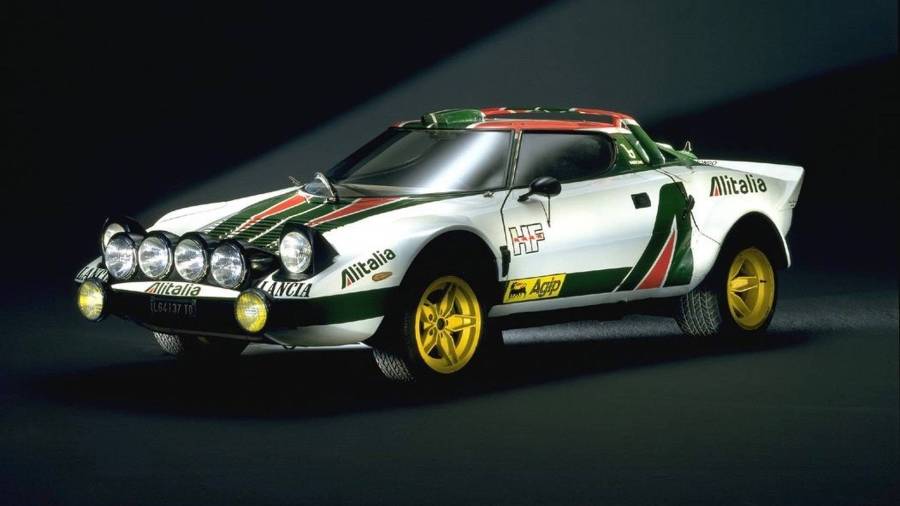
The Stratos’ predecessor, the Fulvia coupé, had been used on the rally scene in the 60’s with some success, and Lancia saw rally as a way to position the brand as a sporty alternatively notably the the siblings from Fiat. This meant that unlike basically any other rally car at the time (or for that matter, thereafter), the Stratos was developed exclusively with rallying in mind, and not as a civilian car later converted to rally usage. You don’t need to look at the car for long to see this was the case, and also that this was a completely new design language that would follow Gandini notably to the Countach. The ultra short wheelbase of only 2.2 metres carries a body with minimal overhangs but with a big, sweeping front screen giving the driver great visibility. The engine was mid-mounted in the ultra low, rear-wheel drive car, getting in and out of which it is not an exercise suitable for any kind of daily driving. Looking at the Stratos today, it’s surprising how small it really is at 3.7 metres and around 900 kg. Lancia did however have to comply with the rules for any rally car at the time, namely that 500 so called homologation cars for street usage had to be built and sold along side the rally cars themselves.

How most of us remember it – on a clay road in some southern rally!

During the development of the Stratos, Lancia had considered various engines for the car, but the one they really wanted was the 2.4 litre V6 that Ferrari was using in the Dino. After long negotiations, rumour has it that Enzo Ferrari himself agreed to deliver the 500 engines necessary for the homologation of the Stratos. However, after the first 10 engines or so the deliveries suddenly dried up, with Ferrari claiming various production issues. It wasn’t until Lancia threatened to replace the Ferrari engine with another motor that they finally started coming in. Strangely enough, that also coincided with the end of production of the Dino, which Enzo had of course seen as a competitor to the Stratos… In the homologation street cars the engine produced 190 hp, in the rally cars performance was typically between 300-400 hp thanks to a big, old-school turbo. With the car being rear wheel drive, it’s an understatement to see that the Stratos was difficult to drive, but for those who mastered it, it was one hell of a car!

The Stratos premiered in the world rally championships in 1974 and went on to win the title straight away, as it did in 1975 and 1976 as well. It won both the Swedish Rally on snow, and the African rally on clay in the same period. There’s little doubt it would have gone on to win further titles had Lancia let it, but by this time Fiat had taken the somewhat strange decision that the Fiat 131 Abarth, a not very futuristic car that few will remember and that didn’t see much success, would be the rally car (and Fiat thereby the rally brand) in the Torino car family. The last major title the Stratos won was therefore the Monte Carlo Rally in 1977, although private teams continued to race the car and having success doing so after that. Of course Lancia came back on the rally scene a few years later with the Lancia Delta Integrale, that we looked at in an old post from 2015, but that’s another story.

The quite minimalistic interior of the homologation cars

There’s been various initiatives over the years to revive the Stratos, some of which have made it to some of the big car shows, but none of which have so far made it all the way to production. The most promising one was designed by, hold on to your chair now, Pininfarina and not Bertone, although it was, let’s say heavily inspired by the Bertone-designed original. It was built on a Ferrari 430 chassis and was to be built by a company called Manifattura Automobili Torino (MAT). It was shown at the Geneva Auto Salon in 2018, but the project then died off, apparently not because of Covid but rather because of Ferrari vetoing it, unclear why. I included it in my overview of the auto salon back then in a post you can find here.

The Stratos was thus a truly unique car, and to me, one of the coolest cars around to this day. It’s also uniquely small, uniquely focused on rally and if not uniquely, then at least very successful. It’s also a uniquely difficult car to find today should you want one. With 500 built in the early 70’s that’s perhaps no surprise, especially since many of the buyers certainly thought of themselves as hidden rally talents. As I write this in the middle of February, there’s not a single car on the market anywhere in Europe, nor in the US (which is less surprising since the Stratos never made it officially there). The Stratos will thus remain a rally legend for poster walls or these days Youtube, but what a car it was!

Celebrating the real legend!

You may have seen that Lamborghini has re-introduced the Countach. Yes, you read that right, the most legendary of all sports cars of the 80’s – scrap that, of all times! The one a fair number of us born in the early 70’s with a head full of petrol dreamt about and put a poster of on our bedroom wall, next to Samantha Fox, Sabrina or Miami Vice. Just hearing the news, I imagine I wasn’t the only one filled with not just a little excitement. It didn’t last long though. The fall back to reality was heavy a few moments later as I learnt more about the new car.

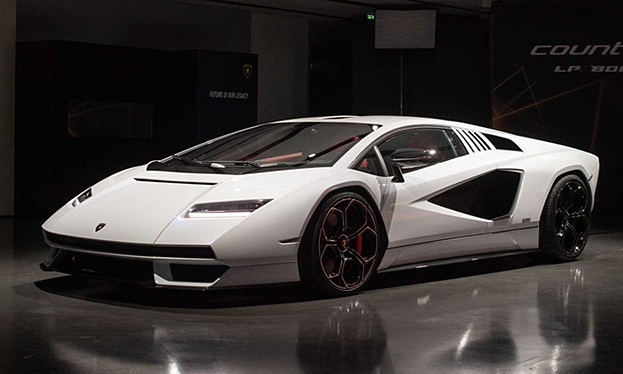
You see, what Lambo dares calling the new Countach, under the official name LPI 800-4, has precious little to do with Marcelo Gandini’s jawdropping design from back then – nor is it a modern interpretation of the same theme. Nope, visually the new Countach is nothing more than a relatively modestly re-designed Aventador with some clumsy Countach references, of which 112 will be built (that’s good as it reduces the risk of being disappointed seeing it “live”). They’re of course extremely expensive (price not known at this point but probably around USD 3m), atrociously fast with 814 hp leading to a 0-100 time of below 3 seconds, naturally hybrid with a small electric engine making up 45 of those 814 hp, supporting the V12 and, it goes without saying, all sold, presumably to buyers of which a majority will park them in a garage and never drive them. Disappointed? Me?

The new Avent… sorry, Countach.

That is however all I’ll say about the new Countach and I also promise not to make this a long rant about how much modern supercars lack the heart and soul of the true legends. Instead we’ll do something much more fun: we’ll travel back to our younger years when our jeans were stone-washed, our socks white and our shoulders impossibly wide. For a few minutes, we’ll return to that poster on the bedroom wall (no, not Samantha) and have a good look at the original, REAL Countach! Interestingly, doing so also involves coming back to some legendary Italian car builders that have been featured on this blog earlier and only serve to highlight the true legend that the original Countach is.

The story begins in the early 70’s with Bertone being commissioned by Lamborghini to come up with a replacement for the Miura, which had only been on sale for a few years but already faced strong competition from the new Ferrari Daytona, introduced in 1969. Marcello Gandini, lead designer at Bertone, had a few years earlier started to experiment with a new design language as notably shown in the Lancia Stratos: a much more wedge-like, angular shape, and he took on the new Lambo project in the same spirit while the engineers were working on the engine. It was clear that the new car would remain rear-wheel drive with a rear-mid 12-cylinder engine as on the Miura, but for weight distribution along with some mechanical reasons, not transversally mounted as on the latter.

The true legends – from left to right, Giotto Bizzarrini, Ferruccio Lamborghini and Gian Paolo Dallara in 1963, admiring a prototype of the coming Lamborghini V12, designed by Bizzarrini!

The name Countach has always been a bit of a riddle and is a story in itself. Countach doesn’t mean anything in Italian and is also not following Lambo’s tradition of naming cars after bulls or bullfights. The story goes that one of the mechanics in the Sant’Agata factory only spoke Piedmontese, a regional language closer to French than to Italian in which there is the word “contacc”, an expression showing astonishment. The unnamed mechanic used it quite frequently when working on the car and Marcello Gandini therefore half jokingly sugested it as a possible name to Bob Wallace, Lambo test driver at the time, who confirmed it worked in English with a minor adaptation. The most spectacular supercar of all times was thus named on the factory floor and not in a board room! The first prototype was presented to the public at the Paris Auto Show in 1971 with sales starting three years later in 1974. They wouldn’t stop until 16 years later, in 1990.

A 1974 Countach, with 14″ inch wheels and lovely rear wheelarches!

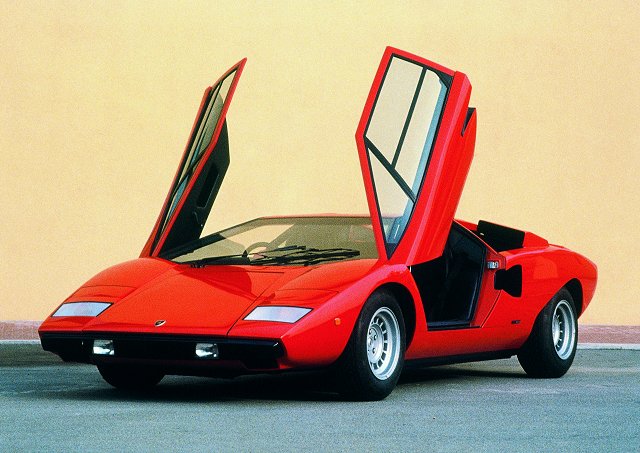
Next to the long production time itself, it’s impressive how well the new design held up (and still holds up if you’re lucky to see one!). If you remove the increasing amount of spoilers and skirts that were added over the years, the basic design of the car remained unchanged throughout the 16 years of production. I guess I wasn’t the only one who in my youth found things like the giant spoiler on some later cars ultra-cool, but looking back with (slightly) more mature eyes today, it’s pretty clear the the first iteration was the cleanest and best-looking. I’m not sure beautiful is the right word, but spectacular definitely is. The wedge shape, the side air intakes, the forward movement created by the cutting of the rear wheelarches – and of course the scissor doors. The doors did not only come about for show though, as given how wide the Countach is and especially how massive its doorsills are, fitting conventional doors would have been both unpractical and complicated. Owners of later Countaches with the dome on the engine are especially thankful for that given for them, sitting on the doorsill with the door open and turning your head backwards is the only way to have any kind of rear-view visibility. If the Countach was wide (almost 2 metres) with poor rear visibility, it certainly wasn’t long. At 4.15 metres it’s far smaller than you would imagine, and actually shorter than a Lotus Evora!

As long as your garage is high enough, you’ll never have issues getting in!

If the design was spectacular, the engine was of course not less so. The V12 came from the Miura and as shown in the first picture, had its origins back in 1963, having been designed by Giotto Bizzarrini, whom you can read an earlier post of here. Also as mentioned it was longitudinally mounted such as to improve notably weight distribution and solve some other issues, with the 5-speed manual transmission being placed in front of the engine. The initial Countach LP-400 had the same 3.9 litre volume as the Miura, with a power output of 375 hp. It was later increased first to 4.7 litres in the LP5000S in 1982, and then 5 litres in the LP5000 QV (Quattrovalvole, four valves per cylinder) version from 1985 with 440 hp. It’s noticeable that until the end in 1990, the engine retained carburettors when everyone else had switched to fuel injection (for emission reasons the Countaches going to the US had to be injected). Having originally been side-mounted, the carburettors moved to the top of the engine on later cars, explaining the dome over the engine. This wonderful machine would outlive the Countach over the Diablo all the way to the Murcielago, meaning a production time of almost 50 years! Contrary to what you would maybe think, it also has a reputation of not being very primadonna-like, but rather very reliable.

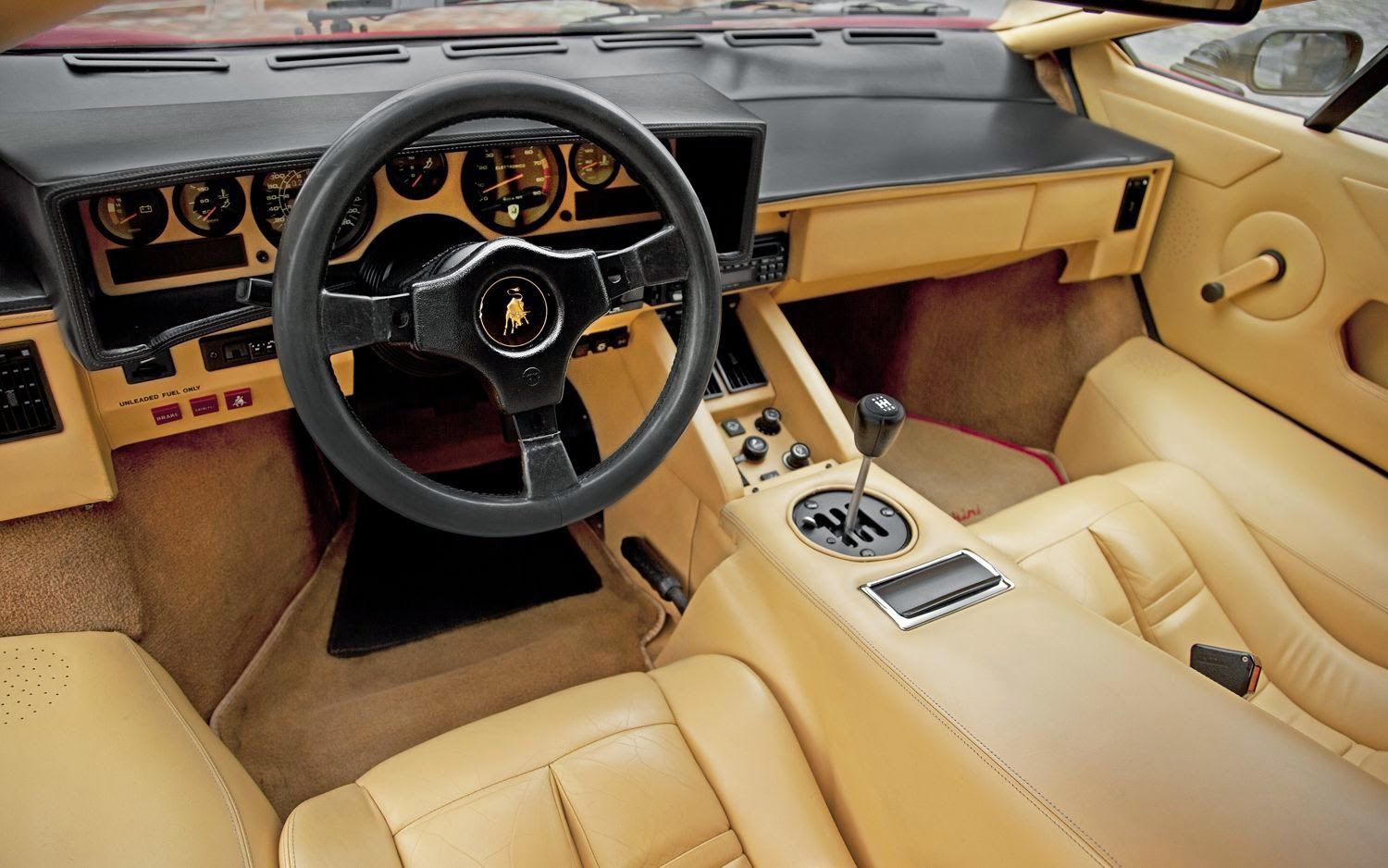
Except for in my dreams I’ve never been in a Countach, much less driven one, but this is very high on the bucket list (you wouldn’t happen to own one, would you?). I have however peaked in to several of them and as anyone who does so, you may not realize that the window you look through only opens 5cm or so, but definitely that the money had run out before the time had come to design the interior. Not that it’s worse than on many other 80’s cars but the grand plans Lambo had for notably digital instruments never materialized and the interior is thus very conventional compared to the spectacular body. The seats are however a wonder of comfort compared to modern bucket seats, but they can only be adjusted in length. If you’re taller than 180 cm you should also be prepared to have contact with the roof lining (here, the later cars helped, giving another 3cm of head space in the “high” versions). And when it comes to driving, taking it from multiple reviews, it’s all hard work with an unassisted steering, a heavy clutch (those six carburettors are partly to be thanked for that, but you can’t have it all!) and a general experience of needing to work hard to get the most out of the car. Then again, isn’t that the way it should be in a true supercar?

Initial plans for a singe-spoke, Citroën-style steering wheel were also dropped

Production of the Countach came to an end in 1990, with the 25th anniversary edition introduced in 1988 with a certain Horacio Pagani (on whom you can read more here) being responsible for a lot of the restyling. The final iteration wasn’t loved by everyone given it departed from some of the most classical design features on previous Countaches and had a bit too many skirts, even for the late 80’s. It was however the fastest version of the Countach, capable of a top speed of 295 km/h and a 0-100 km/h time of 4.7 seconds. Remember this is 30 years ago on a car that was equipped by 345 mm rear tires, however only 15″ in wheel size! At the time, those were the biggest tires on the market.

The Anniversary edition was also the most popular version in production numbers, built 657 times and thus making up a third of the total production of around 1970 Countachs ever built. That’s right, the most legendary supercar of all times was built less than 2.000 times, to be compared for example with the over 7.000 Testarossas (not counting the 512’s). Not only that, a third of all Countaches were sold when it had already been on the market for 14 years! Another third was made up of the Quattrovalvole version (610 cars), thus leaving just a third of the early Countachs. Good luck finding one of those today… The easiest one to find today is the QV with prices starting around EUR 300′, with real jewels going for up to EUR 700′. That’s a lot of money, and a lot more than you would have paid ten years ago. Having said that, it’s still a couple of million less that you would pay for the new 2022 version if you were on the list of the selected 112 owners, and seen in that light, probably one of the greatest bargains out there! Junior may have more power and features, but in the Countach world, there’s no doubt that Daddy still rules big time!