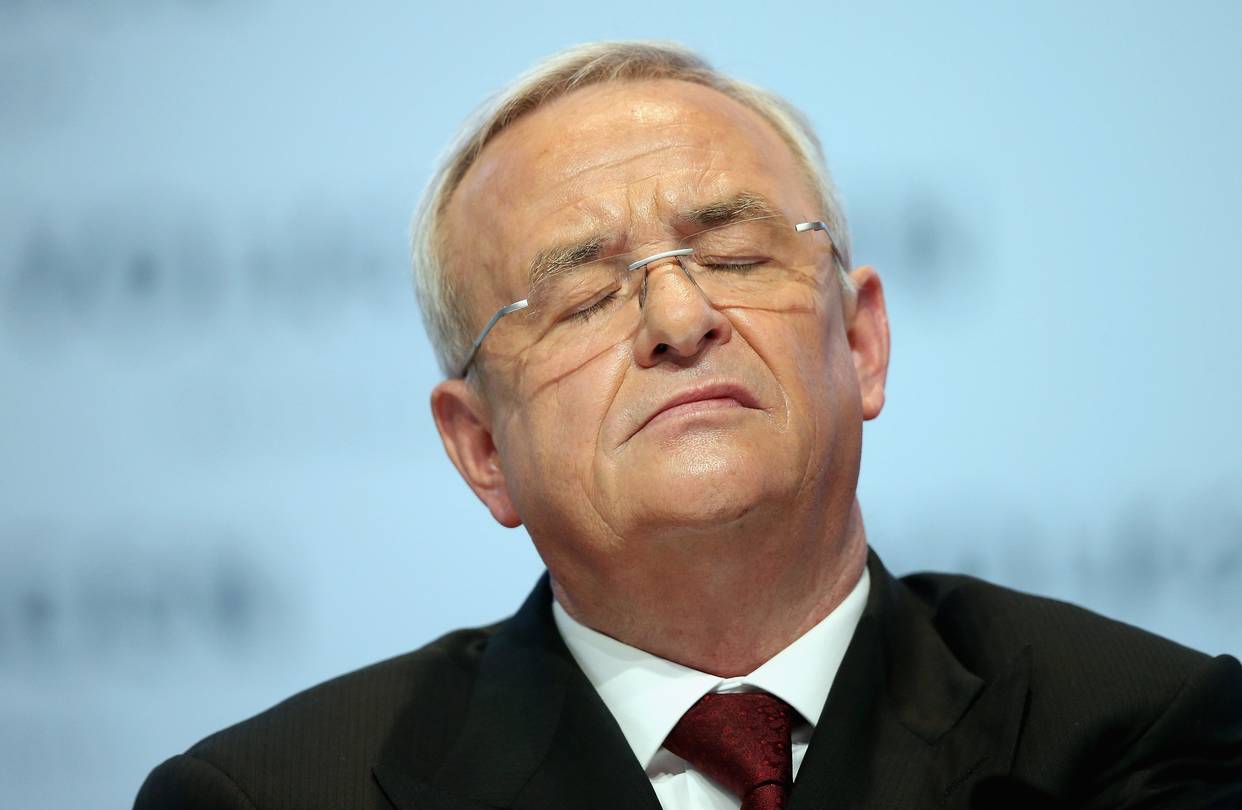
You remember Dieselgate? If not, it was the emissions scandal in 2015 when it emerged that Volkswagen, keen to sell more diesel cars in the US and doing so under the slogan “clean diesel”, had manipulated the software of several diesel engine types so that these produced less emissions only during test cycles, not in real life thereafter. It emerged that a total of 11 million cars with the same software had been sold in other regions as well, notably in Europe, and after a few months of management denying any knowledge of anything at all (What? Do we build cars??), the group’s chairman Martin Winterkorn had to resign.
Of course this was nowhere close to the first scandal in the car industry. To stay in modern times, just the year before, issues emerged around GM’s management after it had delayed a major recall regarding ignition switches which could lead to the engine turning off while driving. In 2009, Toyota scared the world as some of its cars accelerated unintentionally, which of course no one at management level knew anything about. And in 2016 and 2019, as if Dieselgate had never happened, Mitsubishi and Fiat Chrysler were caught violating emission regulations or lying about fuel consumption. The list goes on and on, and now it seems we’re there again. This time however, it’s the stock market darling that has been found with not one but both hands very deep in the battery p… sorry, cookie jar.

As Reuters uncovered a couple of weeks ago, since about 10 years, Tesla has been programming their cars to show rosy range projections and use these in their marketing. More precisely, the software was set to show a longer, unrealistic range until the battery was half depleted, and then to switch to a more realistic one. The result (and desired effect) was of course that customers bought cars believing they would have a longer range than they actually did. Many of them would then complain to Tesla and book an appointment to investigate the issue. In between the contact and the appointment however, Tesla would tell them they had performed a remote diagnostic on their car, that everything was fine with the battery, and that the appointment was therefore cancelled.
With time, the number of complaining customers apparently became so great so that Tesla created a separate team with the task of killing complaints by proceeding as described, something that saved Tesla around USD 1000 per cancelled appointment. Apparently it was common for the responsible team to sound xylophones and dance on their desks for every cancellation. Personally this reminds me of “The Wolf of Wall Street” which is an excellent movie, but perhaps not the culture the renewables’ hero company is meant to portray. In a test from April this year by the engineering organization SAE International, it was shown that most EV manufacturers lie about range, but none more so than Tesla, whose three tested cars in reality had a range that was on average 26% inferior to what was claimed. Ouch.

The range of an EV will vary with conditions, driving style and temperature, as will that of a combustion engine, however then mostly depending on driving style. This leads to the two important differences with EV’s we all know of: firstly, that low temperatures limit the EV range disproportionally (and this by the way also if the car is parked in the cold during for example your ski holiday, as a friend of mine discovered in the French Alps last year…). Secondly, the fact that charging, although slowly improving, is still not comparable to filling up at a petrol station, neither in speed, nor in availability. What Reuters uncovered however helps solve the mystery around Tesla’s superior range claims. As it turns out, it had little to do with more efficient battery integration as a consequence of internal battery production, and more with dirty business practices, not too far from Dieselgate. Who would have thought?
Staying on the electrification theme, one thing that has been noticeable in Europe this summer is an increased number of EV’s from Chinese brands. It seems these are making rapid progress in Europe, doubling their market share from 4 to 8% (as a group) of EV sales since 2021. The biggest brands include MG (yes, sorry to say it’s Chinese these days), BYD (short for Build Your Dreams, the second largest EV manufacturer globally after Tesla) and Lynk & Co (owned by Geely). My understanding is that of these, only BYD is present in the US, however building buses rather than selling cars. In Europe however, given none of these brands have any brand recognition, they sell on the only argument of being cheaper than Western EV’s. And now Western car executives are getting nervous, promising to offer cheaper their own, cheaper EV’s going forward.

This means that range numbers, real or invented, will not be improving in the coming years. You see, the costliest part of any EV is the massive, 400-600 kg battery pack. It’s also the most controversial, as I’ve illustrated on this blog with a focus on cobalt, but where you could say the same about many other materials as well. Many of the metals in current lithium-ion batteries will quickly become a scarce resource since we are nowhere near extracting the quantities required for the electrification of the world, especially since the green movement in their infinite wisdom do everything they can to stop any additional mining. This also leaves us at the mercy of great countries like China and Russia, where China already sits on the extraction of a lot of these resources, and something like 15 of the 18 major cobalt mines in the Congo. When metals get scarce, China will of course make sure their manufacturers are supplied first.

This bodes well for Chinese EV manufacturers, however given it takes decades to build a brand, they will keep selling on being cheaper for the foreseeable future, meaning keeping battery costs down. The way to do that is to substitute metals where possible, especially cobalt (horray!), against cheaper alternatives. Substitutes are however not as performing as metals used so far, meaning less stability and less range. Assuming Western manufacturers get their hands on enough metals to be part of the race at all, and that they indeed wish to build cheaper cars, they will obviously have to do the same. This will not change until we have some kind of technological revolution in batteries, which looks to be well beyond 2030.
The moral of the story is thus that EV builders are no more honest than traditional car manufacturers (if anyone really thought so), but also that Chinese EV’s will tend to make EV’s globally even less competitive. That they contribute nothing whatsoever to a cleaner planet is well known to those of you reading this blog regularly – otherwise please see here, here and here. In Germany, the MG ZS or Lynk pictured above are yours for EUR 35.000-40.000. They will take you something like 300 km, best case. The same money will buy you a VW Tiguan, equal in size, better in quality, with a modern, low emission petrol engine taking you twice as far and then needing five minutes to fill up. It’s also built in the West, not by underpaid workers without rights in a Communist dictatorship. Seems like a sensible choice to me!
 The Thrill of Driving