The sand pile is crumbling

If you’ve studied economics like me, the name Hyman Minsky may be familiar. He was an American economist who developed the financial stability theory, basically saying that stability breeds instability. Think of a sand pile: at some point, adding one more grain, although infinitely small in itself, will make the pile crumble. That’s more or less what we’re witnessing right now for the sand pile called “Ev’s for all”, crumbling far quicker than even I had imagined. I wasn’t planning to return to the topic anytime soon but sometimes events force your hand, and there’s just too much that’s happened in the last weeks and months not to take note of, as it is kind of important for the whole car world.

The starting point as I remember it was sometime back in February when two things happened. Mercedes boss Ola Källenius, roughly at the same time as presenting the stupidest EV of them all this side of the Hummber EV, the electric G-class, came out and said that electrification of the whole Mercedes fleet would take longer than expected. That’s of course another way of saying that demand is lacking. Mercedes have pushed the date for the last combustion engine forward from 2030 to 2035, where it most certainly won’t stay.

Time will tell, but this could go down as the symbol of when the tide turned…

Roughly at the same time, the FT ran an article on Lucid Motors, where Lucid boss Peter Rawlinson said that his company cannot rely on “bottomless wealth” from its 60% Saudi owners. In other words, the sheiks in the country of many sand piles are thinking of turning off the tap, if they haven’t done so already. Lucid has close to USD 5bn in the bank but is currently burning USD 1bn per quarter and lost close to USD 3bn in 2023. Given they’re not close to making a profit anytime soon, they will thus need to fundraise again before the end of the year to survive. In the current market, I wish them luck.

Luck is also what Rivian still needs, and this one hurts a bit more since I find it a really innovative company that have brought something new to the market, and have plans for continuing to do so in the future as well. A friend of mine drives the Rivian SUV and is thrilled about the car, its features and gadgets. However given a lack of Rivian car buyers, the company urgently needs to save money and announced in March that production has been paused in their new factory in Georgia and that instead, they will fall back on their old production plant which is cheaper to run. And whilst we’re on SUV’s, if anyone is curious about Fisker, they’re so close to the brink that they can go belly up at any point in time, and contrary to Rivian, the SUV called Ocean they’ve launched is crap in most testers’ view.

A small opening side window in the back is the only attraction of the Ocean. Literally.

Moving on to the EV wannabes, Porsche is making all kinds of strange sounds around the all-electric new Macan. The idea was that the combustion one would be taken out of production in 2025-2026, and the all new E-Macan, launched as we speak, would then fully replace it. Now, the talk is of not replacing the ICE one until 2030. The issue for Porsche is that the new Macan is built as an EV from the first screw, meaning it’s not made for a combustion engine. Therefore, it’s most probably the old Macan that will be updated such as to live a bit longer. That’s certainly very far from what Porsche, blinded by the general EV trend, originally intended. It’s really terrible when client demand isn’t where you want it to be.

To round it all off, even the king of the hill Tesla has come down the hill, at least a bit. Firstly in stock price, where it’s down about 1/3 this year, making it by far the worst performer of the so called Magnificent Seven. That said, it’s still worth more than twice what Toyota is. Then there’s production numbers, where Tesla not only ships less cars than a year ago, but also produced around 70′ less cars in the first quarter than analysts were counting on. Tesla has also lost around 1/3 of its market share in the all-important Chinese market, falling from 10.5% to around 7% as per the Chinese Passenger Car Association, all due to the intense Chinese competition discussed in earlier posts.
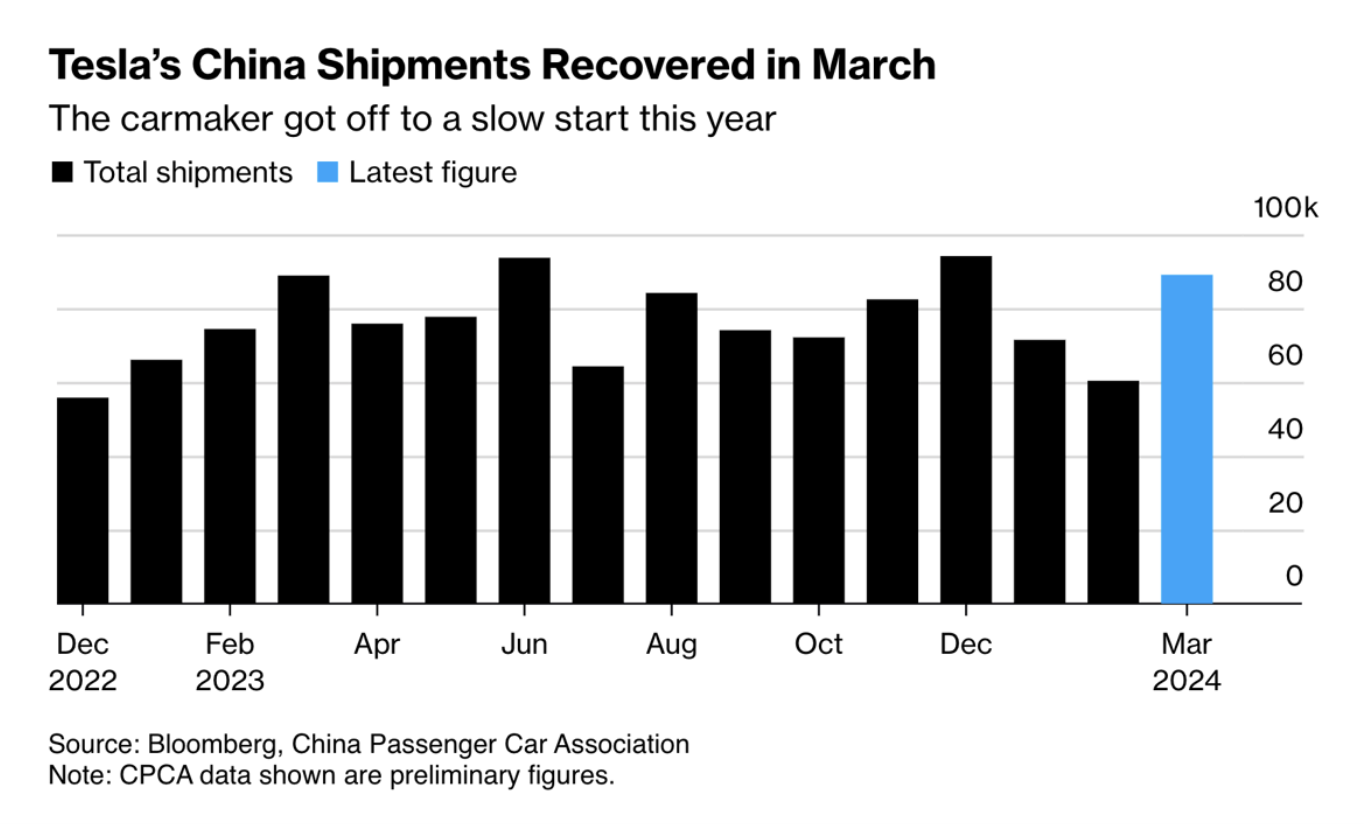
As the headline says, things improved in March, let’s see if it’s the start of a new trend.

You’ll note that all of this has to do with falling client demand, and nothing has to do with the other fundamental EV issues, such as not even being close to having enough metals and related stuff to produce the EV’s our politicians plan for, and that the battery production with all its required input materials is both highly polluting and highly unethical. That comes on top of the waning demand, and as Ineos’ founder Jim Rathcliffe says, you can’t force EV’s down people’s throat – although I’m sure at least some politicians will try.

I yelled at European luxury automakers pathetic efforts to build competitive EV’s a few weeks ago, and also said the cheap part of the market risks being taken over by Chinese EV’s. That’s exactly what’s happening, and in addition, growth has stalled in the developed world for all the reasons we’ve already gone into. A challenging capital raising environment means that many of the new EV brands risk going under, and (especially European) politicians who are still incapable of delivering a charging network commensurate to the growth they want to see have done the rest. I’d say they should take most of the blame.

At the same time, I was surprised earlier this week to see the Biden Administration’s projection for what the US car market will look like in 2050. As can be seen above, EV’s aren’t expected to take over anytime soon, although they are projected to grow quite a lot. Hybrids continue to grow too, which we’ve been discussing here, and what for example Toyota has said all along. Most people drive short distances, and thus splitting a big battery pack in one car into five smaller packs in five cars makes most sense when materials are limited. Anyhow, by 2050, 2/3 of all cars are still expected to be what should be called combustion engine cars, since by then, I’m willing to bet we’ll have other stuff than fossil fuels to power combustion engines with, which also means they may be around for far longer than anticipated.

If you really want an EV, then as I’ve said before, there really is no better alternative than a Tesla, pretty much wherever you live. But if you don’t, be aware you’re part of a growing crowd and that your petrol car will be fine for years to come. As I was finishing this post, I saw the news that the European car safety organization Euro NCAP has come out with new rules, requiring a car’s essential functions to be handled by physical buttons, not over a screen, for a car to get the maximum five safety stars starting in 2026. Trying to sell a car in Europe that has less than five safety stars is all but impossible, so this will obviously cause further pain for many, especially most EV manufacturers. If we keep going at this pace, the future starts looking really bright!

Airy 1300 hp dreams!

It was certainly not a surprise that after our week in western Florida and the car reflections that came to me on the beach, New York would be vastly different. Still, I had to laugh to myself directly after landing, realizing I had just complimented our American friends on their civilized way of driving and was now about to die in a taxi from Newark airport, driven by a constantly honking maniac in a way only a maniac can drive a car. Let’s call it a return to reality… There’s no doubt Florida is more laid back than NY not only driving-wise but that said, it was great to see NYC back to its old, pre-Covid form!

We spent most of our days walking around Manhattan, and it was in the nowadays very pleasant Meatpacking District that we came upon the new Lucid showroom. We went in and talked to the very friendly Johan from Lucid, whom I guess I shouldn’t refer to as a sales guy since some strange American regulation makes a difference between shops and showrooms and prevents personnel in the latter from disclosing prices of cars shown. Having said that, Johan knew all there was to know about the Lucid Air, setting him apart from a number of other car showrooms and even shops around the world. We thus had a great discussion which brought me back to what I wrote last week about the greater freedom in EV design potentially replacing 700 hp V8 engines as the differentiator going forward. Lucid is not what I was thinking of when doing so, but I would claim the Air is a step in the right direction, and no doubt a very impressive one!

The Air in the Meatpacking district showroom

Lucid Motors was started in 2007 in California under the name Atieva as a 20-employee battery company. Today’s CEO Peter Rawlinson joined the company as CTO in 2013, having before that worked as lead engineer for the Model S at Tesla, and before that for Jaguar and Lotus but also for the legendary Porsche tuner Ruf. Rawlinson’s vision was to build the best EV in the world and thereby the first real luxury car in the segment. Before listing Lucid on Nasdaq through a SPAC deal in 2021, the company notably secured financing from the Saudi Public Investment Fund, and its good capitalization no doubt has helped the company bridge the various supply delays it together with other car makers have had in the last year. As I write this, Johan told me they have delivered about 3.000 cars and are ramping up production. Being mostly US-focused so far, plans for Europe have been delayed, but Lucid will launch in a number of European countries in the coming months, including Germany (where there is already a showroom in Munich), Switzerland, Norway, Denmark and the Netherlands..

So what is the Air? The slightly philosophical answer to that is that it’s the kind of car that can only come out of a company that hasn’t built cars along certain routines and principles for a number of decades, and also not from a company with a larger-than-life man at the top who by principle insists on fitting something like falcon doors to a car, even if it delays it by two years and then still doesn’t work when it reaches the market (I know I’m incredible subtle here so just to clarify, I’m referring to the Tesla Model X). The Air takes a new approach and shows a new way of thinking, not only in how it looks but also in the thinking that has gone into it. Rawlinson claims the only principle that steered the team in the development was to build the best EV in the world and having everyone committed to that goal, letting all the underlying pieces contributing to the single goal.

It really looks like nothing else seen from the side…

Size-wise the Air is comparable to a Mercedes E-class on the outside, but with an interior space on S-class level. It looks good but I would not call it beautiful. It is however definitely different, especially over the passenger space between the A- and C-pillars. The Cw-wind resistance factor at 0.21 is of course excellent, and the front booth / frunk space is huge at 280 litres, apparently the biggest in the industry. It may look like a hatchback but the rear booth is conventional, being very deep but also quite low, in a Citroën CX-kind of way. That’s a shame since it makes it difficult for those of us with needs for dog cages or other bulkier stuff, and at least from the outside, it looks like the decision not to go for a hatchback design was not because they couldn’t but rather because they didn’t want to.

The real revelation however comes when you step in to the car and are met with an interior that is far beyond anything in any other EV (very much including cars like the Merc EQS). Under the glass roof that reaches over the full passenger space, Lucid has built an interior mixing leather with textile and wood. It looks and feels very much like the premium car it aspires to be, and does so all the way through and not like for example the mentioned EQS where the lower half of the interior is mostly cheap plastic. It’s a clean, nice design, with all the different screens you have nicely integrated. The glass roof gives a very airy (…) feel, and the leg space in the rear is larger than in most limos, with as only drawback that you can’t fit your feet under the front seats. By the way, the rear seats are in a different color than the front, a neat little design trick I think we’ll see more of. I wasn’t able to test he functionality of all this but the screens interact nicely with each other, and there’s also quite a few functions that can be operated over physical buttons.

The small screen left of the steering wheel reminds of the new Escalade

The Air comes in different equipment versions and also with one or two engines, which is one part of the Lucid magic. At less than 100 kgs and fitting into an airplane carry-on suitcase, not only are these engines smaller and lighter than anything on the market, they are also more powerful. One engine produces 670 hp (meaning that the top version “Dream” has 1300 hp…) and is thereby more than 100 hp stronger than a Taycan engine which is twice as heavy. The battery pack is the second part of the “secret sauce”. Lucid uses cells from LG but develops the pack internally and has managed notably to reduce resistance and thereby power loss through heat. This gives the Air around a 500-mile range, and Johan was very relaxed about this actually being for real even in less-than-ideal conditions. If true, it means that Lucid would set a new range standard. Peter Rawlinson however prefers to talk about charging speed, believing it to be more important than range as it ultimately makes cars with less max range acceptable. And less range means lighter, cheaper, and hereby also sportier cars (remember Rawlinson used to work at Lotus?) Anyway, in Europe Lucid uses the same CCS-system as the German manufacturers and the car can in ideal conditions charge at up to 300 kW, meaning 300 miles in 20 minutes. Prices for dual engine cars will probably start around EUR 150′ which would make it more expensive than a Model S Plaid, but cheaper than a Mercedes EQS.

Will two-tone interiors become the new trend?

I really wish Lucid well, not only because they’ve put together a good car but also because it feels like the next step in the evolution of EV’s, and the first EV I’ve ever really wanted to put in my garage. Of course you need to drive a car before giving any kind of final verdict, but I’m kind of relaxed about it since on one hand tests confirm that it drives well, even very well compared to other EV’s (and that assessment came from none less than Evo!). And on the other, as discussed a bit last week, beyond pushing the pedal to the metal an reaching 100 km/h in 2-3 seconds a few times, which is no doubt a big thrill, neither Lucid nor any other EV will ever bring the excitement through the driving experience. They need to do so differently, and the Lucid air is a good step in that direction!