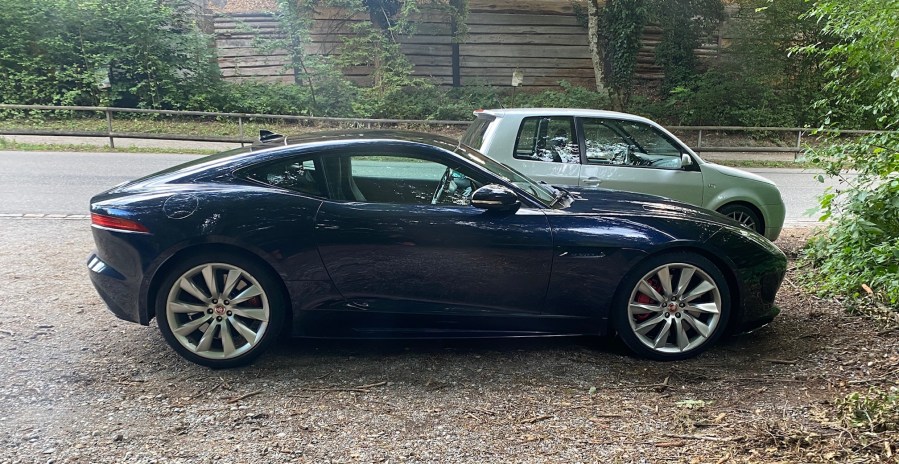
The first street find in a while is actually more a forest find, pictured above next to my son’s Lupo GTI that I used earlier this week for the drive to the local exercise trail. It was when I came back from my run that I saw the F-Type from the angle depicted. Looking at it from the side, I was struck by how nicely the lines flow, something I hadn’t noticed before (my temporary lack of oxygene may have contributed to the revelation moment…). An F-Type isn’t that rare but it’s also not something you see everyday, and given it has its 10-year anniversary this year, I thought we’d have a closer look at the car that was Jaguar’s first two-seater in 50 years!
When the F-type was presented in 2013, it was about 30 years after Jaguar had recognized the need for a replacement for the quickly aging, and by then too big XJ-S, that I wrote about three years ago. Two prototypes were thus developed already in the early 80’s, but then Jaguar was taken over by Ford a few years later, meaning plans and priorities changed. The prototypes instead became the Aston Martin DB9 and Jaguar XK8, which however, at least in theory, are four-seaters. Various other events, notably Jaguar’s decision to enter Formula 1, meant that they F-Type wasn’t shown to the world until 2013, and was then presented as the “spiritual successor” to the legendary E-Type.
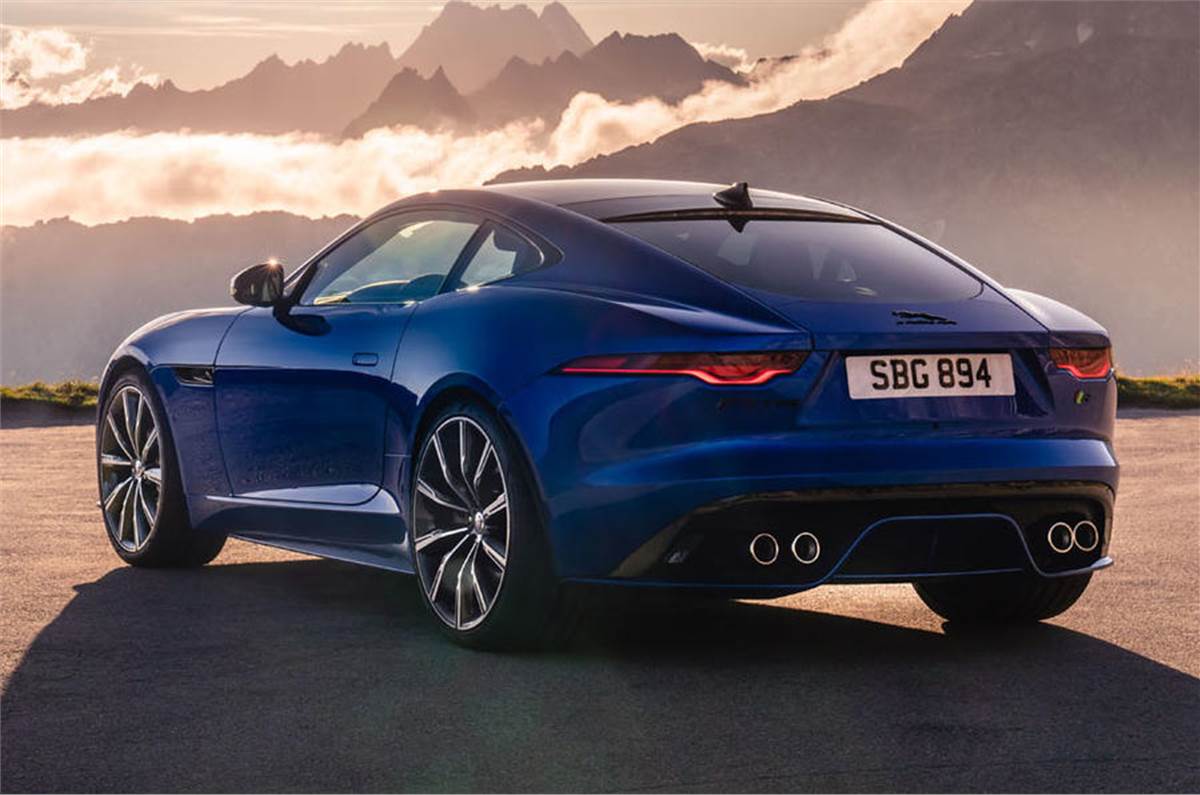
Built since 10 years by now, it’s clear that apart from having only two seats, there’s not much the E- and F-types have in common, although the rear of the coupé does bear a certain resemblance to its predecessor. To me the coupé is also the one to go for since it looks far better than the convertible. Designer Ian Callum produced a very well-proportioned and good-looking sports car seen from the side and the rear, with the front being a bit too anonymous. The convertible was launched a few months ahead of the coupé in 2013, and both versions received a face lift in 2020 that notably improves the front.

The inside is well in line with the F-type’s natural role as a GT car, and anyone familiar with Land Rover and Jaguar interiors from this period will quickly find their mark. Engine-wise, these days the range starts with a 2-litre, 4-cylinder engine with 300 hp, in line with the general trend of less somehow being more. When the car was launched though, it was with two versions of a 3-litre, straight six or alternatively, with the well-known Jaguar/Land Rover 5-litre V8. The V6 versions could be had with a six speed manual rather than the more common 8-speed automatic box, and the stronger version was also available with all-wheel, rather than rear-wheel drive.
At 340 and 380 hp, the strongest six-cylinder was 115 horses down on the V8 (at 495 hp) at launch. It was also slightly, but only sightly less loud. Because if there’s one thing the F-type has in common with the E-type after all, it’s the very loud engine, or rather exhaust sound. With the V8 under the hood, forget all about sneaking away early in the morning without waking up the neighbors…

This is obviously the same engine I have in my Range, where it’s however so discreet that you sometimes wish they would have allowed for slightly more exhaust noise to come through. The F-Type is in other words a nice testament to the power of a good exhaust! If however nothing’s too loud for you, then be aware there’s also an SVR version of the F-Type, adding another 80 hp to a total of 575 hp and producing even better cornering speeds. In any case, power and sound will be plentiful!
Even if the F-type won’t reach the legendary status of the E-type, the good-looking and driving-wise, well-balanced and well behaving two-seater is quite popular, with second-hand values holding up pretty well. That it appeals to other buyers than those wanting a complement to the family Discovery was clearly shown a few years after the launch, at which point 75% of all F-Type buyers came from other car brands.

Well-maintained coupés and convertibles trade between EUR 35-50.000 in Europe depending on mileage, the face-lift version will start at about 10.000 more for the 300 hp, two-litre version. If you’re more into nice weekend cruises than track days and can’t withstand a roaring engine, the F-type is probably a good alternative – and one that requires for less maintenance than its “spiritual predecessor”!
 The Thrill of Driving
Pingback: Closing out 2023… – The Thrill of Driving