
Most things don’t change drastically from one moment to the other, but rather by small increments happening continuously. Taking separately you don’t notice them, but taken together, in the end they make a big difference. Money, or rather means of payment, are a good example: at first, we all had cash. Then, credit card adoption in Europe was good up north and bad in the south (and nowhere as bad as in Germany, in the middle…), but only for larger purchases. Then in the last years with Covid, cards became widely adopted so that today, you can use them for every purchase. Seen in total, in perhaps 10 years, we’ve thus gone carrying a bulky wallet with cash and cards to carrying nothing but a phone on which your cards are stored, since in between, someone invented the card tap function as well.

As it turns out, my hunt for a small city car to use at our place on the Riviera is illustrating the described sequence of incremental changes quite nicely. Our cars may still be powered (in majority) by internal combustion engines, but pretty much everything else about them has evolved in so many small steps over the last 20 years so that if you landed from another planet today, you’d hardly think it’s the same technology anywhere on the four wheels.
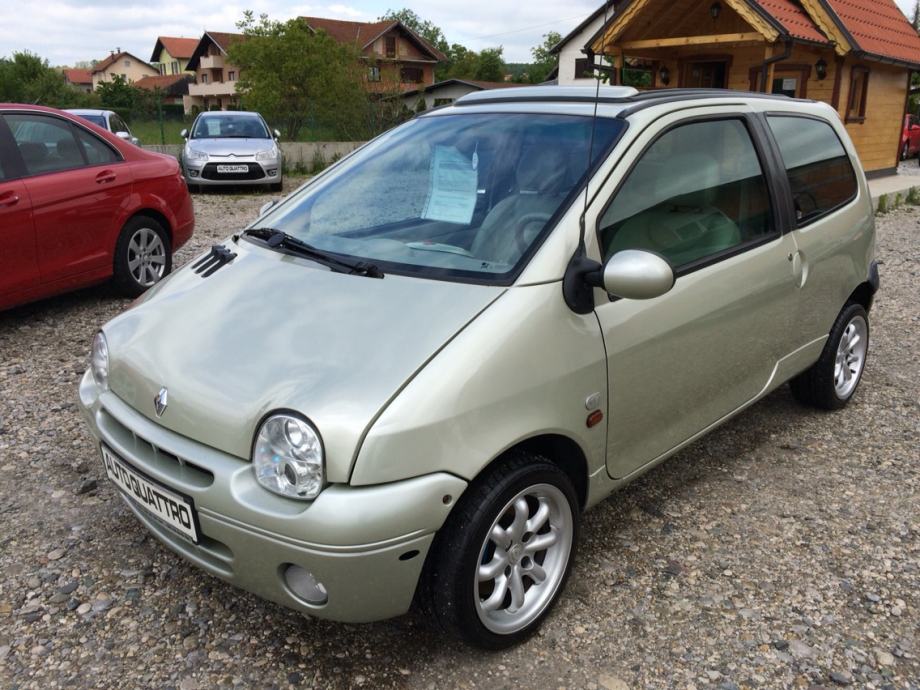
Staying true to my own brief of finding something small (such as to be easy to park), cheap (both to buy and run) not too attractive (such as not to be stolen) and preferrably French (as it seems appropriate) had me circle in, over the last weeks, on the Renault Twingo – a legendary French city car that most Americans have never seen, but which is a perfect representative of the segment. Without going into details, it hits the above described brief bang on, and in addition, has a back seat you can move forward and backwards such as to give more space for luggage (a world first when it was presented!) and on some versions, a very cool canvas, or glass sunroof.

The first series of the Twingo was built from the early 90’s to 2006 in a more or less unchanged shape, with two engine options: there is the 1.2 litre, 58hp base engine, from 2000 complemented by the 75 hp, 16v version. Except for the above equipment, it also came with an optional four-speed auto box. 30 years later, Mk 1 Twingos have become not only old but also cheap, however not dirt cheap, and seemingly trending somewhat upwards, given they’re also slowly but surely becoming scarce. This of course gave me a familiar tingling – maybe this wasn’t just a cheap car, but also a bit of an investment? All this led to quite a fanatic search for good Twingos in the last weeks, and to me testing out a couple of them – a 60 hp manual, and a 75 hp automatic, both in the (for this project) highly attractive price range of EUR 3.000-4.000.
Starting with the positives, both cars started at the first turn, although they’d clearly been standing for quite a while – I guess the collectors’ market hasn’t really taken off just yet. Opening the door, the first thing you notice is the excellent visibility, with large windows in all directions, making you wonder why we felt a need to increase the size of body panels at the detriment of glass areas of modern cars? I sat down in the surprisingly high chair and set off on a test ride in the 60 hp, manual car.

58 hp, of which at least some have certainly found other pastures in the last 20 years (the car was a 2002 model) certainly doesn’t make it fast in any way, but weighing in at 800-900 kg meant it still felt fine. The A/C was cooling as it should and the manual box was ok. Less ok were the breaks, since every time I hit them it felt like the front wheels would fall off. They didn’t, and the seller assured me this was only because the car had been standing for a long time. Right.
The 75 hp version was better equipped, with a power-operated glass roof and leather seats – as luxurious as it gets in a first series Twingo! As part of the luxury package it also had the automatic gearbox, which quite effectlvely ate up all of those extra 15 hp, and then some. It literally took 2-3 seconds to switch gears and in the process, the box made sure most of the power was lost. Given the inefficiency of the gearbox you really didn’t need the brakes that much but they were anyway ok although a bit soft, although this car had been standing just as long as the other one.
As I sat there on a too high mounted seat, turning the steering wheel the five turns it felt like it needed from left to right, and trying to locate where all the noises that shouldn’t be there came from, it struck me that I haven’t been active in this part of the market for, well, many years, and that you can’t expect too much. However, what also struck me is how old the cars felt. The whole build, the missing isolation, the terrible auto box, the powerless breaks. As someone born in the early 70’s, I still think of things from the 00’s as relatively recent (sounds familiar?), but the Twingo just proved that they aren’t – and by extension, that I’m old.
Some readers may now want to remind me that I used to be the owner of a TR4 Triumph that was much older than the Twingo, built in -65. But that’s precisely the point: with an oldtimer, you marvel at how engineers and workmen managed to build something so great so long ago. But a 20-year old car is not an oldtimer, it’s something you instinctively compare to a modern car, and then understand it isn’t. And by the way, my TR4 drove far better than any of those two Twingos!

All this means that the search will be a bit longer than I had initially imagined, and will most probably go through a number of small, incremental changes before we end up with something that, if I listen to my inner voice, will probably be a bit more modern, a bit more powerful, and a bit more expensive. I guess that corresponds to the general evolution of over the last decades. However, cars haven’t just evolved, they’ve also become better – much better. The question is of course, 20 years from now, if we conclude the same thing again? If history is any guide, that’s highly probable!
 The Thrill of Driving
Hi Christopher, as mentioned I am an avid reader of your blog and had to smile reading your piece on the Twingo ater we met up in a city that is full of supercars (and people who don‘t know how to drive them in Monaco last week. Keep up the blog please, I like it!
Cheers
John
Hey John, thanks! Was great seeing you after all these years. I’ll do my best to keep it up! Take care, C