The timeless land shark from Zuffenhausen!

Very few people would object to the statement that the Porsche 911 is the most successful sports car of all time – and they would be wrong. That said, and in spite of that, it’s also a car that Porsche tried to kill off at least 911 times before it earned the unshakable position it has today. It started all the way back in the mid-70’s, when the newly developed 928 was supposed to replace the already then ageing 911.

As we all know, replacing the 911 didn’t work then, it hasn’t worked since, and it’s improbable to work in the foreseeable future. Today we’re glad that Porsche failed and be that as it may, the 928 became a great complement to the 911 when it was launched, as the GT car it really is. Fast forward to today, and it remains a great car and something you could still call a bargain, especially in comparison to classsic 911’s.

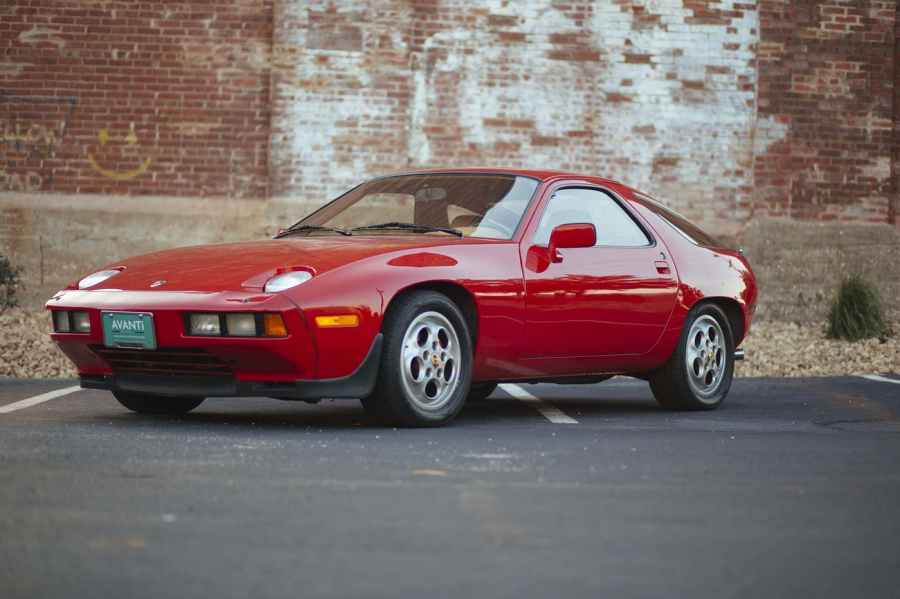
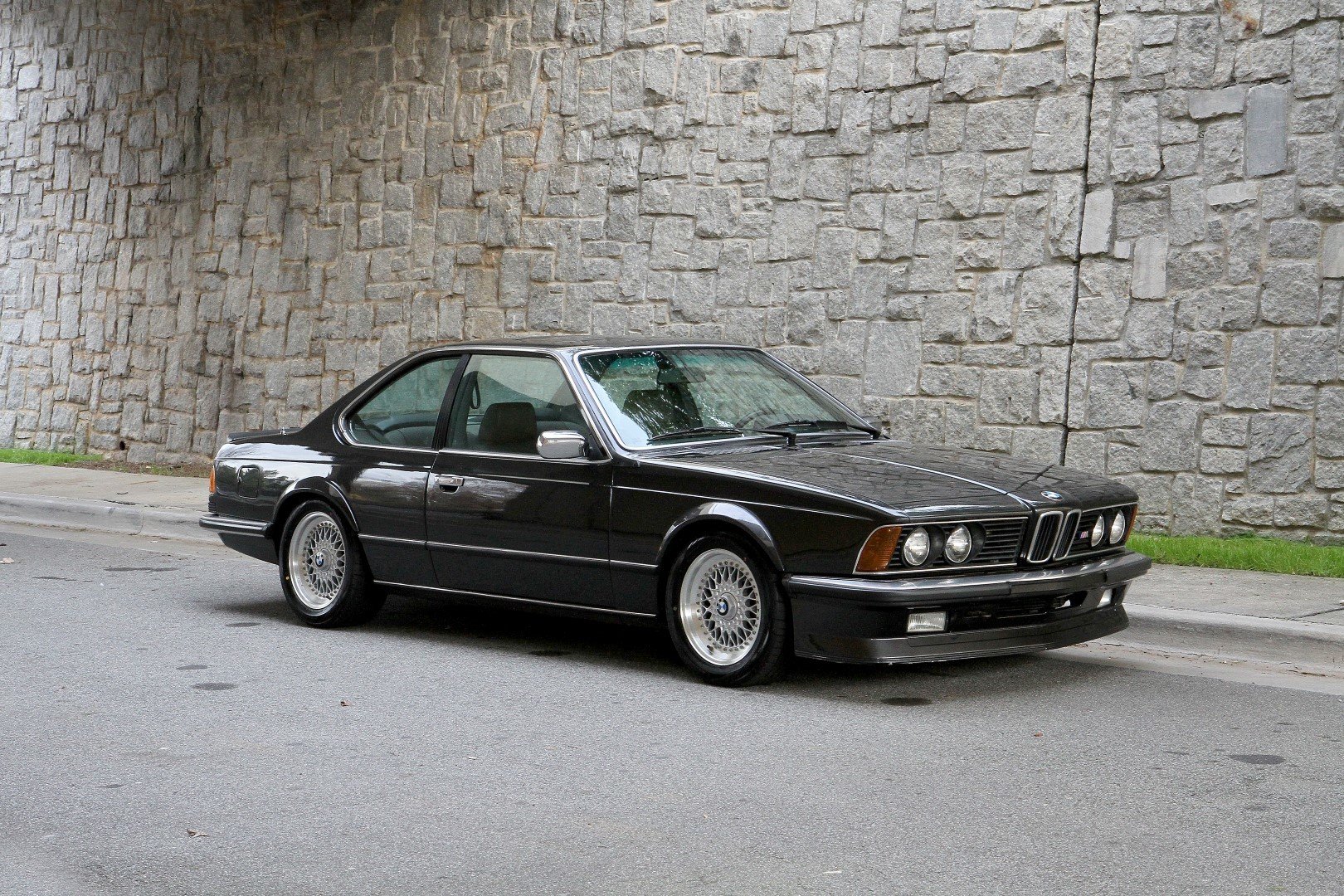
The general 928 shape remained largely unchanged from 1977 (as here) until the end in 1995

Design is a matter of personal taste, but unless you’re heavily into psychedelics, you’ll probably agree that the 70’s weren’t a happy period. The world was mostly brown and orange and cars generally looked like they’d been drawn with a ruler by someone loving 90-degree angles. When it was launched in 1977, the 928 was therefore a true revolution design-wise. The long hood and the “reversed” pop-up headlights earned it the nickname “land shark” in some countries, and the rounded rear with integrated shock absorbers doesn’t look dated to this day. To my mind, the 928 is probably the 70’s car desugb that has best stood the test of time. This was also proven by the production which ran for almost 20 years until 1995, with most of the design remaining pretty much unchanged until the end.

Coming back to where we started, it’s however difficult to see how Porsche actually thought that fans of the air-cooled, rear-engined 911 would ever consider the 928 as a replacement. Firstly it was obviously a larger car, even if it’s better described as a 2+2 seater than a real four-seater. Secondly it has quite a large boot, meaning the engine is up front. Thirdly, that engine was a newly developed, water-cooled V8 rather than a legendary, air-cooled six-cylinder. This led to the 928 being heavier, much more at home on the Autobahn than on curvy mountain roads. To this day, it remains a true motorway cruiser that sat nicely alongside a 911 at the time, although it never saw its success its smaller brother did.

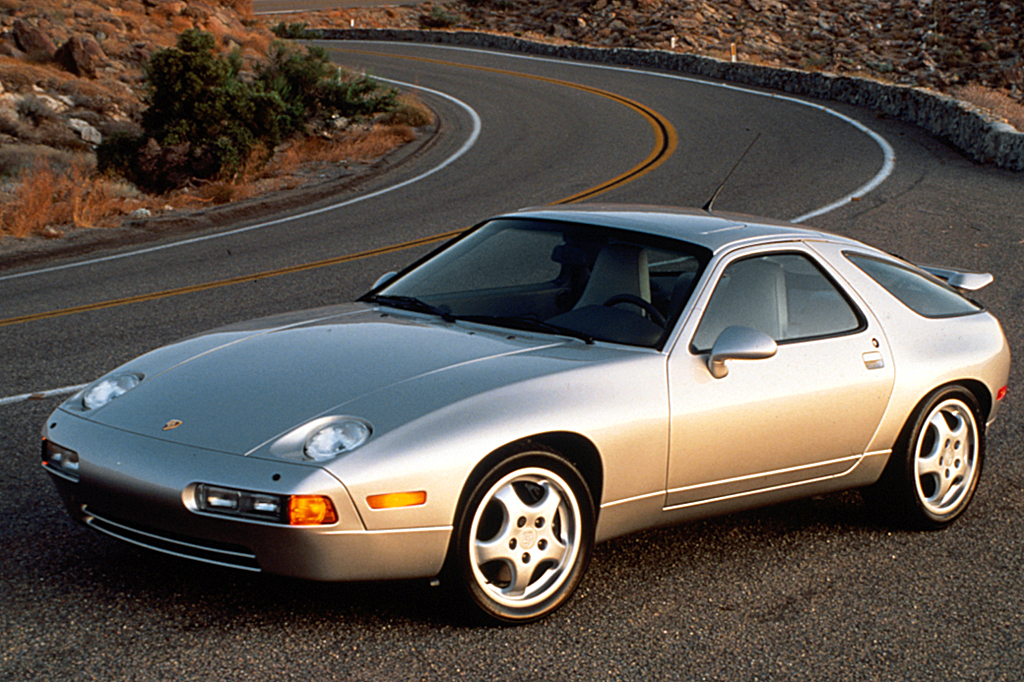
The “phone dial” wheels are sought after today – here on a 928S, distinguishable by the rear spoiler

There was no getting around the 928 being a heavier car than the 911, but Porsche were very focused on doing what they could to keep its weight down. The doors, front aisles and hood are thus all made out of aluminium, and the front and rear bumpers were in composite material around a metal core. The original, 4.5 litre V8 with 240 hp was at the time the second most powerful engine from Zuffenhausen, losing out only to the 911 Turbo, and the 928 was thus well motorized from the beginning, helping offset the additional weight. It was available with either a 5-speed manual or a 3-speed automatic from Mercedes (later a 4-speed) from the start, mounted on the rear axle and thus contributing to the excellent balance.

The 928 was generally an advanced construction with notably double wishbone suspension all around and Porsche’s so called “Weissach axle” in the back of which I’ll spare you the technicalities but which can be described as a system for greater stability and less oversteer. That system was certainly never fitted to the 911’s of the time, and even 911 fans would probably agree that the 928 was in many areas far ahead of not only the 911, but of most other cars from the same period as well.

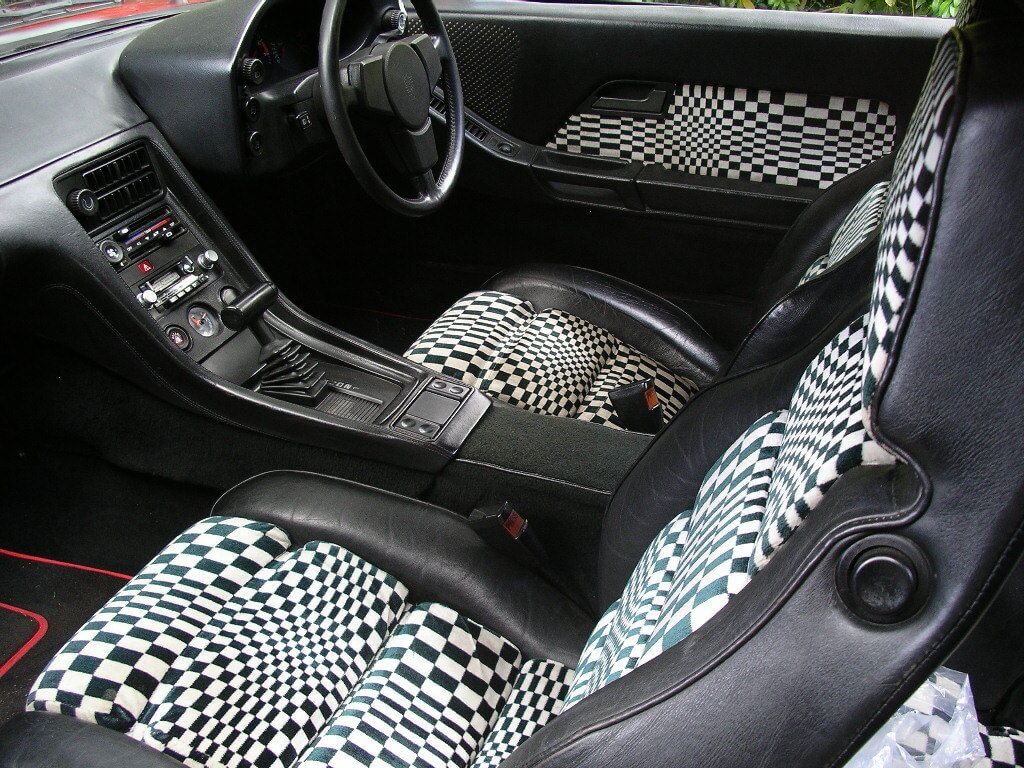
…as is the psychedelic, pepita square interior offered on the first series!
The first series was built between 1977-1982, with the 300 hp 928S launched as a more powerful version in 1980, and a couple of years later becoming the only available version. The S managed the sprint to 100 km/h in 6.6 seconds, a very respectable time in the early 80’s. It was also the car Porsche ran for 24 hours non-stop on the Nardo track in Italy, achieving an average speed of 250 km/h! Think of that a minute – we’re talking 24 hours with the pedal to the metal at top speed, back in the fully mechanical age! Porsche kept improving the S interior and equipment with notably ABS breaking, before it was replaced by the face-lifted 928 S4 in 1987.

The 928 S4 had a face-lifted body, best visible in the rear through new lights and a standard-fitted wing. Engine-wise it went form two to four valves and an output of 320 hp. The 0-100 km/h time was now sub-six seconds with a top speed of 270 km/h. The even sportier GT was introduced in 1989, adding another 10hp and only being available as a five-speed manual. Both versions were replaced by the 350 hp GTS in 1992, produced until 1995 and actually Porsche’s last GT car until the Panamera 15 years later. Over its full lifetime, a bit more than 62.000 928’s were built. Not a huge but still quite a large number, and in that sense it’s surprising how few of them you see on the roads today.

The rear part of the S4 shows where the Panamera inspiration came from!

Unless you’re not a die-hard, nothing-but-911 kind of person, a 928 will deliver the true Porsche feeling from behind the wheel. The engine is like a solid companion at all speeds, especially in combination with the manual box. The suspension is superb given the car’s age, but It’s clear from the first meters you drive that although smaller than modern cars and in spite of all the Porsche attributes, this is a true GT that is most at home on long distances with two (or 2+2) passengers and surprisingly, quite a lot of their luggage. On such trips, it will also surprise on the upside not only by its comfort, but also its lack of wind noise, one of the advantages of the soap-like design.

When writing about classics, I usually add a sentence along the lines of “make sure you check the history and the condition”. Never ever has that sentence been more true than if you consider a 928. As mentioned, the car is a complex construction. Parts have always been expensive and haven’t become less so today, only in some cases harder to find. The engine and gearbox are of course the most critical parts and inspecting the car from underneath before the purhcase is mandatory. If you’re unsure about what to look for, get a specialist to help you or take it to a Porsche garage. Trust me on this but also know that even if you go through all the checks, you shouldn’t buy a 928 with your last money, but rather keep a reserve for things that may come up.

As in late 944’s, the 928 interior has stood the test of time surprisingly well

So which one? Well, no surprise that a manual is preferrable, but the automatic is actually not as bad as you may think, so potentially try it if the rest of the car is good. Do get a four-peed automatic though. Design-wise it’s a matter of taste between the first and second generation, but be aware that the two-valve engine is easier (and thereby cheaper) to service than the four-valve from the S4 onwards. If that doesn’t scare you, the 928 GT of which only around 2000 were built is especially interesting. Otherwise, the 300 hp second series is also a good choice. Please don’t go for the Strosek or Gemballa 80’s versions with massive plastic wings, but rather try to find a car that is as original as possible. For the first series, both the phone dial wheels and the pepita interior you can see higher up are sought after today.

A good first series 928 will set you back around EUR 25-35.000, probably around 50% more than 10 years ago (but you’ve hopefully gotten richer in those 10 years as well!), however not much more than a few years ago, as values seem to have stabilized. The second series will typically cost around EUR 10.000 more with the GT and GTS potentially even more for low-mileage cars. High kilometres need not be a problem though, if the car has a solid and well documented history – but only then.

In terms of value for money, this means that you still get one of the best GT’s ever built for less than half of a classic 911, and no more than a third of what a power-wise more comparable 911 Turbo from the same period would cost. That my friends not only makes this a bargain among Porsche classics, it does so among classic GT cars in general as well!

Yes, design is personal, but no one can really fault the 928, can they?

Mon Dieu what a collection!

I’m currently enjoying a bit of vacation in the south of France, and the other day we went into Nice to explore the area around the port. A lot has happened in the city in the last 10 years, transforming it from a place that at least in some areas was quite rough in my youth, to the delightful city it’s become today.

A lot of the improvements have come with a new tramline system that provide an excellent alternative to car driving in the city itself. And with less people driving, some lanes have been converted to bike lanes, trees have been planted, and it all looks much nicer than before. It proves the point that as long as there are good alternatives, most of us are happy not to drive around in city centers – but the alternatives need to be in place first, which is a point a lot of politicians seem to struggle with.

The tram line running all the way to the airport to the west of the city starts in the port area in the easternmost part. This is maybe the part of Nice that has seen most improvements over the last years, and it was while exploring the streets on the east side of the port that we stumbled upon a small alley with a garage at the end. And the garage had a few interesting cars up front, making it worthy of a closer look.

A Daytona convertible next to an F355 – and this was just the beginning…

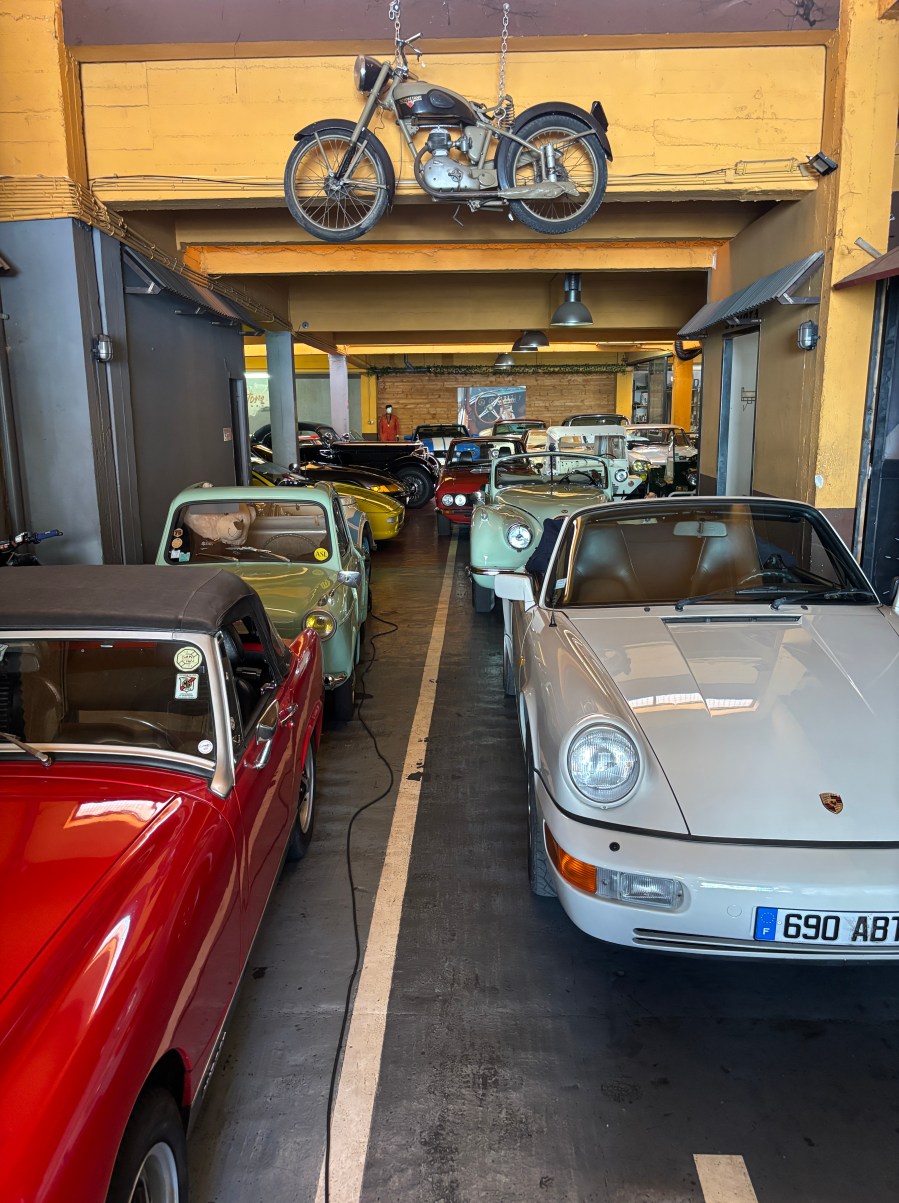
What we came upon and that I had no idea of, was a garge called Motors Corner, boasting a showroom iof over 1000 sqm, with what must be Nice’s largest collection of interesting automobiles. It must also be the most space efficient car collection anywhere, and should they need to move out a car in the back part of the garage for some reason, that would probably take a working day!

Motors Corner specialize in all parts of motoring, from sales and restoration to concierge services, and the collection also reflects the varying nature of the business. Most cars are for sale, others are being renovated, and the company also has an off-market collection that is not exposed at the garage but that boasts some real jewels like the Ferraris F40 and F50, a Bugatti Chiron La Noire, and a McLaren Senna, among many others.

Many cars are on foreign plates, and this is no doubt a European business

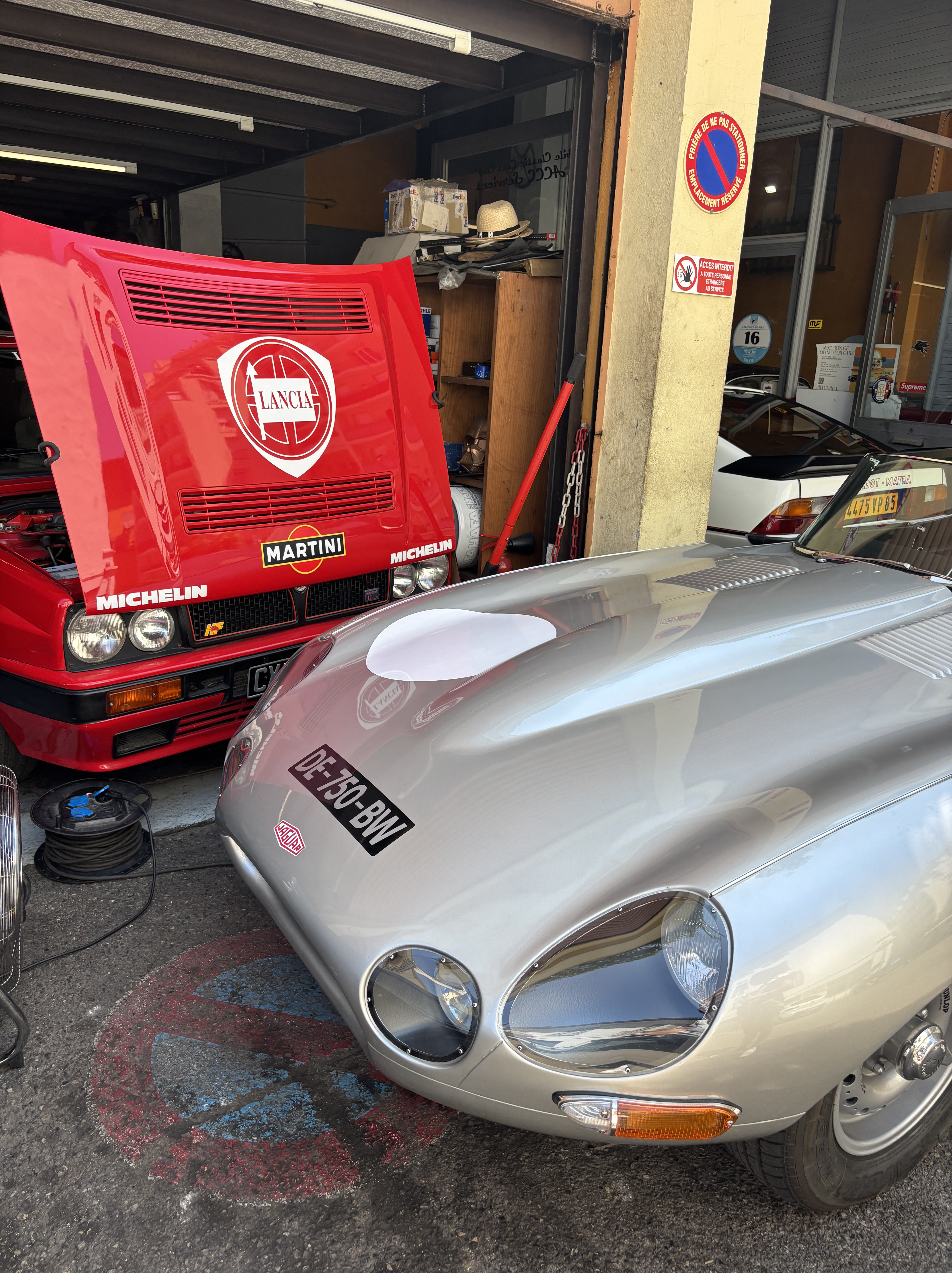
The highlights in the showroom itself included two beautifully restored 911 S’s from the early 70’s, a Ferrari Daytona Convertible (top picture, can’t promise it was genuine though…), a beautiful Mercedes 540 above, a bunch of other Ferrari’s to die for, including a 250 GT Lusso. Just next to the entrance is the workshop where a Lancia Delta Integrale was being worked on, which at least by the stickers had been around on quite a few races! Next to it stood an E-type Lightweight. And I could go on…

An E-type lightweight, a Lancia Delta… and a 3-seater Matra in the background!

The pictures don’t tell the full story and the exhibition is not easy to take in given how cramped it is, but if you’re in Nice, it’s definitely worth stopping by! Until then, you’ll find all the cars for sale (a large part of the collection in the garage) on motors-corner.com, as I’ve discovered since, a site you can spend a lot of time on while sitting in the sun sipping your rosé!

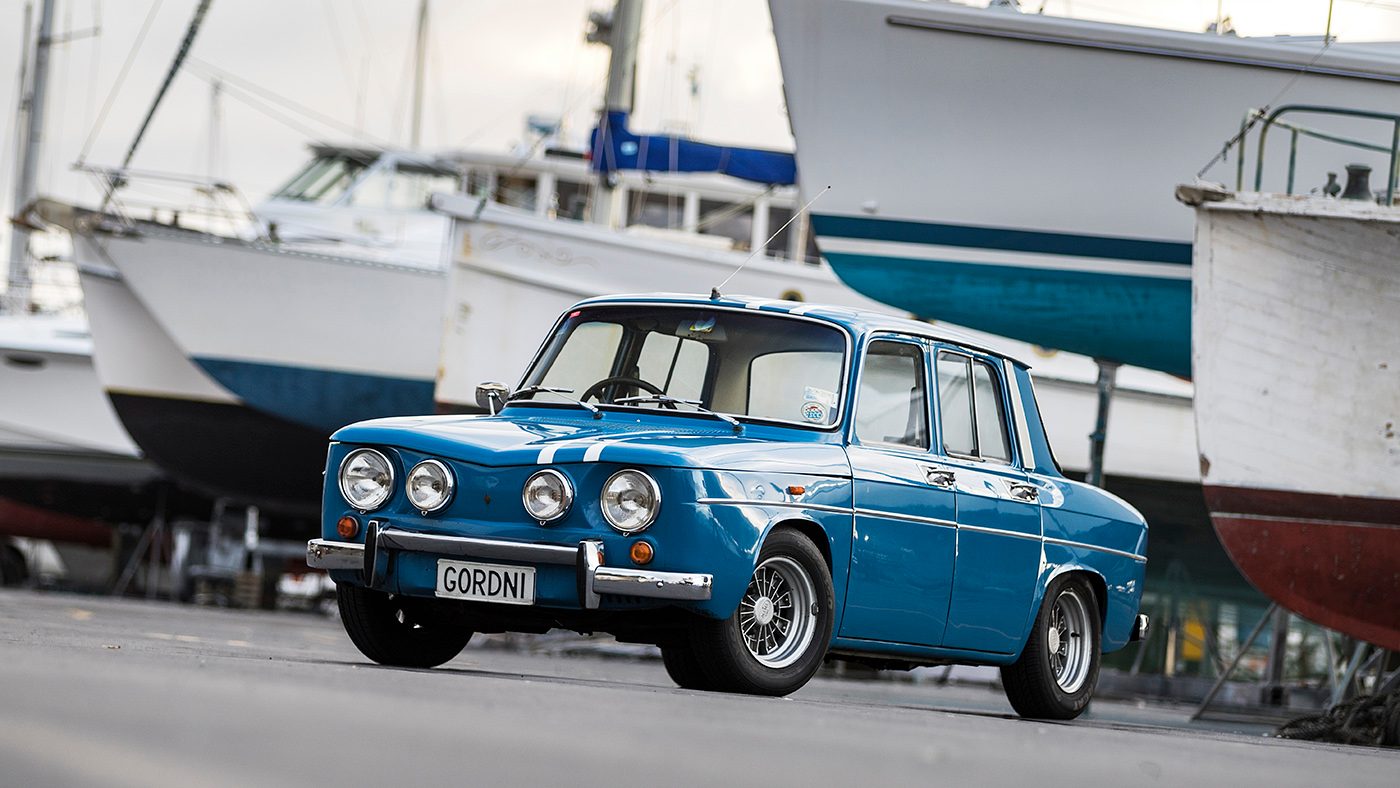
The 8 Gordini – a true rally legend!

Time flies -as if that’s a surprise to anyone. And in the same vein of kicking in open doors, it’s not much of a secret that I have a soft spot for France, as long term readers of this blog will have noted. If memory serves me right, the first “French” post on this blog was that on the wonderful Citroën DS, which I just saw that I wrote five years ago, during the first Covid summer. Those were not happy times so I guess we should be grateful that time flies at least in that respect, but also that floating down a French “départementale” (country road) in a DS has lost none of its charm ever since.

The French have a thing for trees as crash protection…

If Citroën was the technologically leading car brand in the late 1950’s and 60’s, Renault was still the largest. Unfortunately, design-wise the brand was far behind the competition in Sochaux, something that became shockingly clear when Renault launched the R8 sedan in 1962, later called only the 8. Just by looking at one and comparing it to a DS, you would think 20 years sets them apart. Of course it was the DS that was the exception, as at the time, far more cars still looked like the R8 than the other way around.

The R8 was a rear-wheel drive, small family sedan with the engine in the back as was still popular at the time. The standard version of the R8 was the definition of unspectacular, but I remember it clearly as it was also built on license in Romania under the name Dacia 1100. Growing up in Stockholm a couple of blocks away from the Romanian embassy, on the way to school, I would see some of these Dacias parked on the street in front of the embassy, together with a later version based on the Renault 10. Somehow the design felt like a far better fit to a Soviet-era, communist dictatorship than to lovely France!

Pretty” is not the first word that comes to mind…

American readers may be interested to learn that the R8 was sold in the US as well, with the French trying to position it as the nimble city and close proximity car it was typically used as in France. At the time however, the US was all about far longer drives on the new interstate highway net, an environment where the small R8 with its 43 hp made much less of an impression. Needless to say, the R8 never became much of a success on the other side of the Atlantic

In Europe however, things were about to improve a couple of years later, in 1964. The regular R8 got a performance boost to 50 hp, but more importantly, the 8 Gordini was launched. Initially only available in the elegant blue called “bleu de France”, which has become a signature color for Renault’s sports versions, the extra power came from greater displacement (all of 1.1 litres!) and a different Weber carburettor setup. Power would be further increased to 100 hp in 1967, when the Gordini also got the double headlights it’s become known for.

The Gordini deinitely changed things for the better!

The name Gordini comes from the company of the same name and its founder, Amédée Gordini. Specialized in tuning and motor racing, Gordini was founded in 1946 and competed in F1 in the 1950’s and Le Mans in the 60’s. Amédée Gordini was so good at building race cars that he became known as “The Sorcier” (the sorcerer) and whilst he also worked both on Simca and Fiat cars through the years, most of his work was on Renaults, who bought his company and incorporated it as a subsidiary in 1968. Before the Renault 8, Gordini had also built notably the Renault Dauphine Gordini, another rear-engined, small family car.

The 8 Gordini was a true race car, not only with more power than the standard version, but also with lowered suspension and various other technical modifications throughout. It had assisted steering, a five-speed box and disc brakes on all four wheels. And those wheels were typically very small and very wide! For homologation purposes the 1967 version was also produced as a road car, with a few horse power less than the rally version and a different light setup at the front, but otherwise pretty much the same car. This made it one of the first road-legal race cars, as well as arguably the first GTI car (sorry Golf!). Of the few Gordini’s that remain, it’s mostly this street-legal version you see.

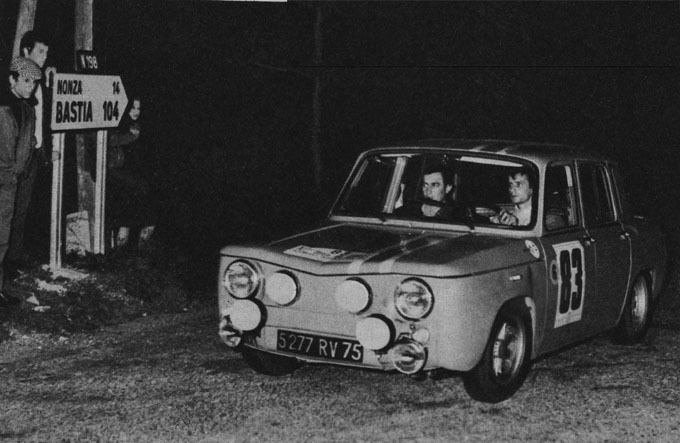
The 8’s predecessor, the Dauphine Gordini, had a lot o success on the rally scene in the early 60’s and sticking with tradition, Renault entered no less than six brand new 8 Gordini in the 1967 Corsica rally. Remember that back in the 60’s, motorsport was almost synonymous with rallying as F1 had not yet got the popularity that would follow in the 70’s. The 1967 Corsica rally would very much lay the foundation for the 8 Gordini’s future success on the rally scene and its position as one of the 60’s leading rally cars. In the first year, the winner and a further three cars in the top five were Gordinis. It would go on to win the Corsica rally another two years, and a long list of other rally victories until 1970 would follow.

Not many cars would keep up with the Gordini in the late 60’s!

If the regular Renault R8 still looks like a not very exciting 60’s family car, the 8 Gordini is a different story. Everything from the front lights to the lower suspension and the small wheels give it a cool poise, and the 100 hp have no problem with the car that weighed it at around 800 kg. Neither do the disc brakes, leaving the gearbox and rust protection as the weak spots. The gear change, given the gearbox in the back next to the engine and thus a long way from the gear lever makes it quite vague, and rust protection as on any French car form the 60’s is largely non-existent.

That said, if you’re lucky enough to find an 8 Gordini today, it will most certainly have been renovated. Rare as they are, a good car will be yours for EUR 30-40.000 and will provide the kind of pure mechanical driving pleasure only a 60’s car can, including the drifts from rear-wheel drive combined with the rear-engine setup. All of it brings back memories of an era when Renault was not just a manfacturer of boring family vans, but a name to be counted with on the rally scene!

Ford Capri – what’s your attitude to life?

Back in April of 2022 (almost three years ago, time does really fly!), I did a piece on the Opel Manta, a European sports coupé from the 60’s that has a huge following in Germany and notably also served as inspiration for a movie by the same name. At the time, I remember thinking that for the story of German sports coupes from the 60’s and 70’s to be complete, I would need to add another car to the mix as well, namely the Ford Capri. After all, if you ask true Capri fans, they’ll tell you not only that it was Europe’s first pony car, but also that explaining its history is difficult, since it goes into your attitude to life. As if that wasn’t a good place to start?

The success of the Ford Capri is difficult to overstate, as between 1969 and 1986, more than two million cars were built. But the Capri story doesn’t start there. As readers of a slightly older vintage may remember, Ford already had a car called the Capri under its American Lincoln brand. And Ford in the UK had also developed a 2+2 coupé called the Capri, based on the Ford Consul. None of those were however the “real” Capri. Instead, the story of the first European pony car really starts in the US in 1964, with the success of a certain Ford Mustang.

A Mk1 Capri, as so often, the purest design-wise compared to later versions.

Shortly thereafter, Ford in Germany and in the UK (regrouped to Ford Europe), seeing the enormous success the Mustang had had in the US, put some 200m Deutschmarks (DM) on the table and started developing the Capri coupe, with the Ford Cortina as basis. A big part of the success was in the design; not only was the US-inspired Capri with its long hood and short rear end pleasant to look at in a pony car kind of way, but it was also quite roomy, offering enough space for four and (at least some) of their luggage. As we all know everything was smaller back in the day, including both people and their luggage, and the fact that quite a few family fathers could thus opt for a flashy Capri rather than a more boring car, lay the ground for the sales numbers early on.

Between 1969 and 1986, the two million Capris that were sold would come in three series. The Mk1 actually represented half of the whole production, selling in more than 1.1 million units until 1974. The cheapest version was positioned very much on price, with a base version being squeezed in just at 6.995 DM, and marketed as a true sports car for under 7.000 DM. You should put a big question mark around the sports car thing however, given the car had a 1.3 litre four-pot delivering no more than around 50 hp and needing not 10, not 20, but all of 24 seconds to reach 100 km/h.

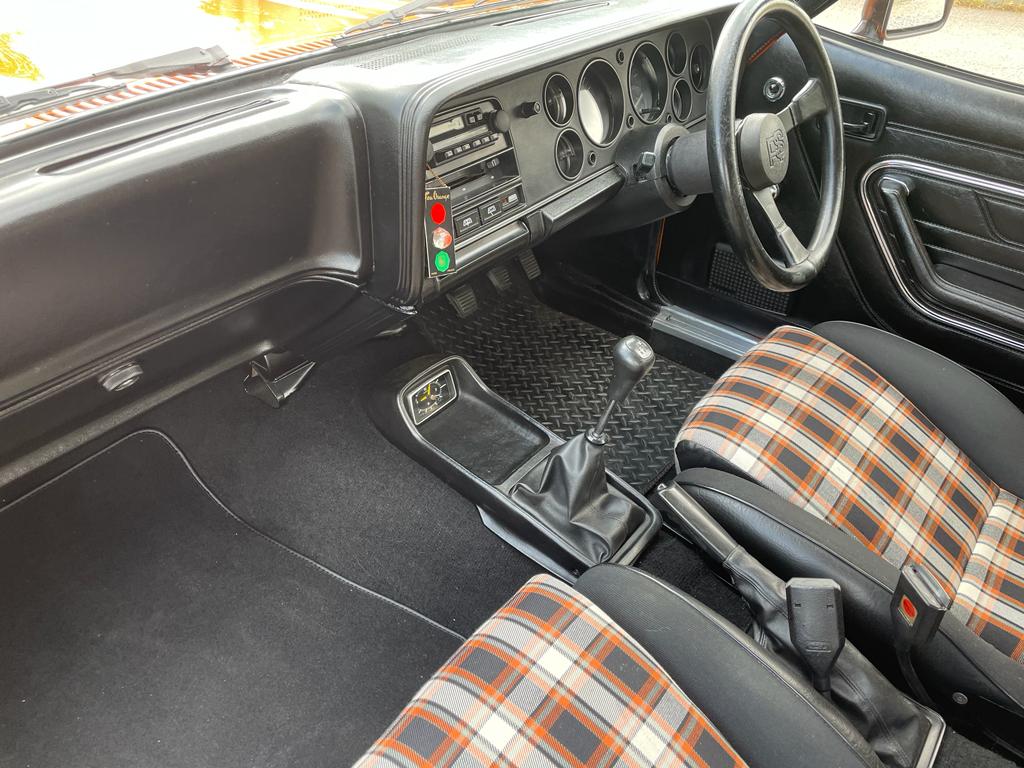
The interior of a Mk2 car – at least it looks quicker than 24 seconds to 100 km/h!

At the other end of the spectrum for the German-built cars (which constituted a clear majority) were however also a 2-litre and a 2.3 litre V6 (later 2.6 litre), delivering 90 and 125 hp. Two optional sport packages called GT and R added various sporty design touches, but in the first series, it was only the V6 cars that had the most important of them all: the bulge in the hood! With sales numbers starting to drop in 1974, it was time for a revised Mk 2 version, which was however not much more than a cosmetic update of the Mk1, with most mechanical parts remaining unchanged.

Correctly identifying many buyers as not that sporty, Ford softened the suspension on the MK2 and a revised rear end improved the practicality with a larger rear window and boot cover. Something far more debatable and typically not ageing very well was the vinyl roof many cars came with. The MK2 premiered in 1974 in the middle of the first oil crisis, which became clear when you look at the sales numbers of the 3-litre V6 that was now available as the top engine: only 188 cars with that engine were sold the first year in all of Germany!

There’s tuned cars of all generations. Unless you know the tuner, stay clear of them!

The third series, which for some reason was officially referred to as Mk2 ’78, was again mostly a cosmetic exercise, trying to make the Capri 80’s chic. Under the body, the early 70’s technology was however still very present, including the rigid rear axle with leaf springs. By the end of production in 1986, that made the Capri the last car in Germany to be built with such an antiquated suspension, hardly something to write home about. The fact that the top version was now quite luxurious and available with an automatic transmission and a 2.8-litre V6 putting out 160 hp was then more so!

If you have some space left in your garage and a strong urge to fill it with a Capri, you’ll be happy to learn that contrary to its bigger brother, the Mustang, the European pony car can be had for not much money at all. If you except the sleepy 1.3 litre engine, good cars can be had for around EUR 25.000. The later series are more difficult to find, but actually less expensive. In between, you’ll find a lot of tuned cars, both optically and mechanically, that you will want to steer very clear of. I’d go for the first series with the biggest engine possible, thus combining purity with power. That’s the best attitude to life I can think of!

Rapid(e) mind mess-up!

If you’re anything like me (and given you read this blog, I guess there’s a fair chance you are), you’ll be familiar with the situation: you see a car that causes a severe, possessive reflex of the “I have to have it!” type, and rather than defining your needs beforehand as any normal person would when looking to buy a car (to the extent that was your intention, which in these situations, it usually isn’t), you instead try to define your needs ex-post to suit the object of desire.

This is what happened to me (again…) a couple of weeks ago, and it’s all the fault of the classic car dealer called Emil Frey Classics that I mentioned in my post on the wonderful MB 500 SLC that they had in the showroom back in August. That car caused a similar reflex but not on the same level, and they luckily sold the MB before I had time to do something completely irrational.

Just for memory and as a short background, the Swiss car import market is dominated by a few privately-owned, large importing groups that split the brands between. Emily Frey is the largest of these, and the family behind it and other similar groups regularly rank among the richest in the country (which in the case of Switzerland is saying a lot…). Emil Frey’s “Classics” division handles the exotic cars they trade in from some of their many wealthy customers, and they expose the best of these in a beautiful showroom about 200 metres from where I spend my working day – the definition of professional hazard!

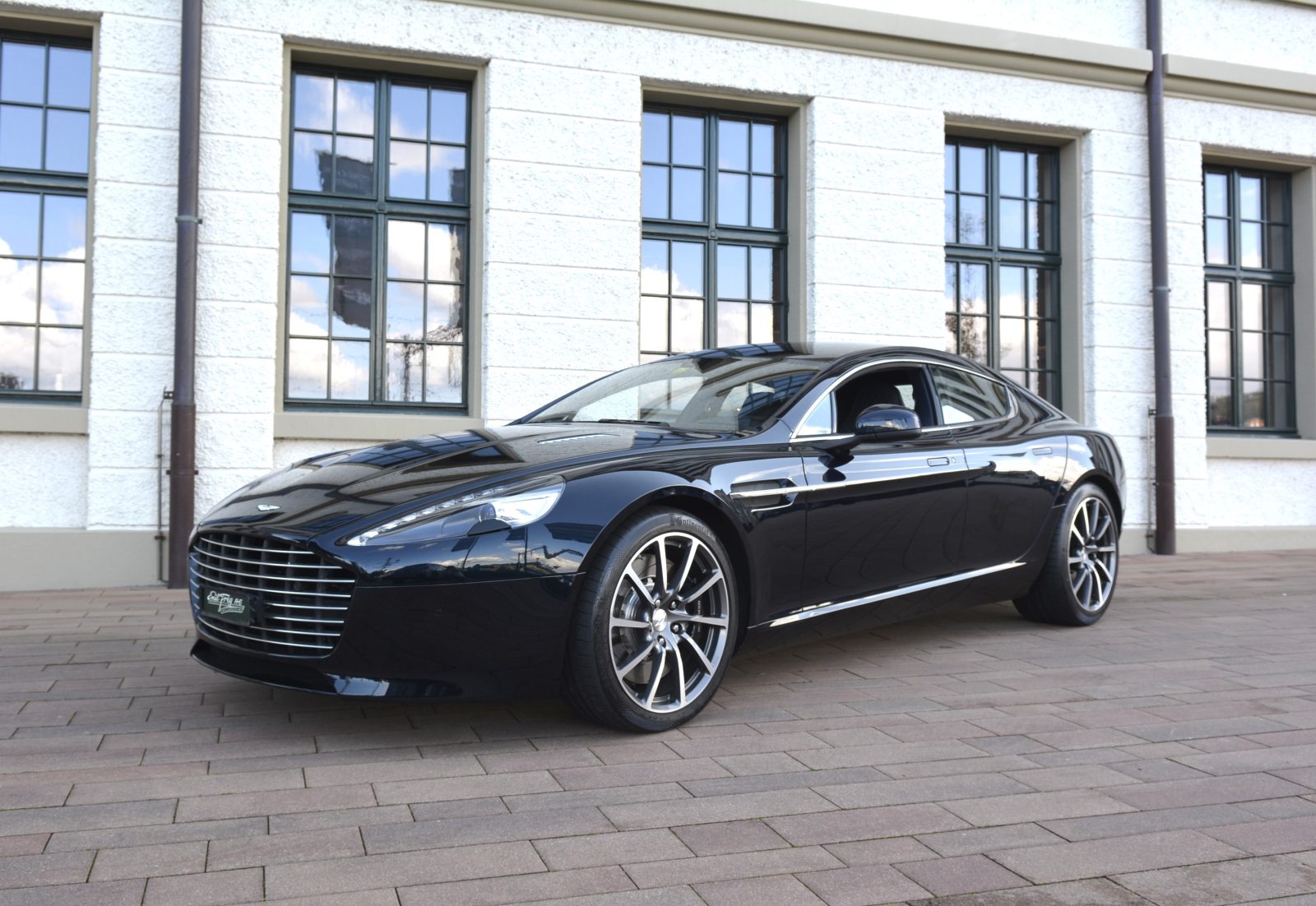
“My” Rapide, in the deepest blue metallic I’ve ever seen…

As you may have guessed, the car that’s messed up my mind in the last couple of weeks is arguably the most beautiful four-door sedan on the planet – the Aston Martin Rapide, here in the shape of 2017 Rapide S in the deepest dark blue metallic I’ve seen, with a black leather interior, driven no more than 13.000 kms since new, and traded in from a client’s Aston Martin collection – the poor guy had apparently run out of space. Needless to say, the car was in mint condition.

I’ve always found the Rapide to be a beautiful but intriguing car, and a rare one at that. Over the full 10 years of production no more than 10.000 cars were built, meaning roughly 1.000 per year (but as it was, far more in the first few years and very few from 2017 and onwards), so you don’t see many of them. And you may actually miss it even when doing so, since seen from the front or even from 1/4, you risk taking it for just a regular DB9. It’s only from the side and back that you note that it’s significantly longer.

Indeed, the Rapide is built on the same platform as the DB9 and the V12 Vanquish, but here extended by 30 cm such as to enable two back seats. These are real, separate seats making the Rapide a comfortable four-seater, provided your back passengers aren’t bigger than around 175 cm (5’9″). And should there only be two of you traveling, the two rear backrests can be folded, thereby creating a very sizeable luggage space, given the Rapide is actually not a sedan, but a very stylish hatchback.

An additional 30 cm from the b-pillar backwards make the DB9 a four-seater

First shown as a concept car in 2006, the first series was actually not built in the UK but rather at Magna Steyr in Austria (most famous for building the G-wagon), with final assembly in Gaydon, and with the full production moved there in 2012. In the year after, the second series Rapide S premiered, with power boosted to 558 hp from the initial 470 hp and with other updates, of which the vastly bigger grill is the most obvious one. From 2014 the S also got an eight-speed auto box, replacing the original six-speed. Finally, the Rapide AMR was sold in the last years from 2018 to 2020, limited at 210 cars, and with the engine beefed up to 600 hp and various visual items to underline its sportiness.

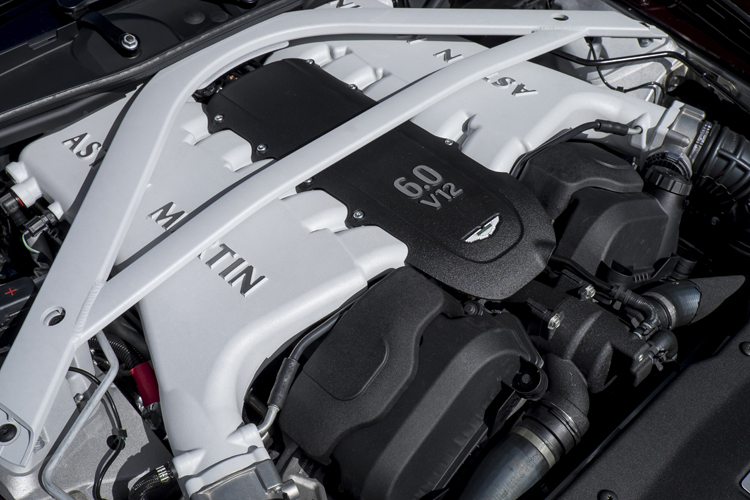
Of course a lot of the Rapide’s thrill is in the engine, that wonderful, 5.9-litre naturally aspirated V12, that for some reason says 6.0 litre on the engine block when you open the hood. It’s a well-known engine across the Aston range and considered very reliable if you treat it right. In the Rapide, it provides the jet engine kind of acceleration – not explosive or high-pitched, more of a relentless push, with a satisfying growl. It’s also the type of non-supercharged, non-hybrid engine that we will never see being built again, whatever happens to the car world going forward.

It may say 6 litres on it, but in truth, it’s 5.9… Wonderful nonetheless!

Coming back to the Rapide S I was drooling over, it was as said a 2017 car which is good, as in the Rapide world, the newer, the better (or as the salesman said, in the first series, there were quite a few Mondays in the week on the final assembly line in Gaydon…). Stepping into it, and thereby opening the “swan door” that opens outward but at an upward angle, you find yourself sitting just as low as in a DB9, with what feels like an immense hood in front of you. The cabin is pretty much identical to a DB9 as well, with beautiful materials, leather from more cows than you care to think about, and a really nice and solid feel to everything.

We went for a drive, but it wasn’t one that in any way tested the car’s capabilities. The feeling of driving a big car however disappears quite quickly, and the accompanying, soft growl from the exhaust is very satisfying indeed. Those that have had the chance to drive the Rapide on track however talk about it as very agile and playful for its size, far more so than the Panamera or Mercedes-Benz CLS it’s usually compared to (and both of which it obviously also outclasses in looks).

Old school? Yes, if infotainment screens is you’re idea of fun. Timeless is the word!

As we came back, my mind was working in overdrive to create a case for this car. Of course there’s quite a long list of negatives that you can think of and that go from, well, the whole package really, from the V12 engine to the electrical system, where if anything goes wrong, the downside is potentially limitless. Running costs are also on the high side, to put it mildly. That said, it’s far cheaper to run than the only competitor I see, namely the Ferrari FF / GTC 4, where the FF price-wise is comparable, and it’s not like it lacks positives either: the sheer beauty, the rarity, the relative practicality which is really all a couple needs when the kids have moved out, and of course that V12 which beats most of what’s out there.

If, having read this, you feel like me, do note that parking a Rapide in your garage is very much a case of buying the best one you can afford. There are super cheap first series cars out there that are tempting, but not where you want to go. Rather, aim for the second series (the S version), and do so from 2015 such as to benefit from the 8-speed box which helps lower the fuel consumption from something really indecent to half acceptable. Maintenance is really critical, but if done correctly, the Rapide is fundamentally a solid car.

Speculation is no more than that, but I wouldn’t be too surprised if the Rapide price-wise stabilizes at this point, for the above mentioned reasons and because there are so few around. As for me, I tried to find other directions for my lunch walks last week, such as not to pass in front of that shop window, where the very friendly salesman will wave to me every time. Luckily I’m traveling next week, and hopefully someone else will have had time to buy it before I get back…

The unique MB 500 SLC!

Last year in September I moved into a new office space in Zurich, nicely located in the center, close to the sea. It’s surrounded by mostly residential buildings, cafes, restaurants, and a few car dealerships. A perfect surrounding for someone appreciating coffee, cars and good food you might say (after all that’s why I chose the office) but as I’ve come to discover, it’s a more dangerous environment than you would think. Not because of street crime (this is Zurich after all…), nor the cinnamon buns of the local coffee shop. As you’ve guessed, it’s the car dealerships that are the problem.

You see, next to Mercedes and Audi’s small city outlets, more to think of as showrooms, there’s also a dealer specializing in the top-end classic car market. It’s called Emil Frey Classics and belongs to one of Switzerland’s largest car importers by the same name. Funnily enough, it’s in this direction my feet regularly take me, and by now the nice sales guys inside have definitely put me in the category of middle-aged men dreaming of “something above their means”. Which, in the case of the Aston Martin DB2/4 and the Mercedes-Benz 300 SL Gullwing they currently have on display, is very true.

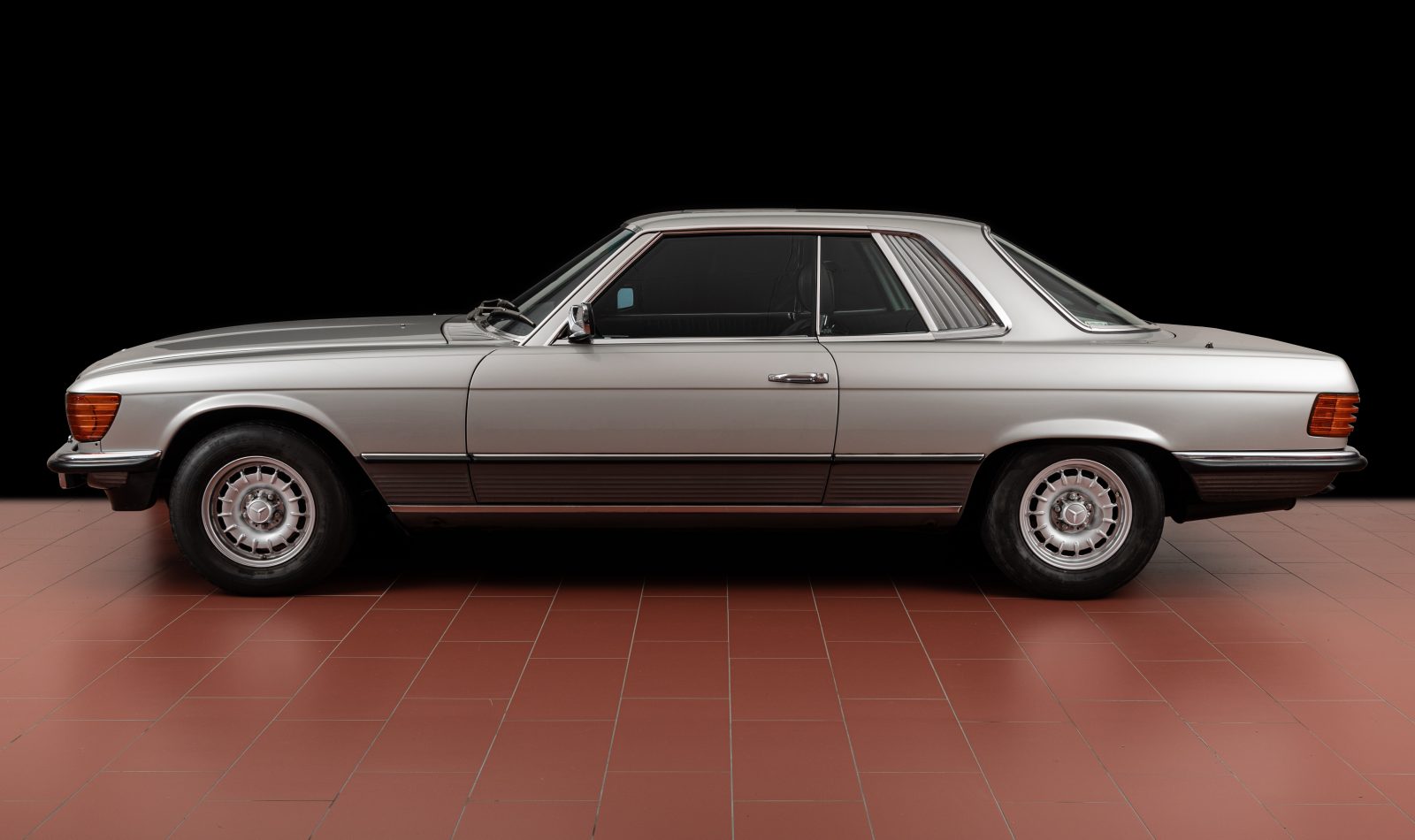
Last week however, a new car was added to the collection and hadn’t it been because it was parked on the street whilst they were re-shuffling the showroom, I may well have missed it. After all, it looked like a nice, but quite regular Mercedes-Benz SLC. However, looking at the fact sheet behind the wind shield (since nothing else would betray it), I saw that it was the ultra-rare 500 SLC, the top version of the SLC series that was only ever sold in Europe, and only built 1143 times in 1980-1981. That, together with the story the seller told me, made for an interesting lunch break!

A wonderful C107 500 SLC a bit too close to my office for comfort…

Before we go into this specific SLC however, let’s just note that the 107 range comprised the very well-known, beautiful (R107) SL convertible (anyone else remembers the bright red one Bobby Ewing drove in “Dallas”?), and the less popular, and according to some, less beautiful (C107) SL Coupé, or SLC. What made both cars so special was the build quality and the fact that in spite of being the sports cars of the range, they would offer a ride as comfortable as the far larger MB’s of the time. That was definitely also one of the reasons why the roadster was built longer than any other MB, for all of 19 years between 1971 to 1989.

The SLC coupé was shown to the world in 1971 in Paris and would be sold for 10 years until 1981. It was built on the roadster R107 platform that had been extended by no less than 36cm, such as to offer four real seats. That does however make it somewhat unique among S-class coupés, which have otherwise always been based on the S-class chassis. The front end of the SLC up to the A-pillar is identical to the roadster, but the cabin is longer, as is best seen from the side, where the side windows end with the legendary curtains. The extension was done in a way such as to avoid a B-pillar, giving the car an elegant, unbroken glass line.

The legendary side curtains and the dome-like rear window (picture Emily Frey Classics)

In terms of overall elegance however, not everyone agrees on the SLC being beautiful, and few MB models have been as widely discussed over the years. The curtains, the long wheelbase and the dome-like rear window are all items that didn’t really go down well with enthusiasts, and it’s not until quite recently that the mood has changed somewhat. In terms of looks, the SLC may lose to its ultra-elegant roadster sibling, but it’s still a beautiful car with great practicality and a mor relaxed ride thanks to the longer wheelbase. In other words, a true S-class coupé as you should imagine it!

In terms of engines, the range started with a 185 hp six-cylinder in the 280 SLC, but most coupés came with the eight-cylinder models called 350, 380 or 450 SLC, with the engine being the good old Mercedes cast iron V8 with 218-230 hp, depending on version. In 1978, MB then introduced the aluminium 5-litre engine that was significant in several ways, as it was built in preparation for the successor of the SLC, the SEC coupé. Power output was higher at 240 hp, and importantly, it was coupled to a four-speed automatic, far better than the 3-speed of earlier or simpler versions.

The 5-litre engine has more than sufficient power for the relatively light SLC (picture Emily Frey Classics)

The late 70’s and early 80’s was the time of different emission regulations between Europe and the US. Don’t ask me why, but this led to the 5-litre, which was only sold in the SLC in the two final years 1980-1981, being called 450 SLC 5.0 in the US, and 500 SLC in Europe. As said, only 1147 cars of the European version were ever built, and it was one of these I stumbled upon. These were complemented by around 1.600 of the US version.

As can be seen from the pictures, the particular car I saw looks if not new, then very close to it, as explained by the fact that the previous owner, one of only two, had invested around CHF/USD 80.000 in maintenance and renovation over the last years. But it was all the more remarkable since he hadn’t only invested in the car but also driven it, so that the it has a mileage since new of no less than 260.000 km! If ever proof was needed that there was a time when literally nothing could break a Mercedes, then it was standing right in front of me!

An extremely well preserved and partly restored car in an optimal colour scheme…

That’s not completely true however, at least not talking about the 5-litre engine. It wasn’t only that aluminium was now used rather than cast iron, it was also that plastic had made inroads in car production, and in the rather fragile type so popular in the 70’s, had proven not to be very reliable and prone to cracking. Part of the 80.000 had thus gone into replacing the brittle plastic slide rails of the engine and some other parts. Further money had gone into the gearbox, transmission, suspension etc. You name it, it had all been done, and the car oozed of quality.

The short ride we took didn’t reveal all the facets of the car, but enough to realize that this was a very healthy machine indeed. As tends to be the case with older cars, you sit slightly higher with excellent visibility given the large window areas, and in the case of the SLC, with a big wheel in your hands, that you need to turn more than on a modern car. The engine is present somewhere in the background and won’t be stressed by anything at normal speeds. For its age, the suspension was fine, and the automatic switched as good as a 40-year old box can. Nowhere did the car feel like it had been driven all of 260.000 km!

…with a blue leather interior in a comparable, perfect condition! (pictures Emily Frey Classics)

The dealer wants CHF 60.000 for the 500 SLC, which when knowing how it drives and what’s been invested, together with how rare this version is, sounds reasonable. The issue though, is that any other SLC with another engine and less km’s, but in equally good shape, can be had for half. Also, given how rare the 500 is, it’s difficult to know what the fair value is. Looking into it a bit, it seems these a couple of these have traded very selectively at auctions at more than 100.000, then at other times, reserves haven’t been met.

Although a truly beautiful car with a great story and a great ride, the 500 SLC doesn’t really make my heart beat faster, more than seeing a great classic car in general does. If it’s your thing though, you should know that what’s probably the best car on the market is currently for sale in Zurich. And as part of my googling, I also discovered that whereas the dealer wants 59.000, the owner himself has advertised the car privately as well, at a price of 52.000, thus 8.000 lower. That’s a number that although not a bargain, sounds rather reasonable!

Porsche 968 – more than a different number?

Back in the day (here defined as when it was assumed we could drive our cars without 17 cameras in every angle), Porsche was a sports car company with a far larger focus on the 911 than today. SUV’s and other, strange four-door creations were still far from the drawing board, but the company was actively trying not only to diversify away from the 911, but more or less to kill it off. I’ve written about this several times, notably in my posts on the Porsche 928 and 944 respectively, four years ago.

As part of that strategy, it was precisely the Porsche 944, launched in 1982, that was to help where until then, the 928 had failed, and it definitely had a lot going for it. It looked modern in a well-designed and quite practical body, including the pop-up headlights that were mandatory in the 80’s. Especially in later years as it evolved, it was also able to shake off most of the Audi vibes its lesser predecessor, the 924, had given it, at least in the eyes of some. For the purists, that was of course not good enough, as it only had a four-cylinder engine that wasn’t even air-cooled.

Although more modern than the 911, the 944 never won the enthusiasts’ hearts

In spite of that, the 944 continued to evolve with a second series, called S2, launched in 1989, which brought both more power and a far nicer interior. Also, during the S2’s short lifetime of only three years, production was finally moved from the Audi plant in Neckarsulm, Germany, to the Porsche plant in Zuffenhausen near Stuttgart. All that didn’t really help though, as when S2 was discontinued in 1991, it still hadn’t been as successful as Porsche had hoped. And by now, its basic design started to look dated, especially the front and back which went back more than 15 years to the original 924 from the mid-70’s.

Porsche decided to give it one more shot in a Mark III version, internally called the 944 S3. In the eleventh hour, the decision was however taken to change the car more than what had been originally planned, so that when it was launched, Porsche felt it deserved a completely new name – the 968. The exact logic behind the numbers isn’t fully clear, more than Porsche wanting to de-emphasize the connection to the 944, while reinforcing the similarities with the 928 and thereby perhaps also create a positive vibe around the latter.

As always in those days, Porsche supported the launch with some great advertising!

Was this a lot of marketing talk, or was the 968 different enough to motivate the new name? Actually, if you look a bit closer as we’ll do below, I would claim it was. The 968 brought updates in several areas that taken together made it a far more modern car. Prospective buyers obviously felt differently and the 968 was never more of a commercial success than the 944 S2 had been. Fast forward 30 years however and it’s become quite an interesting proposition, as we’ll see.

To start with the exterior, there’s no doubt the 968 took after its bigger sibling, the 928. The pop-up headlights were round and the front spoiler looked the same as on the flagship. The rear was completely re-designed and given completely red rear lights, considered highly modern at the time. The interior was however left pretty much alone as since the S2 revamp, it was fully modern and actually an interior that has stood the test of time really well.

Everything you’ll ever need to drive a car!

The bigger changes were however in the drivetrain, where firstly, thanks to the transaxle construction with the gearbox in the back, the weight distribution pas practically 50/50 (this had obviously been a feature of the 924 and 944 as well). Also, that gearbox was now a new six-speed, replacing the five-speed box of the 944. There was also an automatic option, that we won’t go into more than that. The basis of the engine was not the 944 Turbo but rather the “normal” S2 engine, here as a 3-liter inline four-cylinder with about 240 hp. It was the first Porsche engine to feature Variocam, a system for variable valve timing, improving both performance and efficiency.

This made the 968 less powerful than both the 911 and its predecessor, the 944 Turbo, which in its last iteration had 250 hp, but also less prone to failure than the latter. And in the early 90’s, 6.5 seconds to 100 km/h was still a respectable time. Above all though, the 968 conveys a true Porsche feel of the time in terms of how it drives, less powerful but more predictable than a 911, and much more light-footed and sporty than a 928. Unsurprisingly the 944 Turbo has more low-rev torque, whilst the 968 as naturally aspirated, has a broader performance range and enjoys being revved.

The 3-litre four-cylinder, the biggest in the market at the time, is a brilliant engine!

To prove how good the engine really was, Porsche took it to the Nardo circuit in Italy in the spring of 1992, and drove it flat out for 24 hours. Including fueling stops, the 968 covered a distance of 5566 km, equivalent to an average speed of 232 km/h. Try doing that with an EV!

There’s thus no doubt that the last evolution of the 944 was a pretty big and important one, something I was reminded of when seeing a 968 on the street the other day, and being struck by how good and relatively modern it looked. I did what I’m sure you all do, i.e. checked how much they are these days. To my surprise, it turns out that a nice 968 can easily be yours for around EUR 30.000, with the convertible costing 40-50% more. Somewhat surprisingly, the 944 Turbo is in the same price range as the 968 convertible. As a small comparison, the cheapest 911 of the same age will cost you three times that, and whereas a 928 will be yours for maybe EUR 50.000, it will be much costlier to run than a 968. As will a 911 for that matter, which is also far less practical.

If you have room in your garage and if you still feel confident driving a car without cameras and emergency braking, then you know what to do. And don’t wait too long, as 968’s, of which less than 13.000 were built between 1991 and 1995, are starting to become really rare. The 968 is definitely a real Porsche, and it’s no doubt the best version of the 944 series. It’s both modern and practical enough to be used more than on an occasional Sunday, and all this for a price that is lower than that of a Chinese EV. That makes it really difficult to say no to!

M88 – 3x magic!

Remember Rod Stewart? I know he’s one of those artists you need to check whether he’s died since you last heard of him, but given I just did, I can confirm he’s still alive, and by the looks of it, still kicking. Back in the 80’s, Rod did a song called “Some guys have all the luck”. Given he’s known not only as a Scotsman with a smoky voice but also as a great womanizer, it’s pretty clear what “all the luck” was referring to. This week however, we’ll talk about another guy who really has all the luck – in car terms.

Still alive

It all started during an innocent catch-up lunch with an old friend from university back in Sweden, before we both moved to Switzerland many years ago. I know he’s interested in cars, so naturally, that’s the turn the discussion took after we’d updated each other on jobs, travels and families. It turned out my friend had just bought himself the nowadays quite rare BMW M635 Csi, one of my all time favorites and a car I wrote about back in 2020. My friend went through the purchase that was a bit our of the ordinary, but will stay between him and me, and then said, kind of matter-of-fact like, that it was nice to finally complete his line-up of three cars with the same engine.

The first of BMW’s large coupés – the M635 Csi

My brain was working intensely while my jaw was seeking the ground, as my friend (who by now was rapidly taking on a heroic status) told me he’s also the owner of an M5 of the first, E28 generation, and even more incredibly, of an original M1. The M5 is up in Sweden, but the M1 is a car he regularly drives down here in Zurich. And of course, these three wonderful cars are all powered by one of the greatest engines of all time – the so called M88. a suitably legendary engine for one hell of a car line-up!

The M88 engine was first featured in the M1, after the prototype cars had been tested also with a four-cylinder, turbo engine. The straight, 3.5 litre six cylinder with the so called DOHC dual overhead camshaft and four valves per cylinder produced around 280 hp with fuel injection, and around 330 Nm of torque at a relatively low 4500 rpm.

The M1 was a sensation when it was shown to the world in 1978

The power was enough to take the light and aerodynamic M1 to 100 km/h in around six seconds, a spectacular time in the late 70’s. Combined with a top speed of around 260 km/h, this made the M1 the fastest standard German sports car when it was launched in 1978, a crown it held onto until its end of production in 1983, when Porsche updated the 911 Turbo.

The M5 (E28) was launched in 1985, two years after the M1 had been discontinued. The four-door sedan was hand-built and powered by the third version of the M88 engine, referred to as M88.3, with around 10 hp more than in the M1 in the non-catalyzed, European version. The M5 was however a car BMW intended for the US market, where the catalytic converter reduced the power somewhat. It would only be produced for three years until 1987.

Oh how discrete power sedans were back in the 80’s!

The M635 Csi had seen the light a year earlier than the M5, in 1984. Contrary to the latter, it was built by BMW itself and not the separate M division, officially called BMW Motorsport. It rode 10 mm lower than the standard 635i and also had reinforced brakes, a lower front spoiler and two side mirrors – as standard! As its M brothers, the gearbox was of course a manual, 5-speed dogleg box from Getrag.

So there we go, three absolute legends of the automobile world, all powered by the same legendary engine – and all in my school friend’s garages. As it turned out, this was far from the ordinary catch-up lunch! Looking at it a bit closer though made it clear just how extraordinary his small collection is. Rarest of the three is the M1, of which only 453 were built. The M5 was made in 2241 units, but more than half of these were sold to the US. At 5855 units, the M635 Csi was the mass-produced car of the three.

An amazing power unit!

As long-term readers know by now, Switzerland is a rich country and one that is full of car enthusiasts, so that you usually see all kinds of car legends in quite high numbers. When it comes to this trio however, not a single one of either car is for sale at the moment on the regular sites, not even an M635 Csi. Checking Classic Driver turns up three M1’s currently for sale, starting at around half a million USD. The M5 is slightly more common and will set you back around USD 100′. The M635 Csi is the cheap one of the bunch, with good cars starting at around USD 60′.

It’s in other words quite a good pension fund for his older days my friend has collected. But knowing him, I know that’s also not the reason he got them, and I know he drives and enjoy all three cars. Good for him! And in terms of having all the luck, I guess you can be lucky in other things than cars – as well. I’ll settle for that for now…

Dreaming of the 250 GT TdF…

This week is for dreaming. After all, with all the sh* currently going on in the world, I’m quite confident that I’m not the only one feeling a need to flee reality a few minutes. Doing just that, If someone says Tour de France, or TdF in short to you, you most probably think of the world’s most famous road cycle race. Or even dream about it, depending on your disposition to cycling.

As so many other middle-aged men, I’m a road cyclist refusing to realize I’m getting old, and I certainly dream regularly about some of the legendary ascents in the Tour de France such as the Tourmalet, the Col de la Madelaine or the legendary Mont Ventoux, and climbing these at some kind of speed resembling what the pros do. Which of course is never going to happen.

If we go back in time though, there was another TdF as well, namely a car race carrying the same name, which with breaks for various wars ran more or less regularly from 1899 to 1986. As so many other things, the race was especially popular when it resumed after the second world war in the 1950’s. And in the second half of the 50’s, no other brand dominated the race like Ferrari.

The 250 GT LWB Competizione, nr 15 of 17 in the third series

So much in fact, that Ferrari chose to call the new, successful 250 GT Berlinetta the “TdF”. And if ever there was a representative of an era when car design was not bothered with safety constraints and aerodynamics but quite simply by designing strikingly beautiful cars, the TdF is certainly an excellent representative of it, and thereby a perfect dream car!

The TdF dominated the race every year between 1956 and 1959, and until it was succeeded by the short wheelbase 250 GT Berlinetta (same name, but with its introduction the original car was from then called LWB), it was built in four different, distinct series.

And yet, no more than 72 cars were built all in all, of which nine in “Competizione” race configuration. The car pictured above is one of those and was nr 15 of 17 in the third series. As you’ll note, the design was quite different to the earlier car from 1956, pictured below.

An early 250 GT from 1956

What all the TdF’s had in common however, was the beautiful, lightweight coachwork, designed by Pininfarina, and subsequently built in aluminium by Scaglietti. Actually the first body was designed by Scaglietti, as were apparently also some later ones. Things were a bit less organized in the old days.

Anyway, sticking with Pininfarina’s design, I don’t think it requires much in words – just look at it, whether it’s the two cars above, the second of which by the way won the Best of Show“-Trophy at the Villa d’Este Concours d’Elegance in 2021.

On the mechanical side, the V12 (what else?) was developed and improved across the different series, but is said to have produced around 260 hp. It was coupled to Ferrari’s “Competizione” gearbox with a limited slip differential, and mechanically the car was seen as far ahead of its time and was therefore also an important milestone for Ferrari.

This later, SWB 250 GT could become yours!

It goes without saying that the 250 GT, be it as LWB or SWB, is today among the most treasured and pricey classic cars out there. The car shown at the top was up for sale at Sotheby’s in Monaco five years ago an estimated at EUR 6-8m. And if you read this on the day it’s published, be aware that tomorrow Monday, 13 November 2023, the red 1962 250 GT SWB shown above is going up at Sotheby’s in Monaco, this time estimated to fetch USD 60m. Inflation anyone?

Like many other classic Ferraris, the 250 GT is thus best enjoyed as a dream – but what a dream! Of course things weren’t better in the 50’s than today, but coming out of a World War, optimism was slowly returning, and creativity was high. The 250 GT is a great illustration of that and thereby also of what we would need a bit more of today!

Japan’s only real pony car!

If there’s one thing that is even less featured on this blog than American cars, it’s those from the land of the rising sun. In the case of the US, this is explained by this not being my area of expertise. In the second, its frankly because of a lack of interest. Having said that, Toyota sells about 10 million cars per year and although it’s the biggest Japanese brand by a margin, it’s certainly not the only one. Surely there must be something to write about in those numbers ?

Honestly, these days I’m not so sure. There is the Nissan GT-R we’ve talked about, and then of course the Honda NSX, which however isn’t even close to reaching the cult status the original NSX has these days. The Lexus LC is a cool-looking thing, but as so many Japanese cars, it feels like it lacks personality. And then there’s of course a bunch of hot hatches, mostly from Honda, but if you’re into those, chances are you’re not reading this blog in the first place.

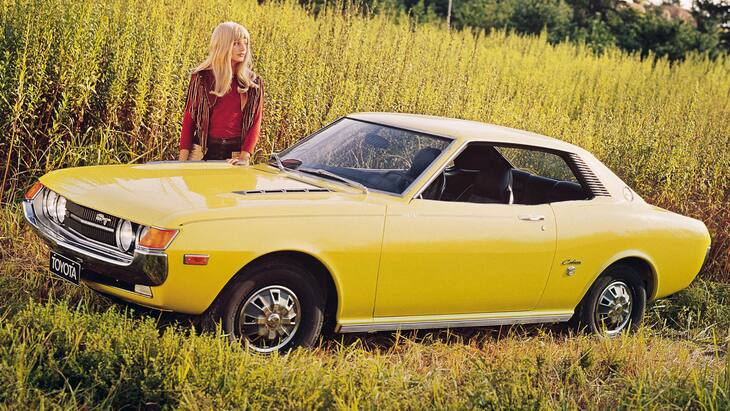
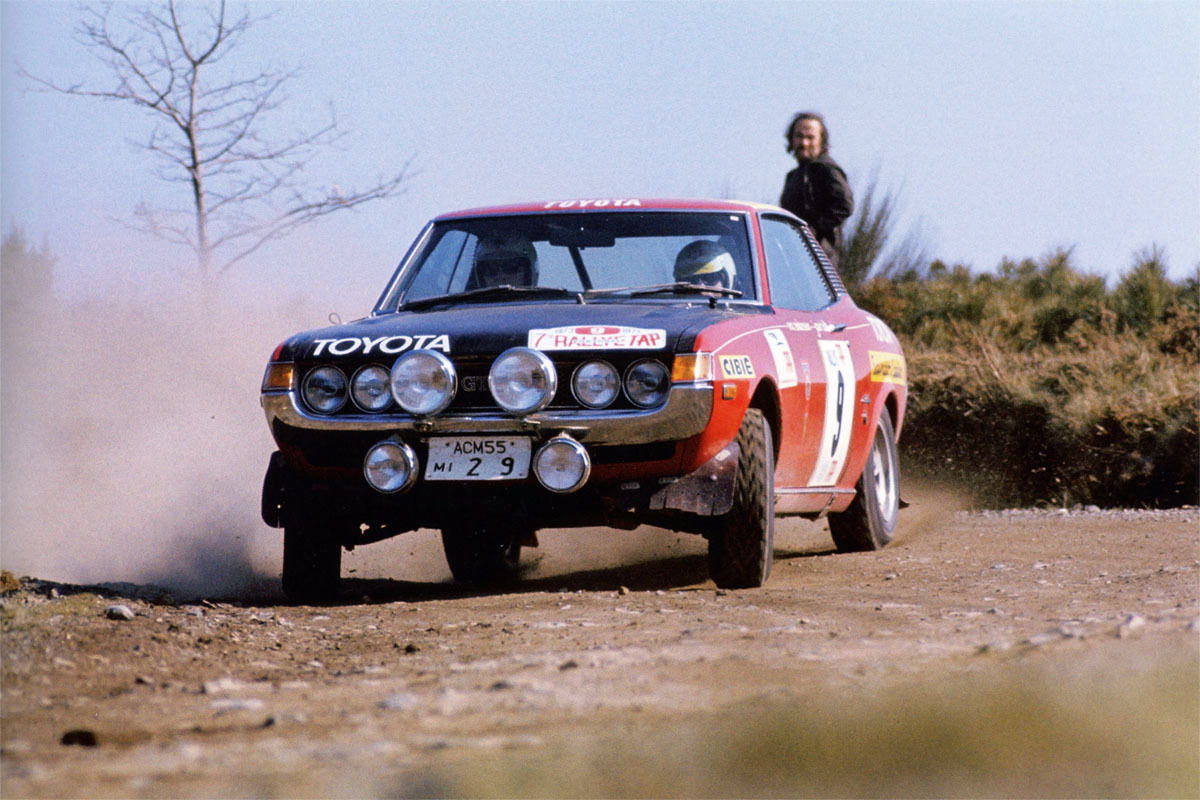
The original Celica, here in cool, 70’s GT trim

Last week however I saw a Japanese car I haven’t seen in a long time and which certainly. has personality. It reminded me of the time when Japanese cars were much less present on Western streets then they are today, meaning the early 70’s (which in turn reminded me of how old I am…). In an effort to change that, and especially to enter the US market, Toyota launched the car I’d just seen, the original Celica, in 1970.

Celica is Latin and means “celestial”, which I guess is the direction Toyota wanted sales to go. And over the coming years, they would be proven correct as the Celica became a very popular sports coupé. However, none of the later series had the charm of the first one, which was of course also Japan’s first try at, if not a muscle car, then at least a cool looking pony car!

The interior, certainly with some US inspiration

Back in Tokyo in the late 60’s, Toyota’s engineers realized that the only cars they had that could come in question for exports to the US and Europe had too small cabins for a normal Western male, and too small engines for their liking. If they ever wanted to make it big on the other side of the ocan, especially the US, that would have to change, and the Celica was Toyota’s first try at doing that.

The Celica was based on the Toyota Carina, perhaps not the best reference in the world if you want to build a sports car, and also a car with which the first Celica shared a few too many parts. But when it launched in the US in 1971, it was considerably cheaper than the Ford Mustang, which certainly helped. That said, it also offered far less under the hood, with a paltry, 1.9 litre four-cylinder, delivering a rather poor 90 hp, coupled to a four-speed manual box. Neither a six-, nor an eight-cylinder was anywhere in sight.

It was certainly no Mustang under the hood…

The original Celica’s looks are both unique as in the angle of the headlights, to the pony car body, also called “coke bottle styling” bridging the 60’s and 70’s. You can spot quite a few US cars in its lines, which is probably no coincidence. It’s also a car along the ladies’ shoe principle, i.e. compact on the outside but roomy on the inside, and this at a time when the Mustang was gaining both in weight and size, but not in power.

Then of course it was also Japanese, meaning it didn’t break, and actually it was the first Japanese car to be fully assembled on an automatic assembly line. It had an independent suspension and disc brakes all around, and of course it was rear-wheel drive, so that even with only 90 hp, if you knew what you were doing, it was happy to swing its tail. That’s all the Westerners needed to know to start buying Celicas in increasing numbers.

No one drove the Celica faster than Owe Andersson!

Swinging its tail in fast corners is also what the Celica started doing on the world’s rally stage, and would continue to do long after the first series. The Swede Owe Andersson was the first to drive a Celica, and he did it so well that he later founded Toyota’s European rally team, something that certainly helped sales especially on the European side of the Atlantic. Of course, later version of the Celica would become both more powerful and all-wheel drive, and make it big on the worlds’ rally scenes.

Going back to the original car however, the first series had a few different trims to choose from, and the engine evolved ever so slightly over the years until the first facelift in 1975, gaining in volume and thereby power, but only to a bit over 100 hp. The Celica was thus never a very powerful car, but as the 70’s moved into the oil crises, that was also not the priority for many buyers. In that sense, it came at the right time, partly explaining its success. The total production number of the first series is uncertain, but over 150.000 cars were sold both in 1972 and 1973, not bad for Toyota’s first try at a sports car in the West!

Japan’s first (and only?) pony car!

Yet as so often, there’s a big question mark around where all these cars have gone today. Sure, build quality was certainly better than rust protection even on a Toyota in the 70’s, and a fair number have simply rusted away. Given its low price, quite a few will also have ended up with young buyers better at fitting a rear spoiler than a new engine, or for that matter, at driving. That doesn’t mean they didn’t try though…

That said, around something like EUR 20.000, you can still find one of the original Celicas if you look carefully. And please do look carefully, meaning going for one with as few skirts and as little plastic as possible, as you never know what hides underneath. Ideally the car should also be complete in terms of parts, because finding spare parts for a Celica from the early 70’s could be “very difficult”, as the Japanese would put it. But if you find the right car, what you’ve then bought yourself is arguably both the coolest Japanese car from the 70’s, as well as its only pony car!

Street finds – the Fiat X1/9!

It’s not only the times that are a’changin, as Bob Dylan noted long ago, but last week in central Europe, very much the weather as well. We thus went from several weeks of wonderful summer days and late dinners on the terrace, to 12-13 degrees C and rain. Luckily things are set to improve, however to something more reminiscent of autumn by the looks of it, so I guess I was very lucky to spot a surprisingly exotic street find just before the weather change – the nowadays very rare Fiat X1/9. It’s no doubt a car that is best enjoyed in the summer, but it’s also a great testament to Bob Dylan’s changing times, as we’ll see!

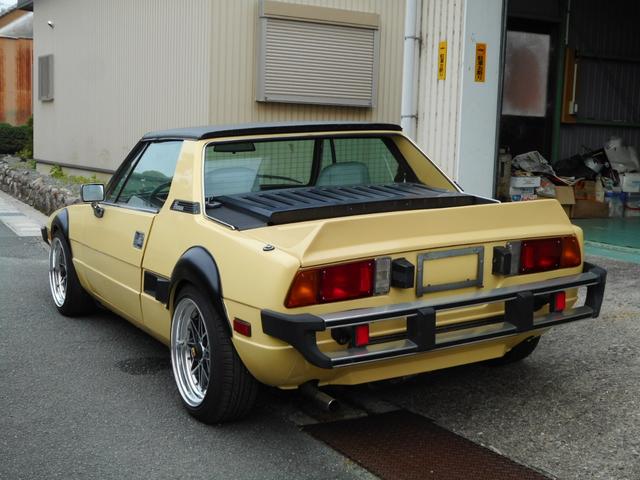
Angular body, engine right behind the seats and thus perfect weight distribution!

The Fiat X1/9 is also very much the flashy family member in an otherwise quite boring group of 60’s and 70’s Fiat cars. It’s the successor to the Fiat 850, a four-cylinder, 60’s creation that looked like a bun (although to be fair, the Spider looked better than the coupé…). But it also belongs to the Fiat 128 family where the rights to the four-door sedan were later sold by Fiat to Soviet Lada, and which most therefore associate with old east-west spy movies.

Contrast both of those with the very futuristic X1/9, and it’s not only the model name that stands out. The angular design with the pop-up headlights was a design that would be if not copied, then definitely repeated in many other 70’s cars, such as the Lotus Esprit and of course the Lamborghini Countach. The X1/9 didn’t look anything like the rest of the family, but somewhat surprisingly Bertone had still designed all siblings, proving design houses can have good and less good days.

Pop-up headlights were of course a must in the 70’s!

As spectacular as the looks was the fact that the engine was right behind the seats, making the X1/9 Fiat’s first mid-engined car. Unfortunately though, that engine came from the boring part of the family, meaning at the launch in 1972 a 1.3 liter, 4-cylinder with a very modest 75 hp, coupled to a 4-speed manual box. In 1980 that grew to 1.5 liters, another 10 hp and five gears. Of course, at around 900 kg it’s fair to say that they X1/9 was a light-weight, but I think we can safely conclude that it looked about five times faster than it really was. That was of course especially true in the US, where emission regulations made the engines even weaker than in Europe.

It wasn’t only emission standards that became strict on in the 70’s, the same was very much the case for safety, again especially in the US. Fiat had actually built the X1/9 with North America in mind and had thus tried to adapt to the coming rules during the development process. Thanks to the mid-mounted engine and the targa body rather than a full convertible, the X1/9 was one of very few cars had no problem complying with what became the new US safety standards.

This gave Fiat’s faltering US a welcome boost, especially since the small coupé was far cheaper than other, somewhat comparable sports cars. Everything was going swell until the mid-70’s when those safety standards were developed further, forcing Fiat to fit what must be the ugliest bumpers in automobile history to the X1/9. Luckily these were later re-adapted to what can be seen on my street find, which is most probably a US import. Around 165.000 X1/9’s were produced in total between 1972 and 1988, and no less than 3/4 of those were sold in the US.

The garden hedge – ugliest bumper ever seen!

As observant readers may have noticed on the first picture, the logo isn’t that of Fiat, but rather of designer Bertone. The reason is to be found back in 1982, when Fiat wanted to discontinue the X1/9 and pull out of the US market, and Bertone therefore bought the rights and continued to produce the car in its name all through 1988. Not much changed on the car in the last years but Bertone would improve both equipment and materials, making the Bertone-branded cars such as the one I saw, the most attractive ones.

So what about the changin’ times? Quite obviously, it’s the concept of a sports car weighing in at less than a ton, making even a small, 1.5 litre engine with less than 100 hp if not plenty, then at least enjoyable enough. This is obviously very far from where we are today and if it sounds like your thing, you may think that with 165.000 cars produced, finding one will be easy. That’s however not the case as very few have survived – estimates talk about less than 1.000 cars in the US. Few are thus up for sale, but those that are tend to come in around EUR 15-20.000 in Europe.

Cars from 1980 had five speeds and (slightly) more power

The only question left to solve is then that around the name, because for a company who have typically been naming cars with real names or with numbers relating to the engine size, how did X1/9 come about? It turns out that prototype cars at Fiat were called X1, with the second number indicating the prototype in the order it was developed counting from a certain start date. The small Autobianchi A112 was for example called X1/2 as prototype, and the X1/9 was thus prototype number nine. It was however the only model to retain the prototype name in actual production and why that was, no one seems to know. But who cares? With the wind in your hair and the humming of a four-cylinder right behind you, you’ll have better things to think about!

The UK’s most successful sports car!

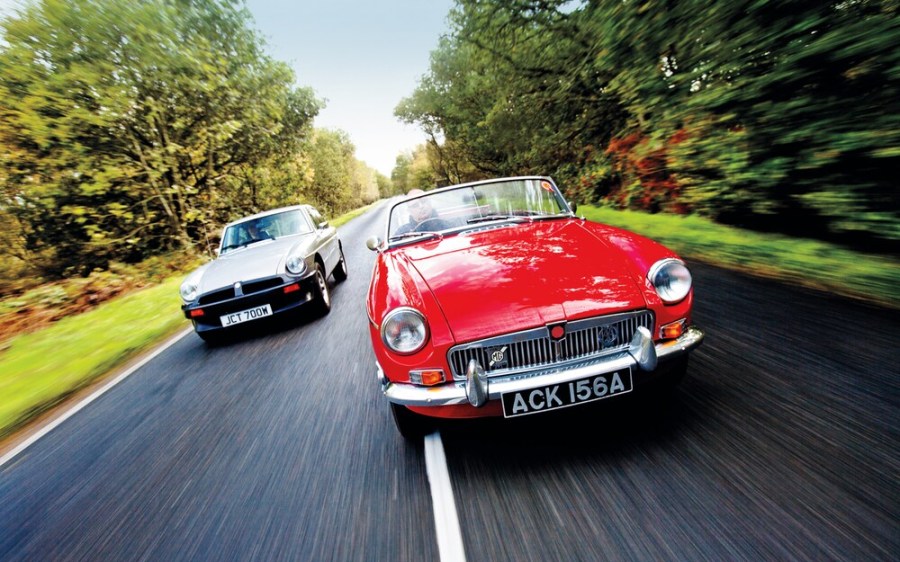
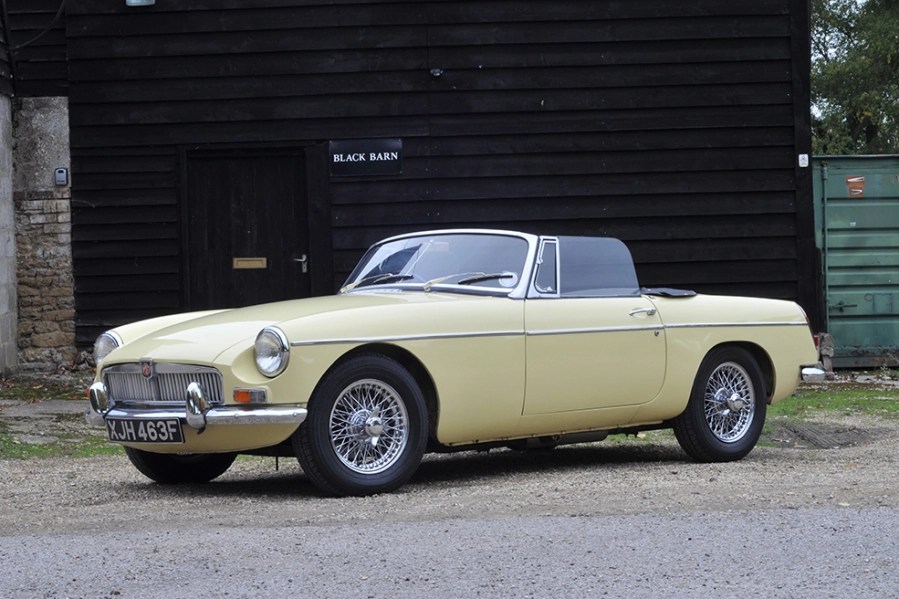
As we’re still in the first half of summer in the Northern hemisphere, the theme of a nice roadster continues to feel very timely. A few months ago I wrote about the legendary Triumph Spitfire, perhaps the easiest and cheapest entry into the British roadster tradition, and more recently we also looked at the forgotten Porsche 914, a German take on the roadster concept. This week we’re back in the UK for a slightly more robust alternative to the Spitfire that remains very reasonable budget-wise – the MGB. And you may be surprised to hear that the car we’re all somehow familiar with ranks as the UK’s most successful sports car ever!

It’s also very timely to look at the MGB right now, not just because we’re in the summer, but also since not only is it 100 years since the Morris Garages (MG) brand was founded, it’s also 60 years since the MGB was premiered. Originally however, MG wasn’t a proper car brand but rather a side kick to the regular garage business belonging to a certain William Morris in Abingdon, UK. In the side business, Morris and his colleagues would take boring Morris Oxford cars, work on them and hereby especially the chassis frame and transform them into if not sports, then at least sportier cars that they would then take to the race track on weekends.

The guys around the car are probably the ones that built it the week before!

In the late 20’s the MG brand separated from Morris Garages and start to make a name for itself in on the racing circuit. It hereby also created a bit of a mystical reputation, often being talked about as a car company with a soul that was almost palpable when you entered the factory. Be that as it may, it was certainly a car company with guts, as the MG guys choose to race the MGB’s predecessor, the MGA, in prototype form at Le Mans in 1955, managing to finish the race with two cars. They continued to do well in 1956, the first official year of production of the MGA, notably in the Mille Miglia.

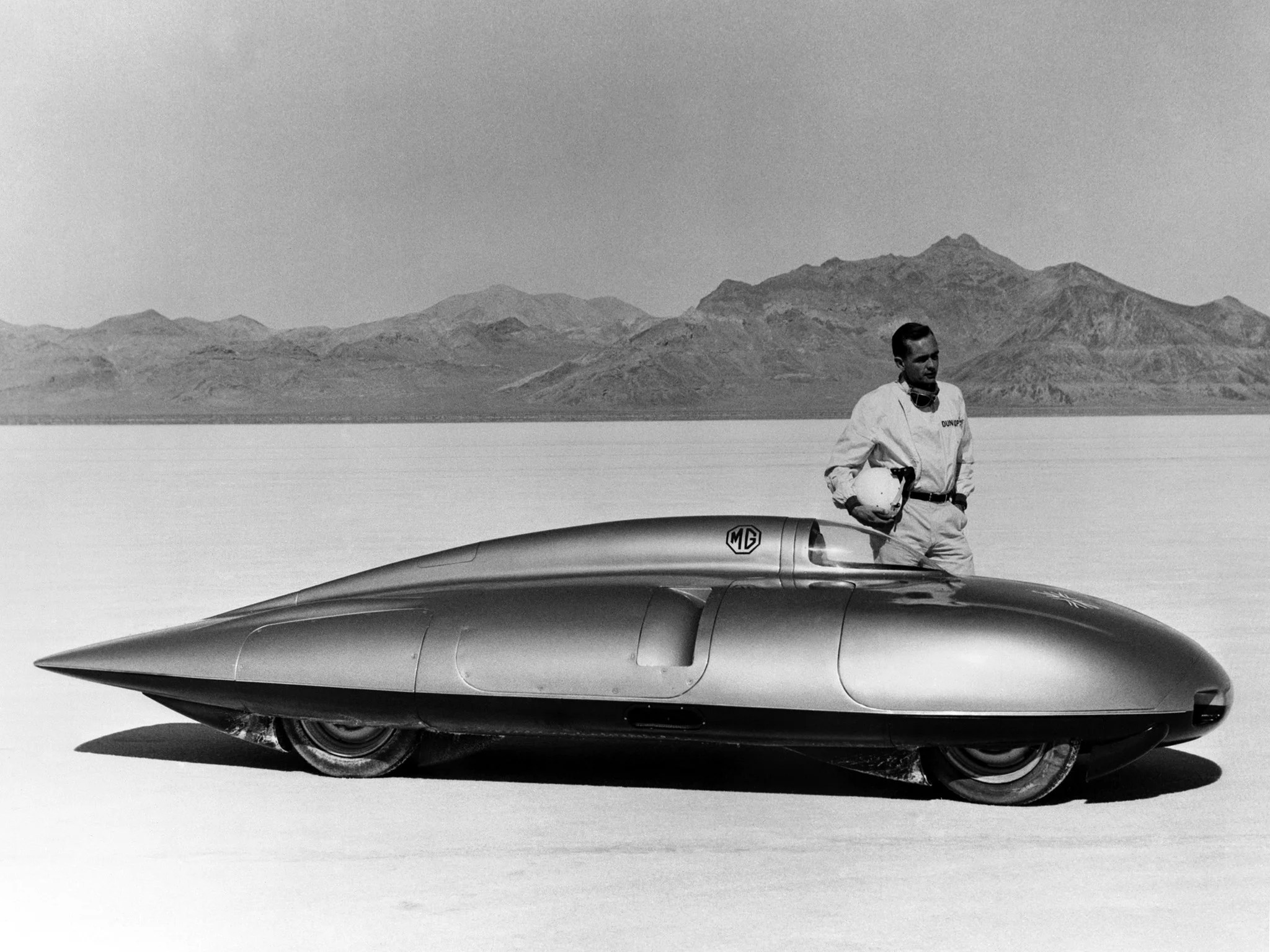
Fast forward to the early 60’s and MG had become part of BMC, later to become the British Leyland group, as was notably Triumph. The time was rife for a replacement to the MGA had come but before that, as a side project, MG built a machine called the EX-181 that looked like a soap and was powered by a 300 hp, supercharged engine. Driven by Phil Hill, the car would set a speed record of 254 Mph (408 km/h) on the Salt Flats in Utah, thereby also doing wonders for MG’s racing reputation. When MG introduced the new MGB roadster in 1963 as the MGA’s replacement, they actually claimed the design was derived directly from the EX-181, which is perhaps something that doesn’t exactly jump to the eye…

Phil Hill was a brave man, driving the EX-181 at more than 400 km/h in Utah…

MG’s original plan was to use the MGA chassis for the MGB as well, but in the development process it was discovered that it didn’t leave enough designer freedom to create the wider but still low car they wanted the MGB to be. MG therefore re-thought the whole project and in the end, built the MGB as a monocoque rather than the traditional body-on-frame construction. One of the advantages of the new construction was enough strength to handle considerably bigger engines but as it turned out, MG would only make use of that in the MGB GT V8, more on that later.

The design of the new car was a purely internal affair, with no fancy Italian design houses involved. Basically the head of design brought his idea to the model maker, who in turn built a small model for approval by the CEO, after which he would do a full-scale model. The development would then start, leading to the finished car a few months later. Not many committees or Zoom meetings there! Even if the MGB didn’t really look much like the EX-181 record setter, most would agree that it’s a nice design, very roadster-specific and relatively timeless. It was also hugely successful notably in the US, to which MG started shipping around 40.000 cars per year in the mid-60’s, as compared to around 5.000 for the UK market.

A timeless look, more modern than for example a Triumph TR4

A selling point for the MGB was clearly the superior room both for people and their luggage that the relatively wide car body offered. Another was no doubt its relative simplicity. The power unit in the form of an 1800 cc, four-cylinder, transersal BMC engine was perhaps not very exciting as it was essentially a larger version of the engine used in the MGA. The 95 hp it developed were however sufficient, but when emission regulations became stricter in the crucial US market, the power number started dropping to just below 70 hp for MGB’s from the mid-70’s. The engine was coupled to a four-speed gearbox with overdrive available as an option, and disc brakes in the front were combined with drum brakes in the back.

To increase the appeal of the car, MG were set on offering the MGB also with a roof, but the MG guys didn’t manage to find a solution that looked attractive, so in the end the had to turn to, you guessed it, one of those fancy Italian design houses. Pininfarina created the MGB GT that was shown to the world three years after the roadster, in 1965. It was also the GT that in 1973 finally saw MG making use of that larger engine bay, by fitting the Rover V8 engine used notably in the Range Rover Classic in it.

The roadster is a great looking car, perfectly usable as a practical daily driver

The V8 may have been bigger but given it was an aluminium construction, it actually weighed less than the 1800 cc four-cylinder, meaning not many modifications were required. There were however various other problems, leading to very few V8’s being produced. On one hand MG could never get enough engines from Rover to build as many cars there was demand for, and on the other that demand quickly vanished with rising oil prices in the 70’s. In the end, the V8 would be taken out of production only two years later, in 1975, after no more than some 2.600 GT V8’s had been built.

Given the increasingly tough regulations not only on emissions but also on safety standards in the US, the 70’s weren’t kind to the MGB. I’ve mentioned the dropping engine power of the 1800 cc unit above, and added to that were some pretty horrific, moulded rubber bumbers that MG had to fit to the cars from 1975 onwards, replacing the stylish chrome model that had been used until then.

The late 70’s wasn’t a great design period for the MGB – either…

There were other, corporate problems as well, linked to a generally cash-strapped British car industry and other British Leyland brands such as Triumph that were given higher priority to develop the futuristic TR7, rather than trying to modernize the ageing MGB. And so the last MGB rolled out of the factory in Abingdon in 1980, and the factory itself closing its doors later the same year.

Between 1963 and 1980, no less than 387.000 MGB’s were produced, a record for any UK sports car. To that should also be added 125.000 GT’s, a pretty remarkable number given the far shorter production run, but only 2600 MGB GT V8’s. This is of course reflected in today’s prices with the V8’s being most sought-after. They start at roughly twice the USD/EUR 20.000 the four-cylinder roadster or coupé trade at in good condition. At that level it’s difficult to go wrong, as the MGB is also a simple and thereby economical car. Get a nice roadster version with chrome bumpers, and as a US MG commercial at the time would say: “at no extra cost, MG gives you the sun!”.

Buying right, and at the right price!

What do you remember about March 2022? Russia had invaded Ukraine only a week earlier, there was a coup d’état in Burkina Faso (yes, I had to look that one up…), and then the Fed started the current rate raising cycle, thereby ending a decade of zero interest rates or if you will, free money. As we know now a year later, the subsequent increases to the current level were the quickest in history, and it’s not clear if we’re done yet. They’ve happened against a background of rising inflation after as said, a decade of zero rates and money printing, by the same central banks who are now trying to contain the inflationary pressures that resulted from it.

When you don’t get any return on your savings, you try to do so by putting your money elsewhere. And so over the last decade, pretty much every type of investment has had a good run that at least partly came to an end a bit more than a year ago. One of the best areas to put your money in this period has been various types of collectible cars – oldtimers, race cars, and then with time, pretty much every car beyond a certain age, never mind really how collectible it really is. That’s what we’ll talk about today, as everything that is priced as a collectible certainly isn’t one, which is something the new market environment will no doubt show us. I have however recently seen some excesses in the market that are frankly just ridiculous and that show that a new balance hasn’t been found yet. Being sensible in your planned car purchase is therefore more important than ever!

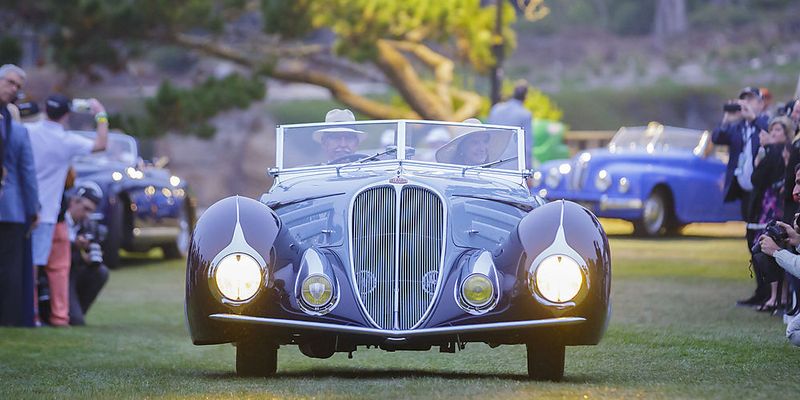
Pebble beach and other car shows have been spectacular in the last years!

Back in 2020 I wrote a post you can find here, where I went into some aspects to consider when buying your dream car. I also emphasized precisely that, i.e. that you should really buy the car because of your love and desire for it – not because you think it will increase in value. Although many cars have continued to do so, that’s worth remembering. Firstly, whether a car will rise in value or not is never a given (except perhaps for a small number of hyper-exclusive and very limited series). Secondly maintenance, storing, insurance and running any car, but especially collectibles, eats up much of the potential value increase, so at the end of the day there often isn’t much left. then again, that’s perfectly alright as long as your priority has been to enjoy the time spent behind the wheel!

You may well think this is too negative, and that value appreciation on, say a manual Porsche 911 of certain series is all but guaranteed since they haven’t yet reached the stratosphere (well, most have, but not all), and they’re becoming fewer and further between. That’s true, but then again so is a Porsche 944 which still hasn’t gone anywhere and probably never will – although its sibling (and less good looking) successor, the 968 has. I’m certainly not claiming there aren’t cars that will rise in value going forward, I’m just saying that you shouldn’t bet on it, and it’s not what should guide your purchase.

Today worth twice as much as its better-looking predecessor…

That said, there are a few clues to help you select a car that is both a joy to drive and can be expected to hold its value relatively well. A manual gearbox is certainly one such thing, if you look for example at a 911, a Ferrari F355, and a bunch of other cars that are 10-20 years old. Production numbers is another, as special series or limited production runs tend to hold values better. The right engine will help, as will provenance, given a famous previous owner tends to do wonders for the price. I find this last one a bit strange since it’s not like it says “this used to belong to (select your favorite famous person)” on the car, but I guess there are things that can’t fully be explained by logic…

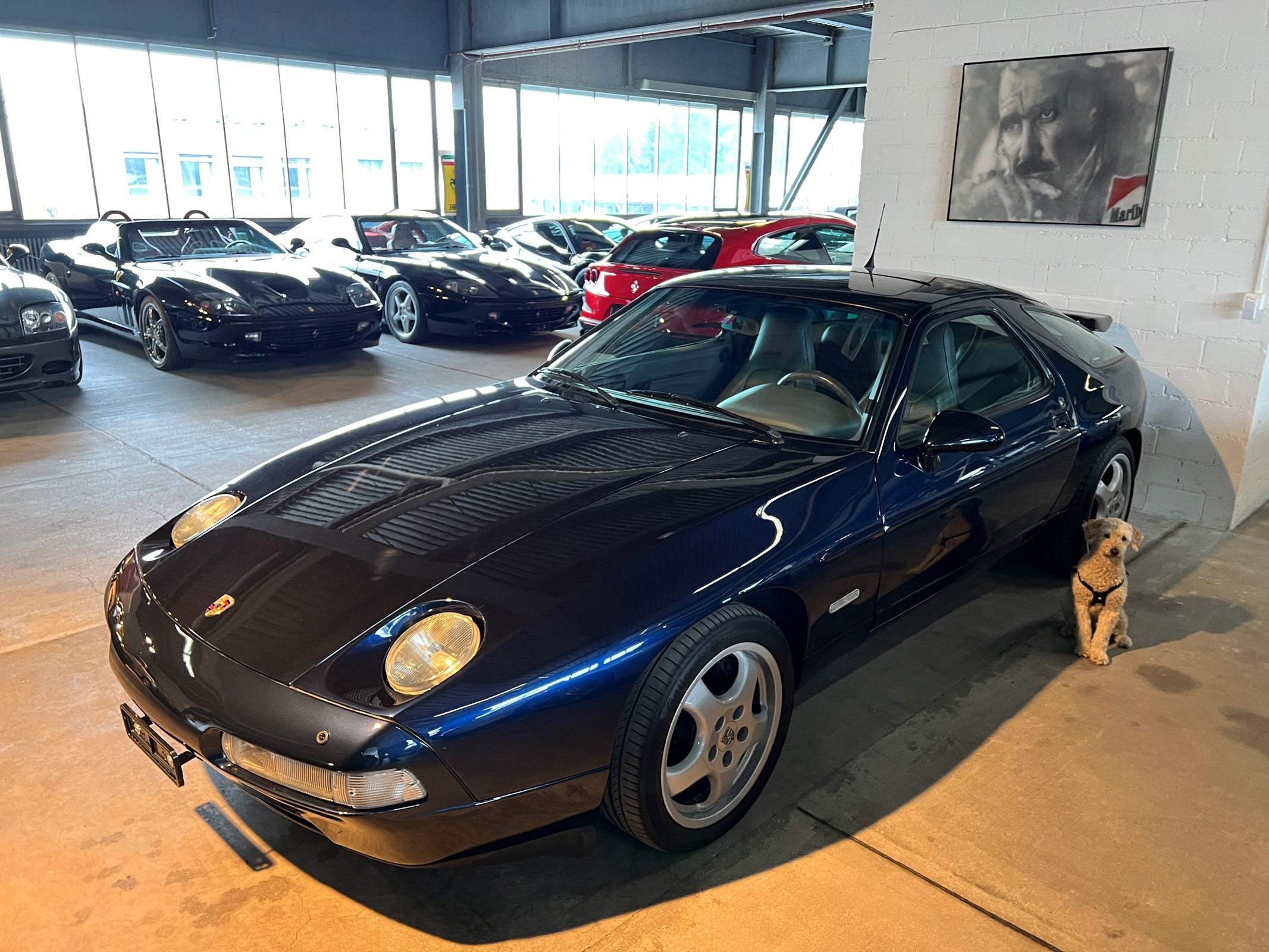
A case in point is a classic dealer in the Zurich area who has a Porsche 928 GTS standing in the showroom. With 90.000 km on the clock the mileage is ok but not exceptional, as is the general condition of the car – very good, but not mint. The GTS was the last iteration of the 928 produced in the early 90’s. At 350 hp it had the highest power output of all 928 series and is for many the most attractive in the range, provided however that it’s a manual, which this wasn’t. The dealer had tried to compensate this with a big sign saying “Prominent Swiss previous owner”.

The dog is not included in the price…

This country is great in many things, but it’s not like we’re lining up famous people. The only two can think of who would motivate paying more for a car according to this logic would be Roger Federer, who’s however tied to Mercedes-Benz through sponsor contracts and, well, Tina Turner, who spent the last 20 years of her life in a magnificent villa on the shores of the Zurich lake. She obviously just passed away, may she rest in peace, but before that was mostly seen in a green Bentley. The “famous previous owner” is thus most probably no one known outside of the local Zurich circle. And it doesn’t warrant you paying – hold on to your chair – around USD 110.000 for this particular 928, especially when a far more desirable manual GTS can be had in similar condition for USD 20-30.000 less. Which is still double what they cost 2-3 years ago.

Another even stranger category is that of cars that someone bought a number of years ago and never drove, so that they’re now sold with very low mileage, most often in a condition close to new – at least on the outside. Obviously, if you’ve stored a car away for 30-40 years, it’s really important to know how it’s been stored, and also if it’s been maintained throughout. Because a car that is left standing for a number of years without no one attending to it, is not a car you want. Then the question is of course also whether there’s anything attractive with the car apart from the fact that no one’s driven it, or if it’s just an old car?

Irresistible? Rather very resistible…

An example of this is a VW Golf GL Diesel from 1983, advertised by one of the most well-known classic car dealers in the region. Someone bought this 50 hp monster 40 years ago, sealed it, and put it away, so that it only has 2.000 km on the clock. I guess the 50 hp were not that exciting even back then… It’s most probably been stored correctly and maintained throughout, but who on earth would pay the asking price of around USD 28.000 for a car that wasn’t even desirable when it was new? I can think of a large number of far better, more modern and certainly more fun small cars for that money, and I’d be really surprised if this example doesn’t sit with the dealer for a long time. As if this wasn’t enough, the 70’s shade of brown really isn’t a particular desirable color,

It’s not all bad though, because the gems are still out there, you just need to be patient and look out for them. Coming back to 911’s, and more specifically one of my favorites, the 997 Turbo, I’ve spotted a manual 2009 car in silver with a red leather interior and all the carbon packs you could have at the time, and around 85.000 km on the clock. It’s in mint condition and has had one previous owner, the F1 driver Jarno Trulli (who raced between 1997-2011 and had the good taste of scoring his only win in Monaco in 2004).

I need to find a good reason to put my money here…

Whether he’s famous or not is not the point, it’s more that I would assume that an F1 driver for one drives the car correctly (albeit fast…) and also knows, and has the money, to maintain it properly. Then again if that isn’t the case, I wouldn’t hesitate going for a car where it is, no matter who the previous owner is. At an ask price of around USD 85.000, the car is only slightly more expensive than comparable cars, but that is probably warranted by its history.

Desirable? To me, absolutely, I’ve had my eye on the 997 Turbo for a while and actually find the red interior pretty cool, although it’s not for everyone. Will it increase in value? Maybe, then again it certainly won’t be free to run. Does it make my “car buying pulse” increase? Definitely – at the thought of driving it that is, not speculating about its potential future value increase. If you ask me, that’s exactly as it should be. Now I just need to find a half-rational argument for it…

Street finds – the Rolls Royce Corniche Cabriolet!

Spring has been slow, cold and wet this year, which is actually the way it is most years if you live in Switzerland. Of course, at least if you’re me, you forget about it being the case over the winter, so I still manage to get as disappointed every year in April when the rain keeps on falling. Last week therefore brought a nice change for the better, also motivating the lucky owner of this magnificent Rolls-Royce Corniche Convertible to bring it out of the garage where it’s no doubt been sleeping through winter, and allowing me to capture the first street find of 2023!

A beautiful Mk III Corniche, as can notably be seen on the bumpers

How do I know it’s slept in the dry over the winter? Well, even though it’s clearly been renovated, and this to an extremely high standard, there is no doubt that this was a car lucky enough to have a meticulous owner who would never leave her outside during the cold season. I’m almost sure the owner has a Range Rover to take him through the dark months, as the two of them would really form an almost ideal pair. Of course, he could have a Cullinan as well, but surely no one with enough taste to renovate a Corniche Cabriolet would buy a Cullinan?

When it was launched in 1971, the Corniche was very appropriately named after the magnificent Haute Corniche, a curvy road stretching from Nice to Monaco on the French Riviera. The automobile (surely you can’t call anything as magnificent simply a car?) became a real long-runner for Rolls Royce. When it was presented, the company had gone over to be owned by the British state, following some not very successful deals involving its flight division. And yet when you see the Corniche, you would never believe it’s been created by anything other than a company awash with cash, such as the opulence it offers its owner. It would be built for all of 24 years until 1995, something today’s car builders can only dream of.

This dark blue beauty with its (no doubt new) cognac hood and interior is a Mk III, meaning it was built sometime between 1989 and 1993. That means it has the updated interior, as can be seen notably on the center console, but still the 3-speed automatic gearbox (a fourth speed would come with the fourth series), and about 200 hp from its 6.75 litre V8. Of course this was the period when Rolls wouldn’t divulge the exact power output, rather referring to it as “sufficient”. It certainly was for the way you’re supposed to drive a Corniche, but by modern standards, 200 hp for a car that weighed close to 2500 kg really isn’t much to write home about.

It should really be the ocean you see ahead!

However Rolls was of course right. You don’t need more power when driving a Corniche, and certainly not the convertible version. It’s a car that fits best along the road it was named after, arriving in Monaco as the sun sets over the Mediterranean in time for a an early supper at the Café de Paris before trying your luck at the Casino. It’s perhaps the ultimate symbol of British blue-bloodedness but above all, to me it’s one of the most beautiful cars ever built. Given the money this owner has invested to keep it in a shape very close to new, I hope we have a sunny and long summer to look forward to!

GTO – three-letter magic!

I spent a few weeks in Singapore some years ago and notably had the opportunity to catch up with a local reader of this very blog, as crazy about cars as I am. He was kind enough to take me to one of the leading, local supercar dealers on what felt like the outskirts of the city, and what he had on offer was very impressive indeed.

The issue is however that if you think speed limits are tough in Europe, that’s nothing compared to Singapore. In addition, the number of cars in the small country is regulated, so before buying a car, you need to buy a license giving you the right to buy one. The number of licenses is of course limited and the price for one varies a bit but was around $100.000 in 2022, and that’s before you’ve spent a dime on the car itself.

It’s not far from Marina Bay to Malaysia…

That said, if you have the money to buy a supercar, spending another 100 grand on a license may not a big deal. The remaining question is however where then to drive the car like it’s supposed to be driven. As it turned out, the supercar crowd in Singapore had a plan for that as well. As a member of the local Ferrari club told me, for their club outings they drive across the border to Malaysia and rent the Sepang F1 circuit for one day. That’s what I call a track day!

Of course, track days is something we have in Europe and the US as well, although in a slightly less dramatic setting. These days however, the car you take to a track day is typically a racing-oriented street car, such as for example a 911 GT2-GT3. Looking back, it used to be the other way around….

One of, if not the, most legendary car in the world – the 250 GTO

To come back to the heading of this post, the three letters GTO have a direct connection to what we today associate with track days. They stand for Grand Turismo Omologato (homologated), meaning the cars a manufacturer had to build for road use for a race version of the same car to be approved. When hearing GTO many of you will directly think of the most expensive and perhaps the most legendary car in the world, the Ferrari 250 GTO, of which 36 cars were homologated for road use.

It’s often referred to as the last true road racing car since after it, safety regulations would put a stop to such extreme machines being used on public roads. In other words, this wasn’t a street car you could race on weekends, but rather a race car you could drive on public roads. Or as Shelby Myers, a car specialist at RM Sotheby’s put it: “this was the last car that you could park in your garage, drive to the track, win the race, and then drive home.”

Racing on Sunday, commuting on Monday…

All 36 Ferrari 250 GTO’s were built between 1962 and 1964, and none of them were identical. They were a development of the 250 GT-series with the center piece being the 3 litre, 300 hp strong V12 with six Weber carburetors and a five-speed gearbox (increased to 4 litres and 390 hp on the three cars built in 1964). The development of the car was led by the legendary Giotto Bizzarrini (read more on him here and here), although he left Ferrari before the GTO was launched.

The cars were built by Scaglietti and Enzo himself apparently selected who was allowed to buy them. With a top speed around 270 km/h, the GTO won the GT World Championships in 1962-1964 and various other races such as Le Mans, Targa Florio (see here) and the 1000 km race at Spa Francorchamps. In total, it accumulated more than 300 race wins under its belt.

At $70m, the price record for this GTO still stands

The GTO is often considered the last great front-engine GT car built by Ferrari. That’s not the only thing it’s been called though. Other descriptions include the most beautiful Ferrari ever built, a true living legend, and rightfully, the most expensive car in the world, It’s perhaps no surprise that buying one takes a big wallet, but just how big is illustrated by the fact that in 2014, a GTO was sold for $38m and in 2018, the current record was set at $70m. The car in question was the 1964 Tour de France winner which thereby became the most expensive vehicle ever sold. Its price as new in today’s money would have been around USD 150′, so in other words, a pretty solid investment return!

The 250 may thus have been the last true GT car, but it was not the last GTO. Fast forward to 1984, when Ferrari introduced the 288 GTO at the Geneva Auto Salon. The car cost around $300.000 at the time, for which you could have got no less than for example three MB 500 SL’s, and it sold out before the Salon was over. If you find a 288 GTO today you can add a zero to that number, which still makes it a bargain compared to the 250 GTO. It may be far less legendary but not less important – rather the contrary.

The 288 GTO set Ferrari’s hyper car strategy for the future!

The 288 GTO (later called only GTO) was launched in period where Ferrari’s line-up with the 308, 328, Mondial and 412 was not the best it had ever been, and the company wasn’t doing very well financially. The new 512 was indeed an extravagant sports car in Enzo Ferrari’s taste, but he wanted something more. Or was it maybe the changes in the Group B rally regulation that motivated the GTO?

We’ll never know for sure, but what we do know is that the racing version of the GTO never happened. Instead, Ferrari reluctantly agreed to increase the street car production from 200 to 274 cars (yo have to think that some of their most faithful owners were pretty influential people already then…). And hereby, without knowing it, Ferrari had also found the formula for hyper car success that’s taken them all the way to today.

For the untrained eye, a GTO could be mistaken for a regular 308. If you look closer though, you see that it’s a bit longer (110 mm to be exact) different headlights. It’s a beautiful car in a more dynamic way than the original 250 GTO was, and looking at it today, it has an 80’s cool factor about it. The longitudinal, double-turbo 2.9 litre V8 put out 400 hp and given the car only weighed 1300 kg, that was enough for a 300 km/h top speed. The GTO hereby became the fastest Ferrari ever, and one of the fastest cars of its time.

As for Ferrari’s future strategy, the attention the GTO got helped lay the foundation for what would become a very successful formula for hyper cars from Maranello: no more than 500 built, technologically at the top, and buyers carefully selected. The F40 followed the same logic as did the F50, the Enzo, and later the LaFerrari.

As a side benefit the increase in value would follow almost automatically. Apparently the group of owners who were selected and thus own all the cars listed above is larger than you think, and they’re no doubt thankful to the 288 GTO for being not only a great car, but also for making what followed possible!

The most bling-bling of them all!

For most of us including yours truly, the Thrill of Driving (ToD) apart from being the name of this blog, refers to exactly that, i.e. the wonderful feeling you get from driving, say a manual 911 Turbo up a twisty mountain road, for example here in Switzerland. Then again, what really constitutes the thrill varies, also as we get older. Some people will think of it as maximum straightline speed, as in a Tesla Plaid. For others it’s hearing the screaming sound of a 12-cylinder from Sant’Agata. And then again for some, it’s more about the Thrill of Being Seen than the driving itself. And whereas a Lamborghini works pretty well also for this purpose, there used to be a brand out there that was only about turning a maximum number of heads. This week we’ll look at the almost forgotten creations from Excalibur, the craziest thing to ever come out of Milwaukee!

Brooks Stevens was an American industrial designer, specialized in cars and bikes, who worked at Studebaker where he had been commissioned by CEO Sherwood Egbert (yep, really) to design a spectacular car to put on the company’s exhibition stand at the NY motor show in 1964. He came up with the idea of creating a car with modern running gear, but in the style of the pre-war Mercedes-Benz SSK. The chassis came from a Studebaker Lark Daytona, over which a fiberglass body draped. The car was called the Studebaker SS and it was a great success with dozens of orders placed during, and after the motor show.

The Excalibur, inspired by the Mercedes-Benz SSK

Unfortunately Brooks’ creation wasn’t enough to save Studebaker that went broke the same year. Stevens was however determined to bring his car to market and did so by setting up his own company together with his sons. They called it SS Automobiles and the car they launched, very reminiscent of the Studebaker SS, was given the name Excalibur. Equipped with a 300 hp, small block Chevy V8 from the Corvette, production of the Excalibur started in 1965. The car’s low weight of about a ton gave it spectacular acceleration for the time, needing less than six seconds to 100 km/h with a 200 km/h top speed. The car was a success and in 1968, the roadster was complemented by an even more spectacular four-seater, the Phaeton.

All cars from Excalibur were hand-made and thus individual

With two oil crises in less than 10 years, the 70’s was certainly not the decade for V8’s on paper, but it didn’t hinder Excalibur from introducing an even bigger V8 and continue to do well without much of design updates. The general design was of course why clients bought the car in the first place, and given all cars were hand-built, a lot of smaller wishes could still be accomodated, as seen from the multitude of Excalibur models. Still, the company was also slightly schizoophrenic, choosing for example to sacrifice basic things such as roll-down windows (rather than just sidescreens) all the way into the 80’s. The Roadster was by then in its fourth series, but the engine had been heavily capped to a smaller V8 with only 155 hp – not even an Excalibur could completely avoid the oil crisis. The problem was that over the years the weight had almost doubled to close to two tons, meaning this by now was very far from being a performance car. It was also far from being a good deal with the price having increased about as much as the weight, to around USD 170′ in today’s money…

A Phaeton 1978 was definitely not a sports car, especially at 155 hp..

As spectacular as the Excalibur was, buyers no longer found this a very interesting proposition, Stevens had to file for the company’s first bankruptcy in 1986, and this woud be the start of a long line of owners over the coming years who all tried to revive the business, and who all failed. Henry Warner took over Excalibur in 1987, created the Excalibur Marketing Corporation with a plan to sell the Excalibur Series V. The engine was back to the original V8, but prices were roughly the same as before and success wasn’t much bigger. Warner sold far too few cars and had to throw in the towel only three years later, in 1990. A certain Michael Timmer then bought the rights to Excalibur, but he went bust before he’d made any cars at all. The last in the tragic row was Udo Geitlinger who acquired the rights to build Excaliburs in 1991 and relaunched the brand three years later with the Roadster Series VI. They would sell a few dozen cars but towards the end of the 90’s, the Excalibur lights went out for good.

Original Mini-like angle to the steering wheel, not much side support on the seats!

There is still an Excalibur Motor Corporation today, but that is one focused on restoring and maintaining as many of the existing cars as possible, both the Sportster and the Phaeton, with no plans for any new cars. In total, around 3500 Excaliburs were built through the years, all in the company’s home town of Milwaukee. How many have survived to this day isn’t clear, and it also seems to be matter of debate whether you like Excaliburs to have survived at all – no one is indifferent. But in a very uniform car world, isn’t it a breeze of fresh air when someone sets out on an arguably crazy project such as this one, and still manages to build a few thousand cars? Personally though, I don’t have any special feelings for the Excalibur. I’ve never driven one but knowing it’s a 60’s US car with a big V8, lots of power, a steering wheel tilted like a bus and initially radial tires, something tells me it’s more at home in a straight line than on a twisty mountain road. And it’s certainly not a car for the shy!

Bristol cars – as British as it gets!

What do Sir Richard Branson, Liam Gallagher/Oasis and Tina Turner have in common? I guess Tina or Liam may well have listened to the other’s music while travelling on one of Richard Branson’s Virgin planes but as you’ve guessed, that’s not the connection I’m after. That would rather be that they have been, or still are, owners of a Bristol automobile, perhaps the most British of all UK car manufacturers. With a long-term building philosophy of “no more than 2-3 cars a week”, never more than a single show room in London’s Kensington High Street and an at times very particular view of what good car design is, it’s really no surprise that the brand hasn’t survived until today – but it is a surprise it lived on as long as it did! Before Bristol is completely forgotten, it’s well worth having a deeper look at one of the UK’s quirkiest car companies and some of the wonderful cars they built during the 70 years it was in existence!

As many other car manufacturers, Bristol had its roots in airplane manufacturing but even before that, as a builder of tramways in the UK. The tramway company started operations as early as 1875 and business was especially good during WW1 when the Luftwaffe kept damaging the tramway’s power lines, thereby creating a need for lots of maintenance work. With the tram business up and running and the Wright brothers having flown over the English Channel, it became clear to Bristol’s founder George White that the future was in the air. The airplane business started in 1910 and enjoyed an equally good business in the run-up to WW1. As for so many other military suppliers though, when the war ended, orders no longer came in. Bristol had no choice but to diversify again, creating the Bristol Car Company in 1918. However, it wasn’t until the 1950’s that it really came alive.

The Bristol 400, Bristol’s first car.

What really got the car business going was a collaboration with Frazer Nash, at the time UK importers of BMW. Somehow Frazer Nash came in possession of all the drawings and specifications of the BMW 326-328 after the war and it was based on these that Bristol built and presented its first car in 1946, essentially a remodeled BMW introduced under the name Frazer-Nash-Bristol. The engine was the same straight six the Beamers had under the hood, but this and later Bristol cars weren’t just copies of the respective BMW’s – they were improved in several ways and already in the 50’s earned a very good reputation. Even though the official collaboration with Frazer Nash ended the year after, Bristol’s 400 series would go on and include all cars until the 80’s. Starting with the Bristol 400 in 1947 and along with the following Bristol two and four-seater cars until the 406 (and there were models for all numbers in between), the cars were all powered by the same two-litre, BMW straight six engine.

The Bristol 50’s factory didn’t change as much as others in subsequent years…

From the start, Bristols were thus positioned as luxury cars and comparable to the Jags and Bentleys out there. Of course all cars were hand-built back in the 50’s and 60’s, but Bristol did so in line with the British car building tradition and was quickly seen as an alternative to for example Jaguar. The cars were built to high engineering standards, said to be “built to last”, apparently to the difference to some other cars of the time. This together with the exclusivity that comes from building such small series of cars was what Bristol felt justified the high price. The “no more than 2-3 cars per week” was probably all the company could do anyway back in the 50’s, but the motto lived on through Bristol’s full history, making any Bristol a very rare automobile these days. Some of those will be far more desirable than others. If the early 400 series Bristols from the 50’s drew heavily on BMW, the 60’s and early 70’s models were certainly the high point of Bristol’s own design. You’d be excused for thinking that the design department was on long term leave during the following decades when you see later cars.

The interior of a Bristol 406 – very nice and very British!

Starting with the Bristol 407 the company switched to a Chrysler V8 engine which from the 411 (most cars) and onwards (all cars) was the large 6.2 litre one. The 411 is actually worth a special mention as perhaps the nicest of all Bristol cars. A total of 287 were built between 1969 and 1976, with the big engine making the car capable of a top speed of 230 km/h which you would have to be very brave indeed to exploit. This made Bristol the cool and far less common alternative to the Jaguar XJ-C or the Jensen Interceptor that I wrote about back in October. Engineering-wise it was certainly comparable and in the looks department, it was certainly up there with the XJ-C and some Italian beauties, which is saying a lot!

The 411, perhaps Bristol’s nicest car in my humble opinion

The late 70’s and early 80’s were certainly not known for good design and nowhere was it worse than at Bristol. Starting with the 412, the company’s efforts to modernize the lines failed so spectacularly that fans pretty much gave up on the company, starting its long demise. Cars like the 90’s Blenheim roadster were seen as dated already when they appeared, and it was in a last effort to save the company that Bristol developed the Fighter, built between 2004 and when the company went into administration in 2011 in around a dozen examples (no one knows for sure). It was a pretty extraordinary car, looking like nothing else and powered by Chrysler’s V10 Viper engine, here producing around 500 hp and coupled to a four-speed autobox. Bristol had plans to build around 20 Fighters a year and also to launch a turbo version with twice that power (yes, really!), but that wasn’t to be. Given the low level of interest the Fighter generated, probably due both to the particular design but perhaps even more to the GBP 230′ price tag, no other Bristol car would ever see the light of day.

The Fighter would be Bristol’s last car – not sure about the license plate

Bristol Cars went into administration in 2011 and was then bought by the Swiss Kamkorp group who never managed to bring out any new models so that until the lights were finally turned off in 2020, the company mostly renovated and supplied parts to older Bristol models. In 2016, the Bristol veteran Richard Hackett was one of the founders of a company called SLJ Hackett, today one of the main distributors of older Bristol cars. SLJ offers most Bristol models for sale and with prices starting around GBP 50′, they are more affordable than you may think. So if you want to do what Sir Richard, Tina Turner and Liam Gallagher did, then SLJ Hackett is the company for you. It goes without saying that the driving pleasure will be from the right side only – after all, who would come up with the strange idea of driving on the other side? Unfortunately there’s no place for companies like Bristol in today’s car world and that’s a shame, because it could certainly use a bit more of them!

The forgotten lord

The Range Rover is the most legendary luxury SUV out there, and it’s now been around for more than 50 years. The brand new model of which deliveries started early this year is however only the fifth generation in the line-up. The original Range Rover was built for all of 24 years, the third generation L322 for 11 years and the L405, the predecessor to the fifth generation of which I have one in the garage, for 10 years without major modifications. You will have noticed that the second generation, the P38, is missing from the above. This is a car that was never really loved, had the worst reputation of them all and had it been possible to stop, would probably never have been launched in the first place. Doesn’t really sound great, does it? This means that the P38 is very much at the bottom of the Range Rover pack in terms of secondary market values (or put differently, it’s dirt cheap), which is something that always intrigues me. This week, we’ll therefore look at the forgotten lord, the P38, to try to figure out if it’s best left to die, or actually something worth considering!

It was certainly not a very confident Rover company that presented the P38 in 1994. Rover had been taken over by BMW the same year in a merger that will not go down in history as the most thought-through, and when the Bavarians came up to the Rover factory in Solihull and saw the new Range project, they were apparently far from impressed. This was the car that was supposed to succeed the Classic that was was already then a legend, and BMW didn’t feel it was even ready to be released. They were however far too late to do anything about it and in the same year, the P38, somewhat half-heartedly, was presented to the world. Production of the original Range actually continued a couple of years in parallel to the new car, and the development of what was to become its successor in 2001, the L322, had already started. Talk about being an unloved child and with a build-time of only seven years, the P38 is (until today) the shortest-lived car in the Range line-up.

Early P38’s are recognized by yellow turn signals front and back

What is clear just by looking at it is that the design is nothing Rover needed to be ashamed about. What was to become the P38 was developed internally at Rover and the final project was preferred over four other, notably one from Bertone. Rover definitely made the right choice, as the P38 is a good-looking car and unmistakenly a Range Rover. The low waistline and big windows give it a friendly look and have the additional advantage of making it easy to place the car on the road, which to be fair is also helped by the fact that at 4.7 metres length and 1.9 metres width, it’s far smaller than later Ranges. The P38 was available with three engines, two versions of the Rover V8 at 4 and 4.6 litres, and a six-cylinder BMW diesel at 2.5 litres. Of these, the only one you should ever consider is the 4.6 l, as even that only puts out 224 hp and 380 Nm of torque and doesn’t make the Range a fast car. The 2.5 litre diesel delivers a paltry 136 hp, less torque than the V8 and needs a spectacular 17 seconds to make it to 100 km/h. It’s not even very economical doing so. All engines are coupled to a 4-speed automatic in a body-on-frame construction.

As in all later Ranges, the interior of the P38 is a very nice place to be, with a very distinct smell from the leather and other materials used. This was very much intentional as Rover had understood that with the introduction of the P38, these cars would start moving away from the pastures onto the roads, meaning buyers would expect a more luxurious interior. There is thus almost as much leather and wood in one of these as in a modern Range and although comfort is not the same at the same level, the air suspension helps you travel in high comfort. I’ve had the pleasure of doing so several times through the years, and the P38 provides exactly the same commading driving position in a plush chair as later – and more expensive – Ranges do. With an engine that doesn’t encourage anything but soft cruising that’s all you’ll ever do, and the P38 will be an excellent companion. All cars were well equipped by standards at the time, with the HSE being better than the SE, the Autobiography better than the HSE and with special series like the Holland & Holland bringing additional goodies.

A low waist line and large windows give a very airy feel!

So what about the quality and BMW’s feeling that the new car wasn’t ready to be released – has history proved them right? It certainly didn’t take long before the P38 started developing a reputation for bad reliability. This may not have been the case had buyers come from Rover’s traditional crowd, but BMW and other owners who were convinced to spend a lot of money on a new Range were far less understanding than traditional Rover buyers of regularly having to clean oil off their driveway. Having said that, all Ranges have a reputation for bad reliability, including mine which I’ve now had for 18 months and almost 20′ km without a single issue, so you could well imagine there’s a cultural angle here as well and that maybe, the car is better than its reputation. As so often, quality will stand in relation to previous ownership and service history, but it’s clear that the poor reputation has contributed to P38’s loosing value like a stone. There was a time you could have them for literally nothing, and people did, ruining them on the way, meaning the P38 has become rare these days and that prices have therefore started to climb somewhat. It will most probably never develop into a true classic like the RR Classic, but my guess is that values have hit the bottom.

A late 2001 car – cars after 1999 have an improved Bosch engine management system.

So, should you park a P38 in your driveway? I can imagine some good scenarios for doing so, but they’re all based on finding a mechanically sound car, so the regular checks of service history and general condition are very much mandatory. High mileage needs not be an issue if the car has been regularly maintained. During the last three years, the Lucas engine management system was replaced by one from Bosch, generally considered better. Among expensive things to fix, pay attention to the suspension, if it’s harsh or inexistent, that means a problem with the air suspension system which will be expensive to repair. Also check the auto box in Manual and Sport. Otherwise one of the attractions of the P38 over its successor, the L322, is firstly that it looks better, secondly that it weighs almost half a ton less and thirdly, that there’s less (and less complicated) stuff to fix. The P38 remains a very comfortable way to travel and of course, being a Range Rover, an outstanding offroad car, and the few remaining nice examples out there can be had today for less than EUR/USD 10′ with much room for negotiation, which is a true bargain. In the electrified world we’re apparently moving towards, there’s of course a risk is you’ll never get more from it than scrap value when you try to sell it, but what the heck – why not enjoy the ride until then in a car that will always look more expensive than it is!

The unique Lancia Stratos!

If competition between car makers has been a trait of the automobile industry for as long as anyone can remember, it’s probably only in Italy that competition between car designers was just as fierce. The two dominant houses in Italian car design are of course Pininfarina and Bertone, both having employed legendary designers through the years who have in turn been responsible for some of the most beautiful car creations to come out of Italy. Usually one of the two big houses would be the main partner for a certain brand, but there was certainly nothing hindering the other one from trying to gain market by various means. Thank God for that because otherwise, the legendary Lancia Stratos would probably never have seen the light of day.

Lancia had historically mostly collaborated with Pininfarina in designing its models, with Bertone eagerly watching from the sidelines. In the late 60’s however, Bertone saw an opportunity as it was obvious that the ageing Lancia Fulvia was up for replacement. Bertone’s gave its legendary designer and our old friend Marcello Gandini, the man behind notably the Lamborghini Miura and Countach, the task of drawing a car that completely broke with the Fulvia and would signal the advent of a new, modern era. So he did, and it was so convincing that the Lancia bosses decided to show the prototype at the Turin Auto Salon in 1970. Gandini was subsequently commissioned with designing the production car that would come to market a couple of years later.

Gandini’s original Stratos prototype was…special!

The Stratos’ predecessor, the Fulvia coupé, had been used on the rally scene in the 60’s with some success, and Lancia saw rally as a way to position the brand as a sporty alternatively notably the the siblings from Fiat. This meant that unlike basically any other rally car at the time (or for that matter, thereafter), the Stratos was developed exclusively with rallying in mind, and not as a civilian car later converted to rally usage. You don’t need to look at the car for long to see this was the case, and also that this was a completely new design language that would follow Gandini notably to the Countach. The ultra short wheelbase of only 2.2 metres carries a body with minimal overhangs but with a big, sweeping front screen giving the driver great visibility. The engine was mid-mounted in the ultra low, rear-wheel drive car, getting in and out of which it is not an exercise suitable for any kind of daily driving. Looking at the Stratos today, it’s surprising how small it really is at 3.7 metres and around 900 kg. Lancia did however have to comply with the rules for any rally car at the time, namely that 500 so called homologation cars for street usage had to be built and sold along side the rally cars themselves.

How most of us remember it – on a clay road in some southern rally!

During the development of the Stratos, Lancia had considered various engines for the car, but the one they really wanted was the 2.4 litre V6 that Ferrari was using in the Dino. After long negotiations, rumour has it that Enzo Ferrari himself agreed to deliver the 500 engines necessary for the homologation of the Stratos. However, after the first 10 engines or so the deliveries suddenly dried up, with Ferrari claiming various production issues. It wasn’t until Lancia threatened to replace the Ferrari engine with another motor that they finally started coming in. Strangely enough, that also coincided with the end of production of the Dino, which Enzo had of course seen as a competitor to the Stratos… In the homologation street cars the engine produced 190 hp, in the rally cars performance was typically between 300-400 hp thanks to a big, old-school turbo. With the car being rear wheel drive, it’s an understatement to see that the Stratos was difficult to drive, but for those who mastered it, it was one hell of a car!

The Stratos premiered in the world rally championships in 1974 and went on to win the title straight away, as it did in 1975 and 1976 as well. It won both the Swedish Rally on snow, and the African rally on clay in the same period. There’s little doubt it would have gone on to win further titles had Lancia let it, but by this time Fiat had taken the somewhat strange decision that the Fiat 131 Abarth, a not very futuristic car that few will remember and that didn’t see much success, would be the rally car (and Fiat thereby the rally brand) in the Torino car family. The last major title the Stratos won was therefore the Monte Carlo Rally in 1977, although private teams continued to race the car and having success doing so after that. Of course Lancia came back on the rally scene a few years later with the Lancia Delta Integrale, that we looked at in an old post from 2015, but that’s another story.

The quite minimalistic interior of the homologation cars

There’s been various initiatives over the years to revive the Stratos, some of which have made it to some of the big car shows, but none of which have so far made it all the way to production. The most promising one was designed by, hold on to your chair now, Pininfarina and not Bertone, although it was, let’s say heavily inspired by the Bertone-designed original. It was built on a Ferrari 430 chassis and was to be built by a company called Manifattura Automobili Torino (MAT). It was shown at the Geneva Auto Salon in 2018, but the project then died off, apparently not because of Covid but rather because of Ferrari vetoing it, unclear why. I included it in my overview of the auto salon back then in a post you can find here.

The Stratos was thus a truly unique car, and to me, one of the coolest cars around to this day. It’s also uniquely small, uniquely focused on rally and if not uniquely, then at least very successful. It’s also a uniquely difficult car to find today should you want one. With 500 built in the early 70’s that’s perhaps no surprise, especially since many of the buyers certainly thought of themselves as hidden rally talents. As I write this in the middle of February, there’s not a single car on the market anywhere in Europe, nor in the US (which is less surprising since the Stratos never made it officially there). The Stratos will thus remain a rally legend for poster walls or these days Youtube, but what a car it was!

Street finds – the Jeep Grand Wagoneer!

Christmas is a time of year full of traditions. There’s the food, the tree, the extremely repetitive Christmas songs, and then of course those Christmas movies. I can think of no other season that you associate with watching the same movie every year, yet that’s what happens at Christmas, and we all have our personal favorites. In our family, Chevy Chase’s hilarious (if you have a rather simple sense of humor) National Lampoon’s Christmas Vacation has a special place. I actually find the first 10 minutes the most fun, when Chevy alias Clark Griswold drives his family out into the wilderness to find the family Christmas tree, and on the way manages to get into a fight with a pick-up and to squeeze his giant station wagon with vinyl wood decorations on the sides between the axels of a big truck.

The movie came out in 1989 and as said, Chevy/Clark is driving a boring station wagon rather than the car that was launched precisely for this kind of family setting and situation (except the part under the truck), featuring the same kind of fake wood decoration. I’m of course talking about the legendary Jeep Grand Wagoneer, a record-breaking SUV in several aspects. The Wagoneer was notably built for 29 years, the third longest of any one generation car in American history. It was also launched in Europe seven years before Land Rover’s first Range Rover, which was of course three-door only for the first years, meaning it’s arguably the grand daddy of all modern luxury SUV’s. I saw the below example in Oslo, Norway earlier this week, perfectly parked in front of a nice hotel entrance, putting its elegant line in the right context. This week, we’ll therefore have a look at this true but increasingly rare SUV legend in its most luxurious version!

It’s difficult to imagine a better city setting for a Grand Wagoneer!

The Wagoneer was produced for so long that its mother company Jeep had time to change owners no less than three times. When production started in 1963 Jeep was part of the Kaiser Jeep Corporation, making the Wagoneer the direct replacement of the Willys Jeep Station Wagon that had been produced since 1946. Seven years later Jeep would be sold to the American Motor Corporation (AMC), and finally in 1987, to Chrysler, where it’s remained until today. As said the Wagoneer was built until 1990, however the Grand Wagoneer version that we’re focusing on here was only introduced in 1984, meaning most of the ones you see were built during the Chrysler years. That’s perhaps less important than the fact that quality-wise, the 1988 to end production years seem to be the best, with a number of improvements both to the interior and the exterior, In terms of engine though, Chrysler continued to use the 5.9 litre (360 cui) V8 developed by AMC, that at around 150 hp wasn’t very powerful in horsepower but all the more in torque, giving the car great towing capacity. It was also a heavy drinker, with average consumption apparently at 11 mpg or around 20 litres per 100 km…

The engine may not be beautiful, but it has all the torque you need!

What’s always enchanted me with the Grand Wagoneer is its looks and of course, it’s wonderful fake wood! Jeep guarantees that not a single tree was chopped to produce the vinyl panels on the exterior, and the same seems to go for the inside. There’s definitely an 80’s chic around the panels but they do add visually to the body, making it look less heavy. By modern standards the Grand Wagoneer was of course less heavy not only in looks, weighing in at around two tons, around half a ton less than a modern, large SUV (in the traditional American way, the Wagoneer was a six-seater). Being the top of the line version the Grand Wagoneer also had a lot of equipment for the time, with stuff like premium speakers, central locking and windows, and even keyless entry on the last model years from 1989. Of course it also had the split tailgate like the Range Rover does, perfect for enjoying a cup of coffee out in the wilderness, or on whichever adventure your Grand Wagoneer has taken you.

A perfect American mix of leather, cloth and vinyl!

Any type of Wagoneer has gotten rare these days and even fewer are in the condition you want them to be. The original Grand Wagoneer additionally suffers from the doubtful long-term quality of fake wood, so I was really lucky to see one in such a good condition as the one in Oslo. The rarity is also seen in prices, with a good version costing at least EUR 40-50.000. Then again, for car that has such presence and literally invites you to take your family or friends out on any adventure you can think of, that really is a bargain. Fuel costs will stay somewhat reasonable given you’ll cruise around at moderate speeds, listening to your cassettes on the premium speakers. There will be some additional costs to pencil in though, unless you already have a pair of used Timberlands, a squared flannel shirt and a leather jacket that has lived as least as long as the Grand Wagoneer in the closet!