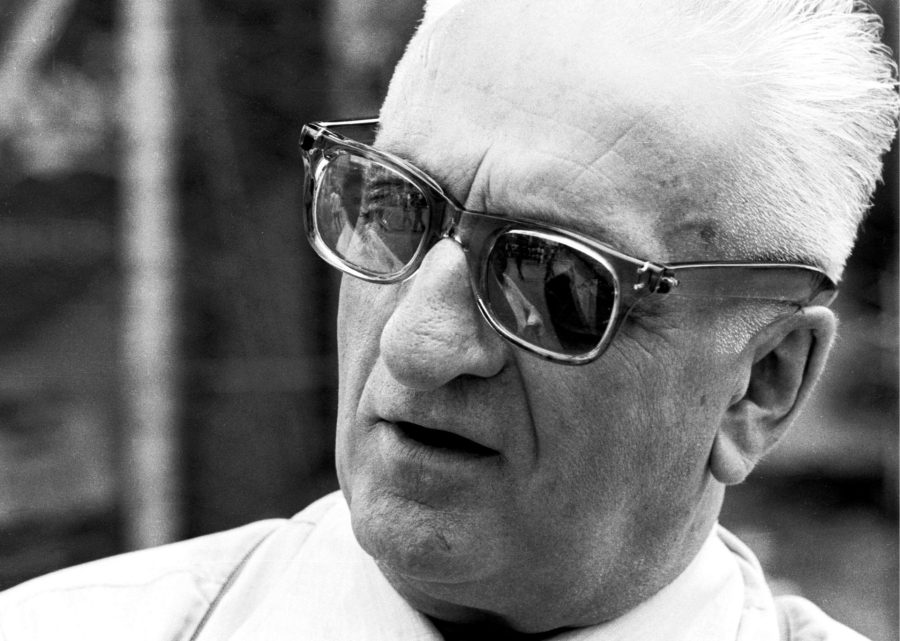
Auto legends: the story of Enzo Ferrari!

When one of my readers gave me the idea to the section on legendary personalities from the auto industry, he did so specifically mentioning Ferdinand Piëch, whom I therefore did the first portrait of earlier this summer. Had I come up with the idea myself though, I wouldn’t have started with Piëch. If someone says “automotive legend” to me, there’s really one name that springs to mind before the others, and it is that of Enzo Ferrari. I kind of suspect it may be the same for some of you, so in this second portrait, we’ll have a look at the Commandatore himself, the legendary man who spent his life in northern Italy between Turin, Milan, Maranello and Modena, and whose legend has only grown since he passed away around 35 years ago.

Young Enzo on an Alfa Romeo, sometime in the 1920’s

It apparently took little Enzo 10 years from his birth in 1898 to be stung by the racing bug, which happened when his father took him to a car race in Bologna. Enzo had an older brother and early on dreamt of becoming an opera singer, but the Spanish flu that swept across the world at the time killed both Enzo’s older brother and his father, forcing him to grow up quickly and lay his ideas of a singing career to rest. He joined the army in 1917 and was very close to dying from the flu as well shortly thereafter, but survived and was honorably discharged the same year. Rather than becoming a soldier, his big dream was now to work for Fiat, but his application was rejected, which we should perhaps all be grateful for.

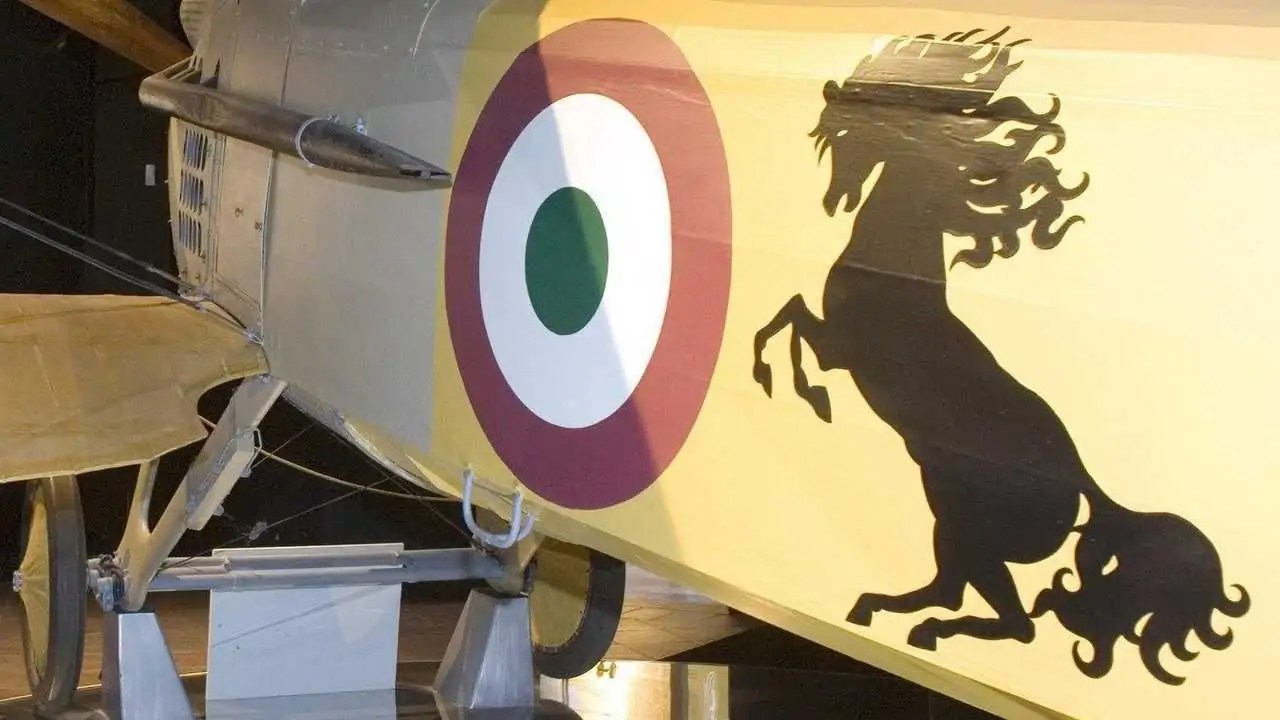
Enzo instead went on to work for a company called Costruzioni Meccaniche Nazionali for whom he also debuted as a racing driver. He took part in a number of races over the coming years with quite some success, before a very defining moment for him but also for the larger automobile world occurred in 1923, when Enzo met the parents of the noble flying ace Francesco Baracca. Baracca had done some heroic flights but later perished in the war, and his parents now invited Enzo to use their son’s coat of arms on his cars for good luck. You’ve guessed it, that coat of arms was none other than a prancing horse, and the Ferrari logo had thus been born.

The original look, and use of the Cavallino Rampante!

In 1929, Enzo’s racing career was crowned when he was knighted for his achievements and given the title “Commandatore” (Commander), that would stick with him for the rest of his life. He would end his driving career in the coming years and instead set up the sporting society Scuderia (“team”) Ferrari, a kind of racing club for aspiring drivers with as symbol the prancing horse. The club would a few years later become affiliated to Alfa Romeo, but the association would only last a few years.

Enzo had now also become the proud father of a boy called Dino, but as he didn’t know then, Dino would only have a short life, dying of dystrophy in 1956. Between the Spanish flu, his son’s dystrophy and other terrible viruses and bugs at the time, it doesn’t hurt to remember that modern medicine has done quite a few wonders in curing and exterminating what people died of less than 100 years ago… Dystrophy however, as a genetic disease, is unfortunately one we don’t yet have a remedy to.

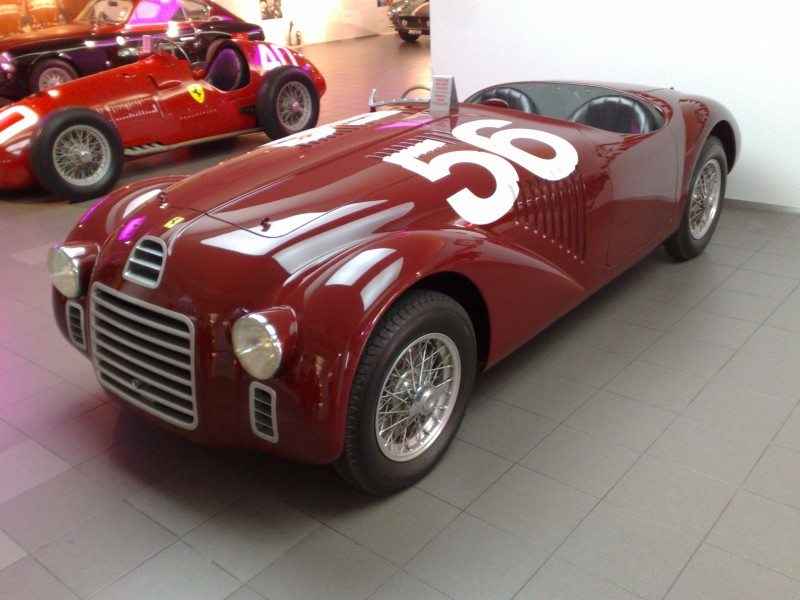
The 125 S was the first Ferrari car to score a race win.

Just before WW II broke out, Enzo had founded his new company Auto Avio Costruzioni in Modena, later moved to Maranello. As soon as the war was over, Ferrari started racing and the 125 S would score its first victory in 1947. That would be the start of many race wins over the coming years, including notably the Mille Miglia in 1948, the 24 hours of Le Mans in 1949, and the world racing championship both in 1952 and 1953, in both cases with the legendary Alberto Ascari as driver. it was at this time that Ferrari also started producing road cars, already then with the rich and famous in mind.

If the late 40’s were all happy days, the 50’s and early 60’s would be less so. Next to the loss of his son, six Ferrari drivers would be killed between 1955 and 1965, Enzo as head of Ferrari would be charged with manslaughter following the accident in the Mille Miglia in 1957 that I described in my post about the race, and Enzo would also lose several of his top people in the Palace Revolt in 1961, that we looked into in the post on Bizzarrini back in February 2021. These events and of course, especially the death of Dino, changed Enzo into a reclusive man. It was most probably also these events that led him to consider a sale of Ferrari to Ford in the 60’s, that would however never happen. Instead it was Fiat that Enzo sold half of the company to in 1969, because Ferrari by then had serious financial issues.
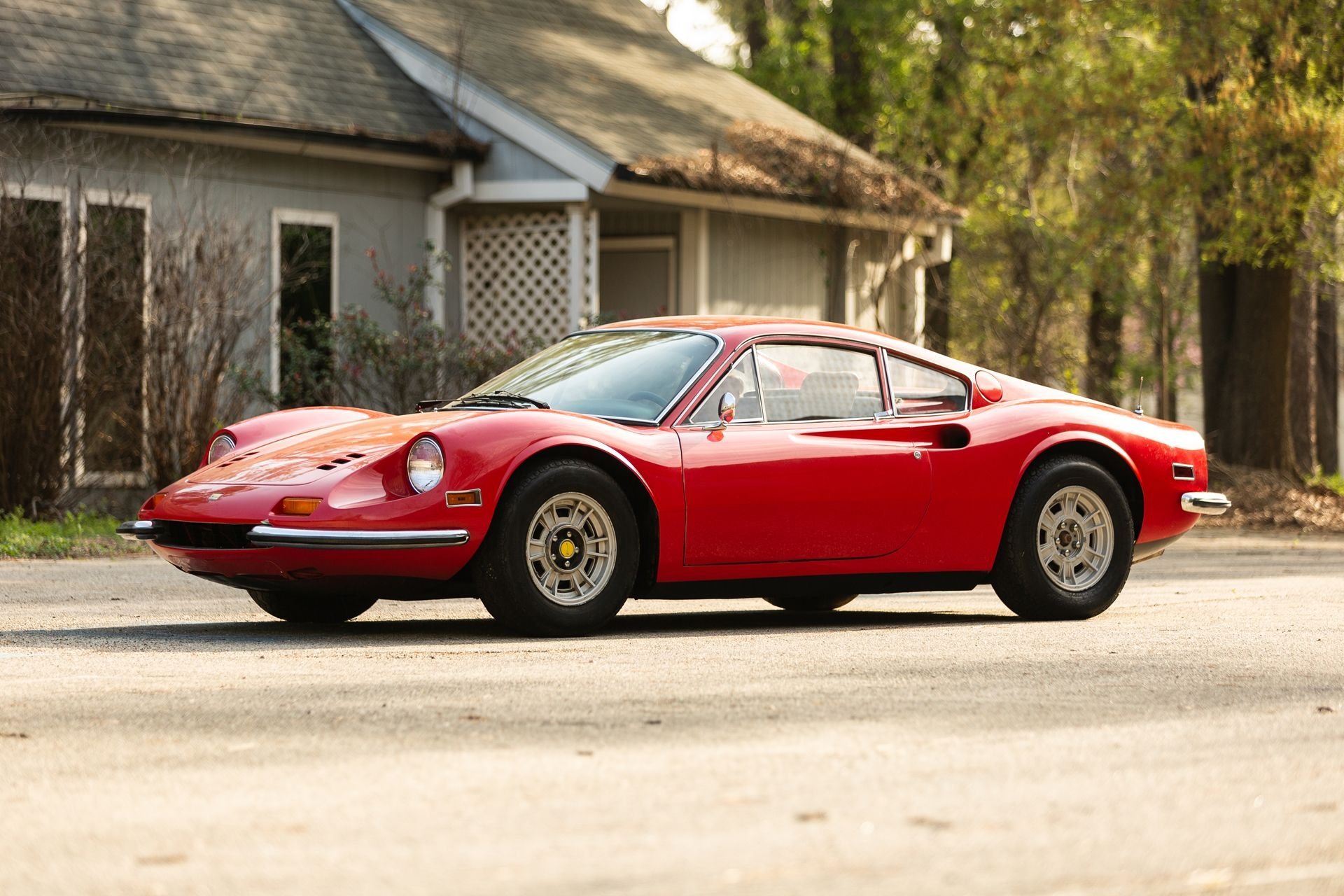
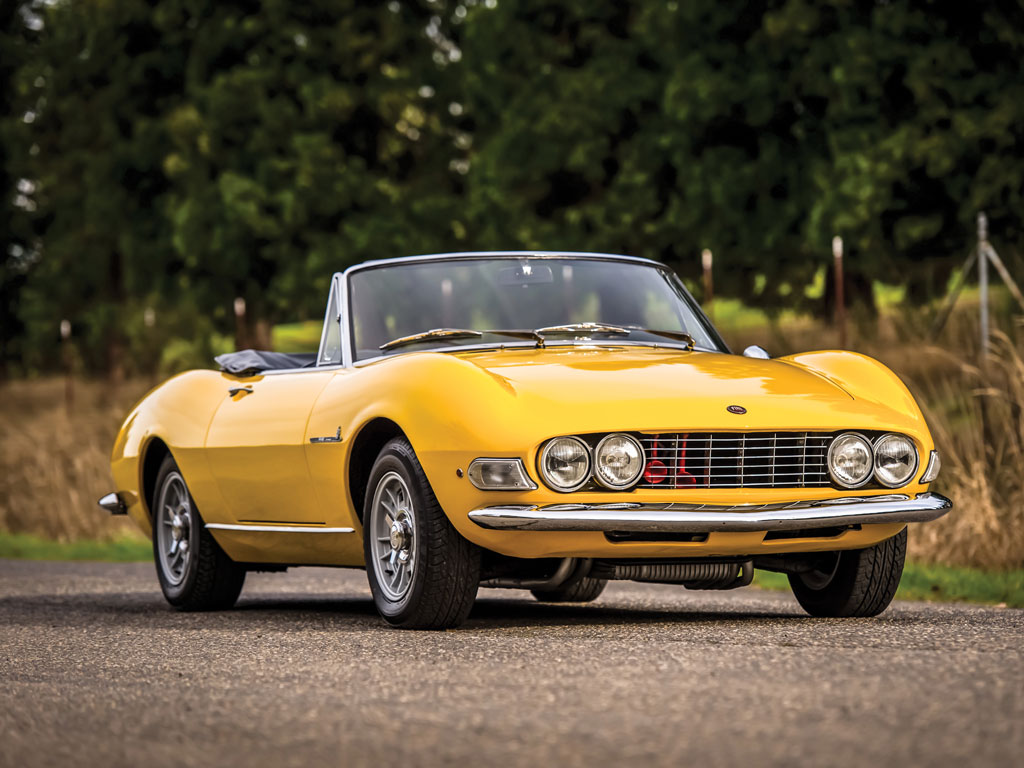
The Dino, one of the most beautiful of them all

At the age of 79, Enzo would resign as president of the company he founded in 1977, but president or not, it was still clear to everyone who was really running the company. A further personal blow was the death of his beloved wife the year after, and finally Enzo himself took his last breath in 1988 at the age of 90, in Maranello that he made so famous. He was later introduced to the International Motorsports Hall of Fame, given the 13 world championships and 4.000 race wins achieved over his lifetime.

Next to the racing successes, Enzo of also led the development of Ferrari’s road cars during the decades he was active. Going through them all is a post by itself, but let me pick two of my (and many others’) favorites. The Dino, named in honor of Enzo’s son, is to me one of the most beautiful Ferraris, and the F40, which was the last car Enzo signed off on personally, one of the most spectacular. These and others are shown in the Ferrari gallery in Maranello that it’s well worth visiting if you’re in this beautiful region of Italy, going by a single motto: Forza Ferrari!
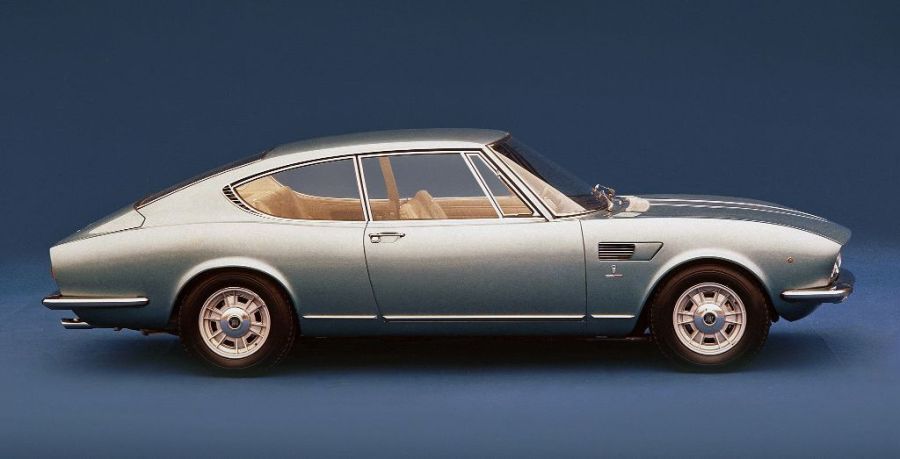
The beautiful Dino from Torino!

it’s time to leave the world of over-powered and over-priced SUV’s and return to a more traditional, and dare I say classy thrill of driving, which after all is what this blog is all about. We’ll do so by going back to a theme that I explored almost two years ago in a post entitled “The best Ferrari is a Maserati”. The reference here was the Maserati Coupé from the early 00’s, equipped with the brilliant 4.2 litre, Ferrari V8. The coupé is however not the only way to profit from a Ferrari engine in a car of a different – and usually cheaper – brand. Another example of that was the breathtakingly beautifful Fiat Dino Coupe from the mid-60’s, one of the highlights of that decade and a car we’ll look closer at today!

Classic 60’s, sweeping GT lines!

It’s the early 60’s, the Vietnam war rages, the mini skirt is the latest fashion and Americans are told smoking is dangerous through warning labels on cigarette packages (Europe wouldn’t get these for another few years). Our American friends however also had the Mustang whereas in Europe the English drive Minis and the French the eternal 2CV and the clever but not very beautiful Renault 4. Design-wise therefore, you had to go to Italy to find the true masterpieces (yep, some things don’t change!), and south of the Alps, Fiat is planning for an upmarket GT coupé and convertible, without having a suitable engine to power it.

Further east in Maranello, Ferrari’s world is a little less rosy. Enzo is still deploring the loss of his son Alfredo (“Dino”) in 1956, only 24 years old. Dino was credited with the development of the Ferrari 2-litre V6 engine that over a few years had been used in various racing cars. Ferrari now needs precisely this kind of engine, i.e. no more than 2 litres and 6 cylinders for its Formula 2 cars, but the engine needs to be homologated through serial production of at least 500 units. At the time this was too much for a small manufacturer like Ferrari and it was therefore agreed with Fiat that they would build the homologated engine and also be free to use it in future Fiat cars. Contrary to what Enzo Ferrari had wanted, Fiat insisted on the engine being built in its Turin factory and not in Maranello, meaning that the Dino engines in cars like the Ferrari Dino 206 and 246 will have the Fiat logo casted somewhere on the motor block. Fiat now also gives the green light to Bertone to design the coupé and to Pininfarina to design the convertible. This was of course not very logical and led to the two cars looking rather different with most people (including me) agreeing that Bertone did a better job – judge for yourself. The convertible was introduced in 1966 and the coupé a few months later, in 1967.

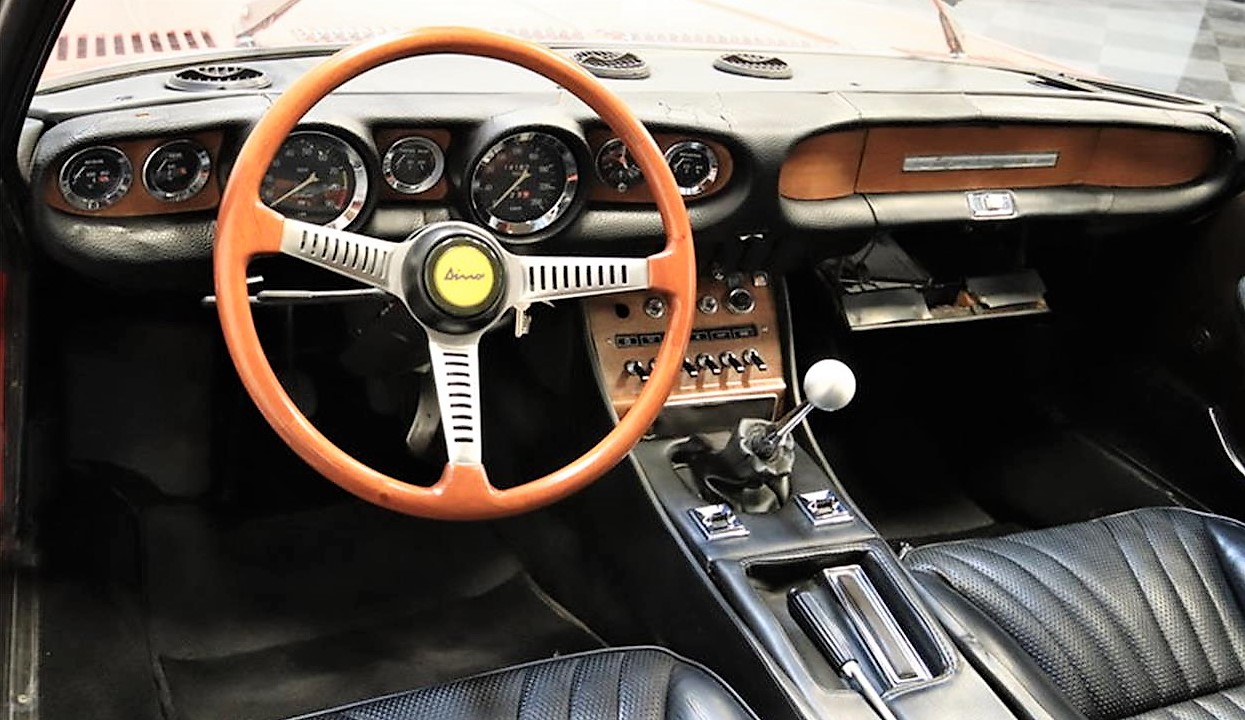
The Dino engine was indeed quite special. A 2-litre V6 with an alloy block, it’s most famous for its unusual, 65 degree angle but also features quad cams and triple Weber carburettors, bringing the output to 158 hp (and also the need for a specialist to make sure those Webers are aligned as they should be!). The face-lifted engine that came in 1969 when homologation was no longer an issue was increased to 2.4 litres and was the world’s first serial engine with electronic injection. Power increased to 180 hp with notably improved torque, and all this was fitted in a magnificent coupé body with flowing lines, an aggressive front with a big grill, and a sweeping, lower rear. I owned a Fiat 124 Coupé from 1965 a few years ago which was also designed by Bertone and the similarities are clearly there but the Dino is a larger, more elegant car. The interior matches the exterior in a plush combination of leather (one of few options but a feature on many cars) and wood with a thin, large steering wheel. The gearbox is five-speed, there are dual-circuit disc brakes all around and even electric windows (still quite rare in Europe at the time). Even though the later 2.4 litre engine has more power and greater torque, enthusiasts will often tell you the smaller 2-litre is actually the sweeter one to drive. The later car was however also updated notably with independent rear suspension, improved brakes and some othe features making it a more modern car.

Leather was one of few options, switches and gauges standard!

Around 5800 2-litre and 2.4 litre Dino coupés were built between 1967 and 1974, with latter cars being assembled not in Turin but at Ferrari’s plant in Maranello. Of all these, few remain today and although only around 2000 convertibles were built, these are easier to find than the coupé. That hasn’t meant they haven’t gone ballistic price-wise though, with good convertibles today costing at least EUR 150.000, and the 2.4 litre being even more expensive as only 400 were built. A good coupé will still be yours for somewhere around EUR 50-60.000. Unless you have a very firm idea of what you want, the individual condition of the car is probably more important than which engine it has. One of the few available options was metallic paint and the dark grey metallic you can still find some cars in is to me the colour which really highlights the car’s beauty!

The Ferrari logo in the grill wasn’t a factory option…

The most beautiful Dino in my eyes indeed carries the Fiat badge (except the one in the picture above…) and to finish where we started, even though they’ve gone up in price in the last years, a Fiat Dino Coupé is still more than EUR 300.000 (!) cheaper than a Ferrari Dino 246 with the same engine! That’s of course an even more legendary car but it’s not a GT and it also doesn’t have the elegance of the Fiat Dino, one of the most beautiful cars of the 60’s. Good design never goes out of style so if there’s still room in your garage, get one while you still can!