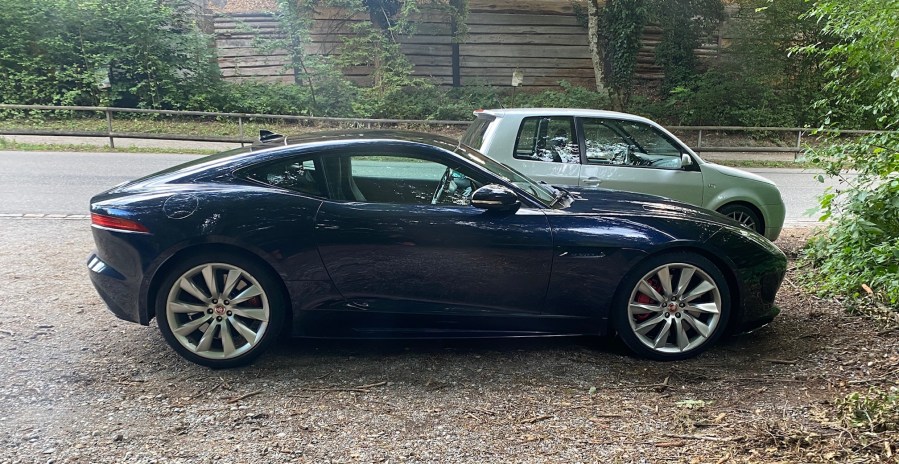
The first street find in a while is actually more a forest find, pictured above next to my son’s Lupo GTI that I used earlier this week for the drive to the local exercise trail. It was when I came back from my run that I saw the F-Type from the angle depicted. Looking at it from the side, I was struck by how nicely the lines flow, something I hadn’t noticed before (my temporary lack of oxygene may have contributed to the revelation moment…). An F-Type isn’t that rare but it’s also not something you see everyday, and given it has its 10-year anniversary this year, I thought we’d have a closer look at the car that was Jaguar’s first two-seater in 50 years!
When the F-type was presented in 2013, it was about 30 years after Jaguar had recognized the need for a replacement for the quickly aging, and by then too big XJ-S, that I wrote about three years ago. Two prototypes were thus developed already in the early 80’s, but then Jaguar was taken over by Ford a few years later, meaning plans and priorities changed. The prototypes instead became the Aston Martin DB9 and Jaguar XK8, which however, at least in theory, are four-seaters. Various other events, notably Jaguar’s decision to enter Formula 1, meant that they F-Type wasn’t shown to the world until 2013, and was then presented as the “spiritual successor” to the legendary E-Type.
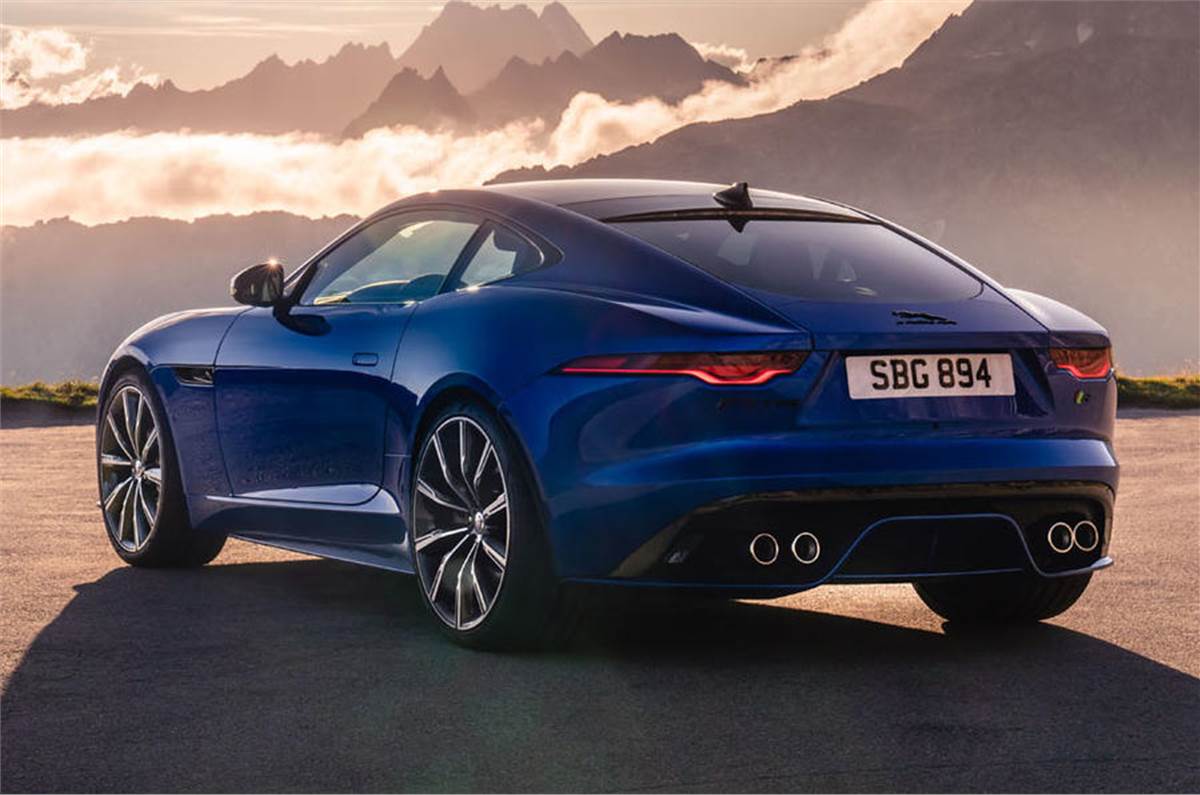
Nice proportions with a touch of E-Type Coupé seen from the rear
Built since 10 years by now, it’s clear that apart from having only two seats, there’s not much the E- and F-types have in common, although the rear of the coupé does bear a certain resemblance to its predecessor. To me the coupé is also the one to go for since it looks far better than the convertible. Designer Ian Callum produced a very well-proportioned and good-looking sports car seen from the side and the rear, with the front being a bit too anonymous. The convertible was launched a few months ahead of the coupé in 2013, and both versions received a face lift in 2020 that notably improves the front.
The face lift version from 2020 has a more aggressive front
The inside is well in line with the F-type’s natural role as a GT car, and anyone familiar with Land Rover and Jaguar interiors from this period will quickly find their mark. Engine-wise, these days the range starts with a 2-litre, 4-cylinder engine with 300 hp, in line with the general trend of less somehow being more. When the car was launched though, it was with two versions of a 3-litre, straight six or alternatively, with the well-known Jaguar/Land Rover 5-litre V8. The V6 versions could be had with a six speed manual rather than the more common 8-speed automatic box, and the stronger version was also available with all-wheel, rather than rear-wheel drive.
At 340 and 380 hp, the strongest six-cylinder was 115 horses down on the V8 (at 495 hp) at launch. It was also slightly, but only sightly less loud. Because if there’s one thing the F-type has in common with the E-type after all, it’s the very loud engine, or rather exhaust sound. With the V8 under the hood, forget all about sneaking away early in the morning without waking up the neighbors…
Not much room, plenty of sound!
This is obviously the same engine I have in my Range, where it’s however so discreet that you sometimes wish they would have allowed for slightly more exhaust noise to come through. The F-Type is in other words a nice testament to the power of a good exhaust! If however nothing’s too loud for you, then be aware there’s also an SVR version of the F-Type, adding another 80 hp to a total of 575 hp and producing even better cornering speeds. In any case, power and sound will be plentiful!
Even if the F-type won’t reach the legendary status of the E-type, the good-looking and driving-wise, well-balanced and well behaving two-seater is quite popular, with second-hand values holding up pretty well. That it appeals to other buyers than those wanting a complement to the family Discovery was clearly shown a few years after the launch, at which point 75% of all F-Type buyers came from other car brands.
The roadster doesn’t look bad, but less special than the coupé
Well-maintained coupés and convertibles trade between EUR 35-50.000 in Europe depending on mileage, the face-lift version will start at about 10.000 more for the 300 hp, two-litre version. If you’re more into nice weekend cruises than track days and can’t withstand a roaring engine, the F-type is probably a good alternative – and one that requires for less maintenance than its “spiritual predecessor”!
There are lots of stories in the classic car world, some true, others not. One of the better ones is about the legendary Ferrari Commendatore, Enzo Ferrari, who when he first saw the car we’ll look at today at its initial presentation in the spring of 1961, referred to it as “the most beautiful car that has ever been built”. Now before you spend too much time trying to figure out which Ferrari he was referring to, let me spare you the effort by telling you that Enzo wasn’t referring to a Ferrari at all, but rather to the latest creation from Coventry – the Jaguar E-Type (XK-E for those of you in the US). Of course Enzo was right. Not only is the E-Type a true legend of the car world, it’s also exactly what he (supposedly) said, i.e. one of the most beautiful cars ever built, until this day. At the time of its launch, it was also one of the fastest and most modern production cars in the world, boosting power and acceleration numbers that remain impressive until this day. And seen over its full production, it’s also one of the most succesful sports cars ever built. The car enthusiast that hasn’t dreamt about driving and owning an E-Type hasn’t been born, so it’s about time to take a closer look at it!
Initially the E-Type wasn’t supposed to be the famous road car it became during its 14 years of production, but rather to succeed the D-Type as a racing car. The D-Type had been hugely successful on the racing scene, notably winning the 24h in Le Mans three years in a row between 1955 and 1957. It was Jaguar’s first car with a self-supporting body frame and no longer a ladder frame solution (basically meaning that the engine was carried directly by the body subframe, notably saving weight), and the E-Type took over this and other solutions. In the end it didn’t succeed the D-Type as a pure racing car, although it has obviously been used for racing many times through the years. Instead it replaced the ageing XK 150 as Jaguar’s new sports coupé and roadster.
The D-Type, to this day a successful racing car
The E-Type was first shown to the world in the spring of 1961, more precisely in March at the Auto Salon in Geneva. As we know from previous stories notably on the wonderful Bizzarrini, car shows at the time were slightly less organized than in these days, and Jaguar was fighting against the clock to have the exhibition car ready in time. In the end the firm’s PR manager Bob Berry had to drive the car from Coventry to Geneva, arriving only 20 minutes before the show started. The reception was so overwhelming that Berry had to call Jaguar’s legendary test driver Norman Dewis and ask him to drive down a second car overnight. Dewis did so in 11 hours, averaging at a speed of 110 km/h (whoever said some things weren’t better before?!?). This obviously only added ot the E-Type’s glory and Jaguar sold around 500 cars directly at the show.
They made it – just in time!
The car’s design is truly unique, with a bonnet that looks like it makes up more than half the car (around a third is closer to the truth), and which has sometimes been referred to as the extension of a certain male organ. Be that as it is, there’s a fantastic elegance in the proportions and also a lightness to the whole design, which serves the car well given it weighed in at 1200-1300 kgs. As we’ll see below there’s always been a roadster and a coupé available and although the roadster certainly provides more driving thrills, the (short) coupé is to me clearly the most harmonious design.
During its 14 years of construction, the E-Type was produced in three series, 1, 2 and 3 (or rather, when the Series 2 was started, the previous cars started to be referred to as Series 1). Being an English car from the sixties there are a lot of special series in addition to that, but this is not the place for a complete overview of all different models and types and I’m also not the right person to give you a complete overview. I’ll limit myself to summarizing the main series and their differences below.
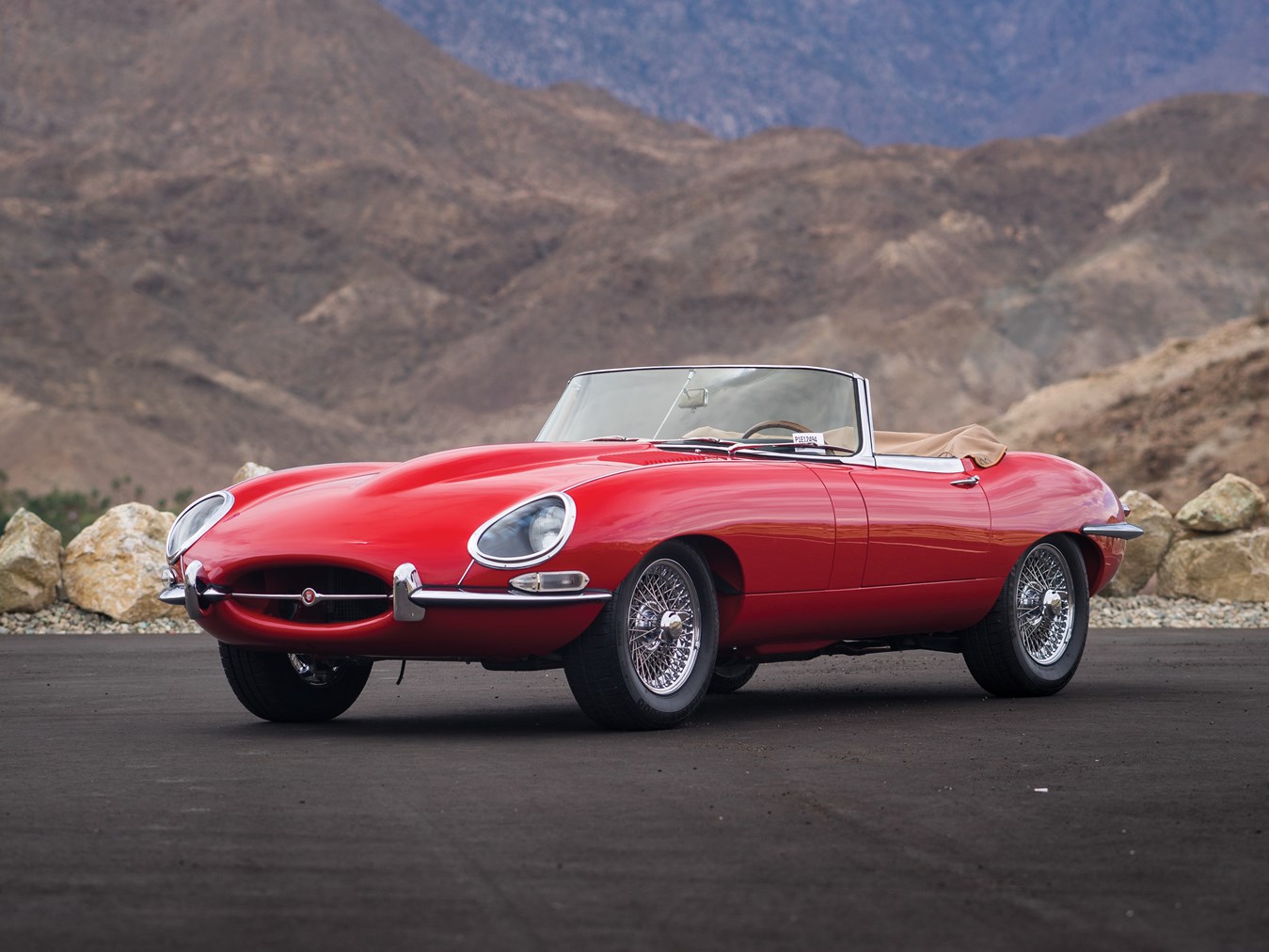
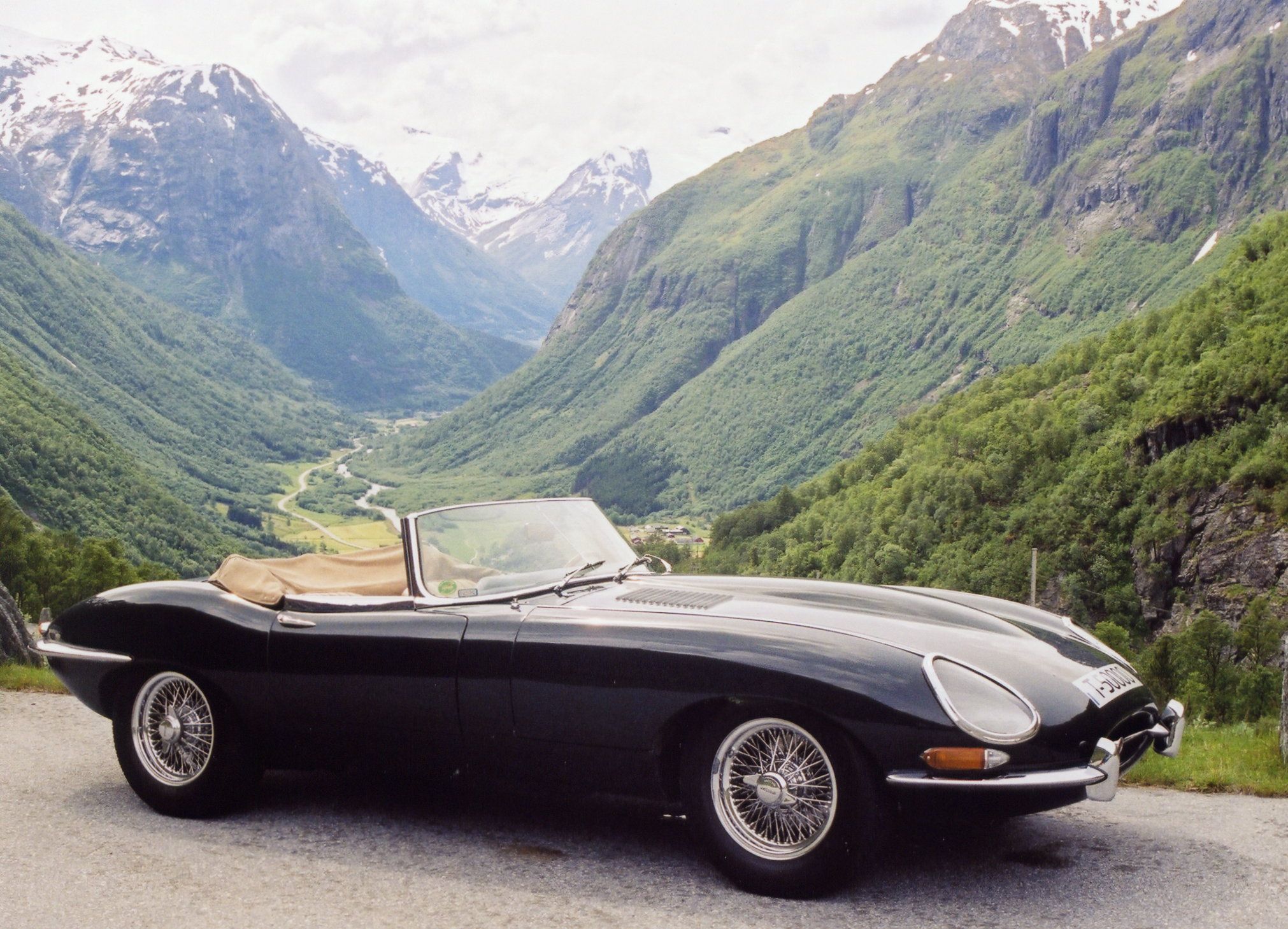
The initial E-Type is by many considered the purest of all versions. It’s notably the only type that has the well-known glass covers over its headlamps. The 3.8 litre, 6-cylinder engine with 265 hp was the only thing taken over from the XK 150, with other parts coming from the D-Type or having been developed for the car. It’s worth mentioning the rear axle with individual suspension which was an advanced and very modern construction that was kept well into the XJ series many years later, and which was a crucial part in the E-Type’s excellent road-handling. The Series 1 was available as a two-seater coupé and convertible and the first 500 cars had a so called flat floor, meaning less leg room. Needless to say how sought after they are, as are early cars with external bonnet latches. In 1965 the first series had its engine volume increased to 4.2 litres, giving more torque although not more power, and in 1966 a 22 cm longer coupé version with two reclining seats was added, referred to as 2+2. These versions were built until 1967.
A Series 1 convertible in all its beauty
The so called Series 1.5 essentially looked like the previous cars but had the headlamp glass covers removed to provide better light but especially to get approval in the US (basically the same problem Citroën had with the DS in the US). It was also American emission regulations that led Jaguar to replace the three SU carburettors with Zenith-Stromberg units, meaning a power reduction of around 20 hp on US cars.
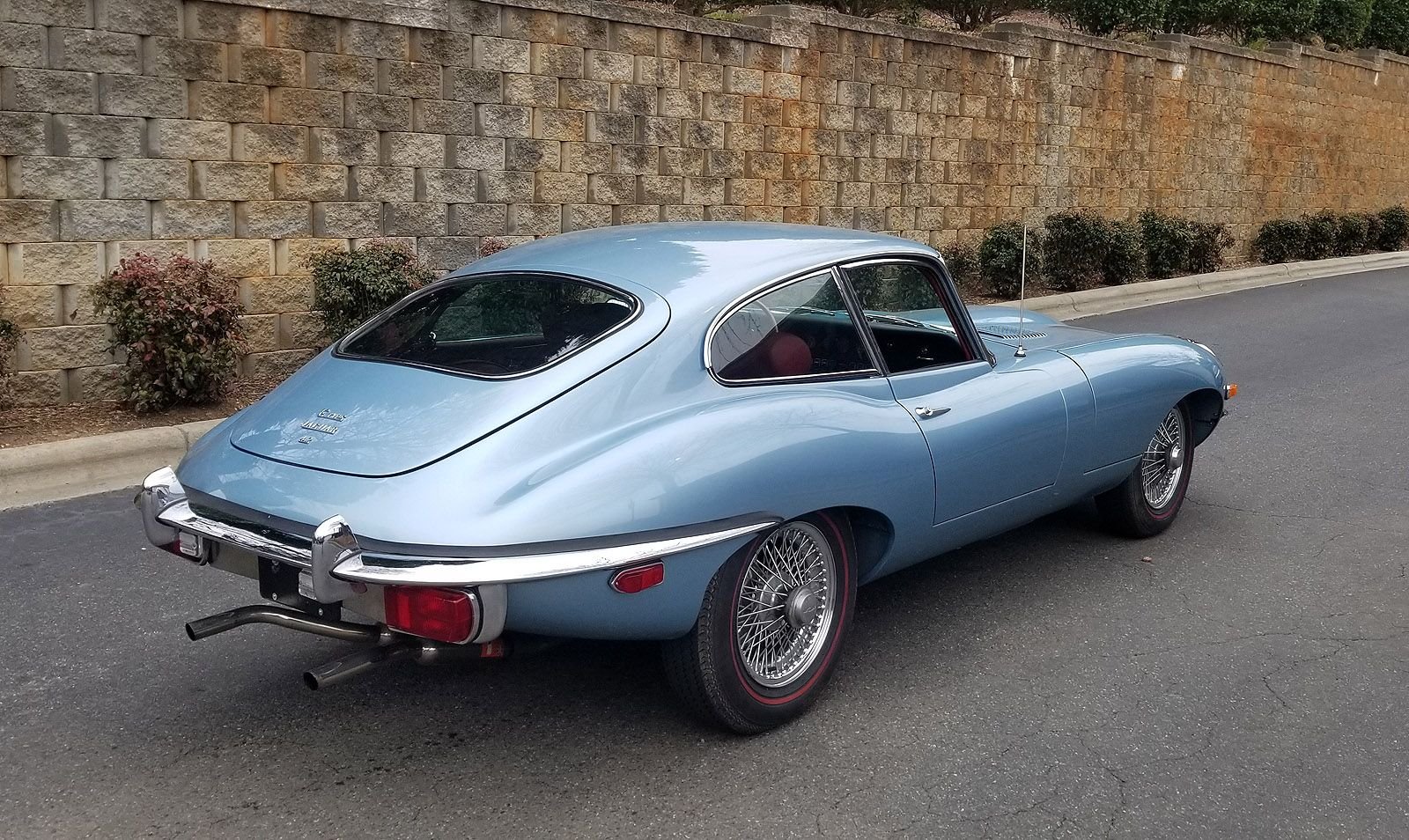
The Series 2 only saw minor modifications to the 1.5 and is most distinguishable by its wrap around bumpers and diferent grille. Series 2 cars were built until 1971.
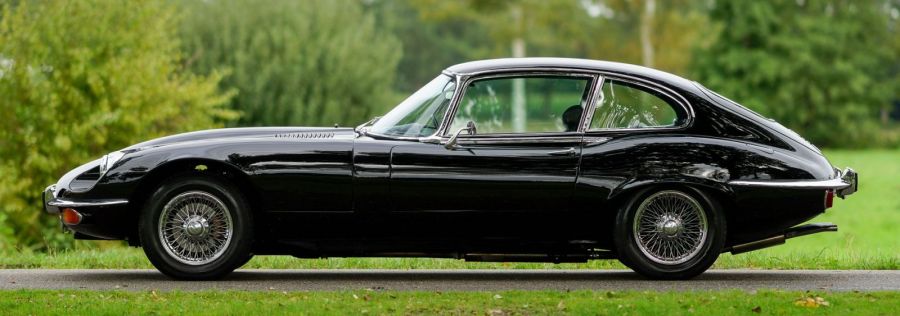
In 1971 the Series 3 saw the introduction of the 5.3 litre V12 producing 272 hp, along with improved breaks and steering. Four Zenith carburettors helped the car to a sub-seven seconds time to 100 km/h and a top speed of around 250 km/h. Very impressive numbers, but only a slight improvement to the six-cylinder versions. The benefits of the V12 were rather the 12-cylinder character and sound… The short coupé was discontinued with only the 2+2 seater and the roadster now built until the production ended. Series 3 cars are identifiable notably by the larger grille, flared arches giving room for larger wheels, and the four exhaust pipes.
A Series 2 short coupé with the side-opening luggage door
Through the sixties and into the seventies until the end of production in 1974, the E-Type was one of the fastest sports cars in production. It was also one that drove well thanks notably to the mentioned rear suspension but also its four disc breaks, something neither the Italians, nor for example Mercedes-Benz had at the time. The engines, provided they were serviced well, were reliable, with the V12 being more or less unbreakable, but again provided it was properly serviced and maintained. Given the E-Type cost roughly half of for example a Ferrari 275 at the time it was hugely successful, with over all series more than 70.000 cars produced, most of which in the first series.
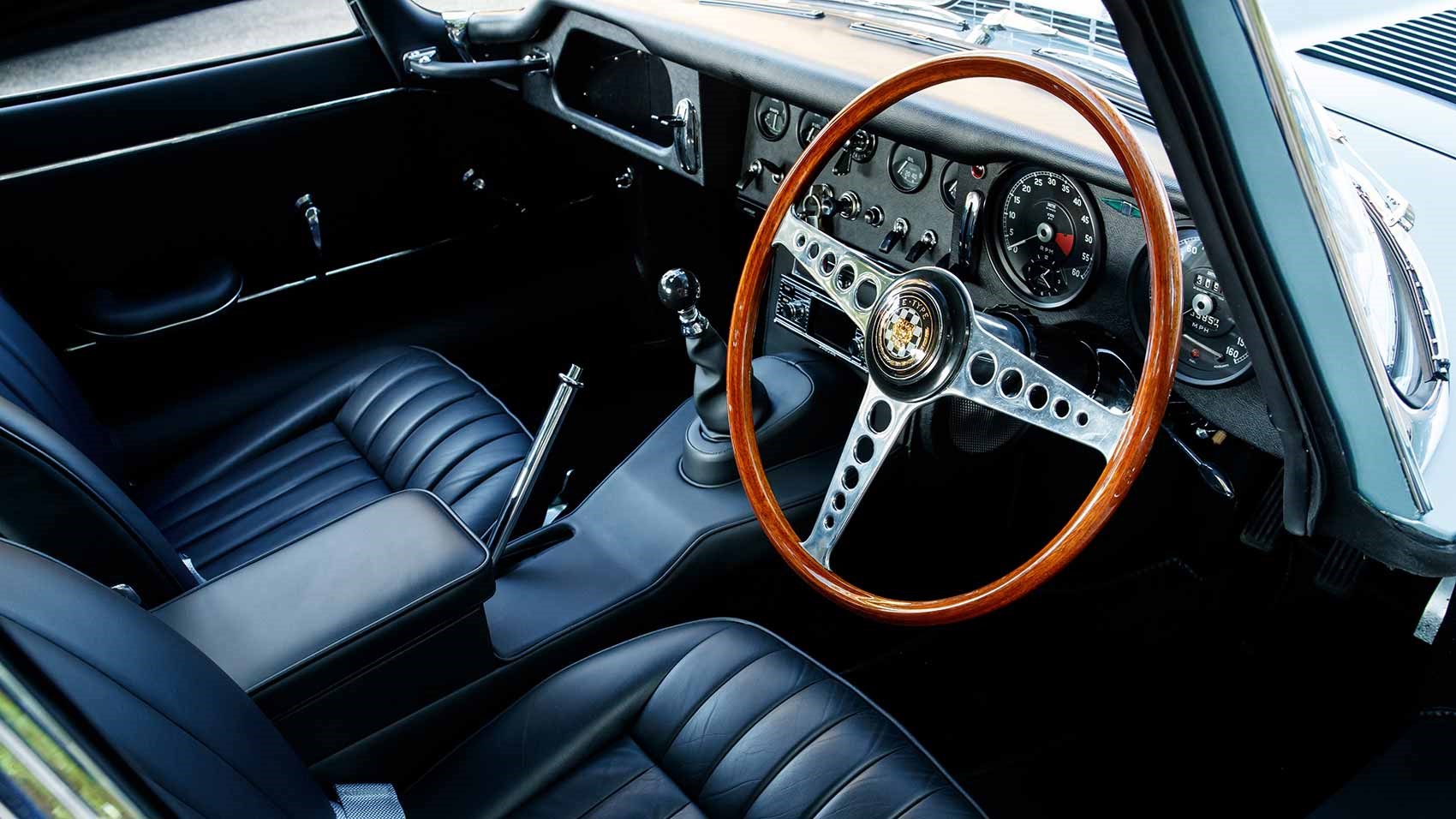
It’s a few years since I had the pleasure to drive an E-type for the only time so far, more precisely a 4.2 litre convertible. I will never forget that long bonnet that seemed to go on forever, the low seating position with the large steering wheel, and then of course the sound from the six-cylinder. I had my TR4 at the time and let’s just say this was a different story. Driving-wise the car is impressive but commends respect given the powerful engine, but the precise steering and powerful disc breaks still give a feeling of control. My friend who owned and still owns the car confirmed my impressions, but also the amount of work that seemed to go into it on a regular basis, which brings us to buying and owning an E-Type.
The interior certainly keeps up with the exterior!
Finding the right car is mainly about three things: rust, engine maintenance and series. Rust is probably the most serious issue and a very common problem, and the monocoque constrution makes it especially critical in certain areas. Any car needs to be inspected carefully also from underneath and ideally with the help of a specialist. As long as he’s there he can then also have a look at the engine, which as said doesn’t usually cause any problems as long as it’s well maintained. Adjusting both the six-cylinder, but especially the 12-cylinder is however a job for those who know, and if you don’t, you will want to know someone who knows! Finally the different series are about taste. Generally first series cars are most popular with their design being considered the purest and most beautiful. Many prefer the original 3.8 litre engine, claiming it’s more responsive and happier to rev than the larger 4.2, probably a matter of taste. The 2+2 coupé with its 22 cm longer body takes some getting used to and is arguably the least attractive design. Between the convertible and the short coupé it’s really a matter of taste, and there is also no meaningful price difference with our without roof.
Finding an E-Type is not difficult, but perfectly preserved or restored cars have reached if not astronomical, then at least ambitious prices. On the good side though, they are still only half or even less as expensive as comparable Ferraris! Good, original cars with some patina start at EUR 90′-100′, with no upper limit depending on condition but even more on the in some cases very limited series. An early 3.8 litre Series 1 is probably where I would put my money but I can obviously see the attraction not only of the V12 but also of the improvement on later cars. Again, the V12 doesn’t have to be a quick way to bankruptcy and is more solid than the 6-cylinder, but it will require more maintenance, and slightly more fuel… Whichever you choose you’ll be driving a true legendary car, one that is never out of place, and that is even more beautiful than the tailor-made Italian suits Enzo Ferrari used to wear!




 The Thrill of Driving