
To borrow from John Cleese in the legendary Monty Python scene from the animal shop with the dead parrot, the V10 is no more. It has ceased to be and gone to meet its maker, and for all those of us who felt it was something truly special, that’s obviously very sad news. That said, there’s a bit of a delay in this post given production of the last V10 engine took place in late 2024, but if you haven’t gone into mourning yet or perhaps hadn’t realized it, the time has definitely come to do so. Let’s therefore look back into what made the V10 so special, the most prominent street cars that featured it, and, should you decide to help preserve the V10 for coming generations, which cars you should consider!
The V-shaped, 10-cylinder engine has been around far longer than many people think. Its roots go back to the 1940’s, but its history in street cars is far shorter, starting in the early 90’s. In the era when naturally aspirated engines were still the way to go, the V10 became a good alternative for when a V12 was too big and heavy, but a V8 wasn’t powerful enough. It produced more power than a V8 and often also ran smoother with less vibrations. And whereas it was less powerful than a V12, it typically had more torque, and was obviously also smaller and lighter. And then there was of course the sound that many still consider unequalled. I won’t even try to describe it in words, but let’s just say that if you’ve heard a V10 in higher rev’s, you’re not likely to forget it!

V10’s were also the main engine used in F1 during two decades. They appeared in the late 80’s after FIA’s ban on turbo engines, when manufacturers during a couple of years used everything from V8’s to V12’s (imagine that today…), Notably thanks to its greater efficiency and lower weight, the V10 then became the F1 engine of choice in the late 90’s and the first half of the 00’s, when all cars ran V10’s in what’s probably the best sounding period of F1 history. The fun ended when FIA made the small, 2.4 litre V8’s mandatory in the mid-00’s, making V10’s became a thing of the past.
In terms of street cars, surprisingly few brands have featured them in their line-up. The first was Chrysler in the 10-cylinder Viper. In the true American spirit of there being no substitute for cubic inches, the V10 was developed from the Chrysler V8 to which two extra cylinders and an aluminum block from Lamborghini were added. The initial version displaced no less than eight liters, putting out 400 hp, which in subsequent versions would increase to 8.3 liters at most, and over 500 hp.

BMW also built a V10 engine, however only one, which was featured in the E60 5-series and the E63 6-series from the (Chris) Bangle-era between 2000-2005. At 507 hp, the 5-litre engine was the most powerful, naturally-aspirated engine BMW has ever built, and also one of the most high-revving V10’s ever produced. Importantly it also featured in the 5-series station wagon called E61, the only M-wagon ever built until the current M3 and M5 Touring, and perhaps the most collectible of the three models today.
The brand family that made the V10 most famous is however Audi-Lamborghini. Audi bought the Italian brand from Sant’Agata in 1998, and when the Gallardo was presented five years later, it was with the same base V10 engine that would be featured in the Audi R8 a few years later, from 2009 onwards. It displaced 5 litres in the Gallardo and 5.2 litres in the R8, but with a similar power output at around 520 hp in both. To round it all off, both cars were also available with a manual gearbox. And whereas the R8 later also came with a V8 option, the Gallardo was ever only available with the V10, as was its later replacement, the Huracan. The special version Huracan STJ, presented in 2024, would be the last production car to feature the V10, in its final form delivering all of 640 hp.

Whatever you think about our coming electrification or lack thereof, the probability of the V10 making a comback is slim, to say the least. So if you want to add an example of this wonderful engine to your garage, you’ll have to look at pre-owned cars. Should you? The answer is a resounding yes, as long as you know what you’re doing. BMW’s V10 wasn’t directly derived, but borrowed heavily from the early 00’s F1 engine the company ran, meaning it’s at heart a race engine and needs to be serviced accordingly. That may be obvious if you buy an R8 or a Huracan. Somewhat unfortunately however, as you’re able to buy both the V10 M5 and (especially) M6 for below EUR 50.000, all buyers don’t realize that. Just as little as previous owners may have.
Therefore, buying a more recent and certainly more expensive R8 or Huracan is probably a safer bet, but as always, if you do your homework properly, nothing fundamental speaks against a BMW V10 either, or a Gallardo for that matter. Personally, I would park an early Gallardo in my garage and make sure it’s a manual. It may have been Lambo’s first mass-produced car, but it was certainly also the best. Now ask yourself when you last saw one? Exactly. Especially in manual form, the Gallardo is certainly a coming classic, with a design language that is as much early 00’s as it gets.
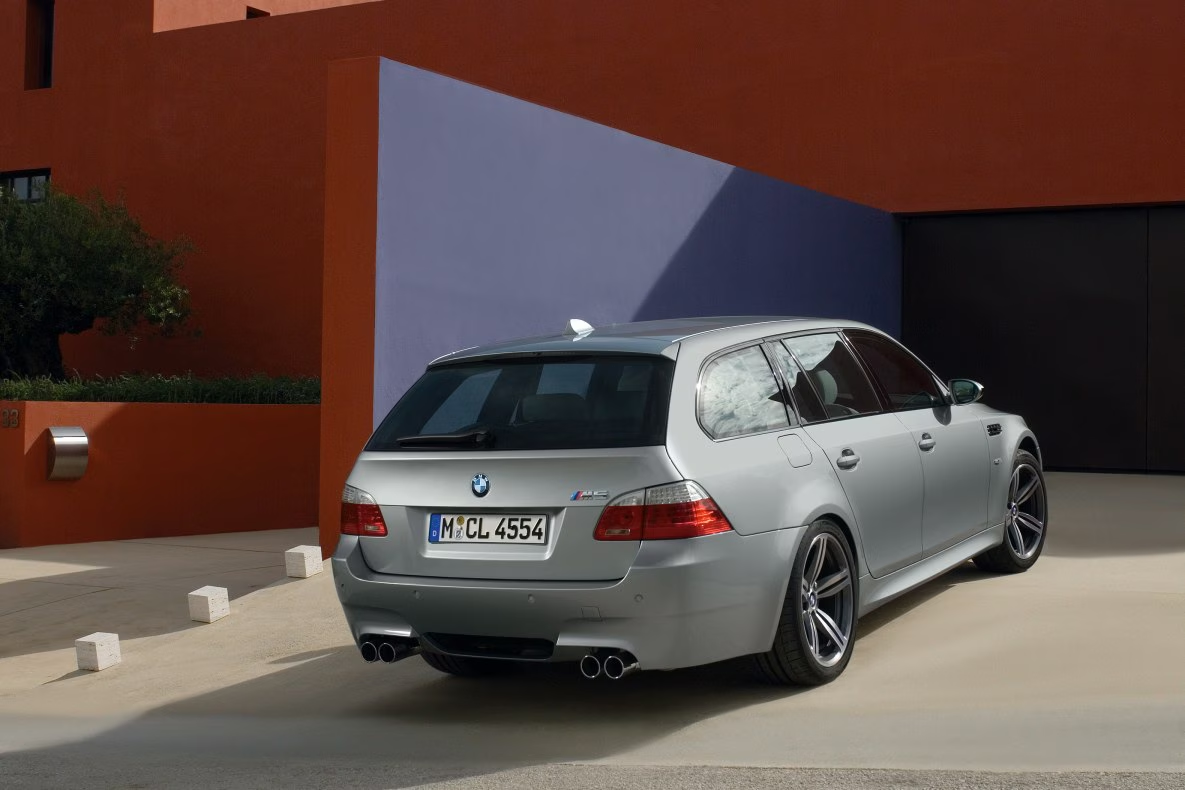
That said, you can’t really fault anyone buying an R8 or a Huracan either – far from it. And the guy that packs his family and luggage into an M5 Touring with a V10 up front before heading south for the summer vacation will obviously always be a hero. The V10 options may thus be few, but they’re all great, so there’s clearly hope that this wonderful engine will live on for many years to come!





 The Thrill of Driving