Street finds – the Peugeot 205 Rallye!

Finding a true French legend from the 80’s has become increasingly difficult, mostly as they were never the most solid cars around – more on that later. Still, given I spend as much time as possible in southern France these days, the place to find one should logically be on a narrow street in Nice. But of course, according to the law that things never happen as you expect them to, that’s not what happened. The below beauty was parked centrally in Zurich, very close to my office. And what a car it was!

The Peugeot 205 GTI is, next to the VW Golf GTI, the most iconic hot hatch from the 80’s, and the only one that can really compete with the latter in terms of brilliance, and these days, price. It’s almost four years ago that we looked at it, and to me, it’s at the top of my list of hot hatches of any period, were I to get one one day (which I most probably won’t, since it isn’t really my thing, also not for down here in France for which it’s both far too nice).

A 205 Rallye looking as new as when it was delivered, 30 years ago!

Describing a hot hatch from more than 30 years ago as luxurious is perhaps pushing it, but there’s no doubt the GTI was the fancier car when compared to its sibling, the 205 Rallye pictured here – the real hard core version in the 205 line-up! It was created as a cheaper and simpler alternative to the more expensive and mechanically more complex GTI, although calling its grand daddy mechanically complicated today is almost laughable.

The Rallye was derived from the base version of the 205, whereby the volume of its original 1.1 litre four-pot was increased to 1.3 litres and about 105 hp. Given that still wasn’t much to brag about, the engineers at Peugeot-Talbot Sport resorted to the cheapest way possible to reduce the car’s weight, namely to remove sound-deafening and other isolation material not deemed strictly necessary. Tada – the trick was done and the Rallye now weighed in at a very modest 800 kg (794 to be exact). it didn’t improve the comfort of course, but rapidly made the car popular among the many aspiring young rally drivers France has always been blessed with!

A perfectly restored example in every detail

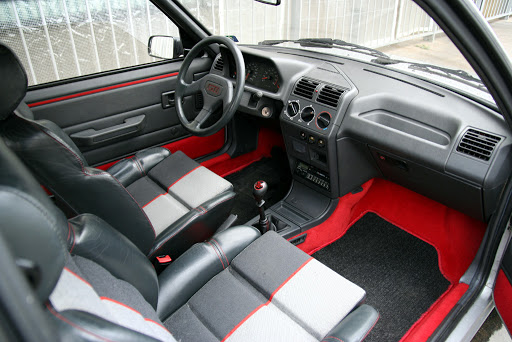
The Rallye also inherited the front suspension and ventilated disc breaks from the 1.6 GTI, keeping the same drum brakes in the rear. The interior (except then for the removed isolation) is also reminiscent of its bigger brother, but the exterior is cleaner, especially in white as they car I saw, and with those wonderful, 80’s-like white wheels (these were however not original, those were also white, however in steel). There was really no doubt that the car I saw had been restored, as it was really in perfect condition, including on the inside.

The Rallye had a far shorter life than the GTI, being produced only between 1988 and 1992, and only sold in a handful of countries in central Europe. Peugeot had initially planned for 5.000 cars but in the end, no less than 30.000 would be built. The Rallye was thus a success, also since it was a car that was really rewarding when you drove it hard. Unfortunately, that together with the quite thin body parts, have contributed to few cars remaining today. As you may remember (or just have read) from my story of the 205 from four years ago, that particular car was written off following a collision that was certainly not nothing, but also not something that would really trouble a car today.

The interior isn’t identical, but close to the 205 GTI

That makes the Rallye even rarer today than the 205 GTI, but price-wise, they fetch around the same money, which is about EUR 25-30.000 for the best cars (and that’s by the way almost twice the money compared to four years ago). The real issue is however finding one – including in France, where even the GTI is not only rare, but today fetches the same price as in other countries, something that wasn’t the case for quite a long time.

I bet this driver doesn’t think about the money though, driving his 205 Rallye, but rather the purest form of driving pleasure, miles from the 1.5 ton hot hatches built today. I just hope he keeps it on the road and avoids close contact with other cars – both for himself and the car!

The striking 205 GTI!

If last week was all about the technological future of our cars, this week we’ll make a trip back in time and explore less of the thrill of technology, and more of the thrill of driving in its purest sense. We’ll do so by looking a bit closer at an absolute legend among hot hatches: the Peugeot 205 GTI.

A brilliant design that has aged really well!

Back in 1990-1991, when the 205 was still riding high although it had already been on the market for seven years, a good friend of mine had parents kind enough to offer him a brand new 205 1.9 GTI when he got his driver’s license. I remember when he showed it to me the first time, it was black and shiny with those lovely 15″ rims and the half-leather interior, and man was I jealous. Not that there was anything wrong with my parents, but the blue Golf from -75 they got me didn’t really do the trick in comparison.

As it turned out though, the Golf lived far longer than the 205. You see, my friend was in love with a beautiful girl, who also had just got her license, and kind as he was (and still is), lent her the car over a weekend. If memory serves me right, she didn’t drive more than a few hundred meters before crashing it so completely that it never came back. Luckily nothing happened to her, but the two of them broke off shortly thereafter, unclear why…

Except teaching us to be careful with whom we lend our beloved cars to, the story also highlights another fact which contributed to the 205’s early demise in the above case, namely that it’s a light car with correspondingly thin and light parts. It weighed in at less than 900 kgs and as I’ve written about previously on this blog, a low weight is the best recipe for good handling and speed – but not a good one if you plan to crash.

The 15″ wheels were large at the time and reserved for the 1.9 GTI

Anyway let’s go back to the beginning, which for the 205 means the year 1983 when the GTI started off in parallel to the regular 205, initially with a 1.6 litre engine developing first 105 and later 115 hp. In 1986 the engine size was increased to 1.9 litres with more torque and between 120-130 hp depending on version. The debate still goes on among enthusiasts as to which version was the best, some claiming the 1.6 is more playful whilst others talk of more speed and torque in the 1.9 litre. I’ve only driven the 1.9 and I’ll just note that the extra power means 1.5 seconds less to a 100 (at 7.6 seconds), quite beneficial since the car is still as playful as you would expect an 80’s hot hatch to be.

The 205 was an instant success in France, and the GTI version was a success pretty much all over Europe. In France its main competitor was the Renault 5 which didn’t have the poise of the 205, and internationally it was the Golf GTI Mk2, which was somewhat roomier and probably the better car, but which design-wise was a step back as compared to both the 205 and the Golf GTI Mk1. The 205 was a stunner in comparison and if you ask me it remains so today. It’s also striking how much cleaner the design is, compared to the the complicated and overburdened forms hatches tend to come in today.

It didn’t hurt the success of the 205 GTI, that lasted for 10 years, that a car by the same name but with few parts in common was very successful both in Group B and the Paris-Dakar rally. The 205 T16 / T16 Evo 2 was a mid-engine super car with up to 500 hp, competing with the Lancia Delta Evo and the Audi Sport Quattro, that I wrote about not long ago (click here if you missed it). The 200 homologation cars have mostly gone the same way as my friend’s car and finding one today is very hard and very expensive.

Looks roughly like a 205 and shoots flames out the back – that’s good marketing!

That the “normal” 205 is a real feather-weight becomes clear as soon as you open the (extremely light) door, sit down and look at the likewise very thin and basic plastic dashboard. Not much here to distinguish the GTI from a regular 205, but the comfy, good-looking seats along with the red carpeting remove any doubts as to which version you’re in, and both look sensational. Visibility is tremendous even by 80’s standards and the car is roomier than you think, both in front and back.

Taking it for a short drive, the first thing you note is how much the body moves and how soft the suspension is compared to modern hot hatches. This doesn’t mean it doesn’t stick to the road – it very much does so, but this was how hatches were built at the time and the longer suspension travel means that it’s actually overall more comfortable than a modern hatch. Naturally a new 206 GTI, Civic Type R or any other modern hot hatch is faster, but the 205 still provides a level of speed and fun which is right up there, especially since speed itself is relative and tends to be rather limited in most places you would use a hatch today. The car is playful, both steering and gearbox are fully ok, and the four pot has just the level and type of sound you wish for. It actually felt exactly as fun as it did 30 years ago, before disaster hit the car I drove at the time in the form of a pretty girl.

The dashboard could be any 205 but the seats and colors make the difference!

Finding a 205 GTI isn’t difficult, finding one in good condition a bit more so. Firstly most cars have really been used, and who wouldn’t? This means that many will have 150.000-200.000 kms on the clock which isn’t the end of the world as long as they have been maintained well. A good car will today cost you at least EUR 15.000, a perfect one with much less kms considerably more. Running costs won’t be much to worry about and the downside risk is very limited, as especially well kept cars get increasingly rare.

So why would you? Well, except for the looks and sweet memories from younger days, which in themselves are great arguments, there are other pretty rational reasons for looking at a 205 if a hot hatch is your thing. Assuming you will use it as most people, meaning on short city drives and spells of country roads rather than for long motorway trips, then things such as sound isolation and lack of top end power become much less important and having a small practical but very cool car with great visibility more so! You don’t need giant, Type R-styled wings in the city and you don’t need park assistance systems to park a 205 as long as you can still turn your neck. And whereas a modern hot hatch costs you three times as much to buy, the pleasure you’ll derive by taking the slightly longer way home along that twisty country road won’t be much different!