Very few people would object to the statement that the Porsche 911 is the most successful sports car of all time – and they would be wrong. That said, and in spite of that, it’s also a car that Porsche tried to kill off at least 911 times before it earned the unshakable position it has today. It started all the way back in the mid-70’s, when the newly developed 928 was supposed to replace the already then ageing 911.
As we all know, replacing the 911 didn’t work then, it hasn’t worked since, and it’s improbable to work in the foreseeable future. Today we’re glad that Porsche failed and be that as it may, the 928 became a great complement to the 911 when it was launched, as the GT car it really is. Fast forward to today, and it remains a great car and something you could still call a bargain, especially in comparison to classsic 911’s.

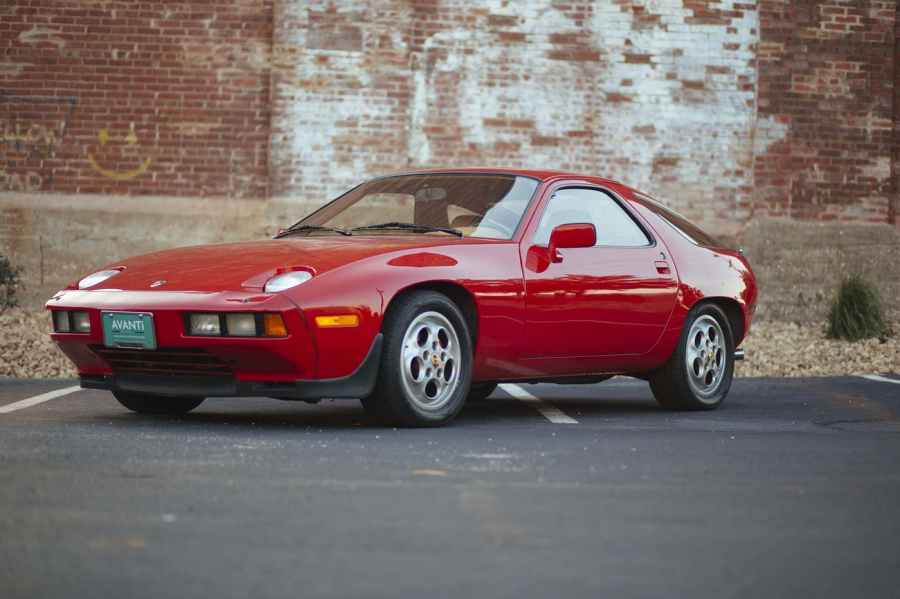
Design is a matter of personal taste, but unless you’re heavily into psychedelics, you’ll probably agree that the 70’s weren’t a happy period. The world was mostly brown and orange and cars generally looked like they’d been drawn with a ruler by someone loving 90-degree angles. When it was launched in 1977, the 928 was therefore a true revolution design-wise. The long hood and the “reversed” pop-up headlights earned it the nickname “land shark” in some countries, and the rounded rear with integrated shock absorbers doesn’t look dated to this day. To my mind, the 928 is probably the 70’s car desugb that has best stood the test of time. This was also proven by the production which ran for almost 20 years until 1995, with most of the design remaining pretty much unchanged until the end.
Coming back to where we started, it’s however difficult to see how Porsche actually thought that fans of the air-cooled, rear-engined 911 would ever consider the 928 as a replacement. Firstly it was obviously a larger car, even if it’s better described as a 2+2 seater than a real four-seater. Secondly it has quite a large boot, meaning the engine is up front. Thirdly, that engine was a newly developed, water-cooled V8 rather than a legendary, air-cooled six-cylinder. This led to the 928 being heavier, much more at home on the Autobahn than on curvy mountain roads. To this day, it remains a true motorway cruiser that sat nicely alongside a 911 at the time, although it never saw its success its smaller brother did.

There was no getting around the 928 being a heavier car than the 911, but Porsche were very focused on doing what they could to keep its weight down. The doors, front aisles and hood are thus all made out of aluminium, and the front and rear bumpers were in composite material around a metal core. The original, 4.5 litre V8 with 240 hp was at the time the second most powerful engine from Zuffenhausen, losing out only to the 911 Turbo, and the 928 was thus well motorized from the beginning, helping offset the additional weight. It was available with either a 5-speed manual or a 3-speed automatic from Mercedes (later a 4-speed) from the start, mounted on the rear axle and thus contributing to the excellent balance.
The 928 was generally an advanced construction with notably double wishbone suspension all around and Porsche’s so called “Weissach axle” in the back of which I’ll spare you the technicalities but which can be described as a system for greater stability and less oversteer. That system was certainly never fitted to the 911’s of the time, and even 911 fans would probably agree that the 928 was in many areas far ahead of not only the 911, but of most other cars from the same period as well.
The first series was built between 1977-1982, with the 300 hp 928S launched as a more powerful version in 1980, and a couple of years later becoming the only available version. The S managed the sprint to 100 km/h in 6.6 seconds, a very respectable time in the early 80’s. It was also the car Porsche ran for 24 hours non-stop on the Nardo track in Italy, achieving an average speed of 250 km/h! Think of that a minute – we’re talking 24 hours with the pedal to the metal at top speed, back in the fully mechanical age! Porsche kept improving the S interior and equipment with notably ABS breaking, before it was replaced by the face-lifted 928 S4 in 1987.
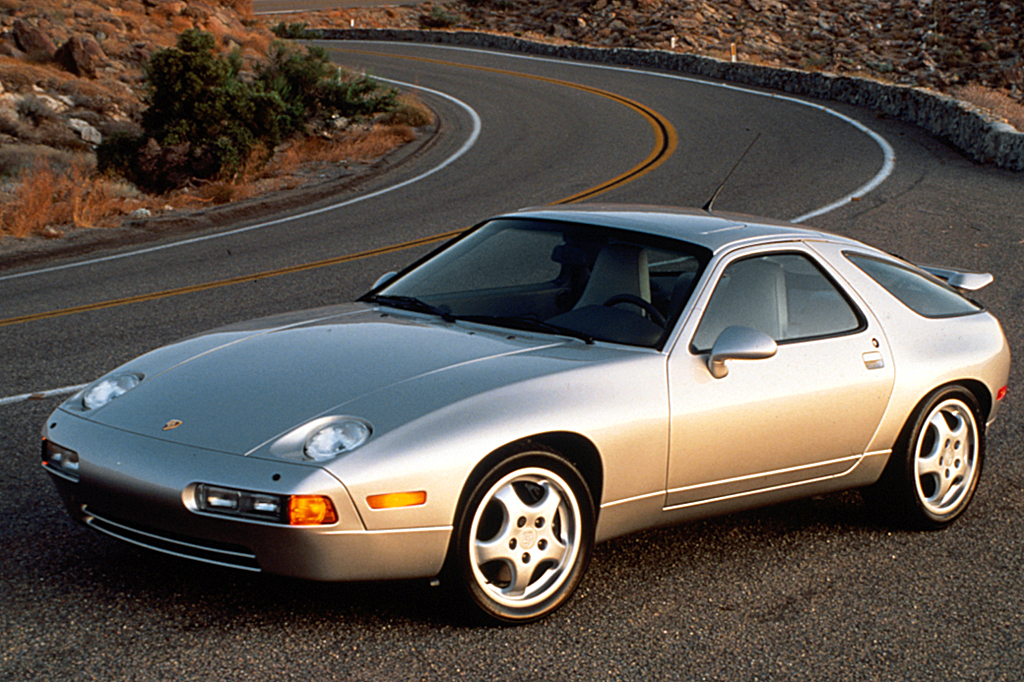
The 928 S4 had a face-lifted body, best visible in the rear through new lights and a standard-fitted wing. Engine-wise it went form two to four valves and an output of 320 hp. The 0-100 km/h time was now sub-six seconds with a top speed of 270 km/h. The even sportier GT was introduced in 1989, adding another 10hp and only being available as a five-speed manual. Both versions were replaced by the 350 hp GTS in 1992, produced until 1995 and actually Porsche’s last GT car until the Panamera 15 years later. Over its full lifetime, a bit more than 62.000 928’s were built. Not a huge but still quite a large number, and in that sense it’s surprising how few of them you see on the roads today.

Unless you’re not a die-hard, nothing-but-911 kind of person, a 928 will deliver the true Porsche feeling from behind the wheel. The engine is like a solid companion at all speeds, especially in combination with the manual box. The suspension is superb given the car’s age, but It’s clear from the first meters you drive that although smaller than modern cars and in spite of all the Porsche attributes, this is a true GT that is most at home on long distances with two (or 2+2) passengers and surprisingly, quite a lot of their luggage. On such trips, it will also surprise on the upside not only by its comfort, but also its lack of wind noise, one of the advantages of the soap-like design.
When writing about classics, I usually add a sentence along the lines of “make sure you check the history and the condition”. Never ever has that sentence been more true than if you consider a 928. As mentioned, the car is a complex construction. Parts have always been expensive and haven’t become less so today, only in some cases harder to find. The engine and gearbox are of course the most critical parts and inspecting the car from underneath before the purhcase is mandatory. If you’re unsure about what to look for, get a specialist to help you or take it to a Porsche garage. Trust me on this but also know that even if you go through all the checks, you shouldn’t buy a 928 with your last money, but rather keep a reserve for things that may come up.

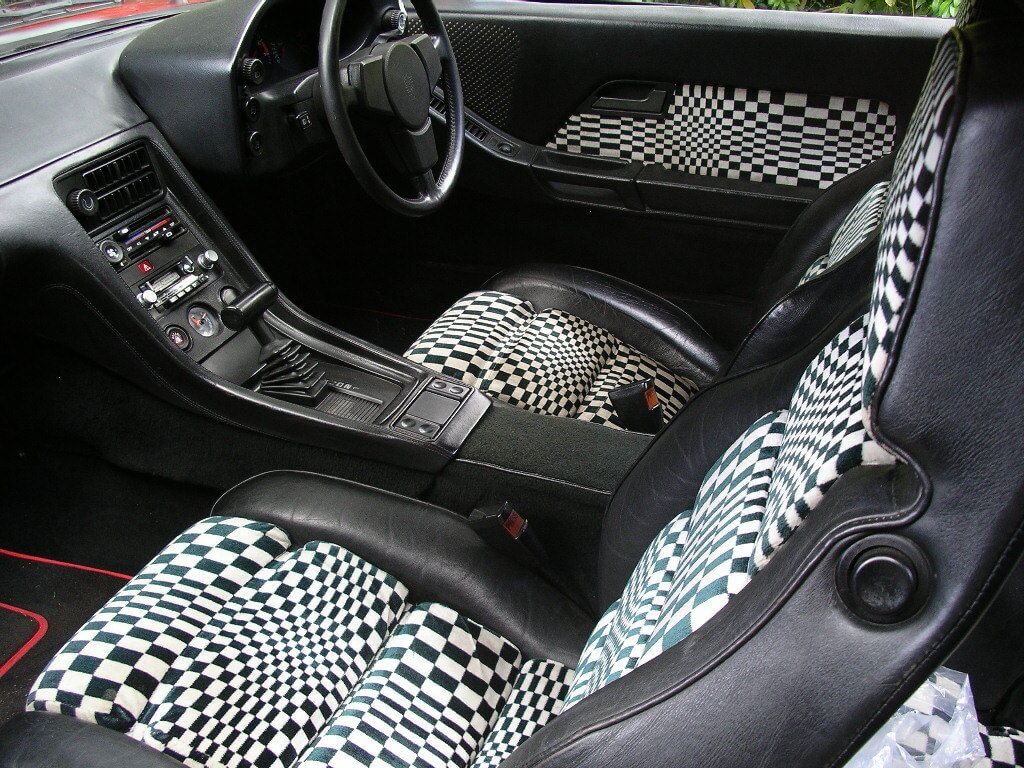
So which one? Well, no surprise that a manual is preferrable, but the automatic is actually not as bad as you may think, so potentially try it if the rest of the car is good. Do get a four-peed automatic though. Design-wise it’s a matter of taste between the first and second generation, but be aware that the two-valve engine is easier (and thereby cheaper) to service than the four-valve from the S4 onwards. If that doesn’t scare you, the 928 GT of which only around 2000 were built is especially interesting. Otherwise, the 300 hp second series is also a good choice. Please don’t go for the Strosek or Gemballa 80’s versions with massive plastic wings, but rather try to find a car that is as original as possible. For the first series, both the phone dial wheels and the pepita interior you can see higher up are sought after today.
A good first series 928 will set you back around EUR 25-35.000, probably around 50% more than 10 years ago (but you’ve hopefully gotten richer in those 10 years as well!), however not much more than a few years ago, as values seem to have stabilized. The second series will typically cost around EUR 10.000 more with the GT and GTS potentially even more for low-mileage cars. High kilometres need not be a problem though, if the car has a solid and well documented history – but only then.
In terms of value for money, this means that you still get one of the best GT’s ever built for less than half of a classic 911, and no more than a third of what a power-wise more comparable 911 Turbo from the same period would cost. That my friends not only makes this a bargain among Porsche classics, it does so among classic GT cars in general as well!


 The Thrill of Driving