Classic cars as investments

In the last ten years, interest rates in the developed world have been close to nil across the board, and you need to look no further for an explanation to why various kinds of real assets have seen steep increases in price. Cars are definitely part of that group, although it’s unfortunately not the family Volvo that has become a good investment, but rather classic cars and selected sports cars.
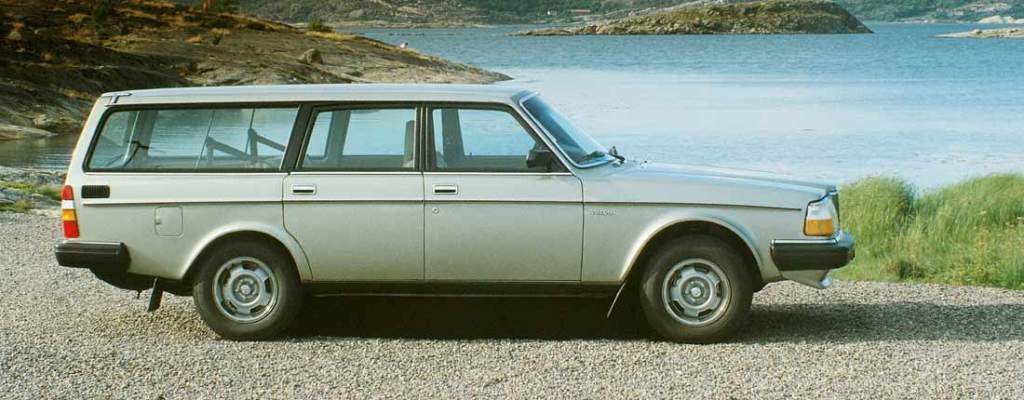
Irrespective of the statement above, the Volvo 240 has actually started to appreciate in value…

If you read this blog, chances are you also read other car blogs or follow some car Youtube channels (perhaps even one or several on my favourite list that you can see here). You don’t need to look far to find someone that describes a classic car such as the Jaguar XJ-S that I wrote about last week (see here) as “a good investment” or something that will “most definitely increase in value”. Personally my stomach turns at such unsubstantiated, general statements, but let’s look into whether there’s any truth to them.

In 2015 we launched the new sub-section “The Thrill of Owning” on this blog. We did so seeing the price evolution many enthusiast cars were starting to take, and I wrote about some cars I believed (without guarantee!) would increase in value over the coming years, adding an economic upside to the ownership experience. The first 5 cars I picked were the Lancia Delta Evo, the Honda NSX, the BMW Z4M, the Porsche 996 and the Ferrari 550. Looking back now five years later, it’s clear that had you bought an NSX, a Delta or a 550 in 2015 that you would sell today, you would get substantially more than you initially paid – the first two have basically doubled in price. For the Z4 and the 996, the evolution has been less steep but still in the right direction. Buying and selling is one thing though. Owning is another that should not be forgotten.

An Evo has basically doubled in value in five years, but is far from cheap to own.

Since close to ten years I’m the owner of a Triumph TR4 from 1965, a car that has brought me great joy and that I’ve been extremely lucky with. It hasn’t left me standing a single time and has generally been close to as problem free as a classic car can be. Nevertheless, and even if I haven’t driven thousands of kilometres per year, it still needs regular servicing and old parts will wear out and need replacing. Also, not to forget on a classic car is that the engine will typically need more adjustments than a modern one. In ten years I have thus had it thoroughly serviced and revised three times, redone the breaks once, and replaced more regular wear and tear parts such as the battery, tires etc. in between. A rough estimate is that the car has cost me around EUR 12-13.000 in servicing and parts costs over my years of ownership. To that should be added tax, registration, garage etc., but given how different those costs are depending on your circumstances and country, we’ll leave them aside for this exercise. You shouldn’t though, when you budget your ownership!
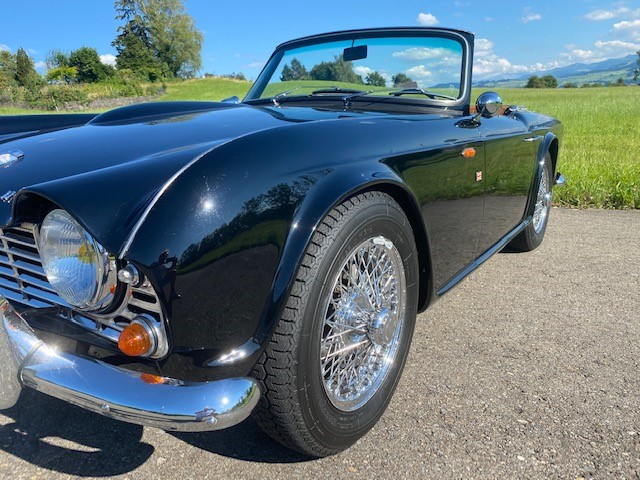
My TR4 is living proof that not all English cars fall to pieces!

Had I instead bought that Delta Evo in 2015 my costs would most probably not have been lower, as the Deltas are known as cars needing lots of love an attention. That said, the economic upside would definitely have been higher. On a higher level for the 550 as well, at least with the right car. The bullet-proof NSX may have been cheaper to own, had I been lucky. But again, all this will depend on the particular car you buy, its history, condition – and luck. This is why a statement such as something “definitely increasing in value” is quite simply not true. Firstly, it’s very difficult to say which models will increase in value (although if you know your stuff, I agree you can have a pretty good idea). Secondly, it’s all about the condition of the individual car.

Has my Triumph been a good investment? Price-wise it’s worth around CHF 10.000 (30%) more today than I bought it for, thus covering a fair part of my running costs. In my particular case living in Switzerland where owning and running an oldtimer is cheap, I’ve nevertheless had to rent a garage for the ten years I’ve had it and I’ve certainly not covered the costs for that. It should also be noted that a TR4 is quite a basic oldtimer, with an extremely robust, 4-cylinder engine. Friends of mine who own E-Types, Aston Martin V8’s and other, more advanced cars, will give you a number considerably higher than mine, even though most of them are more capable in a garage than I am and thus do a lot themselves.

The original V8 Vantage – a beauty when it works, a nightmare when it doesn’t…

That’s the economic side of it. On the emotional side, there is no doubt that it’s been a good investment and has brought me much joy and great memories. And that is really the point of all this. Don’t buy a classic car purely as an investment, but also as something to love, drive and enjoy! There will never be any guarantee that an XJS or any other car will be worth more 5 years from now and if you buy the wrong car, you will most certainly not make any money. Arguably it will also reduce the pleasure of ownership, but if this is the car you’ve been dreaming of since you were young, believe me, you will forgive a lot!

Unlike a painting, a car is made for driving. Be thorough in your checks, but also buy with your heart in the sense of loving what you buy, enjoying it, and not to be forgotten, knowing that you will be able to use whatever your dream car is on a regular basis. Good luck!

I hope you like this blog – please help us keep it interesting by subscribing!
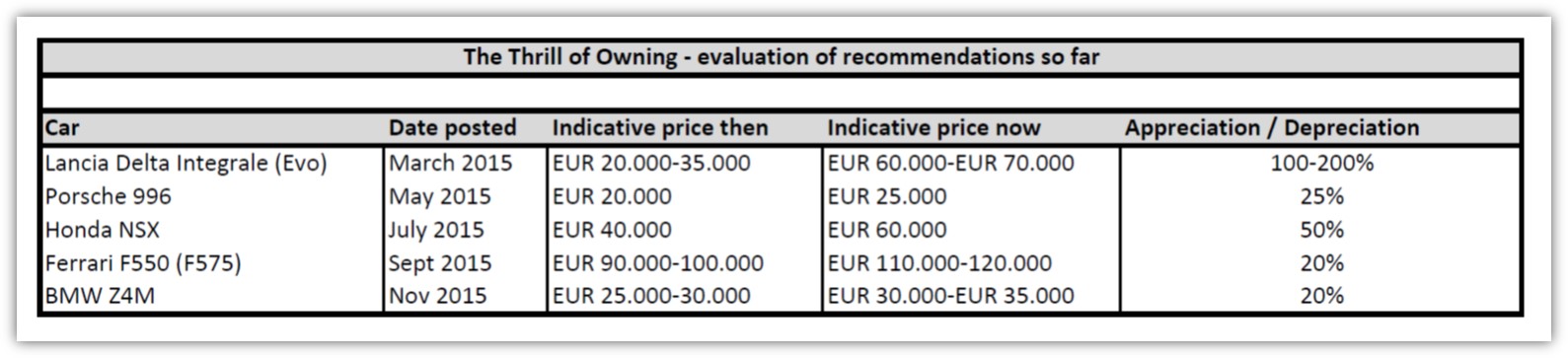
Thrill of Owning – evaluation of recommendations so far

It’s been awfully quiet lately under the Thrill of Owning heading, something unfortunately due to a rather hectic work schedule of yours truly. Another factor at play is however the steady rise in collector car prices over the last year, by no means a new trend and no doubt one of the side effects of a zero- to negative interest rate environment and investors’ feverish search for alternative investments. This actually has led to quite a few objects that were intended for the column rising so much in price before the time of writing that they disqualified themselves!

In light of that I felt it was time to go back and have a look at the cars presented so far. If you had purchased them (and who knows, maybe you did?), would they so far have been a good deal not only driving-wise but also investment-wise? Given we started this heading in 2015 the track record is obviously short, but summarized below is an estimate of the price evolution seen by the cars presented during 2015 as per today, i.e. in November 2016.

thrill-of-owning-price-evolution

It would not take much academic effort to completely disqualify the methodology behind the price estimations in the above table, but at least it is consistent with how prices were initially estimated. Basically I have done a rough estimate of average market prices for the presented cars in Germany, Switzerland and partially Sweden, according to the specs (for example max kms) as described in the post. Given in all cases samples are also small and the individual condition therefore critical, it should really be taken as an indication at best.

Still, it is interesting to see how some models have seen spectacular rises in a short time, none more so than the Lancia Delta Evo, whereas others such as the Porsche 996 or the BMW Z4M have had a moderate, although still positive price evolution, probably also due to them being newer cars produced in larger numbers. However, you will probably struggle to find another investment in the current period that has a comparable performance on average whilst at the same time bringing true driving pleasure!

Even if the mission of the Thrill of Owning has become harder, the column will remain and I still have a few objects up the sleeve to enlighten the darker and colder season. Stay tuned!

The greatest Porsche bargain of all times!

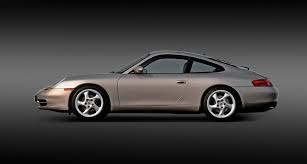
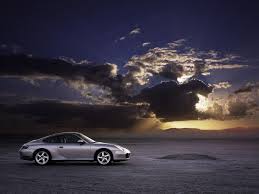
imagesOur new heading The Thrill of Owning is about cars that are not only a thrill to drive, either because they are very good value, or because their future value can be expected to hold up very well, alternatively even rise. One car that firmly ranges in the first of those categories is the Porsche 996, produced between 1997 and 2006 as the successor of the fabulous 993. Looking at the classifieds in different countries today, early rear-wheel drive 996 Carreras with less than 100.000 kms on the clock can be had for around 20.000 CHF/EUR. As anyone who has driven a 996 knows, that is a true steal and there is clear reason to believe they will never be cheaper!

History

Most readers of this blog will be familiar with the 996 so we’ll keep it short. The new model was the 993’s successor but and in many aspects a new car – larger, roomier, more comfortable and far more practical than the old one. It was also Porsche’s first water-cooled, six-cylinder boxer engine, something that didn’t go down well with the 911 purists. For slightly more flexible owners, it did present several advantages (notably that of cheaper servicing) but more importantly, it was something that had become necessary as certain technological developments and new emission regulations were not compatible with the air-cooled boxer.

images

The other thing that didn’t go down well with the purists were the headlights. The Boxster had been launched one year earlier and some cost-saving genius in the marketing department came up with the not-so brilliant idea of fitting headlights in the same layout as on the Boxster to the 996. This is something that has haunted the car ever since and is today given as the main reason for the poor secondary value. We agree – the headlights are not pretty and especially on the Mk1 version until 2002 they are downright ugly. But we are talking about a pair of headlights, and as long as they light up the road in front of you when you are driving, that is about as much thought as you should given them.

Versions

imgresimages

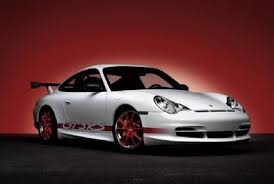
The 996 was available as coupé (Carrera) and convertible in 2- and 4-wheel drive versions. Standard output was 300 hp (320 hp from 2002). The four-wheel drive Turbo (above right) was launched in -00 with 420 hp, increasing to 450 hp in the Turbo S from -05, as coupé or a very fast hair dryer. Further versions included the more hardcore, rear-wheel drive GT3 (above left) and subsequent GT 2 with up to 483 hp.

Owning

images

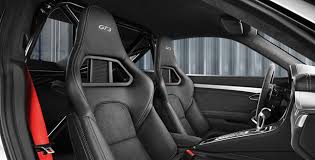
As some of you know, my fellow blogger Sven is a 911 aficionado, having owned both a Mk2 996 Carrera (with performance kit, as he is keen to point out…) and a Mk1  GT3 Clubsport (pictured right). He loved them both and praises the practicality of the “standard” 996 that he used as an everyday car. This is not something that is recommended with the hardcore driving machine GT3 CS, of it is becoming increasingly difficult to find a low-mileage one in good condition.

Which one to get?

The real bargains are the low-mileage Mk1 996’s, that even well-equipped will be yours from around 18-20′ CHF/EUR with less than 100′ kms. Many 911 drivers praise the 2-wheel drive version as a bit more agile than the 4-wheel drive, so if you have money to spare, rather put it on a cabrio if that is your thing, or on a Mk2 version, which both start at around 25′ CHF/EUR. Whether to go for the 6-gear manual or tiptronic is a matter of taste but the manual difficult to fault.

Looking at Turbos and GT3’s, they both start at around 45-50′ CHF/EUR, again for sub-100′ kms cars, and come roughly at the same price even if the cars are radically different – whereas the Turbo is comparable to the standard 996 in practicality, the GT3, standard or CS, is a pure driving machine. In terms of future value the GT3 is probably the way to go, especially the GT3 CS (if you can find one, that is…).

images

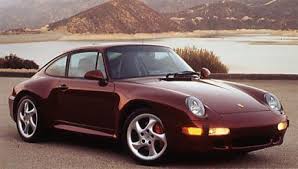
To put these prices somewhat in perspective, a comparable 993 (i.e. the previous, last air-cooled version, pictured left) in standard version costs about 3 times more than a standard 996, starting at 60′ CHF/EUR. The 993 is a fabulous car, but it is not 3 times better than a 996.

images

Whether the early 996’s will also start to see their value raise is difficult to say, notably given the quite large number of cars produced. But there is clearly reason to believe they will never be cheaper than today. In terms of driving and value for money, you could argue it is one of the best deals on the market, and one that is very hard to resist!