The big short reloaded!

Oh how quickly things can change! Three months ago, most of us would agree that we were in a very different place, and nowhere more so than at Tesla, who at the time was valued at more than all other car companies in the world combined. Yes, you read that right, as incredible as it may sound. And even after it’s lost close to 50% of its value this year (with the stock trading at around USD 240 as I write this), that still values the company at around USD 800bn, about three times the value of Toyota, or 12 times the valuation of GM or Mercedes-Benz. Perhaps most relevant, it means that Tesla is currently valued eight times higher than BYD, the leading Chinese EV brand that has now surpassed it in number of cars sold.

The BYD Seal – a superior competitor to Tesla’s Model Y

The first quarter of 2025 was not kind to Tesla. Not only has the stock price imploded, the company has also seen sales dip heavily in several key markets, with a corresponding loss of market share. And nowhere more so than in China, the most important market of them all and of course, the home market of BYD and other Chinese EV’s. During the first quarter of the year, Tesla’s Chinese deliveries were down 13% as compared to 2024, with its EV market share dropping to 7%, down from 12% a year earlier.

Q1 2025 was also the first quarter when BYD delivered more pure EV’s than Tesla (BYD sells plug-in hybrids as well). In 2024, the two companies sold almost exactly as many EV’s at 1.75m each, but this year, BYD is projected to double that number, and given the brand isn’t present at all in the US and so far on a very limited scale in Europe, most of these will be sold in China and across Asia. And yet, even at a stock price of USD 240, Tesla’s valuation is eight times higher than that of BYD.

Tesla’s stock price evolution year-to-date. Not what many expected.

If it was just to prove that Tesla’s valuation makes no sense, we could probably stop right here. However, there’s a lot more to say and as we’ll see, it only gets worse from here. Tesla has no doubt been instrumental in making EV’s part of today’s car landscape, but I would argue they’ve now fallen so far behind Chinese brands such as BYD that their market share, and thereby stock price, will only keep on falling. I would even say that it’s doubtful whether Tesla will continue to build cars in the coming years, and if that’s even what they aspire to.

To understand why that is, let’s start with the line-up. Models S and X have now been on the market for 13 years, with the Model 3 not too far behind at nine years. That’s an eternity in modern car cycle terms. Their battery packs have seen continuous improvements, but both the exterior and interior have seen nothing more than a quite mild face-lift over the whole period. The Model Y, the best-selling car in the world in 2024 (obviously quite an achievement!), has recently seen a similar cosmetic update, but it’s six years old by now. We’ll never see the Cybertruck in Europe (thank God for that…) just as little as any of us will probably ever see the roadster or the sub-$25.000 car Elon has been promising for years. That means that Tesla has an older model line-up than all the other car brands, the valuation of which it exceeds by up to 12 times.

The Tesla Roadster is suppose to come out next year. I wouldn’t bet on it…

Next, there’s the quality which was terrible in the early years but has gotten better such as to be more or less ok today. As a comparison however, I was in a Polestar store the other day and checked out the Polestar 4, the SUV coupe without a rear window. Polestar may market themselves as Swedish, but they’re owned by Chinese Geely and all models are these days built in China. Except for a bit of Nordic interior design, it’s therefore a Chinese car. In terms of interior quality however, it’s on another planet compared to not only Tesla, but also to any EV coming out of Germany these days (and even worse, of any ICE car the likes of Audi, BMW and Mercedes have in their current lineup).

Beautiful materials, plush seats, no hard plastics anywhere, lots of space and all the features you could wish for. Everything is solid and well put together and as I’m lead to believe, Polestar is hereby not the exception, but rather quite representative of modern Chinese EV’s. They even drive well, in the not very passionate but comfortable way EV’s do. Given Tesla’s European charging network is now open to other brands as well, if I were in the market for an EV, I wouldn’t hesitate a second between a Polestar 4 and a Tesla Model S. I’d actually be prepared to pay a premium for the former, but I wouldn’t have to, given it’s 20% cheaper.

The Polestar 4 – one of the nicest car interiors I’ve ever seen, any category.

Then there’s the whole self-driving thing. Basically since the first Model S came out, buyers have been given the option to add thousands of dollars to the price by opting for self-driving packages that were set to become reality “soon”. Well, in over 10 years, “soon” hasn’t happened yet, which makes you think that at least in Europe, some kind of consumer protection body should step in. How can you be allowed to sell options for functions that never become reality? And for each passing day, Connectivity Day is becoming less likely to happen, quite simply because Tesla’s technology isn’t even close to where it needs to be.

If you’ve been to Austin, San Francisco or a few other American cities in the last years, you will have seen or perhaps been in a Waymo driverless taxi. Based on the Jaguar I-Pace, they transport people around the cities like a normal taxi without any issues. Given they’ve been doing so for some years now, it makes you wonder why they haven’t spread to more places, which may have something to do with their price tag of over USD 250.000 per car. The price is explained by the fact that a Waymo is equipped with not only cameras, but also a radar system and Lidar (Light Detection and Ranging), all necessary for self-driving.

A Waymo in Frisco. USD 250.000 cars usually look differently…

Tesla doesn’t have that. In fact, Tesla is the only brand promoting self-driving on a large scale which relies completely on cameras. That’s of course because it’s a cheaper technology, but it brings the slight disadvantage that cameras struggle to see some things that a radar or Lidar system pick up. Driving in the dark is one of those things you would need to be really stu…. brave to do in a self-driving Tesla. Youtube also has illustrations of someone putting up a picture looking like the continuation of the road at some distance in front of a self-driving car. The Waymos and other radar cars all pick up that it’s not the continuation of the road, and stop. Teslas just run through the picture. Trust me, with the current system and without major developments, no Tesla will ever be fully self-driving, whatever the regulation says, and whatever was promised at the time.

You’ll notice that at no point so far, I’ve mentioned Elon Musk’s politics. Doing so doesn’t improve things. This is not a political blog, so let’s just say that the position he’s assumed in the new US administration doesn’t sit well with his cult-like following, who now start putting stickers on their cars like the one below. No doubt this has also contributed to the falling sales numbers, as apparently, if you buy a Tesla, it’s important that the CEO shares your political positions. I guess I should call BMW then, to make sure the current CEO Oliver Zipse shares my beliefs?

The problem with cults…

More seriously, the problem is of course that if your sales were based on cult-like, non rational behaviour and the cult then disappears, you’re in trouble. In the case of Tesla, what remains is a heavily top-run business where the guy at the top is no longer fully committed to the company. At this point in time, given all the other issues the company is confronted with, that’s not a very good sign.

You’ll also notice than when Elon talks about his companies these days, it’s usually not so much about the cars as it is about AI robots, energy storing and space travel. Given the man is obviously quite talented and probably not as crazy as his once followers believe, I have no doubt he’s very aware of everything I’ve written above, but doesn’t really care, as he may see Tesla’s future elsewhere than in the car business. The problem however, is that no one outside of his head has an idea of what that business is, and thus how to value it.

Coming back to what we can measure, Tesla is a car company on a slippery slope that is likely to continue downwards. EV’s will not take over the world anytime soon but China will most probably take over most of the EV market, such is on one hand the quality of what they build and on the other the size of their domestic market, where various kinds of incentives go towards promoting EV’s.

BYD’s new factory is bigger than San Francisco. Elon, they’re coming for you!

Tesla’s home market is far smaller, and the wind has turned against it. They may get some protection from tariffs, but they don’t solve the fundamental issues of the company. And Elon would do well to remember the 70’s, when the US tried to protect Detroit from superior Japanese cars by imposing tariffs. It made Japanese cars more expensive but Americans still bought them, because they were better.

Then again, none of this matters if Tesla’s future isn’t in the car business. I don’t have more of an idea than anyone else of what goes on inside Elon’s head, but I’d say it’s more likely that Tesla focuses on other things than cars, rather than that they turn the numbers around and bring a new model line-up to market in the coming years.

Whatever the scenario, it remains that Tesla is hopelessly overvalued as a car company and the brand’s cult-like followers are now to a large extent gone. And if you’re in the market for an EV, you’d do well to look at a few options before signing a check for the 13-year old Model S. The Chinese are coming big time, and it will be interesting to see how things evolve in the coming years!

13 Fords for 1 Tesla

So it’s time to talk about Tesla. Again. I did so addressing its shaky finances in 2019, and I wrote about a first glance of the Model 3 in Q4 2018. As in 2019, the reason this time is mainly financial. This is obviously a car blog, not a financial one, but then again, under all the bells and whistles, Tesla is a car company. And in that sense, when its stock price values it at $300bn or 13 times Ford as it did earlier in July at a stock price of around $1750 per share, you should notice (it’s come back to $1417 at the time of writing, so we’re probably down to something like 11-12 times Ford now). The first reflex is of course to think something major has happened, but that’s not the case. Tesla’s more than tripled stock price since it dip under $400 earlier this year could be called the definition of momentum for future financial text books. Congratulations to all that were part of the ride. I wasn’t.

I’ll happily spare you all the explanations of why the stock has rallied and in any case, the stock price is a poor reflection of a company’s quality. You could probably argue that it’s especially poor in the case of Tesla. Not that things haven’t improved for the California-based car maker. They just turned in their fourth quarterly profit in a row, including $104m in the very lacklustre second quarter 2020. That said, on one hand profits are rather modest and on the other they’re always a bit clouded, including various subsidies and tax breaks. But the trend looks positive, better than in the poor scale of the diagram below.

Courtesy of theverge.com

Tesla is also delivering more cars. Elon Musk has set his target at 500.000 cars in 2020 which doesn’t seem fully unrealistic as Tesla has delivered more than 100.000 cars per quarter in the last quarters. It’s not all rosy though, as the Model 3 now makes up over 80% of all deliveries. Total deliveries of Models S and X have fallen from 28.000 in Q4 -17 to 12.000 in Q1 -20, i.e. less than 10% of all deliveries. This basically means that going forward (and until the cyber truck, that however looks to be a few years away), Tesla profits are riding on the Model 3 and the new Model Y.

There are however problems as well. Quite a lot of them. One is the EV market in total which both in Europe and the US is growing but is still very small. In Europe’s leading car market Germany, EV’s now make up around 3.7% of new car sales. In the US where EV’s is basically synonymous with Tesla, the share is below 3% in all states but California and Washington DC. In most of them, it’s below 1%.

Source: https://evadoption.com/

Another problem for Tesla is that the big car brands have woken up and as the EV market grows, competition will only intensify. Were the big guys late to the game, as is so often claimed? Not sure if you look at the above stats of the total EV market. They’re anyway here now and you can already see the effects in Germany where Tesla’s trend is negative since a while back. 4367 Model 3’s were sold in the first six months of 2020, but VW and Renault sold more than 7.000 each of the E-Golf and the Zoe, and the Model 3 will probably also be overtaken by the VW E-Up and the Audi E-tron still this year. An E-Golf or a Zoe are not comparable to the Model 3, but neither is an E-tron – in the other direction. The EV mass market will no doubt be in Zoe land, but the premium market will increasingly move from Tesla towards Audi, Mercedes and other large brands. This is not a big surprise. Tesla was never a premium product in quality – only in pricing.

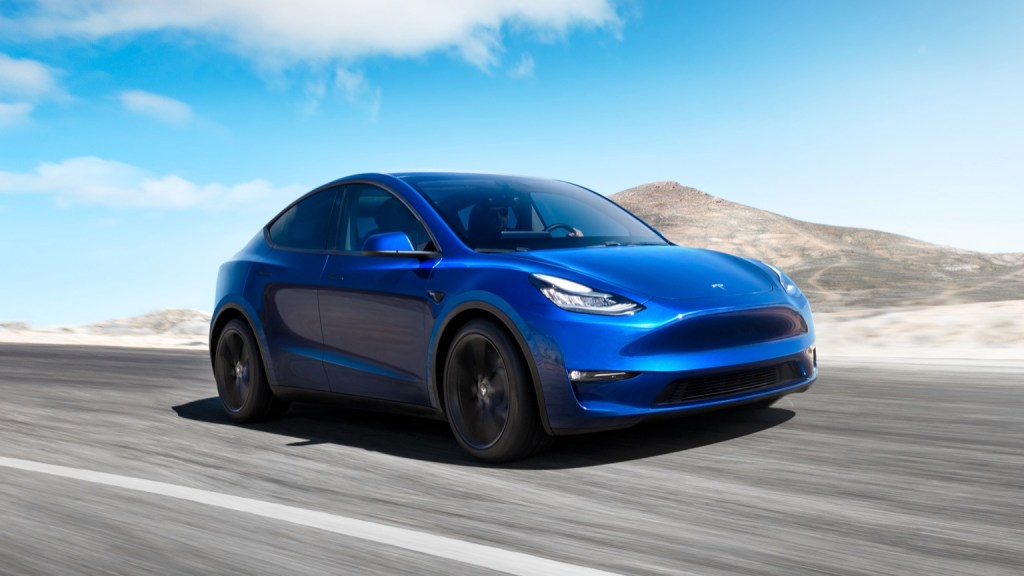
The Model Y – the latest interpretation of basically the same concept.

This brings us back to the stock price, because of course, Tesla doesn’t need to dominate the world. It’s already turning a small profit on the current production of around 400.000 cars per year, and if it can increase that by a few ‘000s, it would look pretty good. That would however also be necessary for coming necessary capital expenditure. In any case, it’s not enough to put a value on the company at 13 times Ford, who by the way sold 1.13 million cars worldwide in Q1 -20, a 20% drop on the previous quarter.

I have no clue where Tesla’s stock price is going next, but personally I stay away from emotionally driven companies, and this is a prime one in that regard. It may be useful to remember that in the dot.com boom and bust 20 years ago, a young online retailer called Amazon lost 94% of its share value before it turned things around and moved to dominate the world. That’s not something Tesla will ever repeat, but irrespective of the stock price, I wish Tesla all the best and think it’s amazing what they’ve managed to achieve. My guess is however that when we look back at this in five years, if Tesla is still around, it will be selling almost all its cars in the US where the EV market share will still be in single-digit territory.

Two great visionaries, but at least with Tesla, Elon won’t overtake Jeff.

The E-tron – impressive or not?

The E-tron is becoming an increasingly frequent sight on the streets of Zurich and elsewhere. I had the opportunity to study the car in detail at the recent Geneva Salon (check out my video here) and found it a bit difficult to get my mind around: sure, impressive in build quality and good-looking, but that has nothing to do with it being electric and everything to do with it being an Audi. But for the rest?

If you’re a bit cynical, but only a bit, you could say it’s taken Germany’s leading car manufacturers (Mercedes will join the electric SUV party in the coming months with the EQC, a car very similar to the E-tron) seven years since Tesla’s first Model S, and four years since the Model X, to bring out alternatives in the form of cars with less range, less room and, especially critical, far less charging points at present.

Starting with the range, Audi claim an optimal value (also called WLTP range) of 417 km, but are honest with the fact that it’s a distance you’ll only achieve with the AC turned off and ideally neither passengers, nor speed. A more realistic range – in optimal conditions, meaning neither too hot, nor too cold – is, according to multiple tests, somewhere around 300-350 km, and in winter, you can deduct around 30%, bringing you down to as little as 200-250 km per charge. This still supposes driving very legally. The Model X in its latest configuration has an unrealistic WLTP range of 505 km, probably meaning around 400 km in reality, and thus 300 km in winter. Not great, but around 1/3 better.

A short range means you will be charging quite often. Audi will tell you that the E-tron has the mechanical ability to charge up to 350 Kwh, which is more than twice as fast as a Tesla Supercharger (150 Kwh). That’s however in the future, as such chargers are not around yet. Audi is a member of Ionity, a collaboration of leading European car manufacturers currently building charging stations with charging power of up to 150 Kwh across Europe, power-wise on par with Tesla’s supercharger. But in all of Europe, there’s currently not more than 20 such stations. That leaves you with the other 90.000 or so charging stations which are part of the European electric car “roaming” network and that E-tron owners can use (against payment by an E-tron credit card), but the vast majority of those have a charging power of 22 Kwh at most, in many cases even less. Charging an E-tron to 80% at a rate of 22 Kwh means three hours charging time. Taking as example a 600 km holiday drive from Zurich to the French Riviera, there are seven Tesla supercharging stations along the way. With an E-tron, it would mean at least one three-hour stop, and thus more than 2 hours longer travel time – for a six-hour drive.

In terms of interior space, the advantage of Tesla’s swollen egg form is that it offers lots of room, and that its luggage compartments back and front are both roomier, as is the passenger space. An Audi Q7 is much roomier than an E-tron, which more resembles a Q5 space-wise.

So where does this leave us? If space, range and charging times are all irrelevant, then the E-tron is probably the better car – as it should be, given Audi is an established, leading manufacturer and not a Californian startup. But all else is not equal, meaning it’s taken Germany’s leading car brands more than five years to bring out a car that is only almost on par with Tesla, but with a charging network that is comparable to what Tesla offered more than five years ago. That is not very impressive, to say the least.

Keep your hands on the wheel!

The below video made the rounds on Twitter yesterday, so you may already have seen it. If not, it’s quite scary. Five attempts at the same piece of road, but the Tesla autopilot gets it wrong every time, illustrating not only a lack of reliability, but also a lack of self-learning…

Now before you tell me that Tesla recommends drivers only to use the autopilot on motorways, the problem is obviously that you CAN use it on other roads, and as long as you can, someone will – hopefully with better results than this.

There is however – unfortunately – more to the story. The below video was filmed by my co-blogger Magnus, this time on a motorway, a few months ago. The driver talks to Magnus about how long you can hold your hands off the wheel before the car reacts, and after that, what happens speaks for itself. So whatever Elon says, please keep your hands on the wheel!