Prefer listening, for example while driving, to reading? Check out your favourite blog on Spotify!
The curse of a petrolhead, one we probably share if you’re a reader of this blog, is that we’ve seen most of the cars on our roads many times before, and few things on four wheels really make our heads turn. Luckily though there are exceptions, and today we’ll look into possibly the biggest exception of them all – the Aston Martin Lagonda.
Even as a true car fanatic, there’s a fair chance you’ve never seen one in real life, especially since only 645 were ever built. I’ve had the chance to do so a couple of times, and it’s made my jaw drop like little else. And the best part is that when you hear the story behind the Lagonda, you realize it’s a small wonder that a single one ever made it on to the road.
Today, we’ll thus look at the truly fascinating story of the Lagonda, a native American word no one’s really certain of the meaning of, but which has followed Aston Martin through the years. I think this is also a first on the blog, in the sense of it being the first time that I write about a car that was included on Time Magazine’s list of the 50 worst cars of all time!
As many of the slightly bizarre and rather entertaining car stories out there, this one starts in the mid-70’s in the UK. Of course, this wasn’t a very happy time for the British car industry. The oil crisis had hurt car manufacturers badly, and the European ones had also been hit by new US emission rules. British Leyland was saved in the last minute by being nationalized on the brink of bankruptcy, but Jensen cars and Aston Martin found no other solution than to hand in the towel.
Luckily, Aston Martin was to be saved. It was bought out of legal proceedings by three private investors led by Peter Sprague, an American notably involved with National Semiconductor, an early Silicon Valley business that will become important for the story. The trio also included Alan Curtis, who would subsequently take the role as Aston’s CEO.
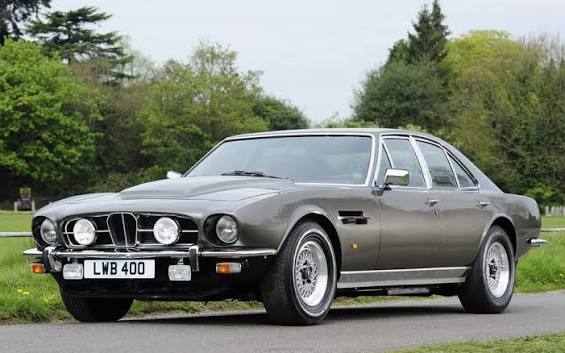
The new owners had grand plans for Aston but not much resources. These however included the good chassis from the Aston Martin V8, and, well, the V8 engine. Both had been used in a first iteration of a four-door Lagonda in 1973 which must count as one of the biggest failures in modern car history, since only seven cars were ever built.
As if this had never happened, the surprising decision Sprague & Co took was that in order to get Aston onto safer financial ground, they needed a big, luxurious four-door sedan. It just had to be much more spectacular, especially in its design, than its predecessor. And since money was running low, they needed to develop it quickly.
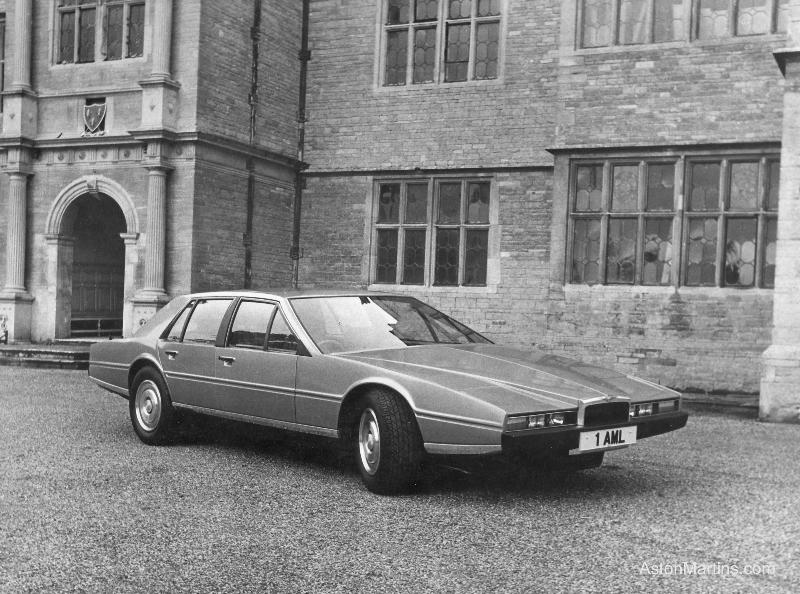
The design trend in the mid-70’s was the wedge, or folded paper shape. Examples at the time included the Triumph TR7 and the Lotus Esprit. In a complete break with the brand’s history, Aston’s new owners were convinced that a wedge-like design would sway buyers of the new Lagonda, and mandated designer Peter Towns to develop what became one of the craziest car drawings of all time.
At 5.2 metres, the new Lagonda was about as long as two Mini’s, but much lower. And at over two tons in spite of the all aluminium body, it also weighed as much as four. If you imagine the wedge design cutting through the air, you’re wrong however. With a drag coefficient of 0.44, the Lagonda was very far from impressive in this regard. Pop-up headlights were of course mandatory for cool cars of the time. The ability to fill one tank through filler caps on both sides of the car was if not cool, then at least rather quirky.
To compensate for both the weight and the wind resistance, the 5.3 liter V8 would have needed more power than in the Series 1 Lagonda, but that wasn’t on the table in the short time available. The engine developed around 280 hp and literally had to be squeezed in and pushed as far back as possible under the impossibly low hood to fit at all. The new Lagonda was thus slower than its predecessor, but that was far from being the car’s main issue.

The new owners at Aston had set themselves the objective of presenting the new Lagonda at the British Car Show in 1976. At the time that decision was taken, that was nine months out. In other words, they had given themselves and the Aston crew less than a year to develop a completely new, hand-built car, supposed to set new luxury car standards. If you think that sounds a bit short, you’re right. Especially when you learn that the team consisted of 11(!) engineers.
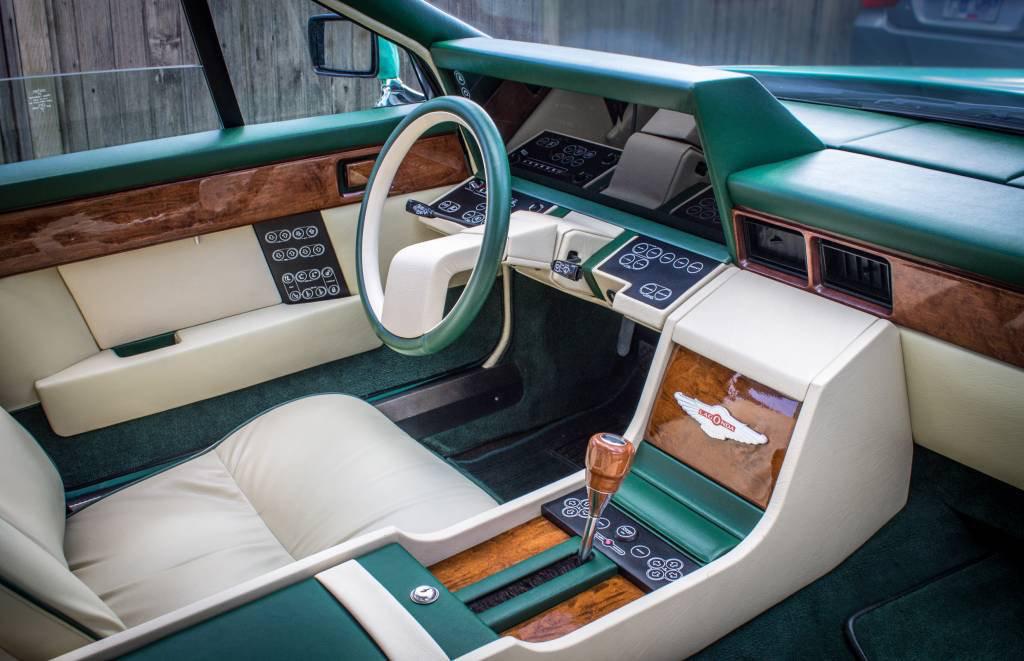
It’s not clear how 11 pair of hands split between developing panels for the new, hand-made body on one hand, and the new, plush and fully electronic LED interior on the other. The interior was Peter Sprague’s idea, driven by his involvement with National Semiconductor. In his vision, the new Lagonda would have digital instruments and new touch sensors, replacing old gauges and switches. This was in line with the times, and the computer era which was just around the corner.
As the 1976 British car show opened in Earl’s Court in London, the Lagonda was unveiled to the world. Or at least, the body was. The car Aston showed at the show had neither an engine, nor a transmission, as there hadn’t been enough time to fit them. That didn’t prevent the car from getting all the attention at the show though. The new Aston was subsequently on the first page of every car magazine and 76 orders were taken during the show. Quite remarkable for a car no one had driven and which was sold at a price of close to GBP 200′ in today’s money!
With orders in, it was now all about getting the Lagonda out to buyers. Various issues however pushed the first deliveries forward. The main issue was the fancy LED instrumentation, as the technique behind it was quite simply not ready. Mid-70’s silicon chips worked much better in a lab environment than in the heat and cold a car is exposed to, and their reliability was just awful.
As an illustration of the desperation Aston was in, on the eve of the first car being delivered in the spring of 1978, 14 people worked through the night to make the car work. By morning, they had to surrender. The car wasn’t drivable and the deliery had to be cancelled. And as if this wasn’t bad enough, inflation also meant the price of the undelivered car kept rising.
By 1979 Aston started getting the cars out to buyers at a pace of around one car per week. Slow deliveries however meant money was still tight, and the car Peter Sprague had ordered for himself provides a good illustration. Sprague had taken possession of his car on a Tuesday but hadn’t picked it up by Thursday, so Aston sold it to another buyer to be able to pay the workers their salaries.
Electronics were no doubt the Lagonda’s main issue, but far from the only one. We’ve already talked about the problems of fitting the big V8 under the low hood. The low shape also meant boot space in a car of over 5 metres was very limited, as was room in the back seat. You also had to be quite agile to get in there, given how small the rear doors were. And in an era characterized by oil crises and inflation, an average fuel consumption of around 30 litres per 100 km wasn’t great, even for a luxury car.
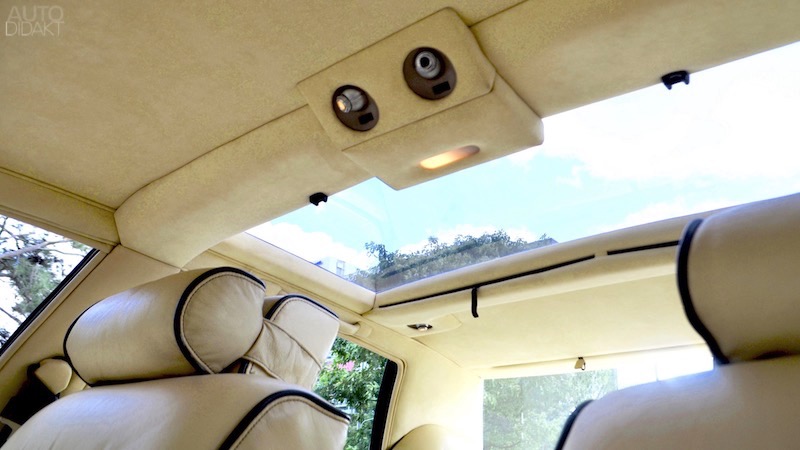
Discussing the interior of the Lagonda in detail would be a post on its own. Let’s just say it included a great number of buttons and touch sensors that were hard to understand and made little sense. There was a hood opener, but no way to open the boot form within the car. The hood opener was also located confusingly close to the tank lid. There was a sunroof, but only over the back seat. There were six switches for moving the seats, but none of them were marked as to their function. And so on…
By the mid-80’s the Lagonda wasn’t considered that futuristic anymore, and Aston was struggling to keep the car modern. The updated Series 3 in 1985 (the original Lagonda built only 7 times counts as Series 1) brought fuel injection and thereby slightly more power with better fuel economy. It also made away with the manual choke, which until then had provided an interesting contrast in the otherwise LED-powered interior. By now it was however very clear that time was running away from the Lagonda.
In a final twist of our story, the troublesome LED dashboard was replaced in the Series 3, but not with normal instruments. Aston instead opted for a so called CRT display from a fighter plane, also including an early voice control, telling you for example if your boot lid was open. Whether it also told you if you’re hood was is unclear. Impossible as it may seem, the CRT system proved even less reliable than the previous LED system.
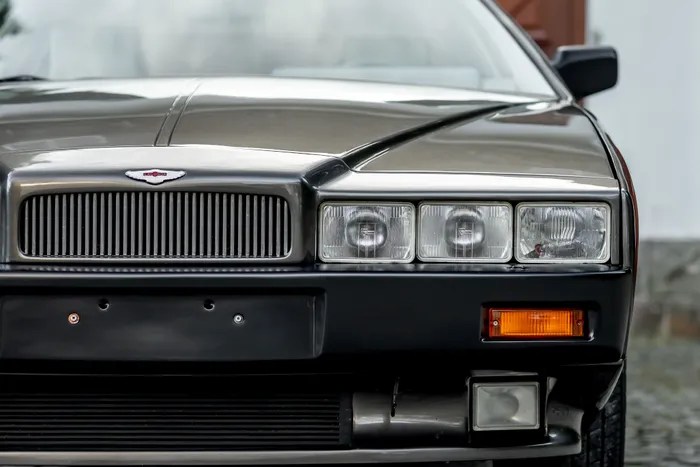
The final Series 4 Lagonda was launched in 1987. The pop-up headlights, no longer modern, had been replaced by fixed ones, and Aston had also tried to soften the angles of what was once a spectacularly futuristic design. Finally, they had also given the car a more conventional interior, although the gauge cluster was still digital. By now, it was however clear that the Lagonda belonged to another age, outrun by cars like the S-class and the 7-series which were better in all areas.

It was also in 1987 that Aston Martin was bought by Ford, and the new owners quickly came to the conclusion that Aston’s future wasn’t in building four-door wedges, but rather two-door sports cars. That’s where the resources were put, a development which a few years later led to the launch of the DB7.
The last Lagonda rolled off the production band in 1990, bringing the total production number over a bit more than a decade to 645 cars. Many of these went to the Middle East where the design seems to have been especially appreciated. The first series (officially Series 2) made up around 500 of the 645 and is thus the most likely that you see today. With so few cars produced and with all the issues the cars had, that in itself is however not very likely at all.
Unless you’re financially suicidal or more into car quirks than Doug DeMuro, it’s difficult to find a single reason why you should get a Lagonda today. It’s a car that is best left to what it is, namely an example of another age when a dozen engineers with very limited resources built one of the craziest cars ever produced in record time. I can’t help thinking how wonderful it would be to see someone doing something similar today – preferably without that LED dash though!

