
Christmas is a time of year full of traditions. There’s the food, the tree, the extremely repetitive Christmas songs, and then of course those Christmas movies. I can think of no other season that you associate with watching the same movie every year, yet that’s what happens at Christmas, and we all have our personal favorites. In our family, Chevy Chase’s hilarious (if you have a rather simple sense of humor) National Lampoon’s Christmas Vacation has a special place. I actually find the first 10 minutes the most fun, when Chevy alias Clark Griswold drives his family out into the wilderness to find the family Christmas tree, and on the way manages to get into a fight with a pick-up and to squeeze his giant station wagon with vinyl wood decorations on the sides between the axels of a big truck.
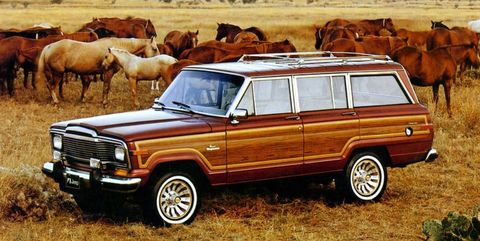
The movie came out in 1989 and as said, Chevy/Clark is driving a boring station wagon rather than the car that was launched precisely for this kind of family setting and situation (except the part under the truck), featuring the same kind of fake wood decoration. I’m of course talking about the legendary Jeep Grand Wagoneer, a record-breaking SUV in several aspects. The Wagoneer was notably built for 29 years, the third longest of any one generation car in American history. It was also launched in Europe seven years before Land Rover’s first Range Rover, which was of course three-door only for the first years, meaning it’s arguably the grand daddy of all modern luxury SUV’s. I saw the below example in Oslo, Norway earlier this week, perfectly parked in front of a nice hotel entrance, putting its elegant line in the right context. This week, we’ll therefore have a look at this true but increasingly rare SUV legend in its most luxurious version!

The Wagoneer was produced for so long that its mother company Jeep had time to change owners no less than three times. When production started in 1963 Jeep was part of the Kaiser Jeep Corporation, making the Wagoneer the direct replacement of the Willys Jeep Station Wagon that had been produced since 1946. Seven years later Jeep would be sold to the American Motor Corporation (AMC), and finally in 1987, to Chrysler, where it’s remained until today. As said the Wagoneer was built until 1990, however the Grand Wagoneer version that we’re focusing on here was only introduced in 1984, meaning most of the ones you see were built during the Chrysler years. That’s perhaps less important than the fact that quality-wise, the 1988 to end production years seem to be the best, with a number of improvements both to the interior and the exterior, In terms of engine though, Chrysler continued to use the 5.9 litre (360 cui) V8 developed by AMC, that at around 150 hp wasn’t very powerful in horsepower but all the more in torque, giving the car great towing capacity. It was also a heavy drinker, with average consumption apparently at 11 mpg or around 20 litres per 100 km…

What’s always enchanted me with the Grand Wagoneer is its looks and of course, it’s wonderful fake wood! Jeep guarantees that not a single tree was chopped to produce the vinyl panels on the exterior, and the same seems to go for the inside. There’s definitely an 80’s chic around the panels but they do add visually to the body, making it look less heavy. By modern standards the Grand Wagoneer was of course less heavy not only in looks, weighing in at around two tons, around half a ton less than a modern, large SUV (in the traditional American way, the Wagoneer was a six-seater). Being the top of the line version the Grand Wagoneer also had a lot of equipment for the time, with stuff like premium speakers, central locking and windows, and even keyless entry on the last model years from 1989. Of course it also had the split tailgate like the Range Rover does, perfect for enjoying a cup of coffee out in the wilderness, or on whichever adventure your Grand Wagoneer has taken you.

Any type of Wagoneer has gotten rare these days and even fewer are in the condition you want them to be. The original Grand Wagoneer additionally suffers from the doubtful long-term quality of fake wood, so I was really lucky to see one in such a good condition as the one in Oslo. The rarity is also seen in prices, with a good version costing at least EUR 40-50.000. Then again, for car that has such presence and literally invites you to take your family or friends out on any adventure you can think of, that really is a bargain. Fuel costs will stay somewhat reasonable given you’ll cruise around at moderate speeds, listening to your cassettes on the premium speakers. There will be some additional costs to pencil in though, unless you already have a pair of used Timberlands, a squared flannel shirt and a leather jacket that has lived as least as long as the Grand Wagoneer in the closet!



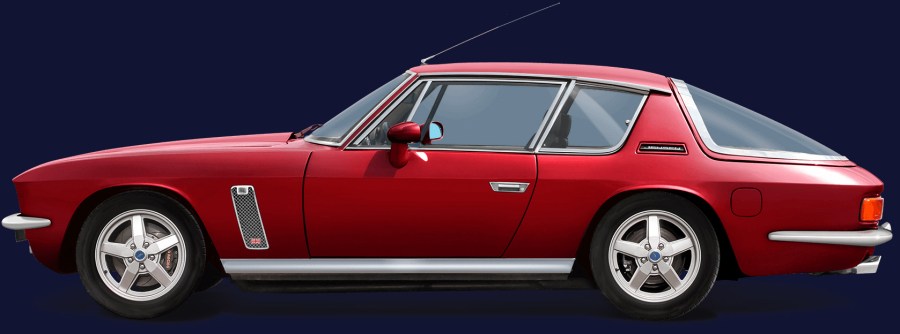
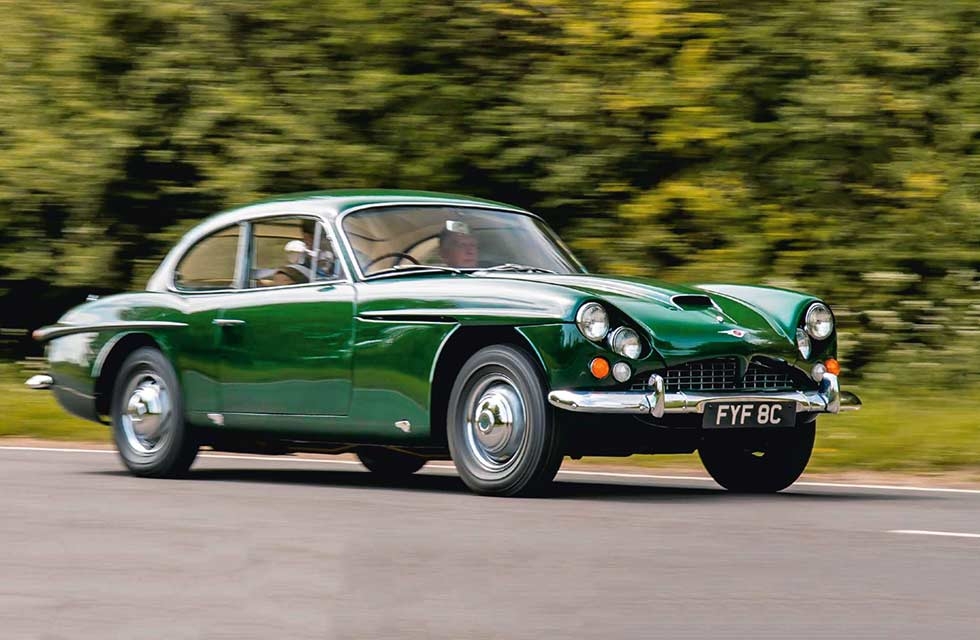 It was the search for a somewhat more successful car than the C-V8 that led to the Interceptor, Jensen’s by far most well-known car, presented in 1966. This time the design had been commissioned to the Italians at Carrozzeria Touring (another company that would go bust a few years later) and although certainly more convincing than the C-V8, it was definitely still quite original. The front looked like many sports car in the day, the rear which in the UK became known as the “fish bowl”, is rather reminiscent of the 70’s AMC Pacer (which was of course designed after the Interceptor). If the exterior isn’t to everyone’s taste the interior is much more so, with a selection and quality of materials that led to the Interceptor being compared to high-end brands such as Aston Martin, Bristol or even Rolls-Royce.
 We’ll make a quick pit stop here for a small side story that I find a wonderful illustration of Jensen and British car industry of the time. Jensen in parallel to the Interceptor built another model referred to as the FF. That’s actually a historic car as it was the first non-SUV passenger car with four-wheel drive, and thus highly innovative for its time. Neither in the 60’s nor now however does it snow a lot in the UK so if you build a four-wheel drive car close to Birmingham, you have to assume it was also intended for exports. All good so far. It’s just that no one in the Jensen factory apparently thought about the fact that most of the world outside of the UK by now had the steering wheel on the left side. So the FF only came as right-hand drive. Let’s just say it wasn’t a tremendous recipe for export success…
Back to the Interceptor, which during the 10-year production came in three series with only subtle design differences between them but where the MK III was by far the most produced. The MK III also came with three different bodies: the most common “glass bowl” saloon, the much rarer and arguably better-looking convertible, and the ultra-rare coupé with a plexiglass rear. All three series had Chrysler big block V8’s and 3-speed automatic transmissions, but whereas the first two shared the same 6.3 litre, 325 hp V8 as the predecessor C-V8, the MK III had an even bigger, 7.2 litre engine, however at 285 hp with less power. This all had to do with the new US emission rules that limited the power of large engines quite heavily. Not only was the 7.2 litre engine less powerful, it was of course also heavier, and just a tad thirstier: apparently we’re talking 25-30 litres per 100 km (8-10 MPG) …
We’ll make a quick pit stop here for a small side story that I find a wonderful illustration of Jensen and British car industry of the time. Jensen in parallel to the Interceptor built another model referred to as the FF. That’s actually a historic car as it was the first non-SUV passenger car with four-wheel drive, and thus highly innovative for its time. Neither in the 60’s nor now however does it snow a lot in the UK so if you build a four-wheel drive car close to Birmingham, you have to assume it was also intended for exports. All good so far. It’s just that no one in the Jensen factory apparently thought about the fact that most of the world outside of the UK by now had the steering wheel on the left side. So the FF only came as right-hand drive. Let’s just say it wasn’t a tremendous recipe for export success…
Back to the Interceptor, which during the 10-year production came in three series with only subtle design differences between them but where the MK III was by far the most produced. The MK III also came with three different bodies: the most common “glass bowl” saloon, the much rarer and arguably better-looking convertible, and the ultra-rare coupé with a plexiglass rear. All three series had Chrysler big block V8’s and 3-speed automatic transmissions, but whereas the first two shared the same 6.3 litre, 325 hp V8 as the predecessor C-V8, the MK III had an even bigger, 7.2 litre engine, however at 285 hp with less power. This all had to do with the new US emission rules that limited the power of large engines quite heavily. Not only was the 7.2 litre engine less powerful, it was of course also heavier, and just a tad thirstier: apparently we’re talking 25-30 litres per 100 km (8-10 MPG) …
 The convertible version of the Interceptor was presented in 1974 and is another example of Jensen’s risk-willingness or complete ignorance of the world beyond the UK, depending on how you see it. At this time most other brands were halting the development of new convertibles altogether, as it was widely expected that US safety authorities would enact a complete ban on open cars without roll-over bar. So Jensen was basically the only brand brave or foolish enough to launch a new convertible in this period. They were ultimately right given a ban was never enacted but they were kind of wrong anyway, since the whole company went bust only two years later, in 1976. By then they had produced about 500 convertibles, out of a total of some 6400 Interceptors.
 Although the big block Chrysler engines were quite bullet proof, the fact that they all had carburettors and lots of them, didn’t make them any easier to run or service. The carburettors had to be adjusted frequently for optimal performance, apparently up to as often as every 1000-2000 km. Cooling was another issue Interceptors were known to struggle with and then there was of course the same issue as with all other cars in the 70’s – rust. You can certainly convert the engines to injection and upgrade the cooling system, an idea that some won’t like at all given the car is then no longer original. It will however be far more drivable, and thus possibly a solution for those preferring to spend time on the road rather than in the garage.
Cooling and carburettors aside, the Interceptor is known as quite a wonderful GT car, offering loads of 70’s luxury and charm typically for far less money than a comparable Aston or Rolls (who as we all know also tend to have an issue or two…). There aren’t many in the market which makes pricing uncertain, but good saloons tend to start somewhere around EUR 50′ with convertibles costing much more. If this wonderful example of British ingenuity combined with a dinosaur-engine of a type will certainly never see again, then please make sure that if you’re not mechanically talented, you know someone who is, and go for a car as perfect as possible, as finding replacement parts for an Interceptor risks being as hard as finding a UK prime minister who will stay longer than a few months!
Although the big block Chrysler engines were quite bullet proof, the fact that they all had carburettors and lots of them, didn’t make them any easier to run or service. The carburettors had to be adjusted frequently for optimal performance, apparently up to as often as every 1000-2000 km. Cooling was another issue Interceptors were known to struggle with and then there was of course the same issue as with all other cars in the 70’s – rust. You can certainly convert the engines to injection and upgrade the cooling system, an idea that some won’t like at all given the car is then no longer original. It will however be far more drivable, and thus possibly a solution for those preferring to spend time on the road rather than in the garage.
Cooling and carburettors aside, the Interceptor is known as quite a wonderful GT car, offering loads of 70’s luxury and charm typically for far less money than a comparable Aston or Rolls (who as we all know also tend to have an issue or two…). There aren’t many in the market which makes pricing uncertain, but good saloons tend to start somewhere around EUR 50′ with convertibles costing much more. If this wonderful example of British ingenuity combined with a dinosaur-engine of a type will certainly never see again, then please make sure that if you’re not mechanically talented, you know someone who is, and go for a car as perfect as possible, as finding replacement parts for an Interceptor risks being as hard as finding a UK prime minister who will stay longer than a few months!





































 The Thrill of Driving