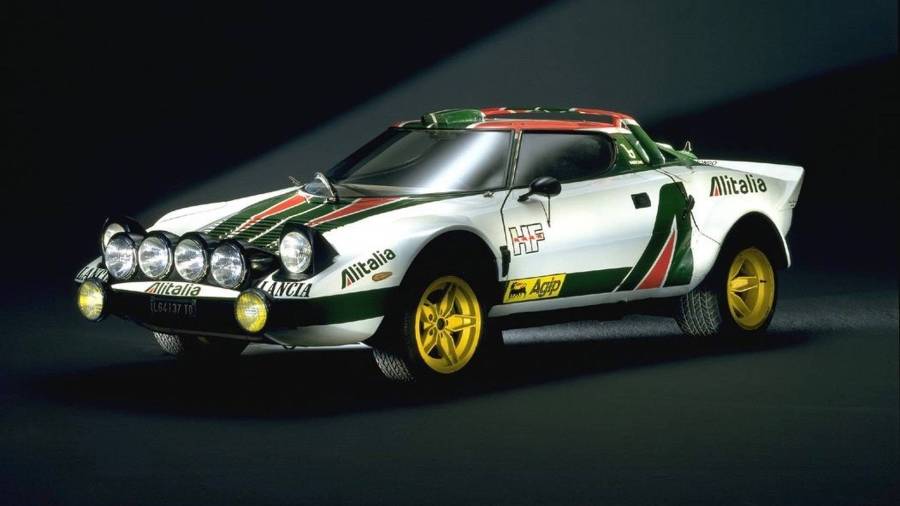
If competition between car makers has been a trait of the automobile industry for as long as anyone can remember, it’s probably only in Italy that competition between car designers was just as fierce. The two dominant houses in Italian car design are of course Pininfarina and Bertone, both having employed legendary designers through the years who have in turn been responsible for some of the most beautiful car creations to come out of Italy. Usually one of the two big houses would be the main partner for a certain brand, but there was certainly nothing hindering the other one from trying to gain market by various means. Thank God for that because otherwise, the legendary Lancia Stratos would probably never have seen the light of day.
Lancia had historically mostly collaborated with Pininfarina in designing its models, with Bertone eagerly watching from the sidelines. In the late 60’s however, Bertone saw an opportunity as it was obvious that the ageing Lancia Fulvia was up for replacement. Bertone’s gave its legendary designer and our old friend Marcello Gandini, the man behind notably the Lamborghini Miura and Countach, the task of drawing a car that completely broke with the Fulvia and would signal the advent of a new, modern era. So he did, and it was so convincing that the Lancia bosses decided to show the prototype at the Turin Auto Salon in 1970. Gandini was subsequently commissioned with designing the production car that would come to market a couple of years later.

The Stratos’ predecessor, the Fulvia coupé, had been used on the rally scene in the 60’s with some success, and Lancia saw rally as a way to position the brand as a sporty alternatively notably the the siblings from Fiat. This meant that unlike basically any other rally car at the time (or for that matter, thereafter), the Stratos was developed exclusively with rallying in mind, and not as a civilian car later converted to rally usage. You don’t need to look at the car for long to see this was the case, and also that this was a completely new design language that would follow Gandini notably to the Countach. The ultra short wheelbase of only 2.2 metres carries a body with minimal overhangs but with a big, sweeping front screen giving the driver great visibility. The engine was mid-mounted in the ultra low, rear-wheel drive car, getting in and out of which it is not an exercise suitable for any kind of daily driving. Looking at the Stratos today, it’s surprising how small it really is at 3.7 metres and around 900 kg. Lancia did however have to comply with the rules for any rally car at the time, namely that 500 so called homologation cars for street usage had to be built and sold along side the rally cars themselves.

During the development of the Stratos, Lancia had considered various engines for the car, but the one they really wanted was the 2.4 litre V6 that Ferrari was using in the Dino. After long negotiations, rumour has it that Enzo Ferrari himself agreed to deliver the 500 engines necessary for the homologation of the Stratos. However, after the first 10 engines or so the deliveries suddenly dried up, with Ferrari claiming various production issues. It wasn’t until Lancia threatened to replace the Ferrari engine with another motor that they finally started coming in. Strangely enough, that also coincided with the end of production of the Dino, which Enzo had of course seen as a competitor to the Stratos… In the homologation street cars the engine produced 190 hp, in the rally cars performance was typically between 300-400 hp thanks to a big, old-school turbo. With the car being rear wheel drive, it’s an understatement to see that the Stratos was difficult to drive, but for those who mastered it, it was one hell of a car!
The Stratos premiered in the world rally championships in 1974 and went on to win the title straight away, as it did in 1975 and 1976 as well. It won both the Swedish Rally on snow, and the African rally on clay in the same period. There’s little doubt it would have gone on to win further titles had Lancia let it, but by this time Fiat had taken the somewhat strange decision that the Fiat 131 Abarth, a not very futuristic car that few will remember and that didn’t see much success, would be the rally car (and Fiat thereby the rally brand) in the Torino car family. The last major title the Stratos won was therefore the Monte Carlo Rally in 1977, although private teams continued to race the car and having success doing so after that. Of course Lancia came back on the rally scene a few years later with the Lancia Delta Integrale, that we looked at in an old post from 2015, but that’s another story.

There’s been various initiatives over the years to revive the Stratos, some of which have made it to some of the big car shows, but none of which have so far made it all the way to production. The most promising one was designed by, hold on to your chair now, Pininfarina and not Bertone, although it was, let’s say heavily inspired by the Bertone-designed original. It was built on a Ferrari 430 chassis and was to be built by a company called Manifattura Automobili Torino (MAT). It was shown at the Geneva Auto Salon in 2018, but the project then died off, apparently not because of Covid but rather because of Ferrari vetoing it, unclear why. I included it in my overview of the auto salon back then in a post you can find here.
The Stratos was thus a truly unique car, and to me, one of the coolest cars around to this day. It’s also uniquely small, uniquely focused on rally and if not uniquely, then at least very successful. It’s also a uniquely difficult car to find today should you want one. With 500 built in the early 70’s that’s perhaps no surprise, especially since many of the buyers certainly thought of themselves as hidden rally talents. As I write this in the middle of February, there’s not a single car on the market anywhere in Europe, nor in the US (which is less surprising since the Stratos never made it officially there). The Stratos will thus remain a rally legend for poster walls or these days Youtube, but what a car it was!














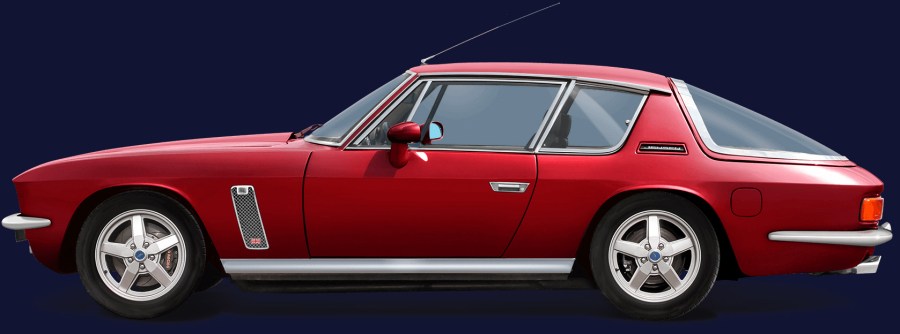
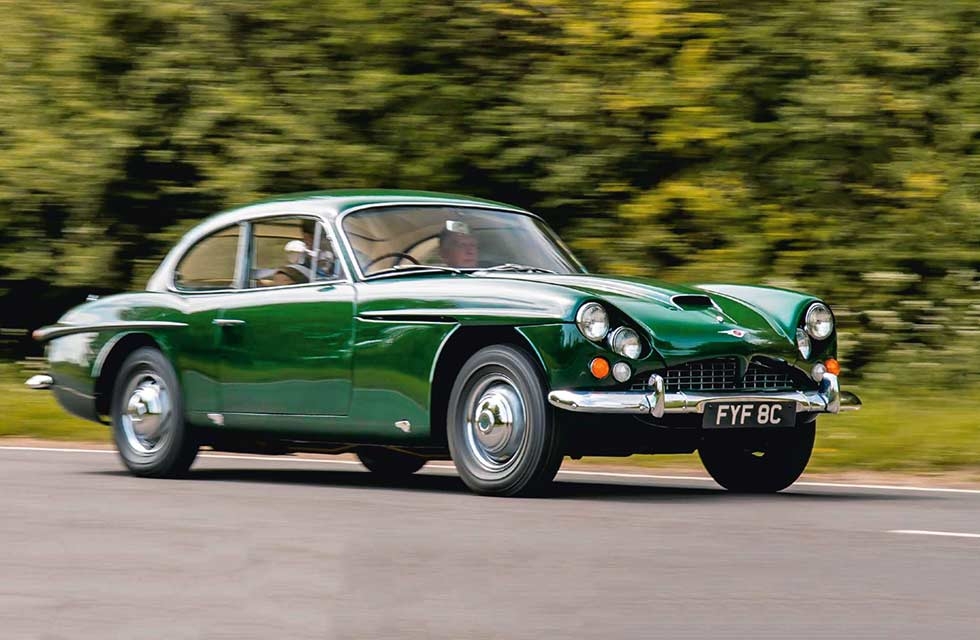 It was the search for a somewhat more successful car than the C-V8 that led to the Interceptor, Jensen’s by far most well-known car, presented in 1966. This time the design had been commissioned to the Italians at Carrozzeria Touring (another company that would go bust a few years later) and although certainly more convincing than the C-V8, it was definitely still quite original. The front looked like many sports car in the day, the rear which in the UK became known as the “fish bowl”, is rather reminiscent of the 70’s AMC Pacer (which was of course designed after the Interceptor). If the exterior isn’t to everyone’s taste the interior is much more so, with a selection and quality of materials that led to the Interceptor being compared to high-end brands such as Aston Martin, Bristol or even Rolls-Royce.
 We’ll make a quick pit stop here for a small side story that I find a wonderful illustration of Jensen and British car industry of the time. Jensen in parallel to the Interceptor built another model referred to as the FF. That’s actually a historic car as it was the first non-SUV passenger car with four-wheel drive, and thus highly innovative for its time. Neither in the 60’s nor now however does it snow a lot in the UK so if you build a four-wheel drive car close to Birmingham, you have to assume it was also intended for exports. All good so far. It’s just that no one in the Jensen factory apparently thought about the fact that most of the world outside of the UK by now had the steering wheel on the left side. So the FF only came as right-hand drive. Let’s just say it wasn’t a tremendous recipe for export success…
Back to the Interceptor, which during the 10-year production came in three series with only subtle design differences between them but where the MK III was by far the most produced. The MK III also came with three different bodies: the most common “glass bowl” saloon, the much rarer and arguably better-looking convertible, and the ultra-rare coupé with a plexiglass rear. All three series had Chrysler big block V8’s and 3-speed automatic transmissions, but whereas the first two shared the same 6.3 litre, 325 hp V8 as the predecessor C-V8, the MK III had an even bigger, 7.2 litre engine, however at 285 hp with less power. This all had to do with the new US emission rules that limited the power of large engines quite heavily. Not only was the 7.2 litre engine less powerful, it was of course also heavier, and just a tad thirstier: apparently we’re talking 25-30 litres per 100 km (8-10 MPG) …
We’ll make a quick pit stop here for a small side story that I find a wonderful illustration of Jensen and British car industry of the time. Jensen in parallel to the Interceptor built another model referred to as the FF. That’s actually a historic car as it was the first non-SUV passenger car with four-wheel drive, and thus highly innovative for its time. Neither in the 60’s nor now however does it snow a lot in the UK so if you build a four-wheel drive car close to Birmingham, you have to assume it was also intended for exports. All good so far. It’s just that no one in the Jensen factory apparently thought about the fact that most of the world outside of the UK by now had the steering wheel on the left side. So the FF only came as right-hand drive. Let’s just say it wasn’t a tremendous recipe for export success…
Back to the Interceptor, which during the 10-year production came in three series with only subtle design differences between them but where the MK III was by far the most produced. The MK III also came with three different bodies: the most common “glass bowl” saloon, the much rarer and arguably better-looking convertible, and the ultra-rare coupé with a plexiglass rear. All three series had Chrysler big block V8’s and 3-speed automatic transmissions, but whereas the first two shared the same 6.3 litre, 325 hp V8 as the predecessor C-V8, the MK III had an even bigger, 7.2 litre engine, however at 285 hp with less power. This all had to do with the new US emission rules that limited the power of large engines quite heavily. Not only was the 7.2 litre engine less powerful, it was of course also heavier, and just a tad thirstier: apparently we’re talking 25-30 litres per 100 km (8-10 MPG) …
 The convertible version of the Interceptor was presented in 1974 and is another example of Jensen’s risk-willingness or complete ignorance of the world beyond the UK, depending on how you see it. At this time most other brands were halting the development of new convertibles altogether, as it was widely expected that US safety authorities would enact a complete ban on open cars without roll-over bar. So Jensen was basically the only brand brave or foolish enough to launch a new convertible in this period. They were ultimately right given a ban was never enacted but they were kind of wrong anyway, since the whole company went bust only two years later, in 1976. By then they had produced about 500 convertibles, out of a total of some 6400 Interceptors.
 Although the big block Chrysler engines were quite bullet proof, the fact that they all had carburettors and lots of them, didn’t make them any easier to run or service. The carburettors had to be adjusted frequently for optimal performance, apparently up to as often as every 1000-2000 km. Cooling was another issue Interceptors were known to struggle with and then there was of course the same issue as with all other cars in the 70’s – rust. You can certainly convert the engines to injection and upgrade the cooling system, an idea that some won’t like at all given the car is then no longer original. It will however be far more drivable, and thus possibly a solution for those preferring to spend time on the road rather than in the garage.
Cooling and carburettors aside, the Interceptor is known as quite a wonderful GT car, offering loads of 70’s luxury and charm typically for far less money than a comparable Aston or Rolls (who as we all know also tend to have an issue or two…). There aren’t many in the market which makes pricing uncertain, but good saloons tend to start somewhere around EUR 50′ with convertibles costing much more. If this wonderful example of British ingenuity combined with a dinosaur-engine of a type will certainly never see again, then please make sure that if you’re not mechanically talented, you know someone who is, and go for a car as perfect as possible, as finding replacement parts for an Interceptor risks being as hard as finding a UK prime minister who will stay longer than a few months!
Although the big block Chrysler engines were quite bullet proof, the fact that they all had carburettors and lots of them, didn’t make them any easier to run or service. The carburettors had to be adjusted frequently for optimal performance, apparently up to as often as every 1000-2000 km. Cooling was another issue Interceptors were known to struggle with and then there was of course the same issue as with all other cars in the 70’s – rust. You can certainly convert the engines to injection and upgrade the cooling system, an idea that some won’t like at all given the car is then no longer original. It will however be far more drivable, and thus possibly a solution for those preferring to spend time on the road rather than in the garage.
Cooling and carburettors aside, the Interceptor is known as quite a wonderful GT car, offering loads of 70’s luxury and charm typically for far less money than a comparable Aston or Rolls (who as we all know also tend to have an issue or two…). There aren’t many in the market which makes pricing uncertain, but good saloons tend to start somewhere around EUR 50′ with convertibles costing much more. If this wonderful example of British ingenuity combined with a dinosaur-engine of a type will certainly never see again, then please make sure that if you’re not mechanically talented, you know someone who is, and go for a car as perfect as possible, as finding replacement parts for an Interceptor risks being as hard as finding a UK prime minister who will stay longer than a few months!




















 The Thrill of Driving