Having spent the last weeks in the US, I’ve seen quite a few of the long-awaited, long-delayed Tesla Model 3, that is now finally being produced and delivered (with delivery times in the US as low as 4 weeks), but still has to make it to Europe. If you haven’t seen it, it’s quite a good-looking car, probably the best looking in the Tesla line-up. The side and rear are similar to a (smaller) Model S, the front has a bit of Panamera over it.
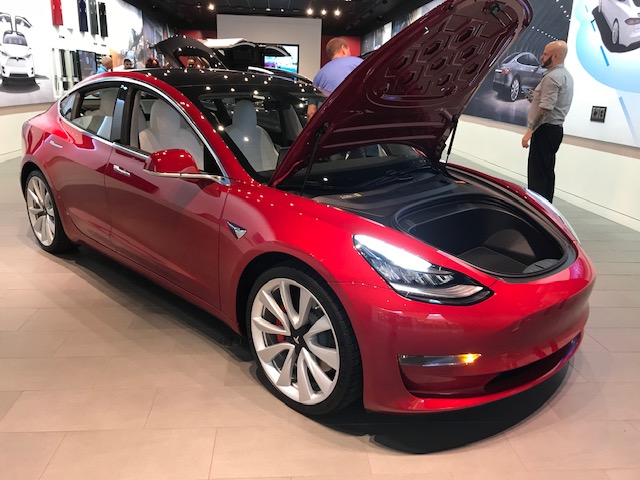
The interior however if very different, I guess you could say more futuristic, but as in the S and X characterized by the giant screen that in the Model 3 is however not integrated to the dashboard but rather stands out of it like a big laptop screen. Feels a bit cheap and the interior is in general a bit simpler than in the S and X.
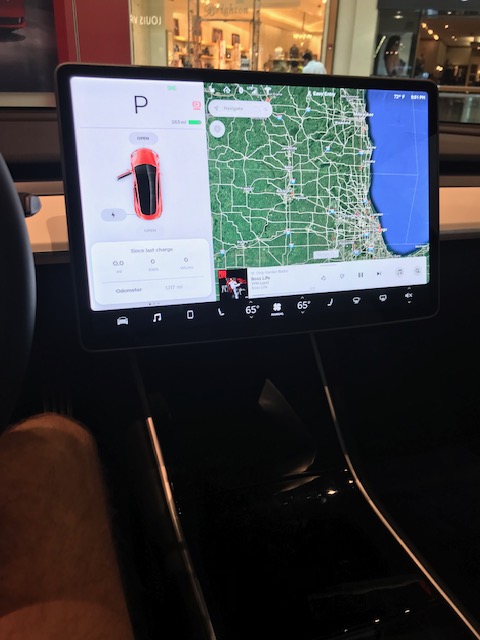
So far only the top version has been introduced to the market and for some unclear reason, Tesla won’t divulge the KwH of the electric engine, only talking about the range of over 300 miles (460+ kms). That would mean that it’s the 90 or 100 KwH engine, and it’s difficult to see why that would be a secret, given it isn’t for the other models. Towards the end of the year, a cheaper version with a smaller engine and a range around 250 miles (400 kms) will be introduced at a cost in the US of around USD 35.000. The top version as shown in the pictures costs around USD 50.000 in the US and both versions should make it to Europe in 2019.

The price will probably decide on whether it becomes a success in Europe or not. As always it’s a bit difficult to pinpoint the competition – it’s difficult to imagine someone choosing between a Model 3 and a Prius. You do however get a lot of fun cars for around EUR 40-45.000, so Tesla would probably need to keep the price pretty much in line with the US. The recent introduction of the Jaguar I-Pace and the coming Audi E-tron and MB EQC also illustrate how the big guys are gearing up. Although not in direct competition to the Model 3, it will clearly be far less smooth sailing for Tesla going forward, whether as a private or a public company…


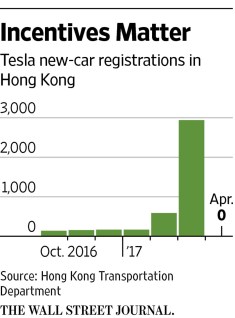 What Hong Kong residents knew back in March of last year, and I didn’t, was that the HK government was about to abolish the heavy subsidy on Teslas to the benefit of more ordinary, electric cars. Hong Kong is not the first market where removal of subsidies has had a dramatic effect on Tesla sales, Denmark is another. To make things worse, Hong Kong residents conscious of the environment should probably be happy about the drop, as research from Bernstein from 2016 has shown that electricity generation in Hong Kong is so dirty that a Tesla will throughout its lifetime be responsible for 1/5 more CO2 emissions than an equivalent petrol car.










 The Thrill of Driving