This week the pictures will do most of the talking as we’re currently enjoying the last warm days of the year in lovely Tuscany. On the way here though, we did make a pit stop in Maranello and spent a few hours at the Ferrari museum, where you can admire a large amount of mostly red Ferrari beauties from different time periods and read up on your Ferrari knowledge.
Should you be in the region a visit is highly recommended, but be aware there is also a second museum a few kilometres away in Modena. I haven’t been there but have understood it’s smaller and more focused on the life of Enzo Ferrari than the cars (and especially the racing cars, which is the focus in Maranello). You can also buy combined tickets for both museums, but be aware that in Covid times, all tickets must be bought online in advance.
At the end of your visit you have the opportunity to try out your own skills in one of three F1 driving simulators. The feeling of slipping into the very tight space and gripping the wheel is a special one, simulator or not, and at least I didn’t feel the urge to be in the real thing. There is however also the opportunity to test drive various “standard” Ferraris both on nearby streets and the nearby Fiorano track, from various providers in immediate vicinity to the museum. Should you want to try that, make sure you have enough reserve on your card both for the rental itself, and for the carabinieri who could be seen in large numbers on surrounding roads…
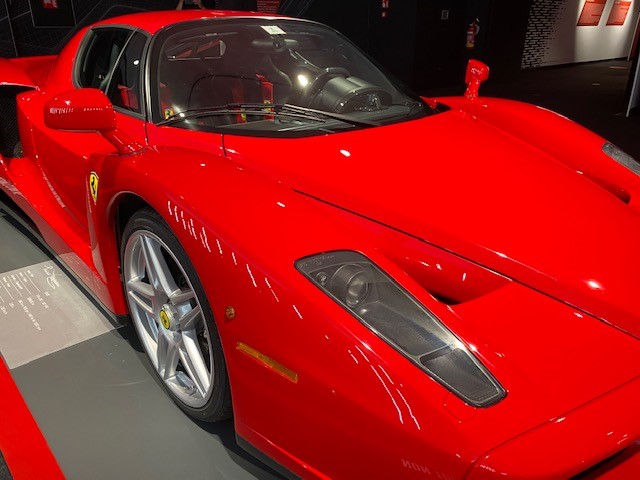
In one of the “non-race” rooms, the Enzo sits next to a LaFerrari – difficult choice!
The F40 is one of my all time favourites, but the F50 is cool from behind!
Ferrari’s long Le Mans tradition also receives the attention it deserves.
The F1 room well illustrates the increasing complexity of especially the aerodynamics on the F1 cars through the decades
Indeed – Forza Seb & Charles for the end of the last season together!
A first week with the 650i is now behind me (if you missed the story from last week you can read it here), and thankfully the weather Gods were kind enough to let the sun shine from a blue sky everyday, meaning I’ve been able to enjoy the car as it should be, with the roof down. Impressions so far are very positive and having now experienced a bit more of the quality, comfort and power train of the 650i, my unofficial rating of it as the most mispriced used car in the market is confirmed – not that I’m complaining!
Therefore, feeling a bit Bavarian this week (and thus sad to hear earlier in the week that this year’s Oktoberfest is cancelled), I thought we’d have a look at last time BMW had a 6-series, back in the 70’s-80’s. The first 6-series indeed still has a lot going for it, as is proven notably by the fact that its 13-year production run is the longest of any BMW model!
The 6-series was introduced at the Geneva Motor Show in 1976 and was produced with relatively minor updates until 1989 to a total of over 85.000 cars. The E24 as it’s called internally replaced the E9, and although it mostly resembles the 7-series that followed a year later in 1977, it was built on the smaller, 5-series chassis, as a true four-seat GT car, that over the 13 years of production was only ever available with 6-cylinder engines.
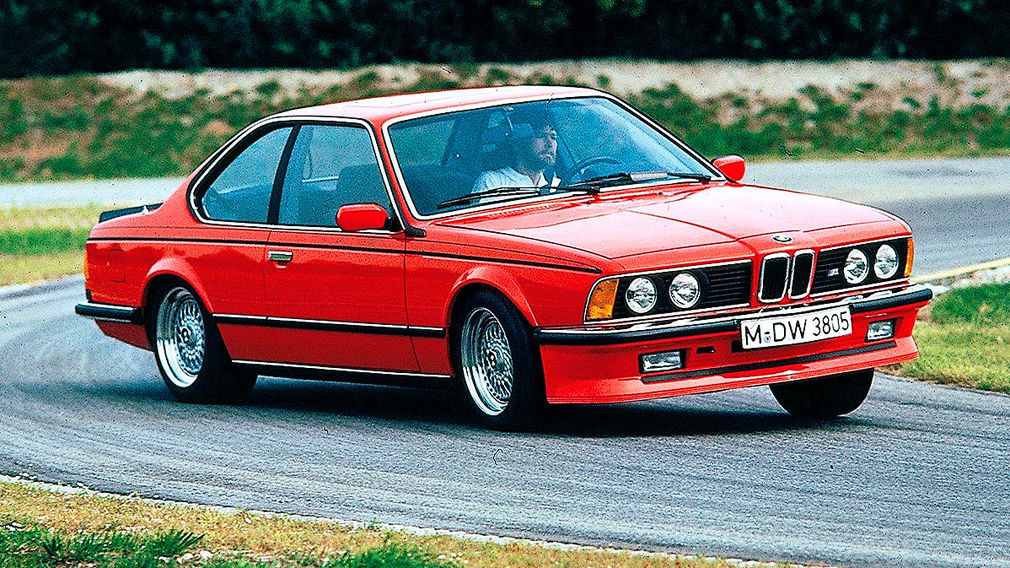
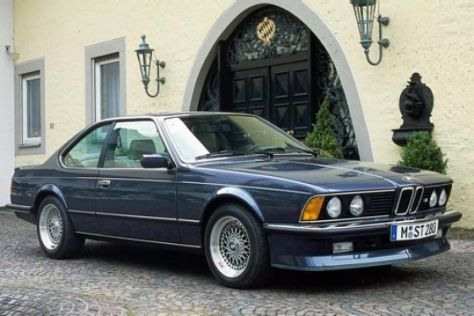
The original line-up included the 630cs and the 633csi, complemented in 1978 by the 218hp, top of the line sport version 635csi that I’ll focus on here since it’s the car to have in the range. The 635csi was easily distinguishable already in the first generation through its front and rear spoilers and ultra-cool, 80’s-style BBS wheels.
Some of the best looking wheels in the last 40 years!
The first (and only) major model update in 1982 was important as the chassis was more or less replaced by that of the second 5-series, giving the whole car far more rigidity and stability in combination with lower weight. From 1982 ABS breaks came as standard on the 635csi, and on the inside, the equally-sized speed and rpm gauges so typical for BMW had now found their place in the gauge cluster. Various other cosmetic touches contributed to give the car a more modern look. Oh, and I almost forgot that the pre-infotainment check control, that allowed the driver to test various functions in the car, was now automatic and didn’t have to be activated by pushing a button. There was also the optional board computer that let the driver check the outside temperature, the average consumption and the total distance driven. That was advanced stuff back in the early 80’s!
Check control far left, board computer far right – this owner was king of the hill in 1982!
In 1984 BMW introduced the top-of-the-line M635csi with a re-worked version of the M1 engine, with four valves per cylinder and dual overhead camshafts (DOHC). The M-version produced 286hp and from 1986 260hp with catalyst, and was only available as manual (by then, catalytic cleaning meant the regular 635csi was down to 185hp).
In 1987, a second and last facelift mostly consisting in various chrome pieces being replaced by black metal and plastic, helped the by now quite old 6-series live for another two years. The last car was produced in April 1989 and the 6-series was replaced only a few months later by the the 8-series and the 12-cylinder 850i, but that’s another story (that I’ve written about here should you want to read it).
M635csi – 30mm lower, larger front spoiler
The clean lines of the 6-series are purest in the simpler versions, but to me the 635csi has always been the one to have. That is except for the M-version of course, but at the EUR 60.000 and upwards good M-cars cost today, they are at roughly double the price of the standard 635csi, which given the car’s age in my view delivers sufficient power and driving pleasure. And driving pleasure there is, in a very 80’s style; I drove a 185hp, 635csi recently, briefly considering it as I was selling my Triumph. No doubt it’s a car that works perfectly as both a daily driver and a GT car for longer trips. The steering is surprisingly good, the manual gearbox is distinct, although with long throws, and the breaks work just fine. The six-cylinder has a nice tone to it and you’re left with the feeling that the only thing missing is an old Modern Talking cassette in the standard Becker cassette radio!
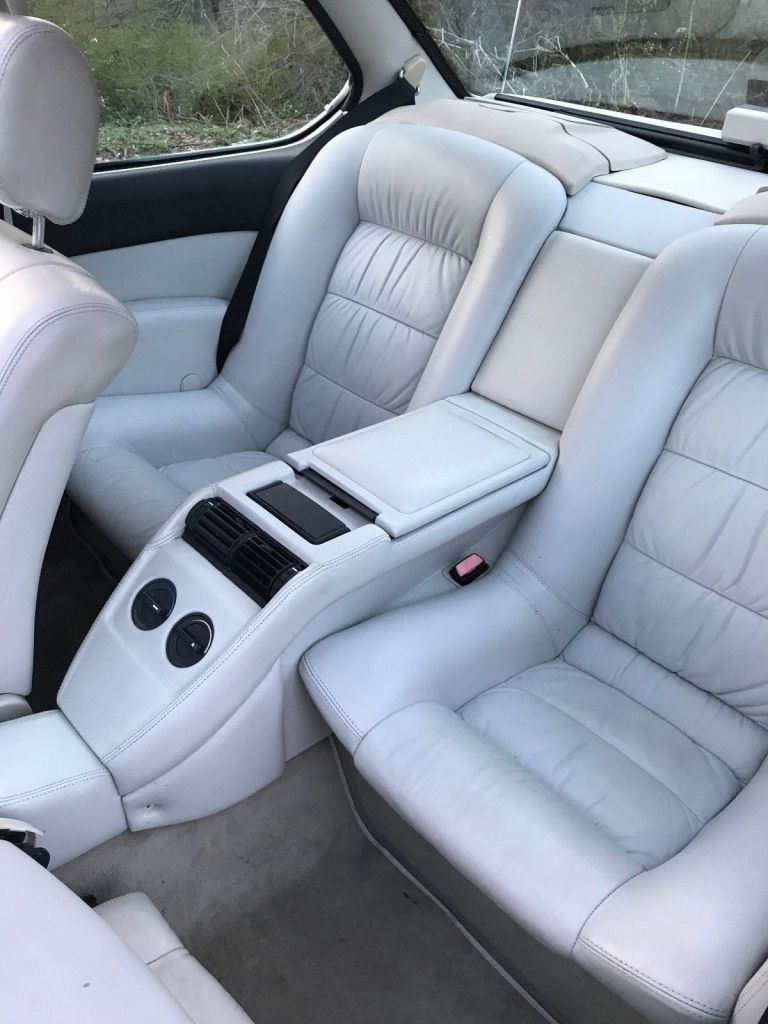
A late 635 with a custom center piece – the coolest back seats ever!
Although it was produced in a total of more than 85.000 cars, the original 6-series is becoming increasingly rare, and if you ask me it’s no doubt one of the best cars coming out of the 80’s. Its combination of good looks, great engine and practicality make it a very usable youngtimer at a still attractive price. I would opt for a manual 635 from after 1982, paying more attention to the car’s history and condition than the exact model year. Go through all the usual checks and in terms of equipment, make sure you get the original BBS wheels, a nice leather interior and a Becker cassette radio, and you should still be on the right side of EUR 30.000. The only thing left before hitting the road will then be trying to remember in which box you stuck those 80’s cassettes many years ago…
We hope you like this blog – please help us keep it interesting by subscribing!
I saw a Lancia Y10 the other day, which doesn’t happen very often. Arguably it’s not something a person not contaminated with the very sticky automobile virus would notice or find interesting. To those of us that are heavily infected, there are however few cars that aren’t of some interest, and the Y10 is a bit quirky in the sense that it was the first real (although a bit halfhearted) attempt to build a luxurious, small city car, with its alcantara or leather-dressed seats and dashboard.
Let’s just say they spent more time on the interior design…
Speaking of virus, there is another one out there that doesn’t seem to be going away anytime soon. I wrote back in May (see here) that I thought Covid would lead to a comeback of the car as preferred means of safe transportation, which has definitely been the case both during the summer and as business now resumes. Given the congestion of major cities that is now back after the empty streets in summer and after that, during the lock downs, I wonder if the trend will continue towards more comfortable small cars for short, mostly work-related transport? These would most probably be electric (which arguably would have been the logical route for electrical cars to take in the first place). You’ll tell me that’s nothing new and mention cars like the the BMW i3, the Zoé or other small hybrids. I’m however thinking of on one hand far more comfortable and a bit luxurious creations, and on the other even smaller cars, towards that 3-metre segment the Y10 represented.
Aston Martin did actually try with the Cygnet, but at another, wrong time.
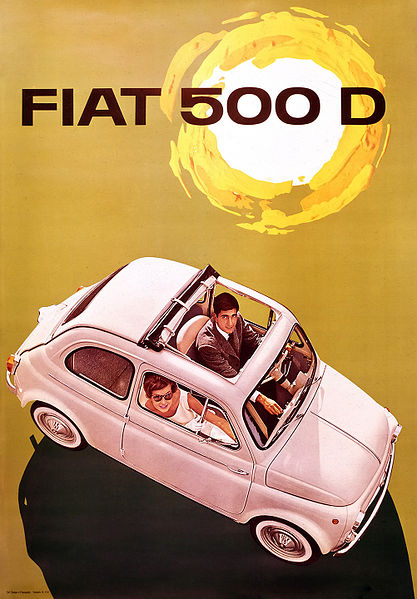
Time will tell but whilst thinking of small cars, this week we’ll pay tribute to a legendary Italian creation that over 2.5 metres meant a lot not only for Italy, but actually for all of Europe: the original Fiat 500!
The 500, or Cinquecento in Italian, was launched in 1957 and thus in the same period as the Citroën DS that I wrote about a few weeks ago (see here). Much like in France, life was looking up in Italy and the post-war, economic boom was in full swing. Fiat was convinced there would be strong demand for a small, cheap car that everyone could afford. There was also a bit of urgency since the preceding Fiat 500 Topolino was by now a 20-year old, pre-war model.
In 1957, the sun was shining on Italy again!
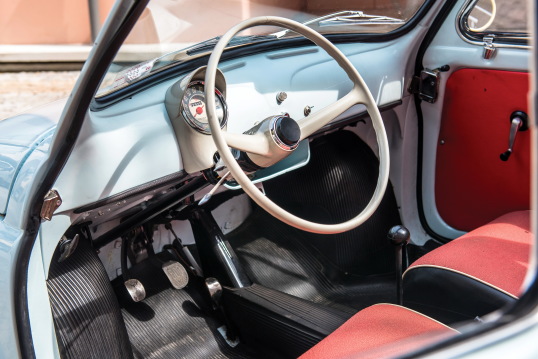
Dante Giacosa was given the mission of designing the Cinquecento, and what a success his design proved to be! Over a total length of only 2.5 metres, the 500 still managed to accommodate four people (at least 1950-sized ones…) and through its limited size it was immensely practical on the small cobble streets of Italian villages. Having said that, the very first Cinquecentos were actually very basic two-seater cars with a 480 cc, 2-cylinder, rear-mounted, air-cooled engine developing a massive 13 hp. Derived from the Topolino, it gave the car a top speed of 85 km/h. The two-seat configuration did however not produce the sales numbers Fiat had expected, and the initial version was replaced by a four-seated car with an updated engine and all of 15 hp(!) the same year. This new Normale version was to become the basis for various models all the way through 1975, i.e. for almost 20 years.
The original interior wasn’t a source of much confusion!
Among these special versions, the Sport with 21.5hp built from 1958 to 1960 should be mentioned, as should the 10 cm longer Giardiniera estate, built from 1960 to 1968. Other modifications to the 500 through the years included more power, but were otherwise mostly cosmetic and equipment-related. An important but for many, sad development was the replacement of the rear-hinged, “suicide” doors by conventional doors in 1968. Rumour has it that the replacement was frowned upon by mostly men, as the traditional doors didn’t offer the same view of women’s legs as these got in and out of the car…
An estate with the standard canvas roof and rear-hinged, “suicide” doors
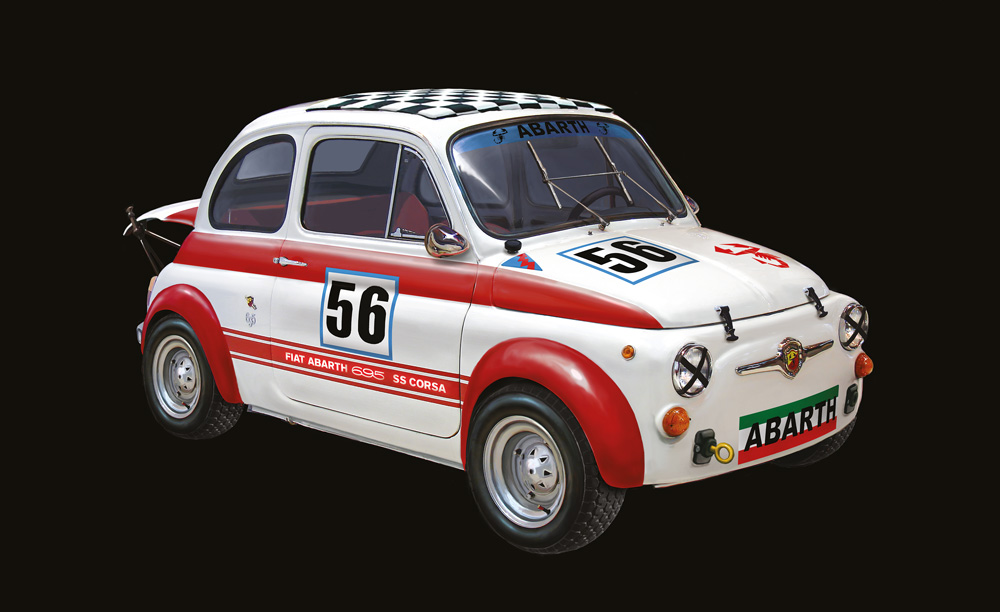
Various performance versions were designed with the 500 as basis, and the ones coming out of the (in modern language) tuning shop Abarth are the most well-known ones. This is especially true for the Abarth 695 SS, launched in 1966 and distinguishable by various stripes and Abarth logos, its flared arches and perhaps most notably, the fact that it’s best driven with the (rear) engine hood open for additional cooling. Various improvements to the engine almost doubled the power output over the standard car to 38 hp and the top speed to 140 km/h, accompanied by a sound that would make you think there’s a zero missing both in the hp number and speed! The SS was built until 1971 and very few remain today.
Chess-board roof , red stripes and open hood – signs of a true Abarth!
Seeing a 500 these days actually happen more often than seeing an Y10, and it’s definitely a sight (and sound!) that always puts a small on your face. The air-cooled tone is unmistakable, how sympathetic the car looks impresses as much as how small it is, and quite often, the shape of a somewhat larger driver in 2020 than in the 60’s looks a bit comical, with the side window rolled down as much for fresh air as for additional room. And should you be lucky enough to see an Abarth, you will know long before you actually see it as the sound precedes it!
The Cinquecento’s importance cannot be overstated as without being technologically advanced in any way, it’s the car that put Italy on wheels, that I bet our Italian readers have driven or been riding in many times, and that actually was a success in many other European countries, with versions built also by other manufacturers, notably Puch in Austria. When it was replaced by the 126 in 1975, that also meant a more conventional car age would start. Rear-mounted engines had notably been popular in the late 1950’s but now increasingly moved up front.
“No thanks, we’ll take the boat instead…”
A new mini car in the age of Covid would most probably never attain the legendary status of the original 500, but the 500 should definitely be a source of inspiration. My son is very much of the same opinion and when he gets his driving license next year, he has the idea of finding a cheap 500 and converting it to electrical drive. Maybe he’s on to something, but I would still go for the original, air-cooled version, notably for the sound. Both him and I should hurry up though, as values for 500’s are on the rise. Today you can expect to pay at least EUR 15.000 for a nice example, with early models with rear-hinged doors and of course Abarth cars being sold for as much as EUR 45-50.000. That’s indeed a lot but then again, there is no better proof that there is indeed a good substitute for cubic inches!
I hope you like this blog – please help us keep it interesting by subscribing!
If last week was all about Italianità in all its simplicity with the lovely Alfa Romeo Spider (if you missed the post you can find it here), this week we’ll turn things around a bit and talk about an undisputed future classic, but also a car that complicates things quite a bit in comparison, and replaces pasta al dente under the Tuscan sun with rainy skies, tweet jackets and lush, green country roads: The Jaguar XJ-S (or as it was written in the last years of production, the XJS).
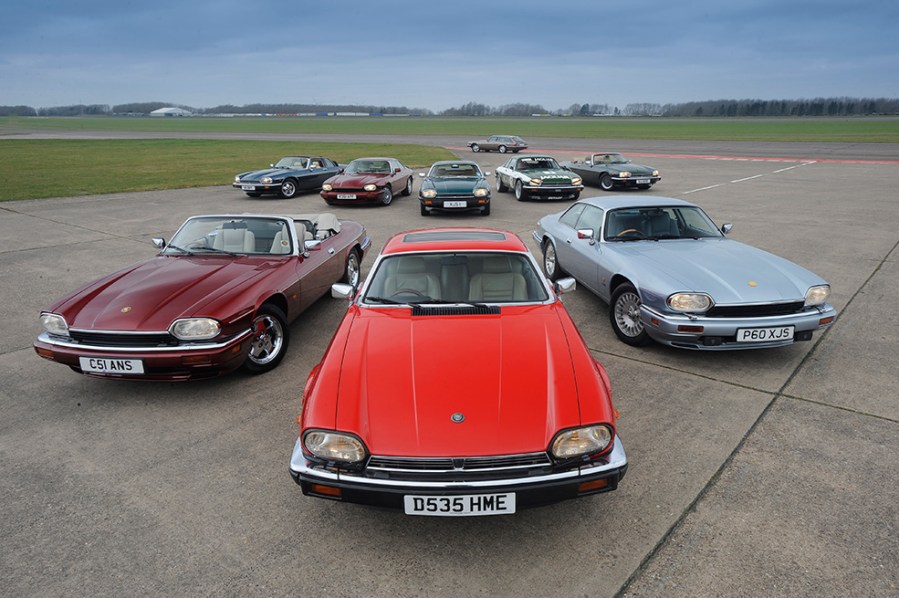
Long time readers of this blog may remember that I wrote a piece about the XJS back in 2016 (read it here), however that was more around its mechanical 12-cylinder engine than the car itself. Given that and also that quite interestingly, and in stark contrast to many other future classics, not much has happened on the price front in the last four years, I felt a fuller description of this true icon of English car manufacturing was called for. Still to this day, the XJS remains something of a bargain – at least in purchase price. That will most probably change in the future.
The XJS was launched in 1975 and produced all the way through 1996, in three distinct series. For a combination of factors, it was far from a resounding success at launch. Firstly, although recognized as rather good-looking, it did succeed the E-Type, one of the greatest designs of all time, which wasn’t to its favor. Secondly it was also a bit misunderstood, as Jaguar never intended the XJS to be a replacement of the E-Type. Instead they were aiming to produce a GT car, comparable to the later Mercedes CL or similar. In that they succeeded, but it took a while for the market to recognize it. Thirdly Jaguar ran into stupid difficulties in some markets such as Germany, where the buttresses behind the windows were deemed to restrict the rear view, and German authorities refused to grant the XJ-S type approval, meaning individual owners had to obtain individual road approvals for their cars – not something that boosted sales numbers… Finally, although there were other 12-cylinder cars in the market at the time, the XJS launched in the wake of the oil crisis and as you will suspect, fuel consumption has never been its strong point…
The rear buttresses (the triangular shapes on the sides of the boot) caused major issues for German clients
So after a difficult launch, the first series was built between 1975-1981 in around 15.000 units and was only available with the 5.3 litre, V12 engine. In the first year the manual gearbox from the E-Type was actually available as an alternative, but that was soon scrapped for the 3-speed, automatic box. The engine developed around 270 hp and made the XJ-S comparable to other V12 cars from Ferrari and Lamborghini at the time.
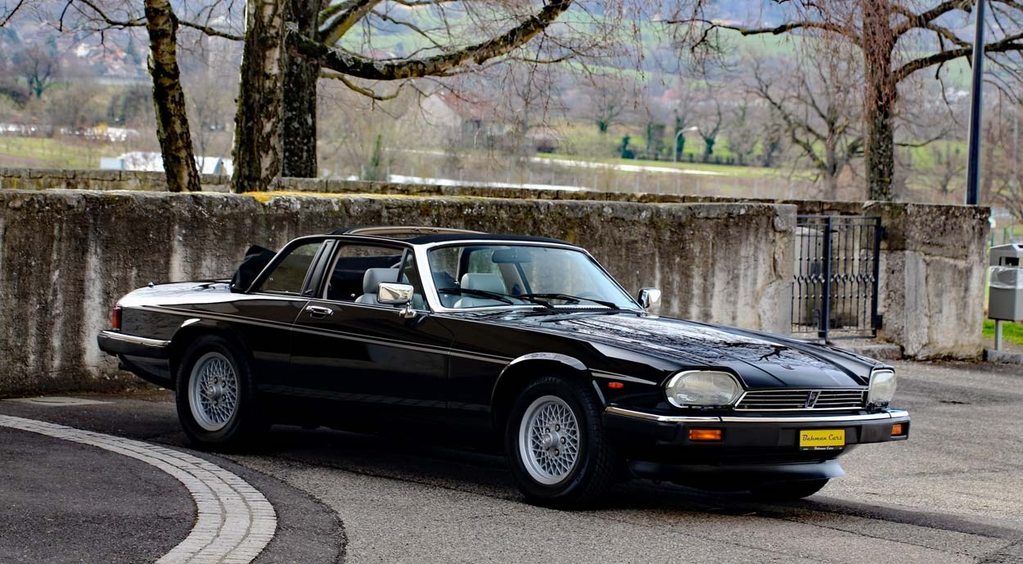
The second series ran for 10 years until 1991, and now a number of things happened. Next to the coupe, in 1983 a targa convertible was introduced, based on speculation at the time that the US would ban full convertibles for fear of roll-over accidents. That luckily never happened, and Jaguar subsequently replaced the targa with a full convertible in 1988, which contrary to the former became a great success. That of course makes the targa a rare and quite interesting find today, since no more than 5.000 cars were produced in total.
A targa convertible currently for sale in Switzerland
In 1983, the 12-cylinder was also complemented with a 3.6 litre straight six engine that was only available with a manual transmission until 1987. It produced around 230 hp as compared to the 265 hp of the V12, obviously with considerably less torque but also less fuel consumption. Importantly, in 1987 the much outdated, 3-speed automatic was replaced by a more modern, 4-speed ZF one.
By the time of the third series that started in 1991 and ran until the end of production in 1996, Jaguar had been taken over by Ford and was part of Ford’s so-called Premier Auto Group. A number of changes were done to the XJS, both in terms of design (front and rear bumbers and lights, slight changes to the windows and famous buttresses etc.) and engines. The 5.3 litre V12 was increased to 6 litres and around 300 hp, and the straight six was replaced by a 4 litre version.
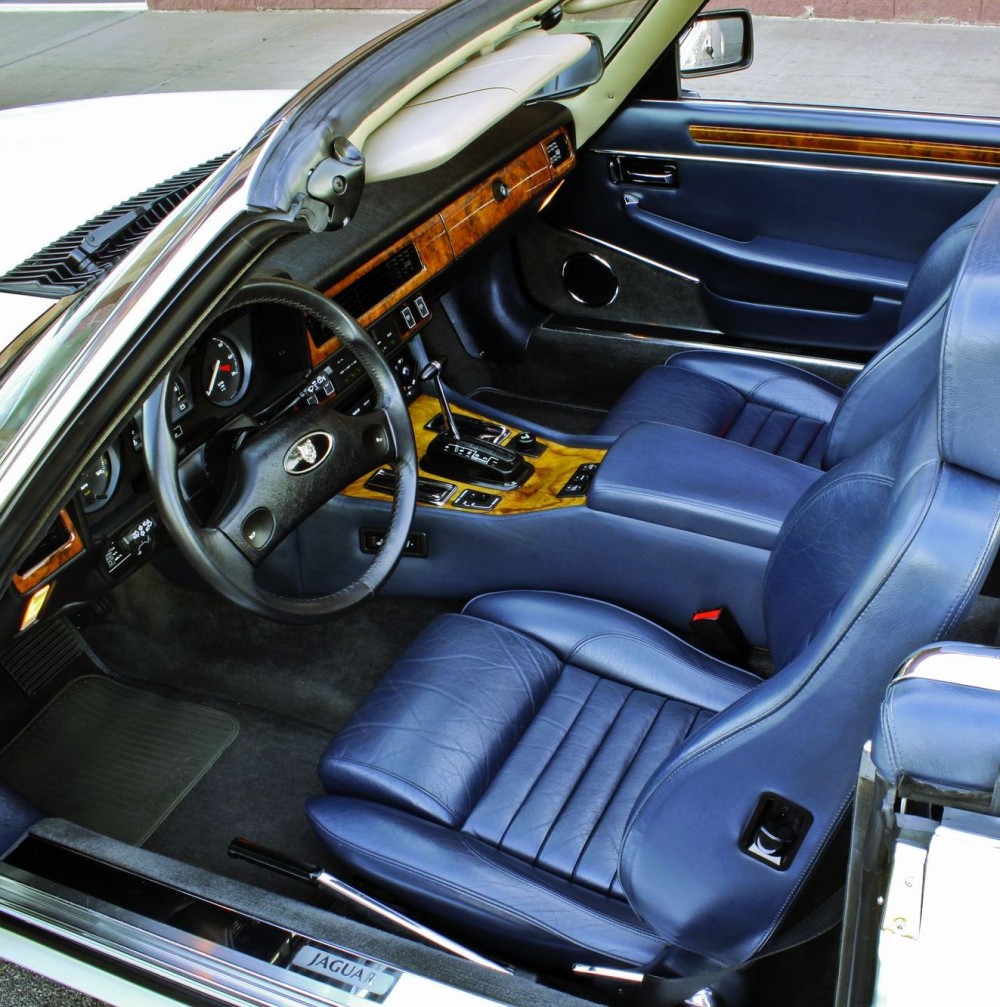
Irrespective of engine choice, the beautiful interior remains the same
Irrespective of age, there are few cars that have the same level of road presence as an XJS in a very British, understated way, very far from the screaming lines of a Lamborghini. By today’s standard it’s also a much smaller-looking car than it was initially, and its smooth lines obviously only add to the attraction. Driving it is a very similar experience. The 300 hp of the final V12 version that I’ve had the pleasure of trying are enough to make the cat roar should it have to, and steering and body roll are actually much better controlled than could be expected. Where the XJS excels still to this day is however in the smooth gliding department. It’s a comfortable cruiser, very quiet even by modern standards, and with a giant booth that will easily accommodate luggage for two. That’s also to say that the rear seats in the coupe and some convertible versions (the other ones being strict two-seaters) are not meant for humans with legs.
Whether to opt for the most common, 5.3 litre V12 version or rather one of the straight sixes is obviously a decision that can have quite wide-ranging, economic implications. There is no doubt that the V12 is the engine that suits the car best, but you could also argue that the straight six has enough power and is obviously much cheaper to own. Whichever engine you go for, a complete service history is critical – do not take any chances here! The 6-litre V12 from the Ford era has a better reputation for reliability than the previous 5-3 litre version, although both engines are actually quite solid if serviced correctly.
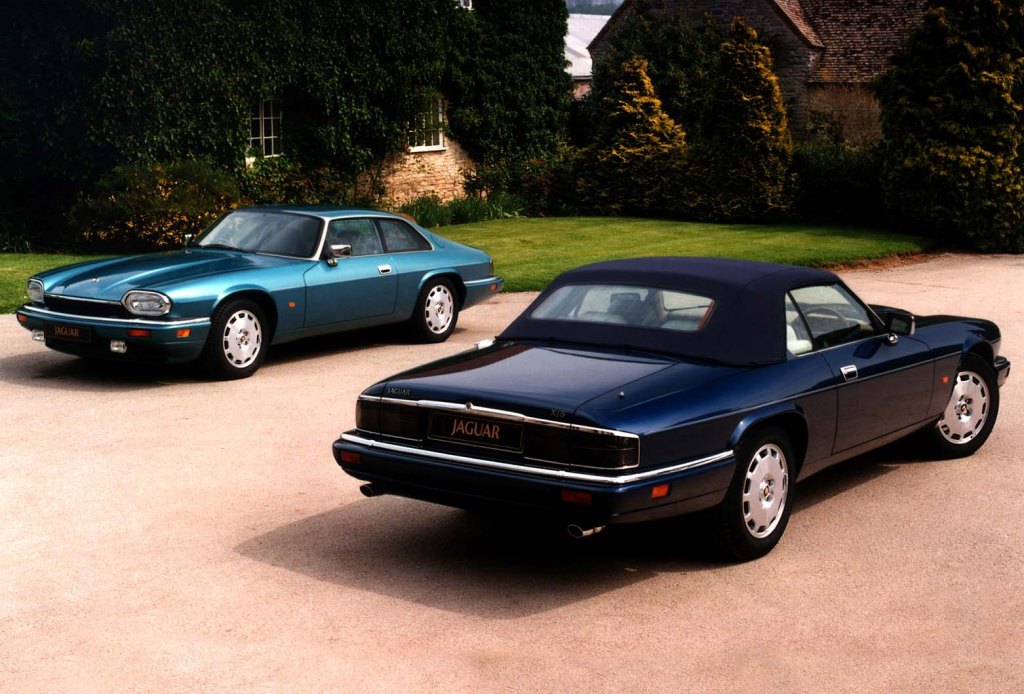
The convertible is generally not more expensive than the coupe
Coming back to the price mentioned initially, a good XJS can still be had for EUR 15.000-20.000, with top cars rarely going beyond EUR 30.000. That’s probably the cheapest V12 you can buy and gives the car a clear upward potential price-wise. As I will come back to in next week’s post however, one reason for the low prices is as so often the far higher running costs, where the V12 is a prime example. But as long as you’re aware of that and find the right car, there are very few cars that provide a similar experience. I would recommend a post-1987 car such as to benefit from the 4-speed automatic box, and if you like the styling of the third series and want a V12, then preferably a post-1991 car. The (full) convertible is the ultimate glider, but the lines come through better in the coupe. It’s really a matter of choice as the convertibles are not more expensive than the coupes. Finally, the targa convertible is the hardest to find but should be most interesting from a value preservation perspective, even though it’s also the most expensive model today.
Find the right car, put on your tweet jacket, make sure there’s fuel in the tank and double-check whether you did start the engine, given how silent it is – silent enough for your passenger to hear you whistling “Rule Britannia” as you set out on your roadtrip!
It’s vacation time! But this year being like no other, for many of us it has made changing plans or holiday habits. Most won’t fly far, we cannot visit certain countries and generally, many feel an unease for the hole concept of travelling. In our case it will mean spending our well-deserved weeks close to home, or rather within driving distance. A bit like it was back when our parents were young in the 50’s and 60’s. So this week, whether you’re at home or not, let’s take a trip down memory lane back in time, more precisely to France in 1955. Because there and then, “la révolution” was about to hit the car world!
First though, let’s picture what Europe was like in 1955. The war was over since 10 years and the worst memories had faded somewhat. The economy was strong as Europe was rebuilding – in fact we were already 10 years into the 30-year expansion period that lasted until the mid-70’s and in France was referred to as the “30 glorieuses”, the 30 glorious years. There were plenty of jobs, things were looking up – maybe peace would last this time and Europe had a bright future?
Paris in 1955 – color returning to a city still showing the scars of war.
With a bit more money in their pockets, people started going on holidays. In France, the first motorway construction projects had just started, but “la route des vacances”, the holiday road, was still the Nationale 7 that ran for almost 1000 kms from Paris to Menton on the Côte d’Azur, just next to the Italian border. This is the road most holiday makers took in cars that were a mix of pre-war models and some early 50’s models. Many were French, and many were Citroëns, at the time the second largest French brand behind Renault but just ahead of Peugeot, with Simca in fourth place. Citroëns at the time were mostly the famous 2CV and the Traction Avant. But in 1955, Citroën introduced the car that would leave a mark for many decades to come – the DS.
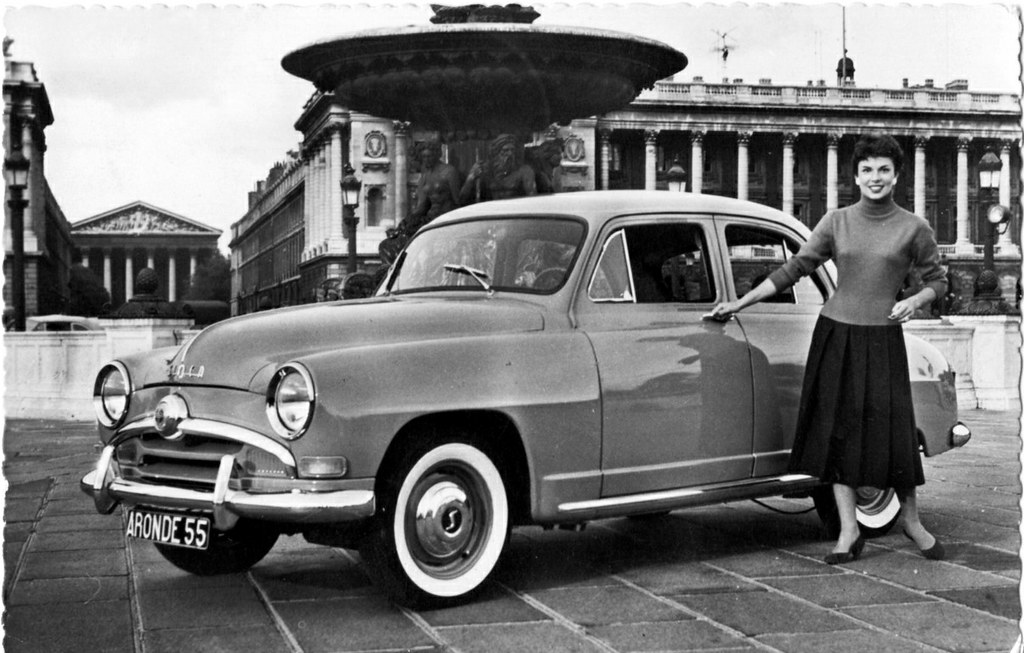
A “Déesse” from 1957 – like nothing seen before!
Citroën at the time were not only innovative when it came to building cars but also in naming them. Pronouncing DS in French can be transcribed as “Déesse”, meaning Goddess. The DS would have many nicknames through the years, but notably in Germany it was most known as the German translation of the word – “Göttin”.
When the Salon de l’Auto opened its doors in October 1955 the car got more attention than anyone could have hoped for, and by the time it closed its doors, Citroën had taken 12.000 orders for the new car, almost equivalent to half the brand’s total annual production at the time! This was obviously a great success and the start of the DS story, that was to last no less than 20 years with more than 1.3 million cars sold in total. What was it then that was so exciting about this car, and that gave it such a long life?
Not much of a competition…
Let’s start with the design. In 1955 cars didn’t look like the DS. If you don’t believe me, have a look at the above selection, all cars from the same era. In comparison, the DS was modern, daring and futuristic. The front axle was 20mm wider than the rear, giving the car a droplet form. The roof-mounted, rear turn lights looked like small turbine engines. The sloaping front was a clear break with other cars at the time. And when other cars still had flat windscreens, the DS’s was arched in a way that was hugely complicated to produce. Given the the car also offered generous interior space (for the time), it quickly became General de Gaulle’s official presidential car.
A design study of the original DS
There was also the technology and innovations that were at a level to make a 1950’s Elon Musk blush. From the start the car offered hydraulic, assisted steering (a first on mass-produced cars) and hydraulic front disc brakes. The steering wheel, originally a model from 1904, was constructed such as not to pierce the driver’s torso in case of accident. The wheels had a single, central bolt until 1966. During the car’s life a number of other technological features were added, most notably the turning headlights in 1967, that turned in the same direction as the steering wheel. Other car brands needed more than 30 years to come up with a similar solution!
Then again, this was a French car, meaning all ideas weren’t necessarily logical to the non-French. Putting the spare wheel under the front hood in front of the radiator was smart, the fact that you needed to remove the rear side body part to change a back wheel less so. And in spite of thousands of tests having been performed, it took Citroën a few years to find the right liquid to circulate through what the car has become most famous for – its hydraulic system and hydraulic suspension.
A DS suspension sphere, at the core of a suspension system that was revolutionary.
Citroën had actually launched its hydraulic suspension system already in 1952 on the Traction Avant, but it wouldn’t become famous until the DS. To provide a simplified explanation, where a normal car has springs and dampers, a DS has spheres filled with gas in one half and hydraulic fluid in the other. Given gas compresses but fluid doesn’t, gas takes the role of a spring and the fluid of a damper. The system was often accused of being complicated and a nightmare for later owners, but provided it doesn’t leak and is being regularly maintained, it basically relies on the laws of physics who work as well today as in 1955.
The hydraulic suspension gave the car a ride quality that was sensational for the time, and still today is a fascinating experience. A DS literally floats over the road, so much so that some people feel seasick when riding in one. Further advantages with the system are notably that you can raise and lower the car, and Citroen’s innovative marketing people were also happy to show how the car could ride on three wheels in case… you had forgotten the fourth one. In 1962 a very capable driver actually managed to save President de Gaulle’s life, escaping from an attack on him at high speed down a bad road – with two flat tyres. Perhaps even more suprising to most is that the DS during 15 years proved a very capable rally car, winning a number of classical rally races such as Monte-Carlo, Marocco and the Thousand Lakes up in Finland.
Should you not have four wheels, three will do the trick!
The DS was built at a high technological level for the time, and a couple of years after it had been introduced, the mechanically far simpler and thereby cheaper ID model was produced in parallel. ID cars had vinyl roofs, a different dashboard, less equipment but above all, a simpler hydraulic system, not including for example the hydraulic steering. They did however retain the same suspension system.
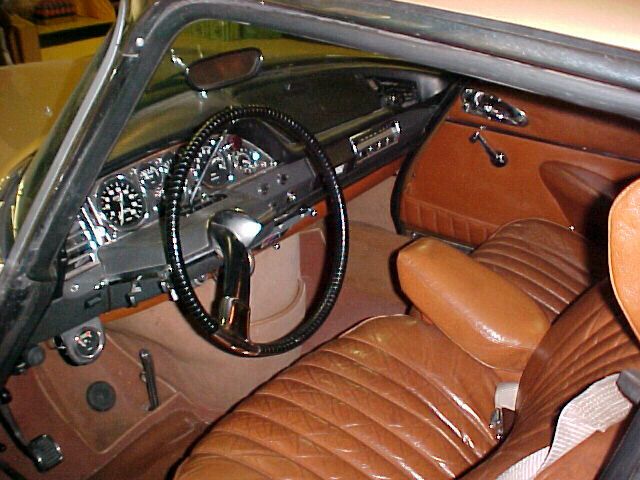
A DS provides a peaceful, floating driving experience. Power evolved through the years from initially 75 hp with the old Traction Avant engine during the first years, to 130 hp for the later years, adequate but not more. The steering is a strange experience with no natural feel whatsoever and requiring very little effort. Much has also been said about the breaking as the DS doesn’t have a conventional brake pedal but rather a sort of mushroom-like rubber button sitting on the floor. Every person driving a DS for the first time will apply too much breaking pressure as you really only need to touch the mushroom lightly for the car to stop.
The black round thing on the floor is the break “mushroom”. The non-intrusive steering wheel was originally designed in 1904.
In the 1970’s the DS started to age and even more importantly, the way it was built was no longer at a modern standard. Citroën was losing money on every car and had run into great financial difficulties in the early 70’s, so that Peugeot had stepped in as owner. This meant the end of the DS that was to be replaced by the no-less futuristic CX – but that’s a different story.
Should you wish to have a bit of French history in your garage you would have been able to pick up a nice DS for EUR 10-15.000 no longer than 10 years ago. Today you won’t find a good one below EUR 30.000, with no real difference between model years or even the ID/DS models as the condition is far more important. Should you want to go for the beautiful convertible model, of which only some 1300 were built by Henri Chapron, it will set you back quite a bit more, currently around EUR 200.000. Whatever you choose, why not take it for a ride this summer? Maybe even to France? Parts of the Nationale 7 are still there and I’m sure the sun will be shining as you gently float towards the south!
I had the privilege to spend part of my childhood in the late 70’s and early 80’s in Monaco. I had caught the car virus already back then, although the 8-9-year version of myself was mostly interested in counting car antennas (these were the days where cars would regularly have 3-4 antennas, and the really cool guys would have a 2-meter, roof-mounted one, making it look like they were receiving from the moon…).
Monaco is obviously embedded in France, and France is obviously very French, also when it comes to cars. In this period there were two French sports cars that easily (at least according to the French) held up with the competition from both Germany and Italy. The first was the Renault 5 Turbo / Turbo 2 nicknamed “the steel mouse”, basically a Renault 5 with a wider body and the engine moved back to sit where the back seats used to be, and developing anything between 160-300 hp depending on version and year. Few of these are left today and when they change hands, it’s at stratospheric prices.
Très cool!Antenna on the smaller side though…
The other came from the small French manufacturer Alpine, established in 1955 and mostly known for the A110, built during the 60’s to the mid-70’s. Alpine had always had a close relationship with Renault who took over the company in 1973 and after the A110, sold its successor the A310 (later A610) until 1995 when the Alpine name disappeared.
Très – ugly, from the front as well as from most other angles.
In 2017 Renault then re-launched Alpine with the new A110, a small, light sports car clearly reminiscent of the original from the 60’s, and in many ways inspired by Lotus (Lotus Exige bodies were even used during the development process). The A110 received a warm reception especially from the motor press since it was a car that finally went against the logic of ever-increasing power in ever-heavier sports cars. The car magazine Evo (the tagline of which this blog uses as its name) even elected it runner-up in its Evo Car of the Year in 2018. In addition, a small engine with low emissions in a light body made the car cheap to own, which is very important in France but increasingly also in other European countries.
The new A110 (left) in the legendary “blue alpine” colour is a great interpretation of the 60’s original!
I obviously no longer live in Monaco but our family typically returns to the south of France every year (typically doesn’t include this year by current looks…) and we stay close to a large Renault dealer with a separate Alpine showroom. I visited it last summer, got a personalized demonstration of the car as well as a test drive in the adjacent back country that was really an experience.
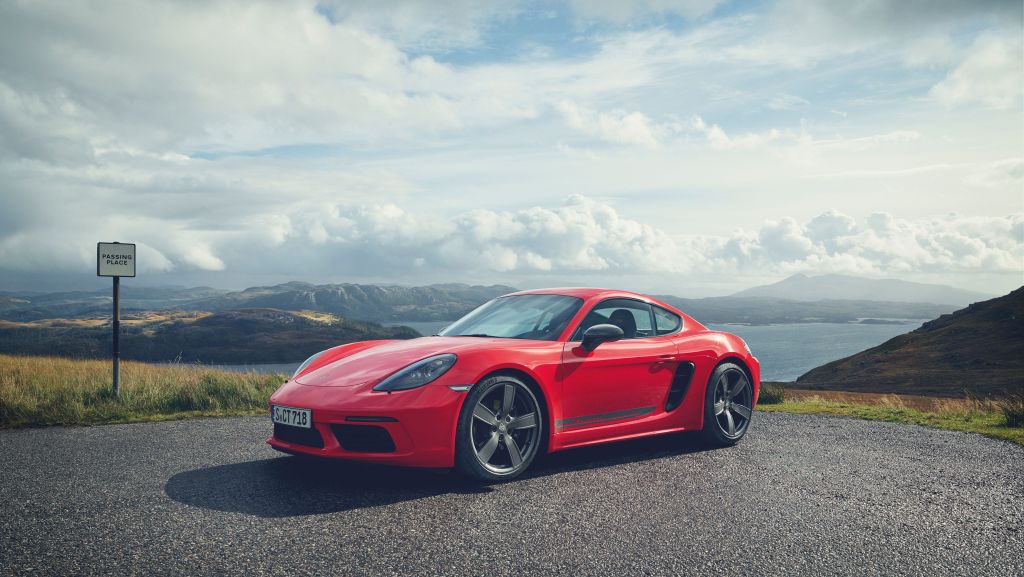
Firstly I love the looks, that for me strike the right balance between old and new and are quite unique. Secondly you sit really low with the car wrapped around you. Thirdly, it’s a great drive. The mid-mounted, turbo-charged, 250 hp four-pot (now also available in a 295 hp, “S” version) delivers more than enough power to the rear wheels for the 1.100 kgs it weighs. The engine is in great harmony with the 7-speed DSG box and handling is sharp with a notable absence of body roll. It’s also very well made and doesn’t need to be thrown around a corner to be enjoyable. As Renault has shown previously, all the way from that R5 Turbo to modern incarnations of the Mégane, it knows how to develop great drives, and the A110 is a testament to that. At a starting price of around EUR 55.000, I would also claim that it’s quite competitive, being far cheaper than any new Lotus (and in comfort and finish, only the Evora could compete) or Porsche Cayman (that is however more than 500 kgs heavier), the two most obvious competitors.
The interior doesn’t disappoint either!
Apparently though, not a lot of people agree with me on that last point – because very few Alpines are being sold – and this is even before the whole Covid thing. A total production of around 7.000 so far of what was always going to be a niche car doesn’t sound too bad, but sales in large markets are in free fall and in December, the daily production was cut from 15 cars to 7. As noted in my post on Daniel Ricciardo’s switch to McLaren a few weeks ago (that you can read here), Renault’s finances are also in bad shape, with 15.000 employees currently being cut as part of an EUR 2bn savings plan.
The Alpine is a great sports car at a good price, and although the brand may be less-known than Porsche or Lotus, the reputation and tradition should appeal to at least some of the mid-aged sports car enthusiasts that are the target group. The problem is rather to be found on the distribution side. Given Alpine is not in line neither with the rest of Renault’s line-up nor with its clients, the cars are sold over separate dealers that are few and far between (11 in Germany, 2 in Switzerland, 3 in Austria and not more than 20 in the home market France, that has more than 3.700 Renault dealers). Taken together, that 6-month old Cayman that can be serviced around the corner, that is certainly the safer option and that definitely carries the more prestigious brand, all of a sudden sounds quite attractive…
If it wasn’t for those Germans…
A mother company in severe financial straits with the French state as 15% owner does not bode well neither for Renault in F1, nor for niche projects like the Alpine. If sales don’t pick up, which is highly doubtful given what’s happened, I wouldn’t be surprised if for the second time in its life, Alpine is laid to rest. That may be sad for Alpine but not necessarily for A110 owners, who can still enjoy a great car that will never be seen on every corner and that can be expected to hold its value really well!
There was a time when Mercedes had a well-deserved reputation for building unbreakable cars. That period reached its peak in the mid-90’s but unfortunately ended with the E-class internally known as the W210, launched in 1995, which tainted the reputation for solid quality quite heavily. In parallel however, Mercedes still built cars based on the previous generation, and one of them, the Mercedes SL (R129), is no doubt the most attractive car from the era – and still a bit of a bargain.
The R129, here with body kit, one of Bruno Sacco’s best designs. Cars from 1995 had white turn signal glasses.
The R129 was built from 1989 through to 2001, an incredibly long lifetime if you compare to today. But again, Mercs from this period were pretty much indestructible, and their buyers, typically elderly German doctors, didn’t look much at driving thrills – so from that perspective, why change a winning concept?
The 90’s SL had a number of different drive trains through the years, from a relatively modest 2.8 litre straight six to a monstrous 7.3 litre AMG V12 developing 525 hp. No doubt the most well-known models in Europe are the 300 SL with a sraight six, and the V8 500 SL developing 326 hp – probably one of the most reliable engines in the modern era.
The 500 V8 with 326 hp in a well-filled engine room.
The SL had some innovative solutions such as an automatic, invisible roll bar and seat belts integrated in the seat backs. The larger the engine, the better the equipment level, but interestingly all cars were delivered with a hard top, to complement the regular soft top. Some cars have (very small) rear seats whereas others only have a flat surface, but in both cases, the area is really only useful as extra luggage space. The SL is a two-seater and an Autobahn cruiser by excellence, steady, heavy, reliable. It will not give you the thrill of an Italian full-blood, but if you choose somewhat wisely, not anywhere near the same running costs either.
A good place to be. The SL is a two-seater, whether it has back seats or not.
A solid, relatively low-mileage SL 500 with the indestructible 326 hp V8 is easily yours for EUR 25.000 or even less, and that’s the wisest choice in the line-up. Cars with smaller engines will not necessarily be cheaper and certainly not give any additional thrills. The same money will buy you a 600 SL with the 394 hp V12, but besides huge running costs, driving-wise that also becomes a very front-heavy car. Finally the AMG models are very rare and correspondingly expensive. Little reason to go there – a 500 SL is good enough, there are plenty of good cars on offer, and it’s doubtful they will get cheaper than today.
It’s not every morning that a 300 SL is parked in front of your office, especially not on a rainy day such as this Tuesday, with no real weather improvement in sight… But if the sun doesn’t light up your day, a Gullwing certainly does, especially the coupe, of which there were only a total of 1400 produced between 1954 and 1957! At the time it wasn’t even the most expensive car in the Mercedes line-up, today at an estimated value of EUR 1.2-1.5m, it probably is…
Speaking of red Gullwings, enclosed below is quite a legendary on board video from the Arosa Classic Car race back in 2012, giving a close-up feel of what it’s like to drive one of these for real – enjoy!
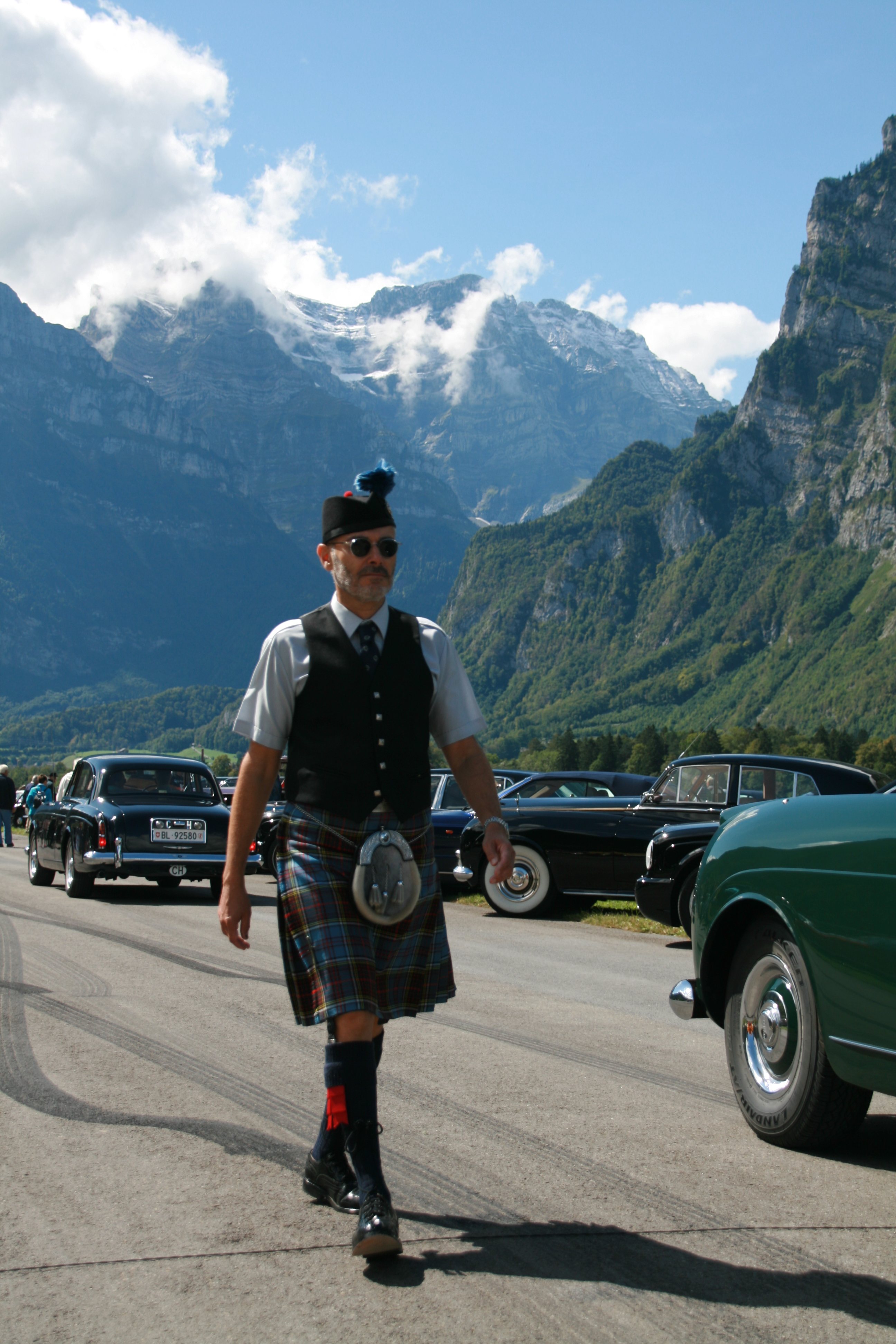
I had the pleasure of attending the British Car Meeting on the Swiss countryside today, an annual gathering where some 1300 British cars of all ages gather to admire each other and be admired by others. A few picks of some of today’s participants. Scroll over the pictures to see the caption.
Against a very Swiss background, some 1300 British cars gather each year in Mollis, canton of Glarus
A large number of Defenders of all ages…
…but only one Aston Martin DB 2!
No big secret that old Morgans…
…are much prettier than the new one!
This gentleman subsequently found his bagpipe and entertained the crowds…
The Esprit has become rare, but not as rare…
…as this “custom” race Lotus, multiple race winner!
Many of us oldtimer drivers have a tendency only to take our jewels for a spin when the sun is shining and temperatures are mild, completely forgetting that it actually rained when the cars were built as well. This time of year our beloved cars are mostly sleeping in a garage somewhere, with batteries disconnected. It is only the hard guys that drive in any weather, but even among the hard ones, only the REALLY hard ones would even think about taking the 356 for a spin on a rainy December day with temperatures around 6 degrees. The only thing missing is the ski rack! Dear owner, I did not get to meet you but I salute you!
We use the occasion to wish all our readers a Merry Christmas and a Happy New Year, with plenty of great cars and great drives!
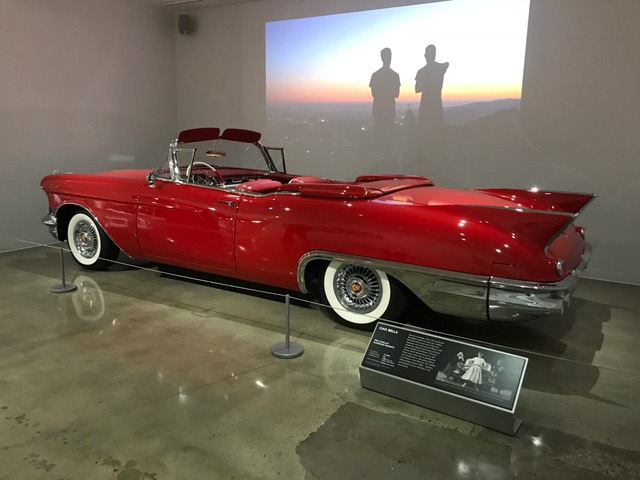
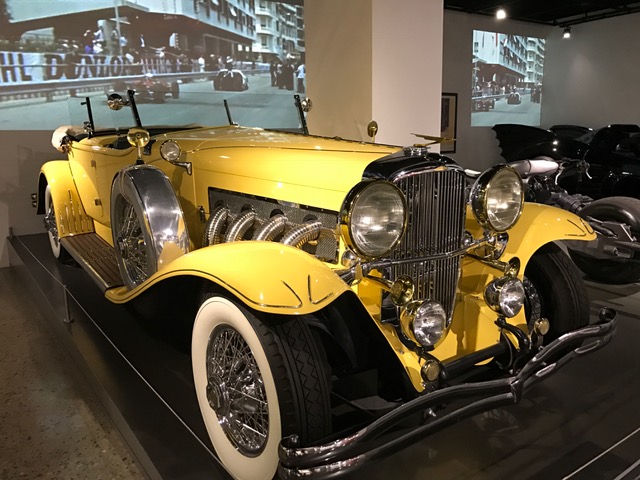
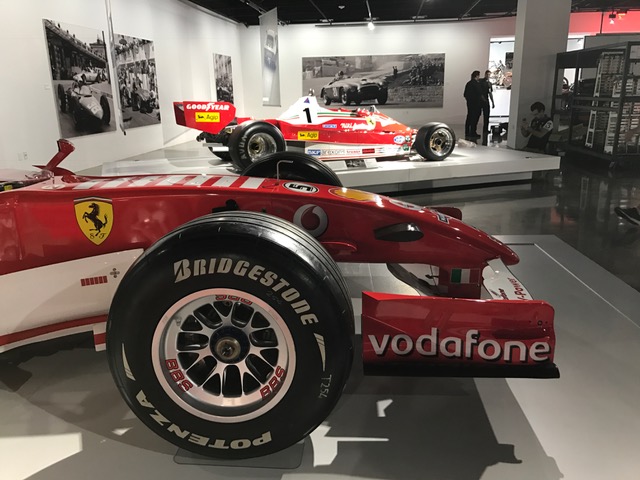
Next time you are around West Hollywood with a couple of hours to spare, make sure not to miss the Petersen Automotive Museum, based on the car collection of the late Mr. Petersen, publisher of the first hot rod magazine in the US and lots of other car-related publications. Given LA’s extensive movie scene, the collection also includes some famous movie cars, two of which are pictured below. Well worth a couple of hours!
At more than 57′ USD, this Cadillac Eldorado Biarritz was the most expensive car in the GM line-up in 1957, and certainly one of the longest!
One of the original eight or so DeLorean’s featured in the first “Back to the Future” movie – and my curious son.
The beautiful, original Duisenberg from “The Great Gatsby” – but unfortunately the original is a replica, built in the mid-80’s.
The museum includes a very nice Ferrari collection. Featured here is the front of Schumi’s original 2006 car, with Niki Lauda’s 1974 car in the background.
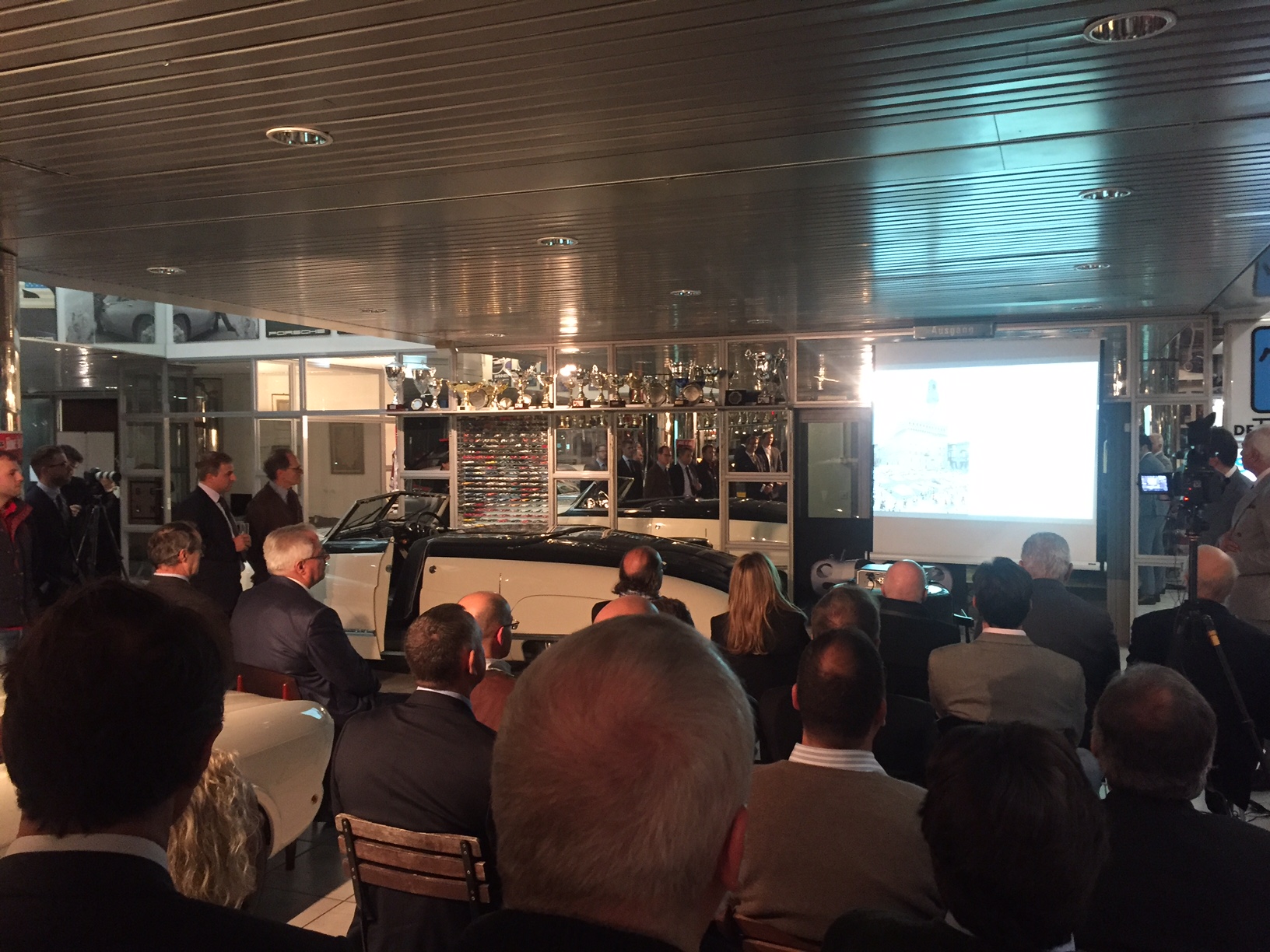
Classic car enthusiasts gathered at the stables of The Classic Car Fund in Zurich last night for an evening together with Corrado Lopresto, Italy’s leading car collector and restorator and a multiple winner of the Villa d’Este and Pebble Beach competitions. He is also the only person on the car scene to have been awarded UNESCO’s World Heritage Award for his extensive work in restoring (rather than renovating) many classic automobiles through the years.
Mr. Lopresto spoke about his collection, the amazing restoration work he undertakes together with his rather large stable of mechanics/restoration workers/artists, and also as a world premiere showed a 1948 Isotta Fraschini 8C Monterosa Cabriolet Boneschi, the last car built by the little-known (at least outside of Italy) Milan auto manufacturer Isotta Fraschini, active in the first half of the 20th century, and probably destined to win many prices at automobile shows the coming years.
As always, the wonderful car stable of Flippo Pignatti’s Classic Car Fund that I interviewed a few months ago, an interview you can read here, provided the perfect setting.
I meet up with Filippo Pignatti in a former Porsche dealership on the outskirts of Zurich that he, together with two other petrol heads, has transformed into a spectacular car showroom with exactly the right pit lane smell, featuring a selection of the cars in The Classic Car Fund (TCCF). This is also the HQ of the TCCF and where Filippo has his office. Italian and from Modena (where else?) by birth, he is a true European nowadays based in Switzerland where next to running a family office business he set up the TCCF five years ago, driven both by a passion for cars and for uncorrelated assets.
As Filippo tells me over an excellent espresso in the pit bar that is one part of the showroom, and as most readers of this blog know, well selected classic cars have provided better returns to investors over the last decade than most traditional and alternative asset classes, including things such as art, wines and gold. This is partly driven by the falling interest rates since the financial crisis, but also by baby boomers becoming solvent and realizing their childhood dreams and emerging market buyers that were not there a decade ago. “The Chinese have so far only been able to own classic cars abroad,” Filippo explains, “but that is about to change and that will create even greater demand in the future”.
The philosophy of the The Classic Car Fund is simple; buy well-selected cars at attractive prices following a thorough evaluation by an independent expert, and sell them later at a profit. The fund is not focused on any specific make or production year, but the emphasis is clearly on sports cars from various periods, especially Italian and quite a few of them from Filippo’s home city Modena. Holding periods vary vastly but the fund does not fall in love with its investments. Some cars have enabled the fund to realize a healthy double-digit profit in as little as three months, others will remain in the fund for up to a few years.
An MG K3 Magnette 1933, owned by the fund for 19 months and then sold at a net profit of 25.3%
As always it is easy to be clever with hindsight and arguably you could have bought most Ferraris from the 90’s and earlier in these last years and realized a good profit. But it’s not just about finding the right model. “It has to be the right car”, Filippo explains, citing factors such as early production years, small, limited series, or, slightly surprisingly, famous previous owners. This last point explains two satellite positions in the fund’s current portfolio, a Maserati Quattroporte once owned by Elton John, and a fully-loaded and personalized Range Rover Sport initially ordered by David Beckham. “Obviously buying a famous person’s car brings an additional risk”, says Filippo and hints at the person’s reputation. “Should it come out tomorrow that David Beckham was doped through his whole career, that would not necessarily be good for the value of the fund”. Luckily though, the risks of that happening seem relatively small.
Next to selecting the right cars, the additional challenges of a car fund are the same as with a private car collection, most notably that you need a place to store them that is not only dry and warm but that also allows for regular exercising to avoid the cars being damaged from being immobilized. The TCCF stores its cars in various locations in Switzerland and Italy, and employs mechanics to keep them in shape. Two additional features of the fund further strengthens the link with private collections: subscriptions are permitted in kind, meaning that you can buy into the fund through a car or a car collection, following an evaluation by an independent expert. Ownership passes to the fund but the original owner receives a buyback guarantee at the same price up to two years from the point of purchase. Also, and perhaps of more interest for most, against a small fee, fund investors may borrow and drive the cars in the fund over a day or a weekend. Filippo smiles and says “take the Testarossa in the showroom down to St. Moritz over a weekend. If anyone asks you can truthfully say it’s your car, as it is part of the fund you are an owner of”.
A beautiful Fiat Touring Aerodinamica 1939, owned by the Fund for 7 months and then sold for a net profit of 8.3%
Filippo Pignatti, CEO and fund manager of The Classic Car Fund
In Filippo’s eyes, the tangible nature of the assets in the fund as one of its best guarantees of future value. “If something goes bad or the market turns completely, we can always sell the cars, making sure you do at least get part of your investment back”. He is also the firstto say that this is not something for the core of your portfolio but rather a satellite position. In terms of the current market he does not see any dramatic changes but some signs that it is becoming more selective, meaning greater expertise and competence will be required going forward. He also sees a breaking point relating to the electronic age: “the Testarossa, or Culo largo (large ass) as we call it in Italian, is a mechanical car. the LaFerrari is very complex electronically, which does not necessarily bode well for future values as it gets increasingly old and fragile”.
The Classic Car Fund has been running since 2012 and has provided investors with net returns of 7% on average p.a. after fees without any negative years (as per April, 2016). It shows no correlation to traditional assets and could thus be an interesting addition to a diversified investment portfolio. At its core though, it is really about the passion for cars. Before we shake hands and part, Filippo concludes with some very sensible words. “I always tell people that if you buy a classical car, do so because it is a car you like and that you like driving. After all, that is really what these cars are for”.
For further information on The Classic Car Fund you are welcome to contact me over the blog.
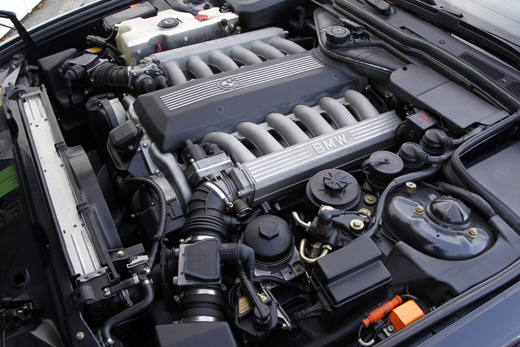
I had the pleasure of having a drink, Friday night, with Pierre, an elderly gentleman as crazy about classic cars as myself, but with a far longer pedigree both in ownership and understanding the mechanics than I will ever achieve. His brand has always been Jaguar, and his garage notably includes a 12-cylinder E-type coupé. We came to talk about the (to some, surprising) robustness of the engine, and it was then that it struck me: at a time when emission levels are being tightened and even Porsches and Ferraris have become turbo-powered, it is pretty clear that we will never see a new 12-cylinder engine being developed. And that, my friends, is sad news.
A revolution at the time!
The first 12-cylinder I experienced (as a passenger at the time) was that of a BMW 750 from the late 80’s. It developed 300 bhp, then an astonishing number, but it was not the power itself but rather the smoothness of the engine that was so impressive. In that regard, nothing can really compete with a 12-cylinder.
So it’s sad we won’t see any new ones – but it’s great you can still get your hands on one without being ruined!
How to fill an engine rome: XJ-S from pre-1990, when a cover hood was added to the middle part.
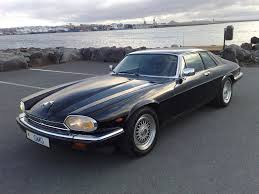
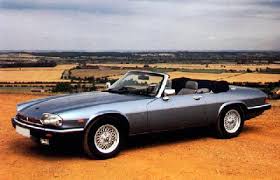
Onone hand you have late 7-series and S-class models that you can oftentimes pick up fully loaded at something like an 80% discount to their new price with less than 100.000 kms on the clock. Surely exciting, but my heart beats more for a classical, mechanical 12-cylinder, such as the eye-watering ones from Maranello, or indeed those from the house of Jaguar. And whereas the former have sky-rocketed in prices, the ones from Coventry are still reasonable. Less so in the E-type, more so in the still very cheap XJ-S models, as coupé or convertible. Both can today be picked up in excellent condition for EUR 20-25.000, meaning they have most probably seen the bottom in terms of prices.
Will a Jaguar 12-cylinder ruin you? Not necessarily, according to my friend Pierre. The engine is quite robust and in some aspects less sensitive than the smaller 6-cylinder. It was also produced during a long time so by the time it made it into the XJ-S, it had already seen a number of revisions. My suggestion would be to find a car with full history, have it checked, and making sure you turn to a specialist the day something happens. If you have that in place, you can’t really go wrong!
The coupé line is purer than the convertible
Still looks like a million dollars but costs far less!
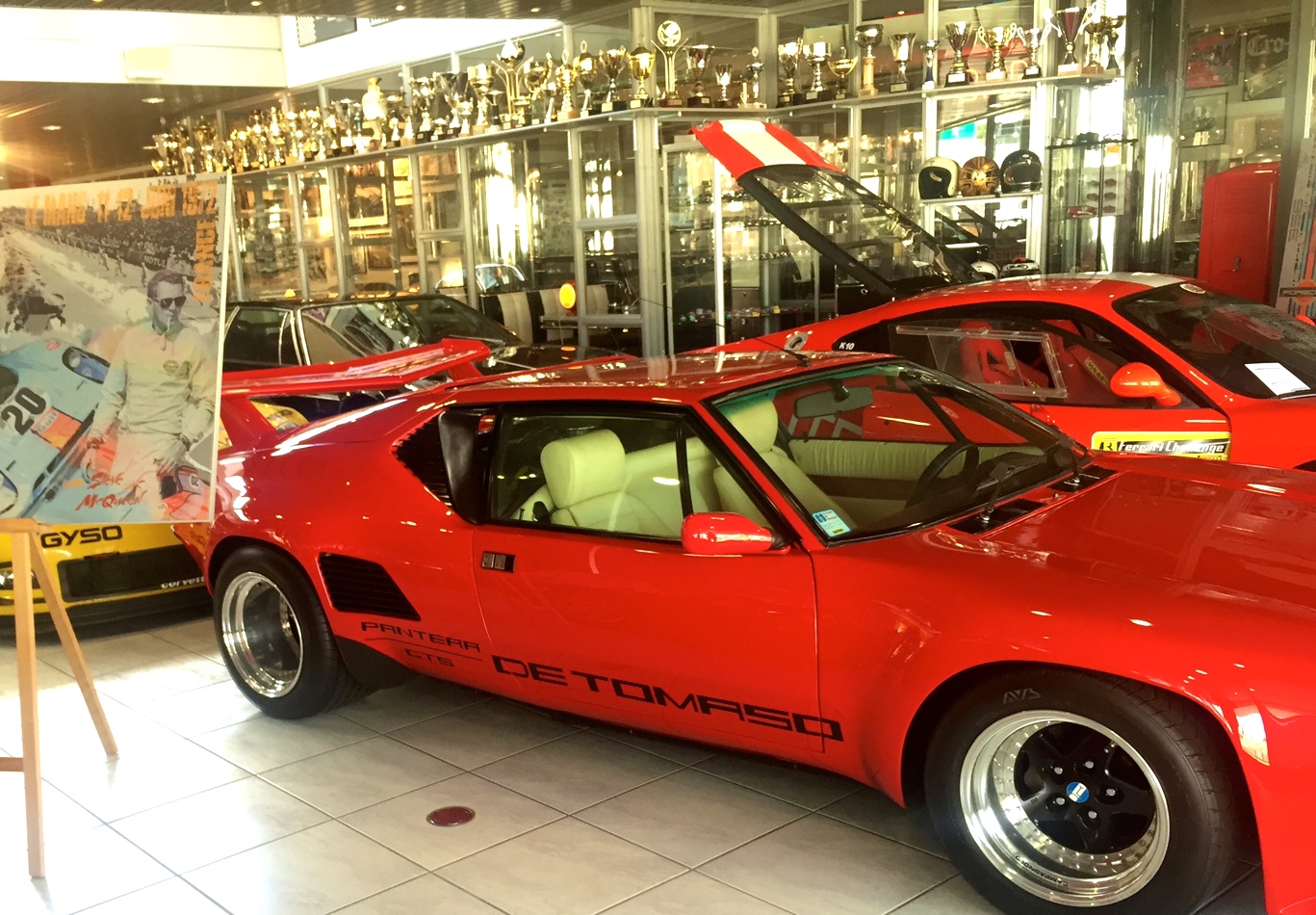
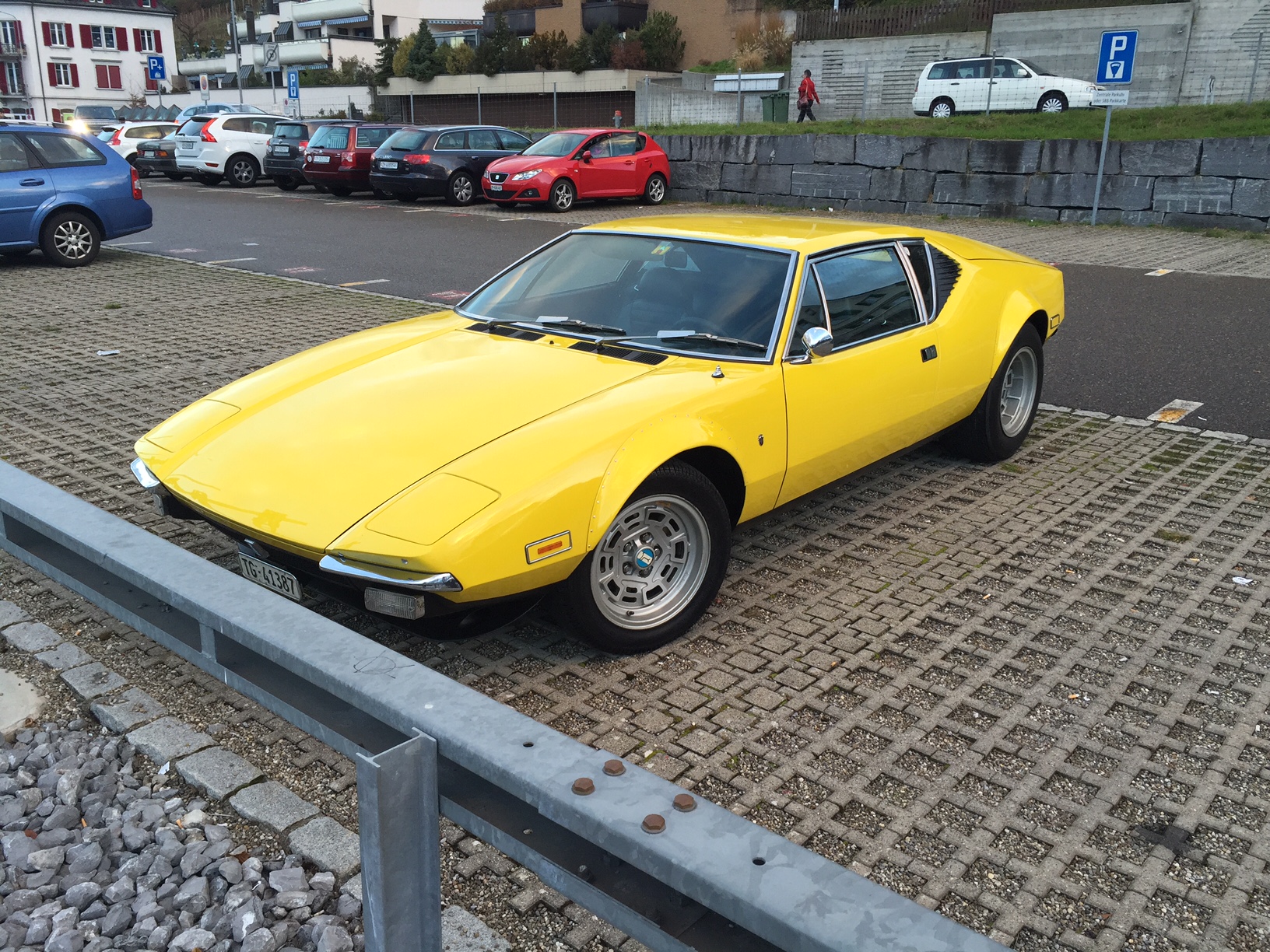
It is not every weekday morning that you see a beautiful De Tomaso Pantera parked at the train station, and the fact that it is late November obviously made the experience all the more remarkable!
The Pantera was always an exotic car. Launched in 1971 and produced all the way through 1992 with an increasing number of spoilers added over the years, the cars were built in Italy but never had their own engines. The nicest examples with the still unspoiled original design from the mid-70’s such as this one had a Ford 5.8 litre V8 developing 265 hp, but both power trains and output varied over the years.
All in all, 7200 Panteras were produced until 2001, before de Tomaso ceased to exist as a brand in 2004. It is not a car you will find under our Thrill of Owning section since values have already taken off – roughly doubling over the last five years to more than EUR 100.000 for a good car today – but it will always remain a thrill in automobile history!
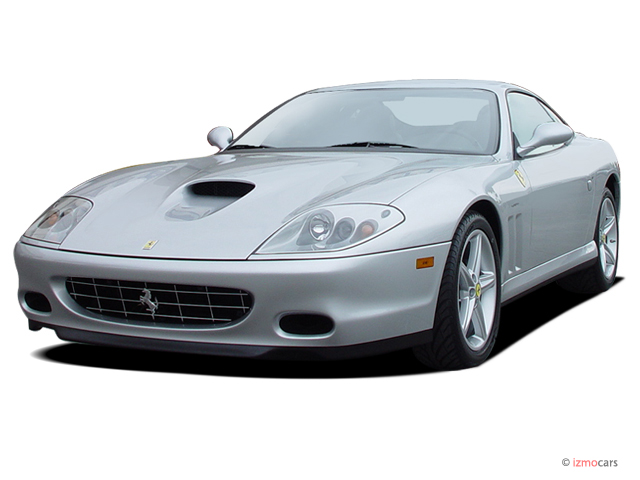
As our Thrill of Owning for September we have chosen something truly hard to beat, except for the very best modern supercars: the Ferrari F550 and its sibling and successor F575). A 5.5 litre V12 from Maranello – can it really get much better?
The F550 was presented in 1996 as a successor to the 512 (Testarossa). Designed by Pininfarina, the car is a mix of lines and curves or more precisely of design items from the past and that were to come in the future. It is not the most beautiful Ferrari but the 550 nonetheless has a distinct styling that has stood the test of time well. In other ways it was however a distinct break with the eighties: the engine was back in the front and Luca di Montezemolo, Ferrari’s long-term boss, at the time of the launch had expressed a clear wish for the 550 to be the return to Ferrari’s racing GT car tradition. This means the car looks considerably longer than the mid-engined 355 and 360, although it was only 10 cm longer than the latter at around 4.55 metres.
Luckily the GT ambitions in no way compromised the chassis which has stood the test of time even better than the styling. It is the extremely well-balanced but also very advanced, and it received wide praise even in comparison to the 360 Modena launched a few years later (1999-2005). Tests concluded firstly that the 550 is a true supercar but that even so the ride is more balanced with less going on than in the equally excellent 360. This is partly due to the individual wheel suspension but also to the front axis being wider than the rear, i.e. the same solution than on the Citroën DS! Ok, sorry, probably not a comparison Ferrari would appreciate.
At the heart of the car is a fantastic V-12 cylinder, 5.5 litre engine delivering 485 hp and 580 Nm torque, later increased to 515 hp and 590 Nm torque in the 575, exclusively coupled to a six-gear manual gearbox (in the 550) but where the torque of the engine meant you rarely need to use more than half the gears. The engine is linked to the adjustable suspension such as to limit the max torque in the softer settings and thereby improve power delivery. Surprisingly though the lovely V12 noise is somewhat muted, arguably improving the car’s GT quality but also the reason many cars have received another exhaust system allowing for a bit more tenor and bass.
The interior of the 550 is pure Ferrari from the analogue age in a combination of leather and aluminium that remains difficult to beat even today. The seats are electrical and adjustable in a variety of positions and all cars had air-con as standards, both features that did not necessarily appeal to the purists as they added unnecessary weight.
A total of 3600 F550 Maranellos were produced until the F550 was replaced by the F575 in 2002. From 2001 a small series of 448 convertible F550 called F550 Barchetta Pininarina was also produced.
The F575 (2002 – 2006) was the 550’s successor and was body-wise just a minor facelift. The engine’s volume was increased to 5.75 liters (+30 hp). From 2003 a semi-automatic gearbox was available and from 2005, as for the 550, a small open top series was produced under the name F575 Superamerica. This was however not a traditional soft top convertible, rather the car had a carbon roof that could be moved backwards, hence a targa construction.
Unlike its predecessor the 512, the 550/575 has not yet taken off price-wise which is obviously one reason why we write about it. Both cars with reasonable mileage and in excellent condition can be had for around EUR/CHF 90.000 – 100.000, around half the price as new, and generally the F550 comes slightly cheaper than the F575. The convertible/targa series due to the limited numbers produced are in a different league. altogether so forget about those. Noticeable is also that most 550/575’s have indeed been used, again a testimony to the car’s qualities (and reliability!), so mileages of 40.000 – 70.000 kms are normal, obviously meaning that a reliable service history is an absolute must! Worth remembering is also that the F550 was only available as a manual whereas most F575 were sold with the semi-automatic.
This being a Ferrari V12 it is clear that each bill will make you cry, but just as clearly you will forget all about it every time a road opens up, you shift down to third and let the 12 tenors find their voice!
Will the F550/F575 take off price-wise as so many other Ferrari models have? That is obviously difficult to say, but factors that speak for it is obviously the car’s uncontested road and engine qualities. And even if it does not it is clear that the downside at this point is very limited to inexistent. So even though owning a V12 Ferrari is hardly rational, this is probably as sensible as it gets! And as the following video will show you, there is indeed a remedy for that somewhat timid V12 sound…
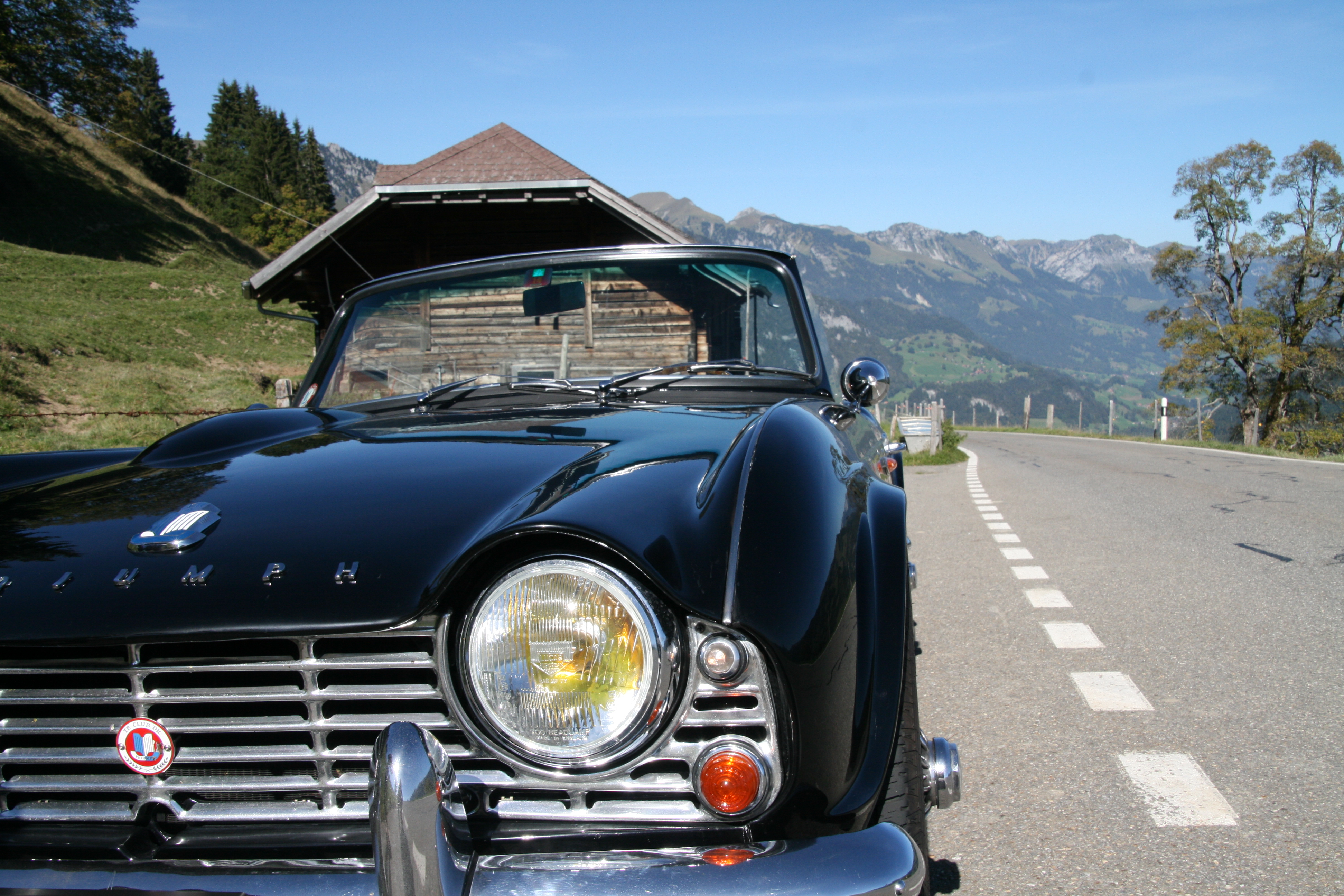
With the weather forecast promising summer-like temperatures, my wife and I took my TR4 for a rather long trip to Lausanne (280 kms one way) this weekend. Naturally we opted for a route more interesting than the motorway over Bern. On the way there the journey took us over Lucerne, Interlaken and over the Jaunpass at 1509 meters through the Gruyère region, before reaching Lake Geneva at Vevey, close to the beautiful city of Lausanne. On the way back we chose another less spectacular but still beautiful route that led us over Murten, Bern, through the Emmental and then again over Lucerne.
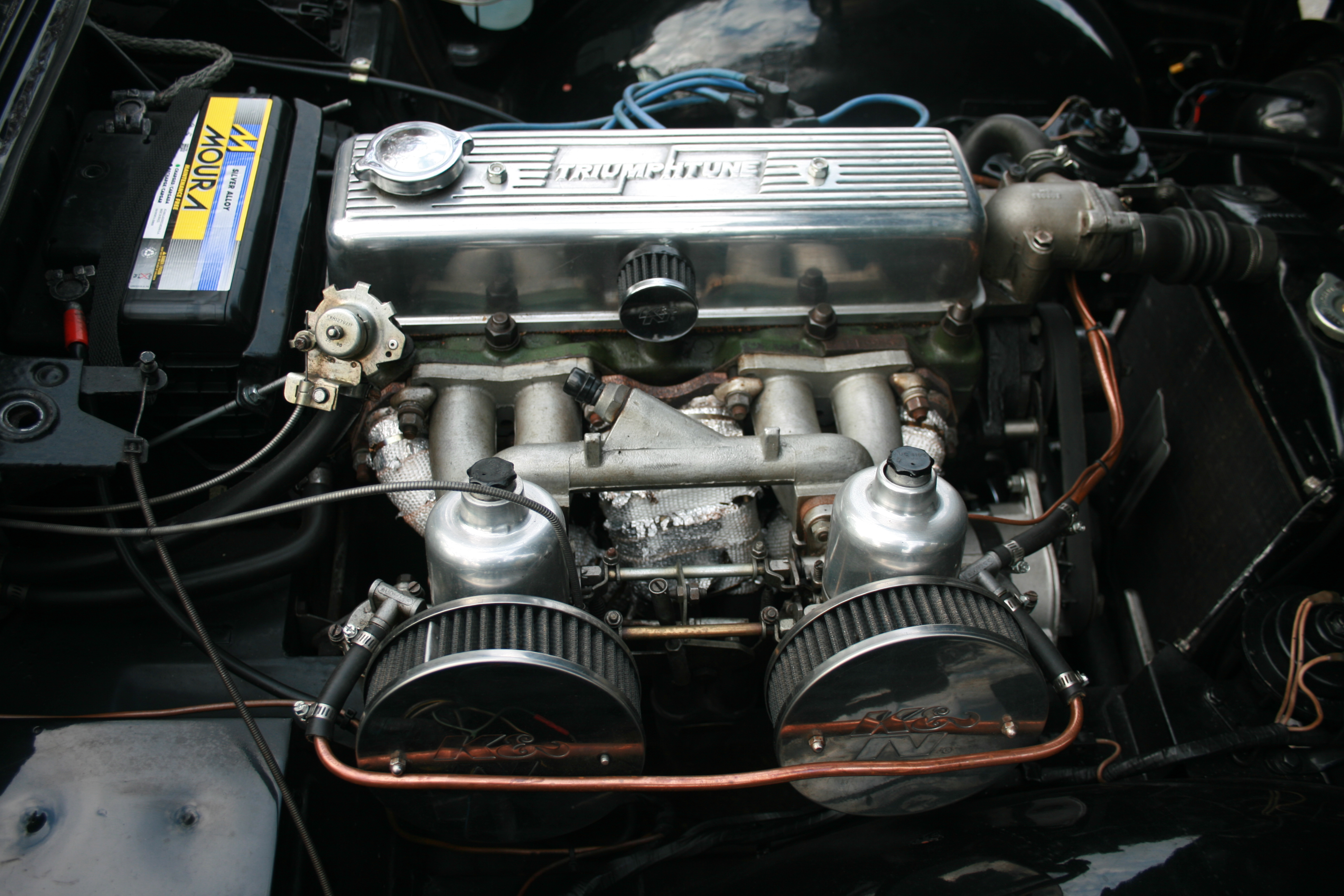
The TR4 performed to perfection the whole way, not hesitating a second even when climbing the Jaunpass, with a 900 meter elevation and up to 12% steep (it was rather the somewhat fading brakes that provided more excitement on the way down…). The old lady’s 2 litre Ferguson engine clearly proved why it was such a popular tractor engine, with a torque powerful enough to take the car up most hills in third which is helpful, given the gearbox is not really a DSG and tends to protest quite loudly against any form of rapid gearchange. I’m therefore happy to say that now that the time has come to plan for the winter storage, no mechanical tasks are on the program over the winter break, just a few minor cosmetic ones. Who said English cars were of bad quality??!?
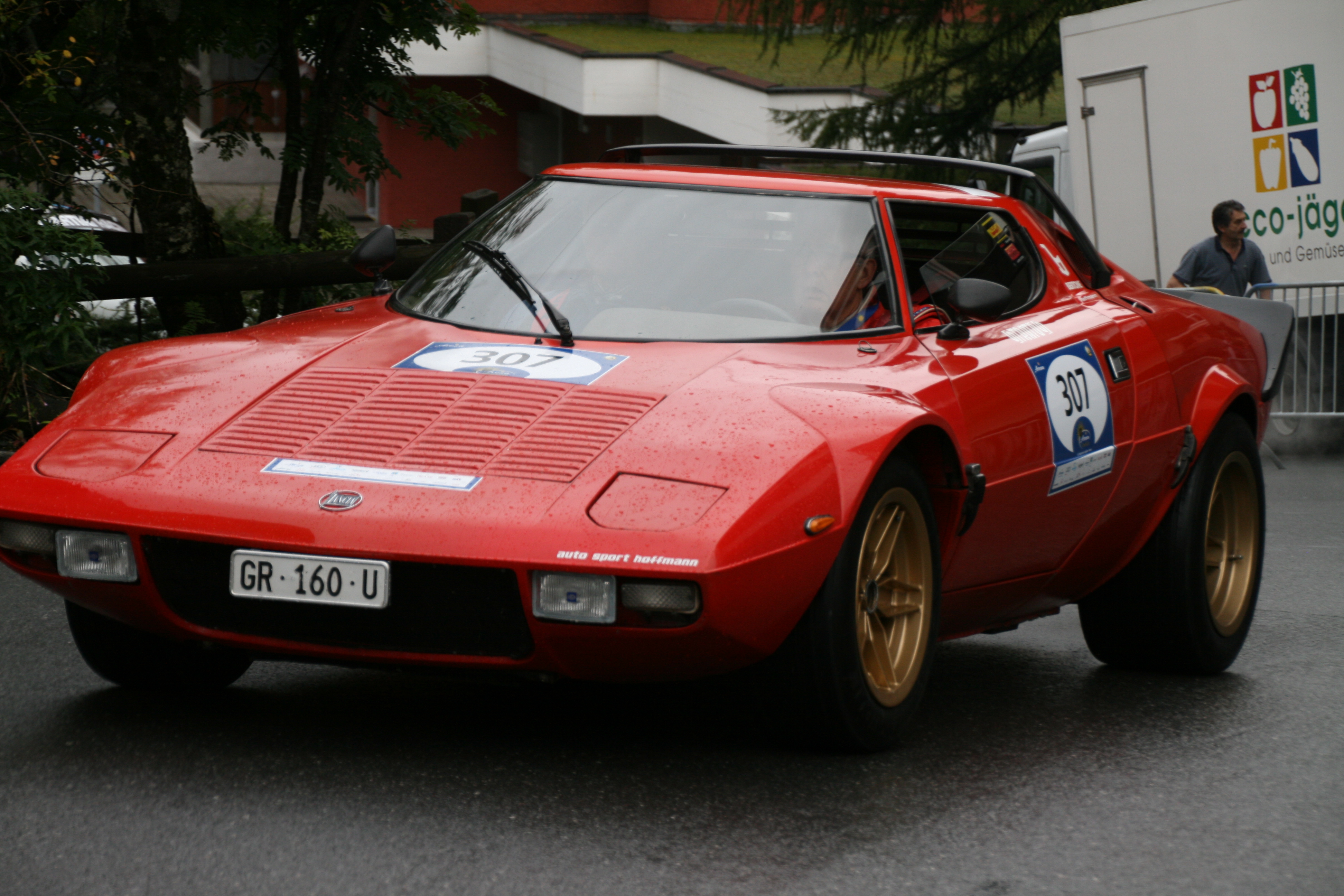
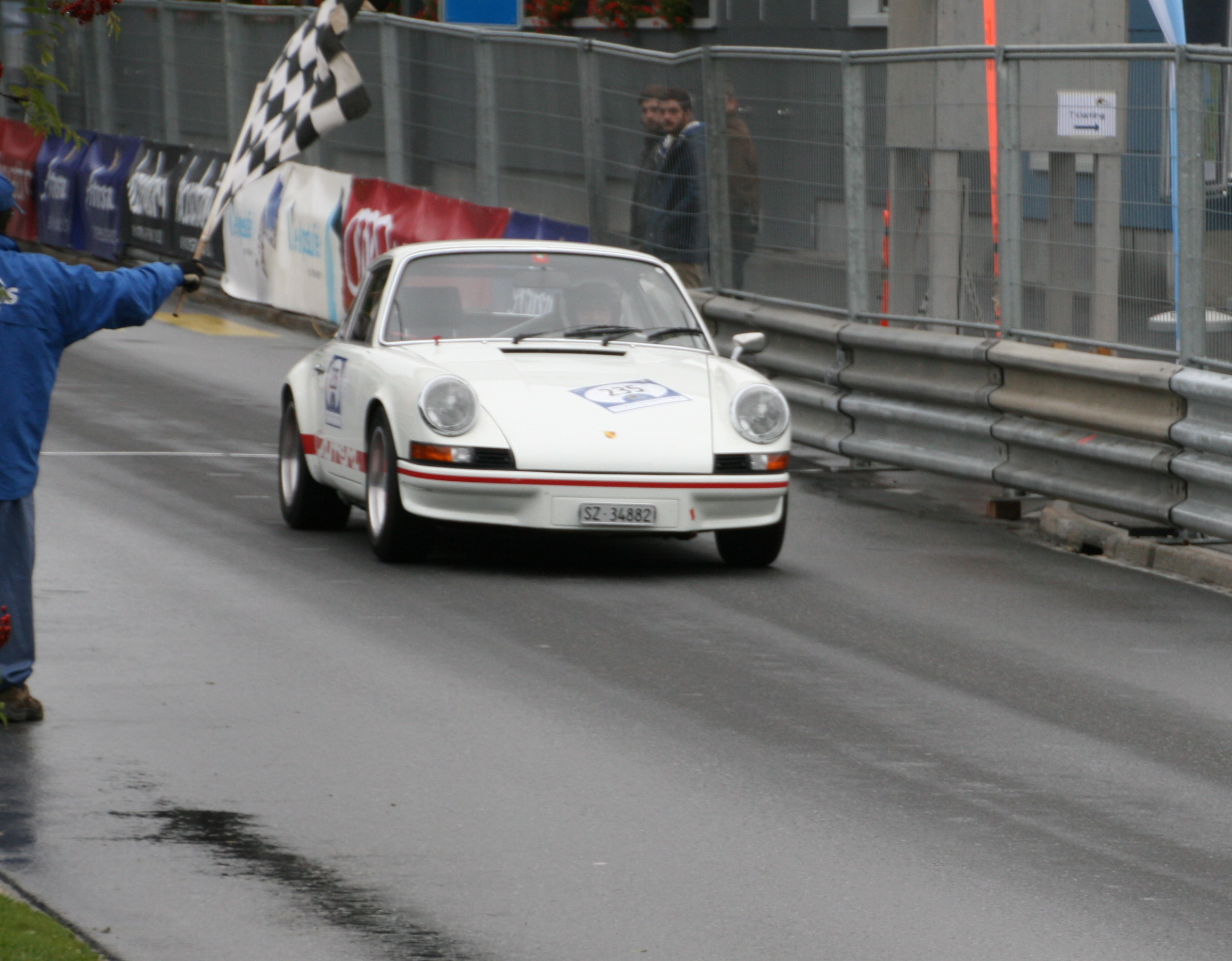
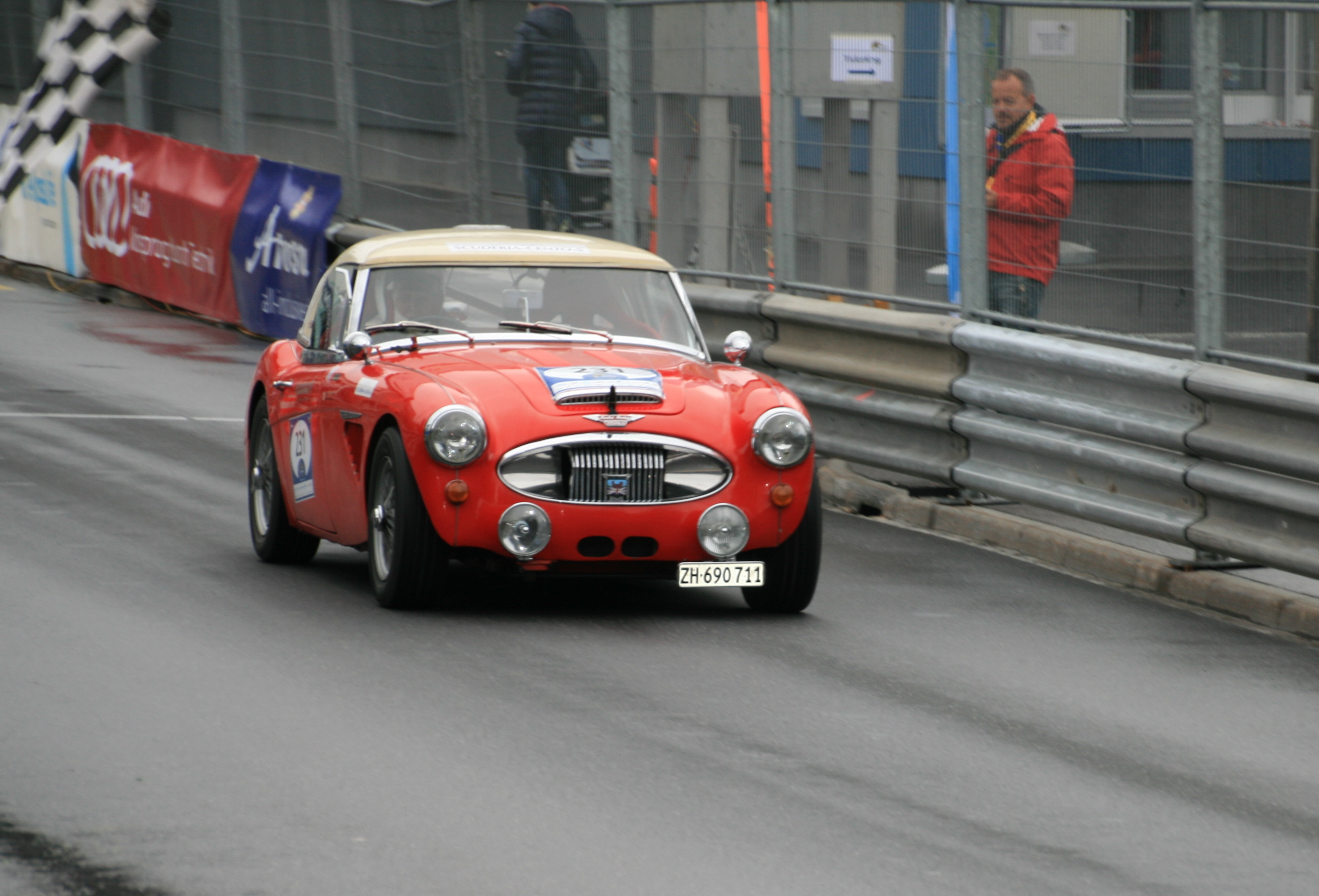
Attending the Tesla event in Arosa yesterday also gave me the occasion to catch a glimpse of the training day of the legendary Arosa Classic Car race, taking place every year at the beginning of September on the last 7.8 kms of the road from Chur to Arosa. The whole road is legendary by itself, as on a total distance of 31 kms and a height difference of 1280 meters, there a total of 360 (!) turns. On the last 7.8 kms used for the race, the cars climb around 420 meters with 76 turns. Challenging enough in good conditions, but as mentioned yesterday, the temperature this weekend up in Arosa is expected at around 5 degrees with rain…
The race is open for cars built betwen 1905 and 1986 or 1990 in the case of group C rally cars, of which there are plenty. it is a very fine selection of oldtimers and old rally cars (including the odd formula car) that take part, typically modified to race configuration, with special emphasis given to the engines judging by the sound. Below a few picks from yesterday and clicking here allows you to experience the race from onboad a MB 300 SL Gullwing, including drifts. A very fine automobile worth around EUR 1.5m in standard configuration…
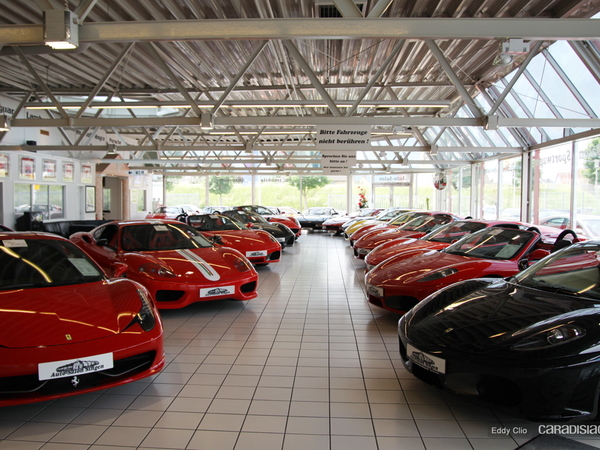
The small German town of Singen, 10 minutes from the Swiss border and around 20 km from the more well known German city of Constance, probably doesn’t mean much to most people. Given however you are a reader of this blog, chances are that you would experience a visit to Singen as finding heaven on earth. Because even if the town itself is about as exciting as a beige Volvo 240, for reasons no one can really explain, Singen has developed into something of a car Mecca in southern Germany.Along what is referred to the auto mile on the outskirts of Singen, more than 20 different brands from Skoda to Ferrari have showrooms. One dealer stands out form the crowd and is at the root of the relative fame of the city: the Auto Salon Singen, maybe the world’s leading dealership of used cars. Yep, you read that right, the Salon sells used, or rather pre-owned cars. There is a however a slight difference to the used car dealership around the corner, as the Salon specializes in very rare, pre-owned supercars and oldtimers. In a showroom that to the outer world doesn’t look like much is an exhibition including cars that you will very rarely have seen in real life, to a total value of which one can only speculate. What makes the Salon unique is on one hand the offer that is second to none, but also the combination of unique old-timers and supercars.
As with so many things, the beauty is on the inside…
This does not mean the Salon is full of millionaires with their pockets full of money. As confirmed by an extremely well polished salesman, very rarely do clients visit the salon other than possibly to pick up their cars. The client base is global with a fair part in Germany and Switzerland, but also with a significant number of clients in Russia, the Middle East and Asia. That has the nice side effect that if you do visit the Salon, you will have it pretty much to yourself and should you wish only to wander around and enjoy this feast for the senses, the well-trained sales force is very happy to let you do so. When asked how they find their truly unique vehicles, a polite reference is only made to their global network and also to their existing clients, of which they have about 35.000 in their database. Another database covers about 15.000 cars around the world, including pretty much every supercar or truly rare oldtimer still around. In other words the exhibition itself is only a drop in the ocean and a significant part of the Salon’s business is also finding specific cars on request.
Definitely more like it!
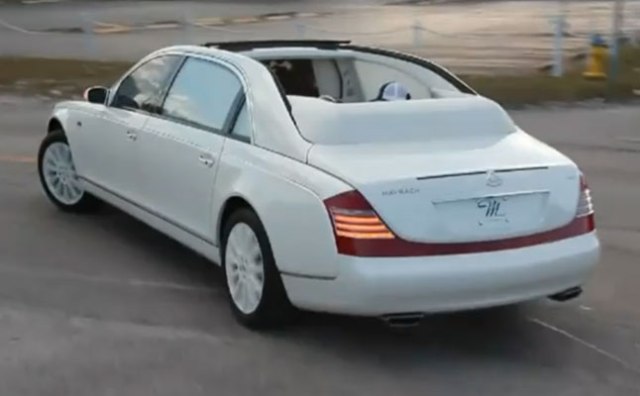
Unfortunately the (still very polite) salesman made clear that the Salon is not very hot on pictures being taken inside the premises, so any illustrations of the offer below are taken from the internet. If you visit the Salon this month, the first thing you will note is a car that really doesn’t fit, not being a supercar at least in the traditional sense. Parked in between a pale yellow Aventador and a Ferrari-red Enzo is a VERY white Maybach Landaulet that takes up about 6 metres of floor space. The semi-cabrios called Landaulets were built on specific request and each one is unique. This one, from 2010 and with very few km’s on the clock, is yours if you have EUR 1.4m to spare and REALLY can’t find anything better to do with it.
Eeeh…. No
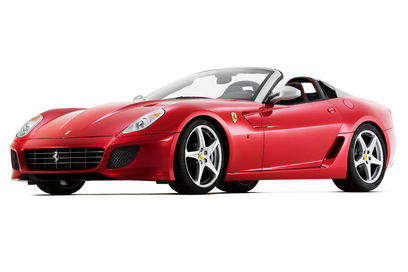
Turning right you will step into the Ferrari section, counting about 30 Ferrari’s, both “normal” and less so. if an Enzo is not exotic enough, the offer also includes notably a magnificent 599 GTO Cabriolet. the GTO was a limited series of the 599, presented in 2010 and of which 600 cars were built. The GTO Cabriolet that was shown the same year at the auto salon in Paris was an even more limited series of which only 80 cars were built. It is a truly beautiful vehicle that has all the style the white Maybach lacks. Priced at EUR 799.900, it will still leave you enough for a decent family car!
Looks even better in real life!
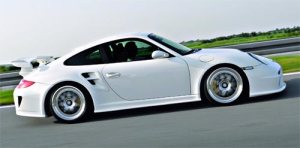
The Porsche section is even larger than the Ferrari section. Starting on the oldtimer side it includes not one, not two but three original Speedsters in mint condition. A 911 Speedster is also included, and at the top end is a fascinating 997 GT3 -08, tuned beyond mechanical recognition by the German tuning specialist 9ff. Still relatively anonymous on the outside except for the trained eye, about every mechanical details has been changed including every part of the engine. The 9ff in this version develops around 900 bhp and 1000 Nm of torque, (hopefully) transmitted to the ground by a sequential six-speed gearbox. With a top speed of 395 km/h, the 9ff does 0-200 km/h in 7.4 seconds and 0-300 km/h in a Veryon-like 15.9 seconds. With only 15.000 kms on the clock it is yours for EUR 134.900, which in relation actually sounds like a true bargain!
You want this. And a racetrack. And probably a good whisky to calm your nerves before you try it out…
Obviously all the wonderful things that could be told about the Auto Salon Singen are too lengthy for a post on this blog, but hopefully these short impressions are enough to make you seriously consider a detour to the Bodensee region when next on vacation in central Europe. It is after all truly beautiful, and no more than one hour from Zurich airport!
Now before I get accused of all sorts of things, let me start by making clear that the old lady here mentioned does not make reference to any close or distant family member of the living kind, but rather to the old lady for which I have had to rent separate living quarters – my Triumph TR4.
As some of you know driving an oldtimer is never dull, neither is owning one. The latter can however easily become financially more challenging, at least when you are as mechanically illitterate as me. Around Zurich there is certainly no lack of specialized garagists very eager to help out, but somehow, in a Western world where inflation is nowhere to be seen (at least officially), the bills these guys send you have something Zimbabwe-like about them in terms of price evolution. So if there is the slightest chance of doing it yourself, you try to, which in my case means calling on far more suitable oldtimer friends than myself, i.e. those who actually understand what happens under the bonnet.
It was around a month ago that my TR4, which has always sprung to life effortlessly even after several months, all of a sudden had problems doing so. Having checked the basics (battery, power supply, corrosion on the bolts etc.) the exclusion method led to a strong suspicion of a defective starter engine. At this stage however the car would not start at all, and the starter engine was no longer even turning. Given the location of the garage, the car can neither be started by running, nor is it easy to tow, meaning just getting it to a mechanic had become a challenge. I felt grey hairs growing as the sunny days went by.
As with any true lady, beautiful to look at, difficult to understand…
Last week I then went for lunch with a dear friend in Zurich, the proud owner not only of some vintage English oldtimers but also of an equally old boat, running on a V8 from the 50’s and having last year had some issues with the starter engine. ”Don’t worry” my friend said between bites, ”try what I did: hit the starter engine with a hammer a couple of times while someone turns the ignition. With a bit of luck, it is just the cogwheels that are dislocated and this could make them spring back.” As if there was nothing more normal in the world than what he had just suggested, he then changed the subject and went on to enjoy the rest of his lunch.
My belief in the suggested solution was, I’ll admit, not very strong. But given the car would not start at all the downside was obviously limited, so I took my son with me and went up to the garage. As he did not want to handle the ignition and could not really be trusted to aim the hammer at the starter engine rather than at something far less suitable, I took the hammer, hit the starter engine three times here and there and then without any hope at all, went round the car, sat down and turned the ignition. As you already guessed, the engine sprang to life on the first try without effort, and has done so ever since (which I’ll admit is only a few days so far, but still).
So what does this teach us? Firstly, whether it relates to cars or in general, take great care of your friends! Secondly, it is actually fun having a car with an engine that still looks like one, and where you can locate things as a starter engine. Would you know where yours is? And finally, an oldtimer requires far less sophisticated tools than modern cars. Sometimes, a hammer will do just fine!
























 only person on the car scene to have been awarded UNESCO’s World Heritage Award for his extensive work in restoring (rather than renovating) many classic automobiles through the years.
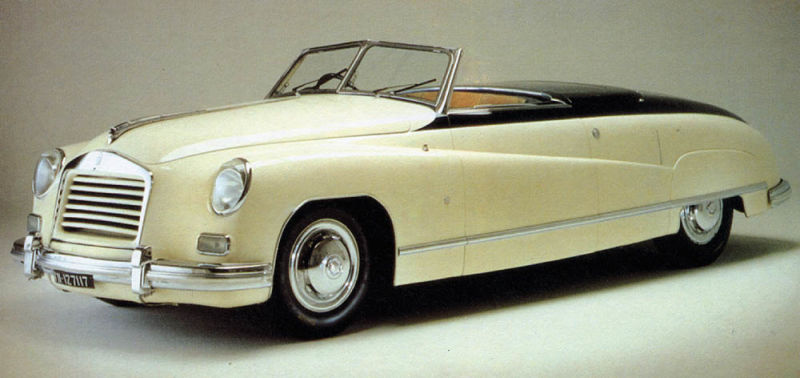 workers/artists, and also as a world premiere showed a 1948 Isotta Fraschini 8C Monterosa Cabriolet Boneschi, the last car built by the little-known (at least outside of Italy) Milan auto manufacturer Isotta Fraschini, active in the first half of the 20th century, and probably destined to win many prices at automobile shows the coming years.

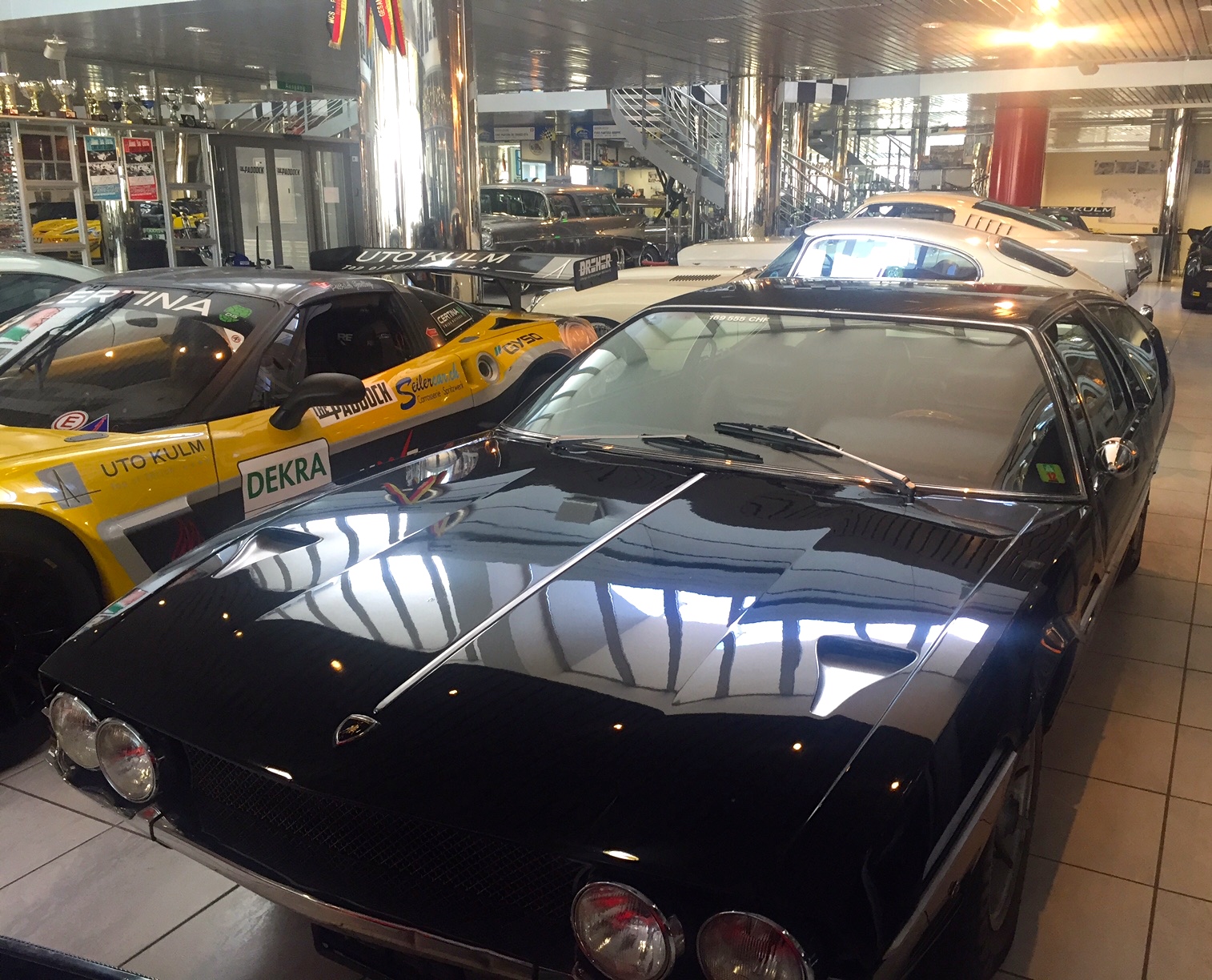 showroom with exactly the right pit lane smell, featuring a selection of the cars in The Classic Car Fund (TCCF). This is also the HQ of the TCCF and where Filippo has his office. Italian and from Modena (where else?) by birth, he is a true European nowadays based in Switzerland where next to running a family office business he set up the TCCF five years ago, driven both by a passion for cars and for uncorrelated assets.
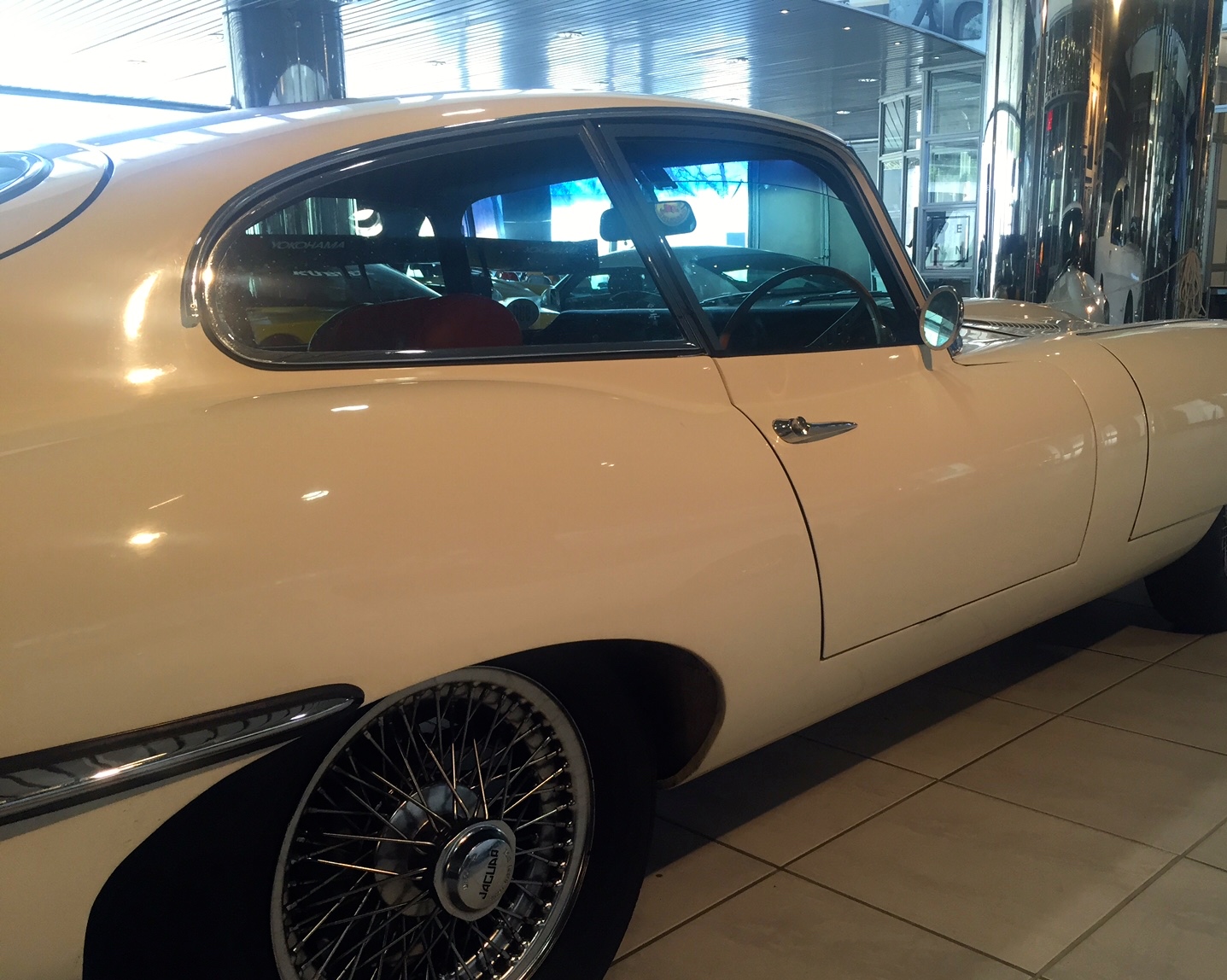 classes, including things such as art, wines and gold. This is partly driven by the falling interest rates since the financial crisis, but also by baby boomers becoming solvent and realizing their childhood dreams and emerging market buyers that were not there a decade ago. “The Chinese have so far only been able to own classic cars abroad,” Filippo explains, “but that is about to change and that will create even greater demand in the future”.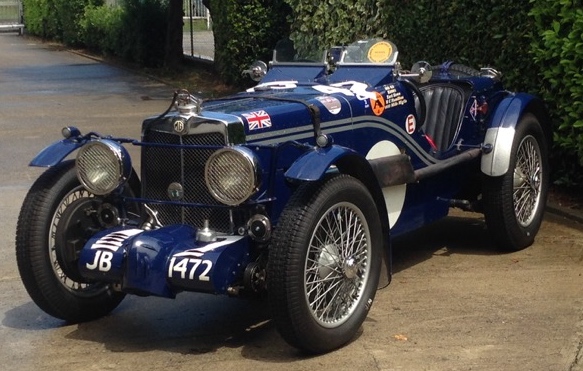
 Switzerland and Italy, and employs mechanics to keep them in shape. Two additional features of the fund further strengthens the link with private collections: subscriptions are permitted in kind, meaning that you can buy into the fund through a car or a car collection, following an evaluation by an independent expert. Ownership passes to the fund but the original owner receives a buyback guarantee at the same price up to two years from the point of purchase. Also, and perhaps of more interest for most, against a small fee, fund investors may borrow and drive the cars in the fund over a day or a weekend. Filippo smiles and says “take the Testarossa in the showroom down to St. Moritz over a weekend. If anyone asks you can truthfully say it’s your car, as it is part of the fund you are an owner of”.




 At the heart of the car is a fantastic V-12 cylinder, 5.5 litre engine delivering 485 hp and 580 Nm torque, later increased to 515 hp and 590 Nm torque in the 575, exclusively coupled to a six-gear manual gearbox (in the 550) but where the torque of the engine meant you rarely need to use more than half the gears. The engine is linked to the adjustable suspension such as to limit the max torque in the softer settings and thereby improve power delivery. Surprisingly though the lovely V12 noise is somewhat muted, arguably improving the car’s GT quality but also the reason many cars have received another exhaust system allowing for a bit more tenor and bass.







 The Thrill of Driving