Vive la République!

Can a supercar that is today worth around EUR 1.5m (or USD 1.6-1.7m) ever be called a bargain? Or actually, let me rephrase that: can a French car worth around 1.5m ever be called a bargain? How you answer that question obviously depends on your economic reality and your relationship to French cars, and you also have to be very clear on the word “bargain” only ever referring to the purchase price – nothing thereafter can be called a bargain, whatever your budget, as we’ll see later. If however you’re lucky enough to have cars above a million being part of your economic reality, then you should certainly have a closer look at the Bugatti Veyron 16.4, built in Mulhouse, France, for all the reasons we’ll look at today!

Most Veyron’s are bi-color, but the real cool ones in my eyes are the single-color ones!

For those of us with slightly smaller bank accounts, the Veyron will remain the stuff of dreams – but what dreams! Every decade has its supercar shining star (Lambo Countach, Ferrari F40, McLaren F1 etc.), but all these fade in comparison with the Veyron. When it was presented in the mid-00’s, no one had seen anything like it. A street car capable of 400 km/h with a 16-cylinder, 8-litre engine with four turbo chargers putting out over 1000 hp, at a level of luxury comparable to the best in the business, and at a new price of around today’s value, i.e. 1.5m. The Veyron was a true revelation and as such, also the precursor to later supercars like the Pagani, Koenigsegg and of course also Bugatti’s Chiron. In that sense, it is and will always remain a true legend of which a total of 450 cars were built during 10 years, from 2005 to 2015.

There are so many fabulous facts around the Veyron that you can’t list them all. As alluded to above, this is a car with a top speed of over 407 km/h, completely unheard of for a road car in 2006 and a number you really don’t need to be embarassed about in any way today either. In comparison, the current top-of-the-range McLaren Speedtail of which McLaren has built (and sold out) 106 cars and which benefits from all the latest hybrid technology “only” manages 403 km/h. Some other crazy facts around the Veyron includes that it takes in as much air in one minute as you breathe – in four days. Or that if you run it at full throttle (for which you require two separate ignition keys, the second to release the full power), the 100 litre tank will be empty in 12 minutes. or that you need to change the tires after 7′-8′ kms or when you’ve exceeded 400 km/h on four occasions, and that they’re not the type that come with a discount at your local tire dealer. And so on. In every single aspect, they Veyron was the most extreme creation the world had ever seen.

Not that you’ll see a Veyron often on the road, but if you do, this is likely to be the angle

Bugatti has a long and pretty troubled history going all the way back to 1909. Ettore Bugatti founded the company in Mulhouse in the French Alsace region, which borders Germany and belonged to Germany at the time, before becoming French after WW2. The company produced some of the most exclusive sports and luxury cars in the world from 1909 until WW2, when the Maginot front line ran practially through the factory. After the war Bugatti wasn’t able to keep up with the times and was unsuccessfully taken over first by Hispano-Suiza in 1963 and subsequently in 1987 by the Italian Romano Artioli who bought the rights to the name and set it up as an Italian company. His ownership lasted 12 years and it was during this time that the EB110 was developed, the only modern Bugatti car before the Veyron and not a huge success. Bugatti continued to balance on the brink of insolvency until 1998 when it was finally taken over by Volkswagen and returned to Mulhouse. Under VW’s ownership, the company started to work on what was to become the Veyron straight away, with a very clear objective: to build the fastest road car the world had ever seen.

The Royale is one of Bugattis most famous cars from the pre-war era

Central to all the Veyron prototypes was the engine, initially planned to be an even larger 18-cylinder monster, basically combining three six-cylinder engines. Technical issues with the highly complex construction led to the company having to settle with “only” 16 cylinders, V-formed and mid-mounted. The whole package with the four turbos weighed more than half a ton, to which should be added the 100 kg of the 7-gear double-clutch gearbox. If you think that sounds like a lot for a gearbox, remember it has to handle a torque of 1250 Nm! The Veyron has a total of 10 radiators with a total system capacity of over 50 litres, and the car’s body is obviously full of air intakes to help cool the massive engine which initially put out 1001 hp and later as much as 1200 hp in the Super Sports version that was built from 2010 onwards.

The Veyron has what I would call a very understated, elegant, sleak design that also looks very aerodynamic in a soap-like kind of way. I’ve seen it live a couple of times and noted it also looks rather small, as supercars often do. It may therefore come as a surprise that in terms of aerodynamics, the Veyron is very far from setting any kind of records. With a wind coefficient of 0.39 it’s worse than most station wagons both then and now, and the problem mainly comes from the giant air intakes required to cool the engine but which upset the air streams. The weight not only of the engine but also of all other mechanical components and of course also the very luxurious interior brings the car to a total weight of around 1900 kg, roughly half a ton more than what was initially planned. If your aim is a top speed of over 400 km/h that kind of wind resistance doesn’t help, and that in combination with the weight helps explain the rather Opec-friendly consumption…

Same style as a Pagani, but far less extravagant!

Seeing a supercar from the inside is usually not very exciting, and going back 20 years, things were certainly not better, rather the contrary. The fact that other supercars were rather crappy perhaps makes the Veyron’s inside even more impressive, but it’s an interior that can easily be compared to the best cars in the business, irrespective of category. It’s a universe of leather and metal, a wonderful analogue universe that in its simplicity makes for example a Pagani look a bit over the top. It’s also the quality of the car that people who have been lucky enough to drive it talk about, and which contributes to completely without drama reaching 100 km/h in 2.5 seconds and then keep going on, and on, and on…

So what about the bargain part? Well, as mentioned, Veyrons today start at around 1.5m. That’s an insane amount of money, but if you compare it to the very small universe of comparable cars, things look a bit different. To take a few examples, the Veyron’s predecessor, the clearly inferior EB110 costs 200’300′ more, as does a Ferrari F40 or a McLaren P1. The Chiron costs around 2.5m, whereas a Ferrari Enzo is around 3m, same as a LaFerrari. And what they all have in common, is that they’re slower than the Veyron! As noted initially, the purchase price is however only half the story because when it comes to the running costs, the Veyron is very much in a league of its own. To take a few examples, an oil change takes 27 hours and costs around USD 20′. That’s about 5′ less than a set of new tires of the only approved type, the Michelin Pilot Sport PAX, and when you’ve replaced these four times, you will also need to replace the magnesium wheels. You don’t want to think about what that costs. I recently heard about a German dealer willing to add a one-year service and guarantee package to a Veyron he has for sale – for EUR 100.000…

The Bugatti factory in Molsheim – impressive and in spite of prices, heavily loss-making!

Of course, talking about the Veyron in terms of service costs is the wrong angle to take. You should instead admire it for the amazing technical creation it is, especially considering its technology is almost 20 years old. Volkswagen’s ambition with the Veyron was to showcase its technical capabilities, and it was willing to take very significant costs to do that. The result is enormously impressive, especially considering it happened almost 20 years ago, but it was also extremely complicated, and thereby expensive. No official numbers are available but it’s been estimated that VW took total losses of around EUR 1.7bn from Bugatti during the first eight years of the Veyron’s production time. That equals around EUR 4.5m per car and if you add the sale price of 1.5m to that, the total is around 6m. Given that and that you can buy a Veyron today for 1/4 of that, how can the Veyron be anything but a bargain??

When youngsters create legends!

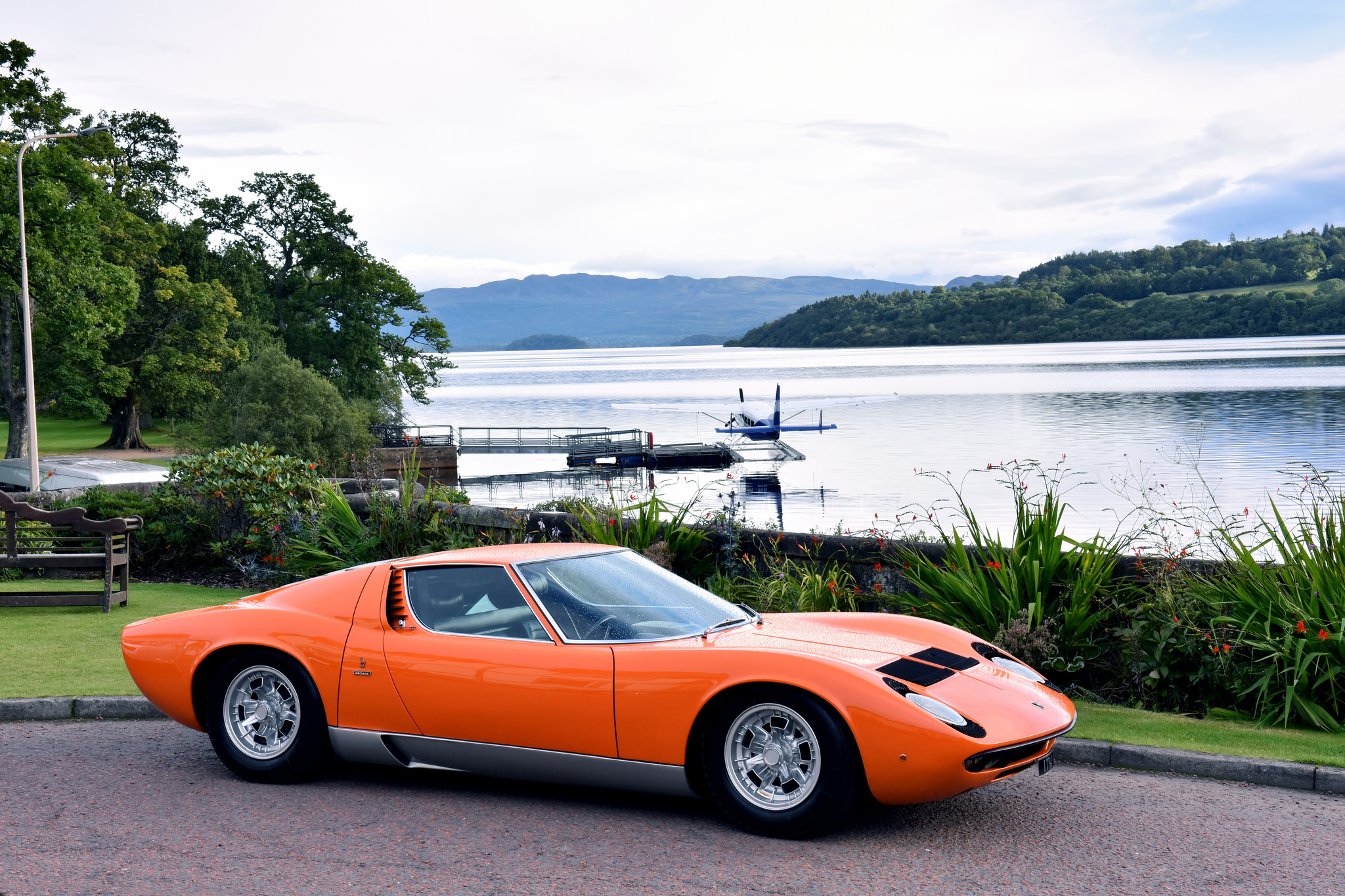
Long-term readers of this blog will probably have understood by now that I have a bit of a weakness for the mechanical age, and a fascination for the fantastic engineers and mechanics that built incredible automobiles in the age before computers and modern production methods had conquered the world. And when all this comes together in the lovely Italian car tradition, then that’s basically as good as it gets – if you ask me. This week we’ll look at what is perhaps the best demonstration of such inspired, but not fault-free engineering. We’ll do so with a bunch of engineers and designers that have already featured a couple of times on this blog, and actually also with an element that can be described as a lesson in good management. This week is about the Lamborghini Miura, small in size but very large in supercar tradition!

We’re back in the mid-60’s and Ferruccio Lamborghini, who has so far introduced three cars to the market, is set on building a better GT car than what Ferrari has to offer. Better in reliability but also better in parts, not recycling racing parts but rather with cutting edge technology. He doesn’t care much for low, loud and uncomfortable sports cars, but he’s keen on using the 12-cylinder engine our old friend Giotto Bizzarrini developed after he left Ferrari to set up his own company (I wrote about Bizzarrini a year ago, see here). That is indeed one hell of an engine which produced 350 hp and revved all the way up to 9800 rpm. That was a bit too much for Ferruccio and he therefore gave the engine to his two engineers Stanzani and Dallara (the latter also the chief engineer of the whole car) to reduce the rev range somewhat and make the engine more reliable. They did so, managing not to lose power in the operation (well, at least not officially), but it doesn’t change the fact that Bizzarrini indeed developed Lamborghini’s first 12-cylinder engine. In Ferruccio’s mind, the only thing missing now was a GT car to put it in.

What Ferruccio had at his disposal next to the engine was an enthusiastic group of young engineers and a designer we’ve also met before, Marcello Gandini, who had just been hired by Bertone. These young stars didn’t really share Ferruccio’s vision of the next Lambo being a GT car, and they were also heavy influenced by a certain Ford GT40 which at the time was big news in the US. The Ford was essentially a race car and heavily inspired by it, the engineers set off on the concept of a race car for the road rather than for the track. Ferruccio watched – and stood back, leaving the youngsters to it. That may not sound as impressive as it actually was. You see, at this time in 1965, in a world where age still counted for quite a lot, chief engineer Dallara was 29 years old, as was Stanzani. Soon-to-be designer Gandini was 27. In a world where old men still ruled, it was in other words a bunch of kids that designed the world’s first true supercar!

Dallara and Stanzani built a frame of a size suitable for the sports car they had in mind, but not necessarily suitable for a large V12. But rather than making the frame any larger, they turned the engine around and basically merged the transmission with it, as there was really nowhere else to put it. This was undoubtedly the tightest package around a V12 ever built and must have been a complete nightmare to work on as a mechanic – and quite a few mechanics would be doing so in subsequent years. The engineers put some wheels on the frame with the engine fitted, and now only the body was missing.

As mentioned, Ferruccio had let the youngsters work on this in peace and probably thought of the project as a good showcase for Lamborghini in general, and the coming GT car in particular. That’s also why the soon-to-be Miura was presented just like that, without a body, at the Turin car show in 1965. To Ferruccio’s great surprise, this was all it took for the first ten orders to come in. For the chassis that is, not for the coming GT car. It became obvious that a body was now needed, and the job was given to 27-year old Marcello Gandini who had started at Bertone two days earlier. He certainly didn’t sit around, but rather designed the Miura in as many days as he’d been employed. Thanks to this, the car in its final layout could be presented just five months later, at the Geneva Auto Show in 1966. 30 more orders came directly at the show, bringing the total to 40, growing to 75 by the end of the year.

Everyone including Ferruccio were obviously happy about the great success, but it also created a bit of stress in Sant’Agata. You see, at the time, Lamborghini employed all of… 78 people. Around 40 of those were engineers, and another 20 were apprentices. The first remark is that it’s remarkable to take an idea to production in as little as two years with such a small team, and even more so when you think of how complicated the Miura was. The second remark is that it would maybe have been good if those apprentices had been real mechanics, as was to be discovered later. For now, everyone was highly motivated, working long shifts all days of the week. Ferruccio was happy to let them work, brought them food at night, and continued to keep out of the way.

Unfortunately the quality of the first cars was problematic to say the least, and probably sensing this would be the case, Lamborghini made sure to deliver the first cars to Italian clients. As the cars came in for service, the clients were then taken to some very long lunches, giving the mechanics enough time not only to service the cars, but actually to do some quite fundamental changes and improvements to them. The first series was thus far from perfect, something that however improved with the updated Miura S in 1969, which produced 25 hp more and had a slightly wider track. Some quite serious problems did however persist during the Miura’s whole production run, including engines breaking down completely because of failing lubrification, and cars catching fire due to a less successful positioning of the tank. On the less than perfect side was also the heat caused in the cabin through the positioning of the engine, and the fact that the slightest touch of the accelerator made any conversation impossible. At the same time, that’s of course one of the Miura’s greatest thrills!

The Miura may not have been a race car but it certainly looked like one. It was also really fast for the time, meaning a 0-100 km/h of around 5.5-6 seconds and a top speed of around 280 km/h. The car was light, as was the front end, causing quite a few rollover accidents. The Miura S was replaced by the last version, the SV, in 1971, and even thought things kept improving, the Miura never became trouble-free. Finally in 1973 Ferruccio decided to pull the plug, but he didn’t do it as you may think, by firing the team behind the less than perfect Miura project. Instead he not only delegated the management of Lamborghini’s whole production to Stanzani, but he even accepted the latter’s demands not to interfere in the day to day work, and never to challenge his decisions. Stanzani, clearly a fan of the saying “when in trouble, double!” quickly moved on to create the Countach, a car no less exotic, but which would become much more well-known and much more legendary than the Miura (see here if you missed my review of it last year).

It may have been the first, but the Miura was thus by no means the perfect supercar. But honestly, how could it have been, with the limited resources and experience Lamborghini had at its disposal? That doesn’t change the fact that what a bunch of under-30-year-olds created in a few months was truly impressive in everything from idea to realization. It’s also a good lesson in management, illustrating that letting young people pursue their ideas usually produces good results! Accidents, fires and breaking engines has reduced the number of Miuras left on the road today from close to 500 produced to no more than a few dozen, and finding one isn’t easy. It’s also not cheap. For most of us, the Miura will thus remain something we may see at a car show, and otherwise a wonderful story of young talent from the golden age of the automobile!

When Alfa gets it right!

Alfa Romeo is a legendary car brand, which through the years has worked like few others on ruining its legend and making the inherent love many of us have for the Italian brand a tough one indeed. Luckily however there have been periods when Alfa gets it right, and when they do, the cars they build tend to be pretty irresistible. The current Alfa line-up is the best Alfa’s had in years, but today we’ll go back 15 years to when Alfa got it right last time, with the wonderful 8C Competizione. Many will never have seen it as only 500 were initially built (of which 80 went to the US), but it was an important car not only in that it was pretty good, but also as it shaped Alfa’s design language over the coming years and also marked the brand’s return to the US, a market from which it had been absent since 1995. Finally, it’s one of very few, if not the only Alfa from the modern era that costs more today than it did as new. More than enough reasons to look closer at it this week!

Purposeful, compact, with elements reminding of Alfa’s past!

The 8C project started in 2003, a time when the Alfa line-up was not much to write home about. It included notably the Brera, a somewhat sporty coupé, far too heavy and with an engine from (hold on tight) Opel… The 159 and 166 were large sedans at a time when no one really wanted sedans anymore and with a design that wasn’t really one. I actually owned a 166 and it’s one of the better cars I’ve had, and surprisingly completely free of any problems, but the world can be forgiven for missing it.

Somewhere around here Alfa’s designers started working on a design study to express a new design language. The study was a sports coupé which the design team and the legendary boss Sergio Macchione were so pleased with that it received the sign-off for a limited production run of 500 cars. It had barely been announced to the market in 2006-2007 before the full production run was sold out. If you look at the car it’s easy to see why, but not only was it beautiful, it was also quite competitively priced at the time at around EUR 150′. That was however still twice as much as anything else in the Alfa line-up at the time.

It may not be a compliment mentioning that the same rear lights later featured on the MiTo mini hatch…

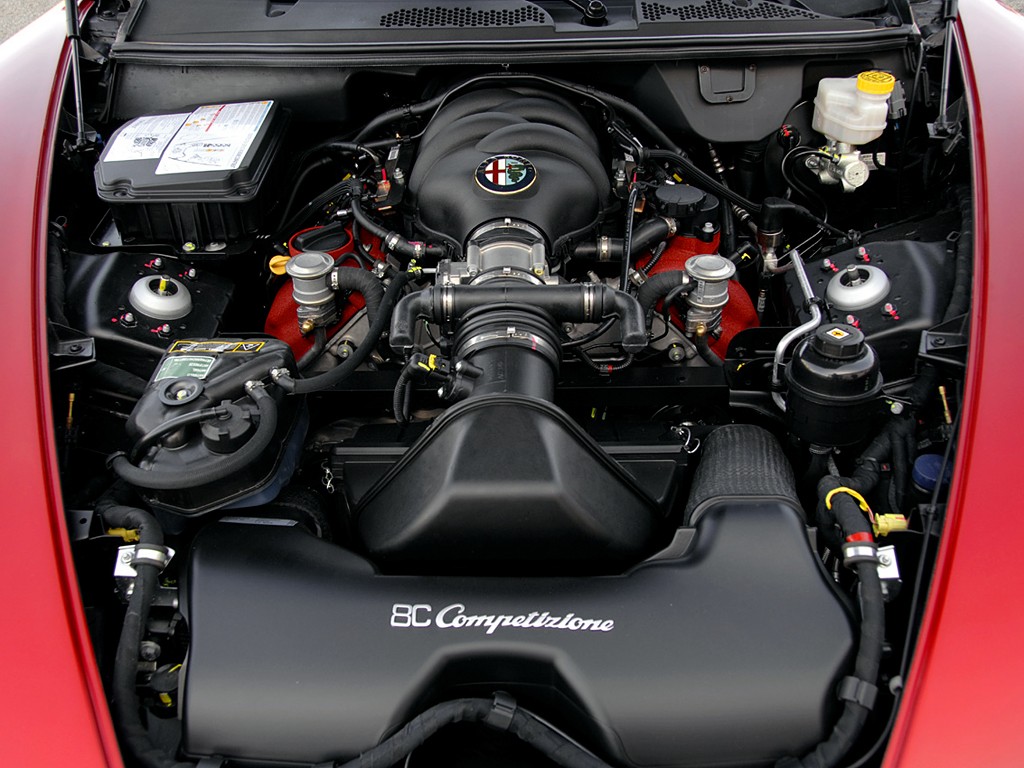
Looking closer at the design, it’s a lovely combination of classic Alfa elements from the 50’s and 60’s with a modern touch in a well proportioned, compact body, or in other words a true Italian beauty. When comparing it to today’s supercars, it’s almost shocking to see how Alfa managed to design the 8C and get the power onto the road without the use of a single spoiler. Under the carbon fibre body Alfa used a lot of what the Fiat sibling Maserati offered in the Grand Turismo, most notably the new 4.7 litre V8 engine which in the 8C sits right behind the front axle. In traditional Alfa style the gearbox was in the back and the 8C is thus a well balanced, transaxle construction. The engine put out 450 hp and with a weight of around 1600 kg, the 8C was more than 200 kg lighter than the Maserati and good for a 0-100 time of 4.2 seconds, and a top speed of 290 km/h, all very respectable twenty years ago.

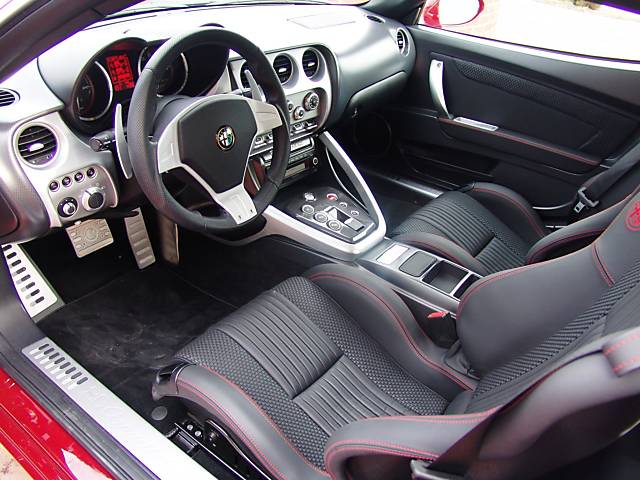
The inside features beautifully-designed carbon seats that look very similar to the Ferrari Enzo’s, a carbon dashboard and various other carbon parts, together giving it a suprisingly high quality, but also quite “raw” cabin feel. This is obviously a car from the mechanical age so the interior doesn’t feature touchscreens of any kind, rather solid buttons that you push and turn. What it didn’t offer either was much luggage space., but you can squeeze in a bag behind the front seats and all the way in the back under the glass cover, there’s a leather bag fitted, slightly bigger than a briefcase – that would be the official luggage space. Then again you can always buy what you need when you arrive, especially if you arrive as fast as would (theoretically) be the case with the 8C. Unfortunately however, there are a couple of things that may hamper that progress.

What looks like plastic is carbon fibre – raw…

The first is not very surprisingly the gearbox. The 8C comes from the time before double-clutches, meaning the semi-automatic 6-speed box is a bit slow and not very smooth neither in manual, nor auto mode. The second is unfortunately the ride, which is said to be quite harsh and not very composed. Finally, the breaks are not comparable to anything in modern supercars, especially not ceramic ones. The thing is however that when you put your foot down you forget about all of that, because when the sound of the 4.7 litre Masserati engine starts to build all the way up to the limit at 7500 rpm, you’re in heaven. We’ve all heard the same engine in the Grand Turismo where it was introduced shortly after, and it doesn’t sound any less in the 8C. Actually it probably sounds a bit more, given its lower weight and the not very noise-isolating carbon interior.

Beautiful engine sitting behind the front axle

At EUR 150′ back in 2006, the 8C was quite competitively priced for what it offered, and as mentioned the 500 cars produced were sold very quickly. Alfa didn’t increase the production run but rather brought the 8C Convertible to the market in 2009, but doing so they also increased the price quite massively, making it far less of a good deal than the 8C was. They built another 500 as convertibles in 2009 that all sold, both in Europe and in the US. And even if the 8C marked Alfa’s return to the US market, as so often Alfa didn’t really manage to build on it so that it took another few years until the brand returned for real, then with the 8C’s younger and smaller brother, the 4C.

The 8C is thus one of the best-looking and best-sounding supercars out there even today, and in good Alfa tradition, slightly compromised. As mentioned it’s also one of very few Alfas worth more today than what they were as new. In spite of the limited production run you actually find quite a few cars in the market, more convertibles than coupés, with prices today typically between EUR 250′-300′. At that price point the supercar alternatives are plentiful, and it’s hard to argue that the 8C is a better buy than many of the other cars out there. But if you want something unique that you definitely won’t see on every corner, and which has a sound making any kind of stereo system completely unnecessary, then the 8C is definitely the car for you!

Winter street finds: the Aston Martin DB6!

As some of my readers know, my 18-year old son spends this winter as a ski instructor in the Swiss Alps (yes I know, lucky guy). I’ll take credit for teaching him to ski well enough to become a ski instructor, and also for transmitting enough particles of the car virus to him so that he keeps his eyes and ears open at the sight (or sound) of something interesting on four wheels. During this winter I’ve thus gotten regular reports and pictures that have clarified things such as my new beloved Range Rover being no more special in this part of the country than a Skoda Octavia, and some people thinking a Lambo Aventador is so suitable for driving on snow that they fly it in from the Middle East. Be that as it may, the picture he sent me last week beats everything: an Aston Martin DB6, parked outside a fancy hotel with several pairs of newly used, modern skis on the roof. This, my friends, is true class!

An Aston Martin DB6 in Gstaad, Switzerland, in February…

The DB6 was the culmination of the part of the DB series which started with the DB4 and was followed by the legendary Bond car, the DB5. The DB6 is less well-known than its predecessor and was built between 1965 and 1971. It’s arguably the most mature of the three cars, with a body which is around 10 cm longer than the DB5, giving it slightly different proportions but above all more room in the back and boot. Officially described as a 2+2, the DB6 will seat four people and in addition carry their luggage. The longer rear ends with a spoiler lip and was referred to as Kammback by Aston, and it wasn’t to everyone’s liking at the launch of the car. The body was designed by the Italian design house Superleggera as a handwritten badge on the side will tell you. Even if everyone didn’t like it then, I believe most would agree today that it’s one of the most beautiful historical Astons around.

The so called Kammback wasn’t to everyone’s liking

The engine is a 4-litre, 6-cylinder unit with tripple carburettors and around 280 hp in the regular version, with another 40 or so in the equally available Vantage version. The base car was good for a top speed of over 240 km/h, a truly scary prospect in a car from the 60’s, even one that drives and brakes as well as the DB6 is said to do. The sound is what you would expect from a 4-litre machine with three carburettors, meaning absolutely fantastic. Most cars have a 5-speed manual gearshift but somewhat surprisingly, an automatic was also available. The large, wooden steering wheel is surrounded notably by a switch allowing you to adjust the rear suspension, a feature taken over from the DB5 but which helps illustrate that Aston was at the top of their game back in the 60’s (somewhat less so today if you ask me).

The wonderful 4-litre straight six, with the carburettors in the back

The original DB cars carry not only the founder David Brown’s initials, but actually the full name as part of the emblem. Brown was a converted tractor builder (clearly a useful background if you want to become a supercar builder, given he shared it with Ferrucio Lamborghini!). What Brown put together in the DB6 was a beautiful creation of which a total of around 1800 were built. There was a Mk II from 1968 and onwards, looking a bit beefier than the car on the initial picture which in other words was produced during 1965-67. There was also a Volante, i.e. a convertible, of which only 140 were built, and independent coachbuilders also built a small number of shooting brakes on the DB6 chassis. The likelihood of ever seeing one of those is… small, and should you wish to park a nicely restored DB6 in your garage, that will cost you around EUR 350′-400′. Then again, that’s only roughly half of what a DB5 is – but it’s also three times more than a perfect E-type of any type, which we looked at a few weeks ago (see here if you missed it).

I bet those seats still have the original leather smell!

My son says the DB6 he saw originated in Savoie (France), not sure how he came to that conclusion as the number plate doesn’t look French. If this guy or girl really lives in the mountainous region of Savoie and uses his DB6 as winter daily driver, then let’s just pray it’s had a thorough corrosion protection treatment, as spring otherwise risks revealing many (negative and expensive) surprises! Then again, given how clean it is, maybe the car was just there for some kind of show and the skis on the roof as well, even if they were modern – because no one classy enough to drive a DB6 would put skis on the roof with the tips facing forward, would they? I guess we’ll never know…

Enzo’s favourite Jaguar!

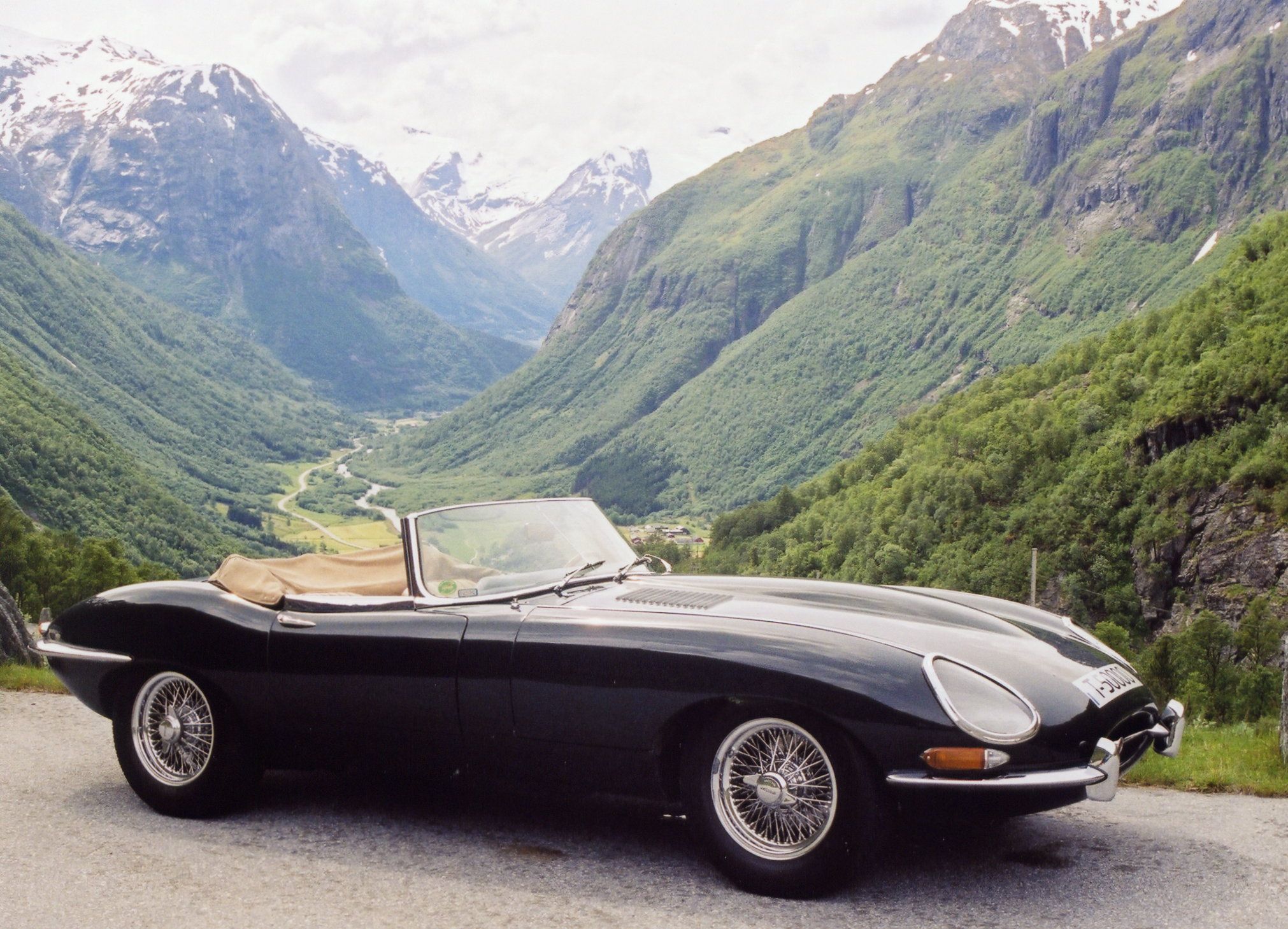
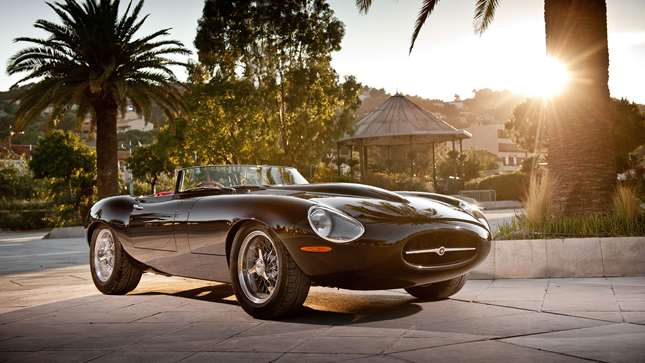
There are lots of stories in the classic car world, some true, others not. One of the better ones is about the legendary Ferrari Commendatore, Enzo Ferrari, who when he first saw the car we’ll look at today at its initial presentation in the spring of 1961, referred to it as “the most beautiful car that has ever been built”. Now before you spend too much time trying to figure out which Ferrari he was referring to, let me spare you the effort by telling you that Enzo wasn’t referring to a Ferrari at all, but rather to the latest creation from Coventry – the Jaguar E-Type (XK-E for those of you in the US). Of course Enzo was right. Not only is the E-Type a true legend of the car world, it’s also exactly what he (supposedly) said, i.e. one of the most beautiful cars ever built, until this day. At the time of its launch, it was also one of the fastest and most modern production cars in the world, boosting power and acceleration numbers that remain impressive until this day. And seen over its full production, it’s also one of the most succesful sports cars ever built. The car enthusiast that hasn’t dreamt about driving and owning an E-Type hasn’t been born, so it’s about time to take a closer look at it!

Initially the E-Type wasn’t supposed to be the famous road car it became during its 14 years of production, but rather to succeed the D-Type as a racing car. The D-Type had been hugely successful on the racing scene, notably winning the 24h in Le Mans three years in a row between 1955 and 1957. It was Jaguar’s first car with a self-supporting body frame and no longer a ladder frame solution (basically meaning that the engine was carried directly by the body subframe, notably saving weight), and the E-Type took over this and other solutions. In the end it didn’t succeed the D-Type as a pure racing car, although it has obviously been used for racing many times through the years. Instead it replaced the ageing XK 150 as Jaguar’s new sports coupé and roadster.

The D-Type, to this day a successful racing car

The E-Type was first shown to the world in the spring of 1961, more precisely in March at the Auto Salon in Geneva. As we know from previous stories notably on the wonderful Bizzarrini, car shows at the time were slightly less organized than in these days, and Jaguar was fighting against the clock to have the exhibition car ready in time. In the end the firm’s PR manager Bob Berry had to drive the car from Coventry to Geneva, arriving only 20 minutes before the show started. The reception was so overwhelming that Berry had to call Jaguar’s legendary test driver Norman Dewis and ask him to drive down a second car overnight. Dewis did so in 11 hours, averaging at a speed of 110 km/h (whoever said some things weren’t better before?!?). This obviously only added ot the E-Type’s glory and Jaguar sold around 500 cars directly at the show.

They made it – just in time!

The car’s design is truly unique, with a bonnet that looks like it makes up more than half the car (around a third is closer to the truth), and which has sometimes been referred to as the extension of a certain male organ. Be that as it is, there’s a fantastic elegance in the proportions and also a lightness to the whole design, which serves the car well given it weighed in at 1200-1300 kgs. As we’ll see below there’s always been a roadster and a coupé available and although the roadster certainly provides more driving thrills, the (short) coupé is to me clearly the most harmonious design.

During its 14 years of construction, the E-Type was produced in three series, 1, 2 and 3 (or rather, when the Series 2 was started, the previous cars started to be referred to as Series 1). Being an English car from the sixties there are a lot of special series in addition to that, but this is not the place for a complete overview of all different models and types and I’m also not the right person to give you a complete overview. I’ll limit myself to summarizing the main series and their differences below.

  • The initial E-Type is by many considered the purest of all versions. It’s notably the only type that has the well-known glass covers over its headlamps. The 3.8 litre, 6-cylinder engine with 265 hp was the only thing taken over from the XK 150, with other parts coming from the D-Type or having been developed for the car. It’s worth mentioning the rear axle with individual suspension which was an advanced and very modern construction that was kept well into the XJ series many years later, and which was a crucial part in the E-Type’s excellent road-handling. The Series 1 was available as a two-seater coupé and convertible and the first 500 cars had a so called flat floor, meaning less leg room. Needless to say how sought after they are, as are early cars with external bonnet latches. In 1965 the first series had its engine volume increased to 4.2 litres, giving more torque although not more power, and in 1966 a 22 cm longer coupé version with two reclining seats was added, referred to as 2+2. These versions were built until 1967.
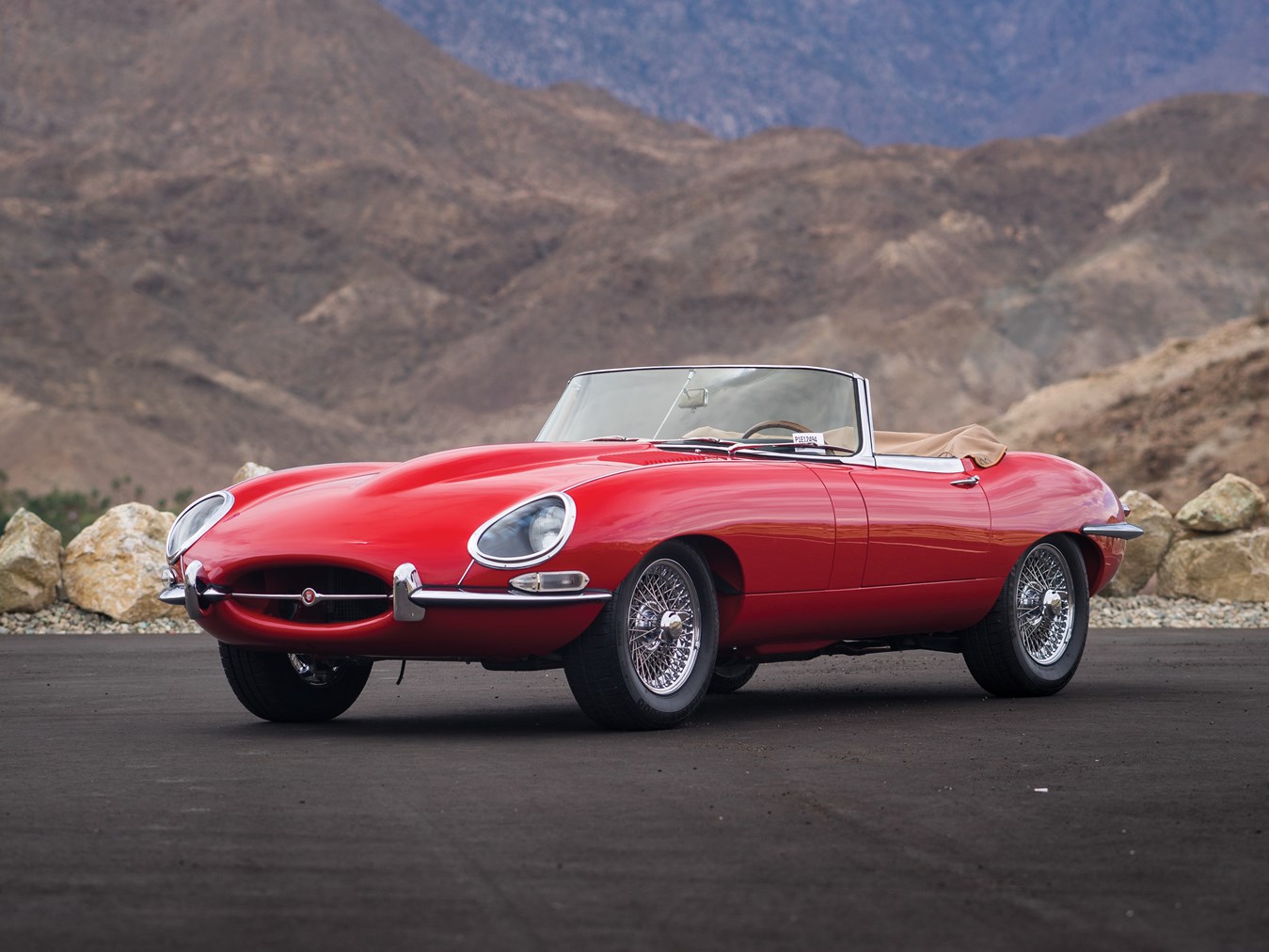
A Series 1 convertible in all its beauty
  • The so called Series 1.5 essentially looked like the previous cars but had the headlamp glass covers removed to provide better light but especially to get approval in the US (basically the same problem Citroën had with the DS in the US). It was also American emission regulations that led Jaguar to replace the three SU carburettors with Zenith-Stromberg units, meaning a power reduction of around 20 hp on US cars.
  • The Series 2 only saw minor modifications to the 1.5 and is most distinguishable by its wrap around bumpers and diferent grille. Series 2 cars were built until 1971.
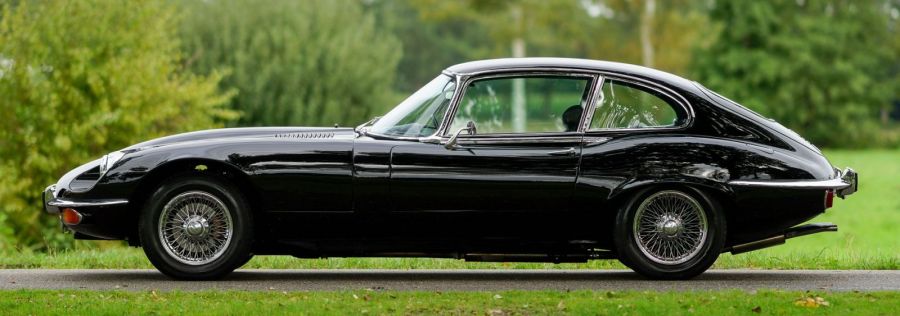
  • In 1971 the Series 3 saw the introduction of the 5.3 litre V12 producing 272 hp, along with improved breaks and steering. Four Zenith carburettors helped the car to a sub-seven seconds time to 100 km/h and a top speed of around 250 km/h. Very impressive numbers, but only a slight improvement to the six-cylinder versions. The benefits of the V12 were rather the 12-cylinder character and sound… The short coupé was discontinued with only the 2+2 seater and the roadster now built until the production ended. Series 3 cars are identifiable notably by the larger grille, flared arches giving room for larger wheels, and the four exhaust pipes.
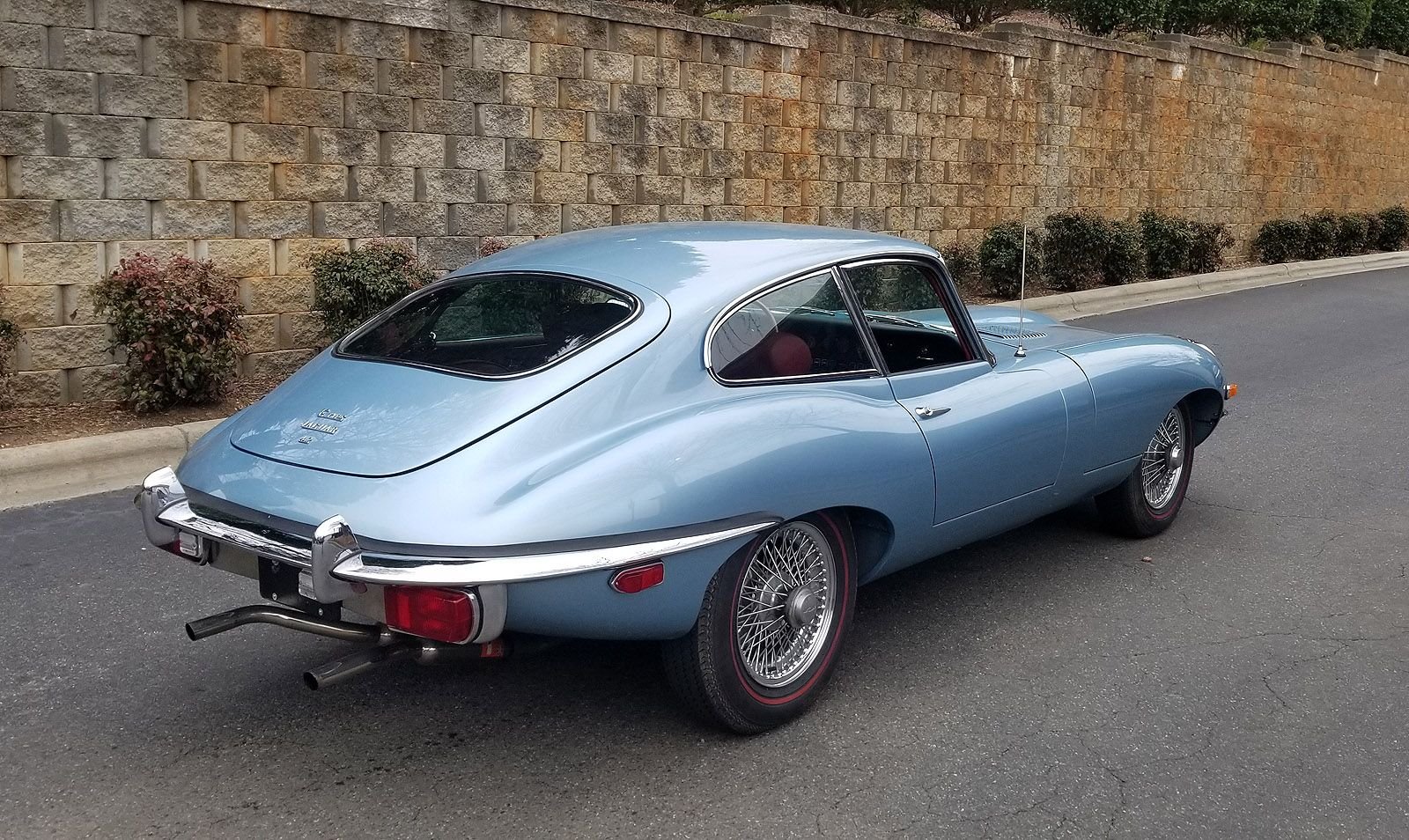
A Series 2 short coupé with the side-opening luggage door

Through the sixties and into the seventies until the end of production in 1974, the E-Type was one of the fastest sports cars in production. It was also one that drove well thanks notably to the mentioned rear suspension but also its four disc breaks, something neither the Italians, nor for example Mercedes-Benz had at the time. The engines, provided they were serviced well, were reliable, with the V12 being more or less unbreakable, but again provided it was properly serviced and maintained. Given the E-Type cost roughly half of for example a Ferrari 275 at the time it was hugely successful, with over all series more than 70.000 cars produced, most of which in the first series.

It’s a few years since I had the pleasure to drive an E-type for the only time so far, more precisely a 4.2 litre convertible. I will never forget that long bonnet that seemed to go on forever, the low seating position with the large steering wheel, and then of course the sound from the six-cylinder. I had my TR4 at the time and let’s just say this was a different story. Driving-wise the car is impressive but commends respect given the powerful engine, but the precise steering and powerful disc breaks still give a feeling of control. My friend who owned and still owns the car confirmed my impressions, but also the amount of work that seemed to go into it on a regular basis, which brings us to buying and owning an E-Type.

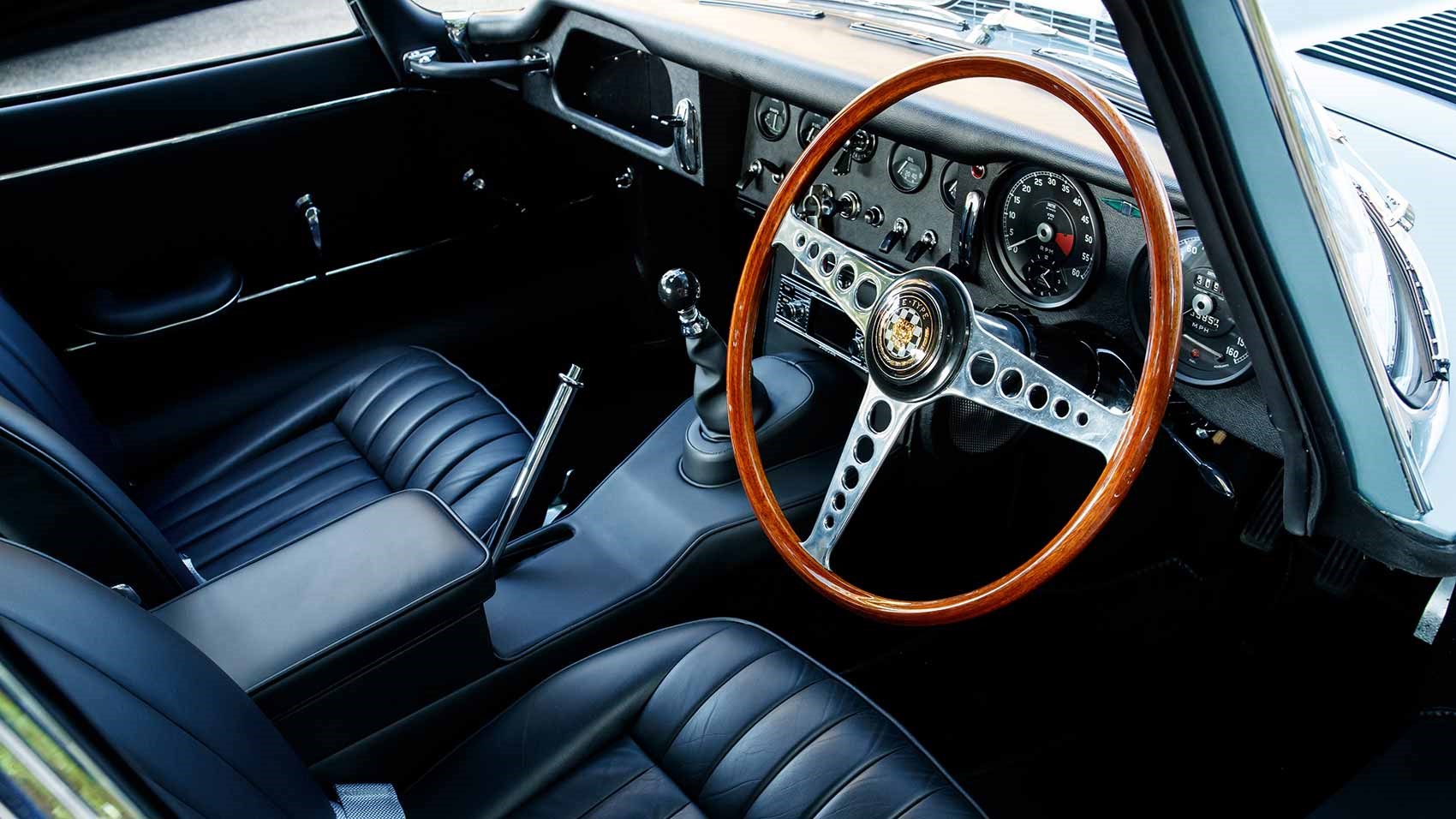
The interior certainly keeps up with the exterior!

Finding the right car is mainly about three things: rust, engine maintenance and series. Rust is probably the most serious issue and a very common problem, and the monocoque constrution makes it especially critical in certain areas. Any car needs to be inspected carefully also from underneath and ideally with the help of a specialist. As long as he’s there he can then also have a look at the engine, which as said doesn’t usually cause any problems as long as it’s well maintained. Adjusting both the six-cylinder, but especially the 12-cylinder is however a job for those who know, and if you don’t, you will want to know someone who knows! Finally the different series are about taste. Generally first series cars are most popular with their design being considered the purest and most beautiful. Many prefer the original 3.8 litre engine, claiming it’s more responsive and happier to rev than the larger 4.2, probably a matter of taste. The 2+2 coupé with its 22 cm longer body takes some getting used to and is arguably the least attractive design. Between the convertible and the short coupé it’s really a matter of taste, and there is also no meaningful price difference with our without roof.

Finding an E-Type is not difficult, but perfectly preserved or restored cars have reached if not astronomical, then at least ambitious prices. On the good side though, they are still only half or even less as expensive as comparable Ferraris! Good, original cars with some patina start at EUR 90′-100′, with no upper limit depending on condition but even more on the in some cases very limited series. An early 3.8 litre Series 1 is probably where I would put my money but I can obviously see the attraction not only of the V12 but also of the improvement on later cars. Again, the V12 doesn’t have to be a quick way to bankruptcy and is more solid than the 6-cylinder, but it will require more maintenance, and slightly more fuel… Whichever you choose you’ll be driving a true legendary car, one that is never out of place, and that is even more beautiful than the tailor-made Italian suits Enzo Ferrari used to wear!

The other “almost” Porsche!

Regular readers of the blog will remember my post from mid-December on the wonderful Mercedes-Benz E 500 (or 500 E depending on construction year) that I modestly called “The world’s best… car?” given at least at the time, it was just that. You’ll also remember that the 500 E was assembled by Porsche who had more spare factory capacity than money in the early 90’s. It was however a true Mercedes, built from Mercedes parts and not, as some will have you believe, an “almost” Porsche.

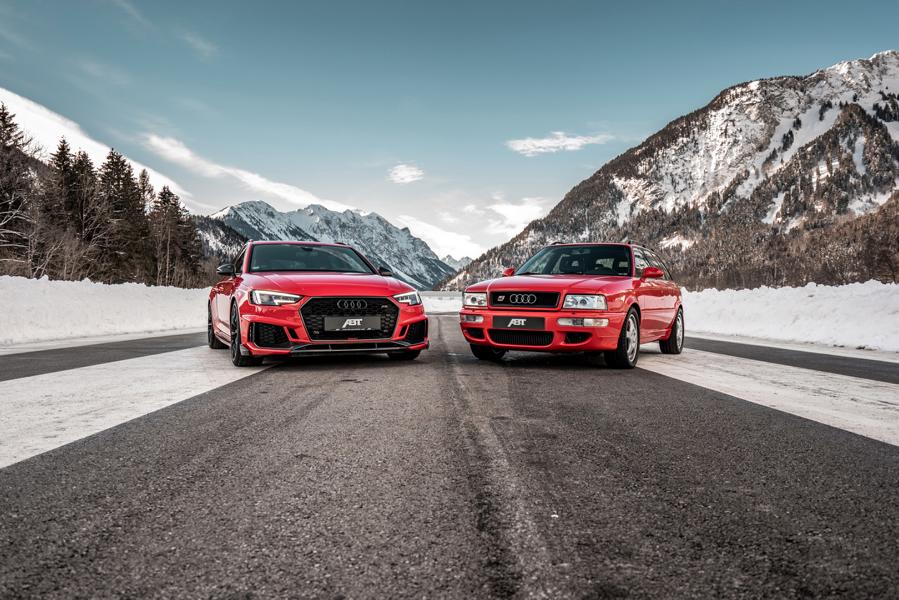
Contrary to the 500 E, Porsche was far more active in the construction of another true legend from the same period that was developed on the basis of an Audi. I’m of course talking about the Audi RS2 which not only started a wonderful series of RS models to come, but can also be said to be the first car in the today very popular segment of sports combis (estate wagons for some of you, but I’ll use combi throughout). More than enough reasons to look at it closer today!

Not spectacular but purposeful – if you know, you know.

The basis of the RS2 was of course the Audi 80 Avant, a conservatively styled, smaller combi from the early 90’s and one of the first models in Audi’s transformation from a brand for grandpas to the cool auto-maker it has become today. Audi and Porsche worked jointly on the project of developing the RS2, which distinguished itself visually from its less powerful siblings notably by its front and rear RS fenders developed by Porsche, its larger breaks with red calipers also from Porsche and branded as such, and its 17″ Porsche wheels. These as well as the exterior mirrors were identical to the Porsche 964, and the rear lightbar going over the whole back is also said to have taken its inspiration from the 964. Together with the fact that the whole car sits lower made it look like a very special Audi 80 indeed! The interior didn’t disappoint either with its bi-color, leather-alcantara combination in black-blue or black-grey (a fully black interior was an option), its Recaro seats and its white dials. If you know the Audi 80 it will feel very familiar, but still special enough – as it should.

I struggle to think of anything more you would need!

Even more exciting is of course what Porsche did with the 5-cylinder, 2.2 litre engine that came from the S2 and originally developed 230 hp. Thanks notably to a larger turbo and intercooler, better engine management and a beefier exhaust system, performance was increased to 315 hp and a torque of 410 Nm. This may not sound like much today and of course it isn’t, however the RS2 Avant only weighed 1600 kg, far less than most power combis today, meaning 315 hp were enough for a top speed over 260 km/h and around 5.5 seconds to 100 km/h. Audi’s legendary quattro system helped bring the power onto the road and the RS2 was equipped both with a Torsen differential and a rear-axle differential, which could be activated up to 25 km/h. Combined with a manual six-speed box this was pretty much as good as it got in the mid-90’s, and it ranks pretty far up there still today!

As mentioned the RS2 was perhaps the first representative of the segment of power combis, and it was quite revolutionary at the time in the way it handled. Of course and RS2 doesn’t feel like a 911, but it also feels nothing like an Audi 80 – in a good sense. Not only the power but also the handling and the preciseness of the whole package was revolutionary in the mid-90’s in a car which over 4.5 metres offered enough room for four people and their luggage, but it’s of course one we’ve seen many times since. Remember though that 25 years ago, these sensations were achieved without a lot of software that help correct less perfect set-ups and excessive body fat!

Probably not how most owners use them today – but you certainly can!

The RS2 was available in 11 colors but the one typically associated with the car (and also the hardest one to come by today) is the so called Nogaro blue that you can still spec your RS with today. You’d be forgiven for thinking it was always only available as a combi, but actually four (!) RS2 sedans/hatchbacks were built as well. One of these is today in the Audi museum, two apparently somewhere in the Middle-East, and the location of the fourth is unknown.

If you’re in the market for an RS2, I suggest you forget about those an focus on the Avant. That certainly makes it easier and less expensive, but a good RS2 is still not easy to come by, and certainly not a bargain. Of the almost 3000 built between 1994-1996, many have not survived and others are of course cherished by their owners. There are currently 11 for sale in all of Germany and three here in Switzerland, which price-wise come in somehwere between EUR 60′-80′. Whether that’s a good deal or not is up to you, but the RS2 certainly deserves its place among 90’s icons as the first of a legendary range of RS models and a power combi in the purest sense!

Almost 30 years of wonderful RS cars!

The Ferrari F8 is a supercar “bargain”!

If last week was all about the classic 911, today will be about something completely different, namely one of the latest creations from the legendary auto maker a bit further south, in Maranello. Ferrari has built many fantastic cars through the years and some of these have today reached truly astronomical valuations. All haven’t however and as all enthusiasts know, saying in advance which car will not only procure an immense driving pleasure (for this writer always the priority!) but also be a good investment is if not impossible, then at least very difficult, except of course for the very limited, small series versions. So without claiming to have any form of chrystal ball, today we’ll look at the Ferrari F8, a car that is still being built and I believe is perhaps one of the best supercar deals you can currently make.

Aggressive, purposeful, beautiful: the F8 Tributo

The F8 is a bit of a strange animal, namely something as rare as a facelift of a facelift. The line starts with the 458 introduced back in 2010, followed by the (face-lifted) 488 in 2015 and then from 2019 the F8 as Tributo (coupé) and Spider. In between there was however also the 488 Pista introduced in 2018, the lightweight version of the 488 and a car that in several aspects is close to the F8. The completely bonkers 3.9 litre, triple-turbo V8 engine with 720 hp and 770 Nm of torque is one of them, as are many other parts as well. Compared to the Pista, the F8 is however a very different drive, a much smoother and far less racy experience. And as I write this, the price difference between the two is huge, making the F8 an interesting proposition also compared to its most comparable predecessor.

Double rear lights and a hood with vibes from the F40!

In terms of design it takes at least a slightly trained eye to spot the difference between the 488 and the F8. It’s a matter of taste which front you find more purposeful, but the new design elements of the F8 contribute to 15% more downforce. Most would also agree that the F8’s rear where the double lights have been reintroduced looks better and contributes to a more aggressive look than on the 488. Noticeable is also the slatted, transparent engine cover in deference to another legendary V8 turbo-equipped Ferrari, the F40. The interior has an updated look compared to the 488, but this is not the fully digital experience: no big screens dominate the interior and most functions are still accessed through classic controls. The LED steering wheel helping you to perfect shifts on the track is standard in most markets but not in all, and it’s an option you should make sure is there.

The LED steering wheel is a “necessary” option

The F8 is thus one hell of a car, but is it a future classic? That’s a question I can’t answer, but there are a few reasons to think that it’s a surprisingly good investment in the segment of true supercars and thus at least potentially a good deal. The first of those is no doubt the engine. You see, the F8 is the last Ferrari – ever – to have a combustion V8 not combined with some kind of hybrid solution. You could say that it’s the culmination of the mid-engined V8 Ferrari concept that has been around for almost 50 years, since the legenday 308. The F8 may not sound as wonderful as a naturally aspirated 8- or 12-cylinder from Maranello, but then again you can’t have it all, and the power will certainly not disappoint anyone!

The culmination of Ferrari combustion V8’s!

Next to the engine the current price point is interesting, with pre-owned F8 Tributos starting at around EUR 250′-260′. Depending on options, this is at or slightly below the price as new. This is especially interesting as the F8 Spider trades at a clear premium and the large spread between the two isn’t really warranted. If it converges, chances are that it’s on the upside for the Tributo. It’s even more of a bargain if you compare the Tributo to the 488 Pista where you’ll be lucky to find a good car for EUR 100′ more. The McLaren 720, probably the most logical non-Ferrari competitor, is also at least 10% more expensive. In summary, Tributos may not start to climb in price tomorrow, especially as long as they are still being built, but there’s good reason to believe that cars currently on the market will hold their value well and that this could be an interesting entry point in a longer perspective.

The Spider currently commands a bit too much of a premium

Finally a point that is valid for the 458 and 488 as well, namely that since 10 years Ferrari offers a 7-year service package on most models including the 458, the 488 and the F8, actually extendable to 14 years in total and following the car, not the owner. This obvioulsy does wonders for the cost of owning. Most F8’s will also still be within the 3-year factory guarantee time which can also be extended. As the F8 is a better car than the 458/488, the risk of owning one of the best supercars out there has thus never been lower.

If you agree with me on the above and decide that life is too short not to own a supercar and if you don’t plan to use it on track every week, then the F8 is a great choice – under a few conditions. Choose your colour wisely and if the cheapest F8 on the market is blue with a greeen interior, don’t buy it. Also, do make sure the car has certain key options. The list is basically endless especially in terms of various carbon applications, but some of these definitely help brighten up especially the interior. The LED steering wheel does so as well, as does the JBL audio system. If you complement that with the reverse camera, the lift system and the sports seats, you have yourself a nice package with the last non-hybrid, non fully-digital Ferrari that gives you all the driving pleasure. Time to start browsing!

A life-long passion for the 911

I’ve been a car enthusiast for as long as I can remember. It started with counting antennas on cars from a very young age and has grown exponentially (as virologists love to put it these days) ever since. My interest has always been general in nature, basically as reflected in the content of this blog. I can feel just as passionately about a beautiful oldtimer or an 80’s legend as about a modern supercar. That’s not the case for everyone though. For many, their love of cars is tied to one particular model, one of which they know all there is to know and which follows them through the years. I don’t know which category you fit in, but since a few weeks I know which one my friend Philip belongs to. His category is the one of air-cooled 911 passionistas, and his story is a wonderful one of true passion for the Zuffenhausen legend. We therefore sat down for lunch back in December for me to understand how his life-long interest developed.

Philip lives in Zurich and I’ve known him for many years. Coming from a Swiss-Swedish family, he grew up in Sweden but spent a lot of time in Switzerland around the capital Berne but also in beautiful Ascona in the southern, Italian-speaking part. As newly retired, he today splits his time between Zurich and Ascona, when the weather allows using his tangerine-coloured (blood orange) 1972 911 2.4T. The way there has however been a long one that starts in Philip’s young years in the Swedish town of Uppsala, as Swedish readers (and potentially some others) may know an unspectacular mid-sized Swedish city mostly known for its university and certainly not for its car scene, and even less so back in the 60’s. This stood in stark contrast to Ascona where back in the day, Pilip tells me you regularly saw Lamborghini Miuras and Ferrari 365 (Daytonas) on the streets. It wasn’t one of these that would become the passion of Philip’s life though – it was the 911 2.4T Targa his neighbours in Uppsala had parked outside their house, one of less than a handful 911’s in the whole town. At first it was the sound of the air-cooled engine that captivated him, so different from the Italian beauties. Then there was also the fact that the neighbours drove their car all year around, very much unlike anything you would do with the Italian fullbloods, had they ever seen the Uppsala winter climate.

Uppsala in the 1960’s – very far from Ascona…

The 911 2.4 was presented in the German auto magazine Auto, Motor & Sport nr 23/71. It was Philip who told me this, he was 14 years old at the time and the reason he still knows is that he kept that number of the magazine for more than 30 years. His grandmother in Switzerland sent it to him and with at the time a very limited grasp of German, Philip went over it time and time again until he understood it. The seeds had been sown but it would take more than 20 years and a number of other cars for the dream to result in Philip’s first own 911. By now he had moved to Switzerland and met a car dealer outside of Zurich, one of those you would go to when you needed a special car. Of course he knew “just the car” when hearing that Philip wanted a 911, but when Philip heard that “just the car” in the dealer’s view was a 1987 white convertible with a blue top, he wasn’t fully convinced.

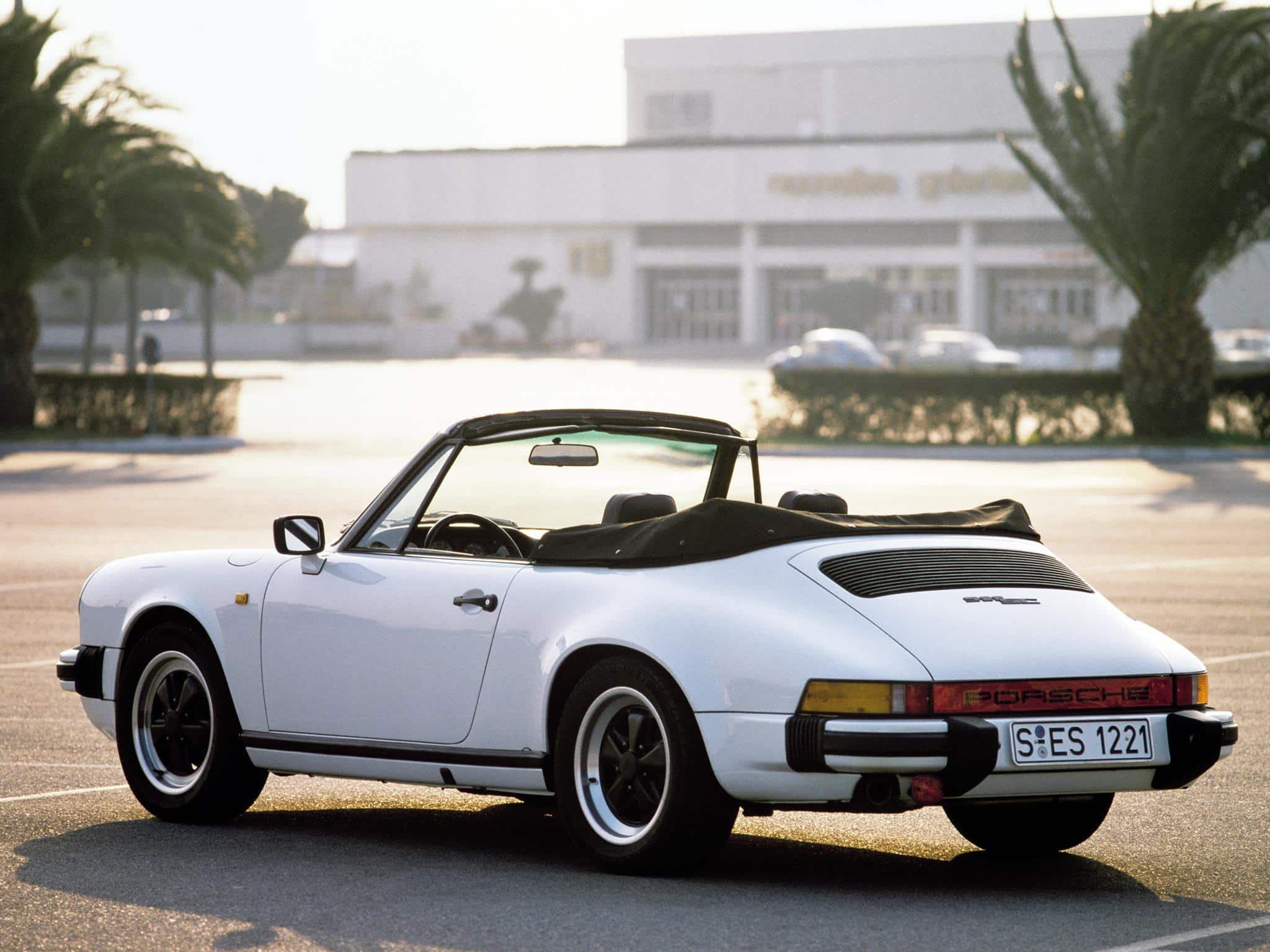
In fact the dealer had found not only one but three 911’s and had lined them up in a nice diagonal outside his shop by the time Philip arrived. With the late afternoon sun shedding its mellow light on the street, it was immediately clear to Philip that he white one with the blue top was indeed THE car. it was a 1987 911 3.2 and a US import meaning it was equipped with A/C and an electric top, both quite rare options in Europe. He would enjoy and love every moment of his first 911 for eight years until 2002 but by then, he had his sight set on something else – an original 911 Speedster. This also tells you that Philip didn’t collect cars. Being of a practical nature his line of reasoning is clearly that you can’t drive more than one car at any time. That’s usually a sensible approach but as we’ll see, when it comes to old 911’s, things are a bit different….

A 1987 964 3.2 cab in white, although Philip’s was blue inside

Today an original 911 Speedster is beyond most people’s budgets, but you need only to go back 20 years for that to be different. Philip went about finding the Speedster in precisely the right way. He consulted the dealer from eight years earlier who of course knew of exactly the right car and was happy to join Philip on the two-hour drive to check it. When they arrived he told Philip to stay in the car. “I’ll take care of this” is all he said. An hour passed, Philip grew impatient and went up towards the seller’s house but when he was about to knock, the dealer opened the door and said “I’m almost done with him”. Luckily the indicated violence was at most psychological but it did result in a final price of around CHF 90.000, a good price at the time and obviously a bargain today. What will always remain a secret is how much the seller really got and how much the dealer took in between…

If Philip had loved his first 911 deeply, the Speedster wasn’t his thing at all. The car that is a dream to many of us was in his view impractical, extremely loud and with a top that would let water in when it rained. So he went on to sell it a few years later, unfortunately before prices started to climb. He got his money back though and what followed was two far more practical 964’s and also a -94 964 WTL, a 30-year limited 911 series. Philip then switched to a 993 that he kept for eight years and with which he participated in several classic rallies. Other regular participants in those events included 356’s and original 911’s (Urelfer), and it was when seeing one of these that it dawned on him: what he really wanted and subsequently set out to get was the car which had started his love story with the 911 in the first place: an early -72-73′ 190 hp 911 2.4S. This was the most powerful of the three models sold at the time, with the 2.4E (165 hp) and 2.4T (130 hp) being the other two (the T actually put out 140 hp in the US version where like the S and E, it was fuel injected).

A nice Speedster starts at around EUR 200′ these days

I consider myself a relatively experienced used car buyer, and anything else would certainly be pretty disappointing given how many cars have come and gone through the years. And yet, compared to a real expert such as the one Philip called upon when deciding to find the perfect 911 2.4S, I’m not even a beginner. There are people out there who know everything there is to know about a car and by that, I really mean everything. Philip’s expert whom he subsequently travelled around Europe with in search of the perfect 2.4S (and whom he met through the 964 WTL mentioned above) would not only notice residual marks from an engine number having been scraped off, but also that the new stars that had been engraved didn’t have the right number of arms. He would notice very minor chassis imbalances and imperfections and would use a tool to check the thickness of the paint in different places as an indication of potential body repairs. He would use surgical instruments in investigations of rust in every hidden body pocket. He would do it all. And of course, if you do it all, finding the perfect car is a near impossibility. This is what Philip noted as well, as potential candidates came and went over the coming years, none being good enough in the expert’s view.

I think there are a couple of lessons to be learnt here for all those in search of their dream car. Firstly, whilst you should always make sure to buy a fundamentally healthy and non-accidented car, you need to define your tolerance for imperfections, both visual and in documentation. Although there’s certainly nothing wrong with trying to find the perfect car with a complete documentation, that requires not only true expertise but also (lots of) time and money. Not only that, when you finally get your hands on the perfect item, will you still dare to drive it and participate in those oldtimer gatherings and rallies you dreamt about, or will it just sit in your garage? On the other side of this spectrum there are the “rally pros” who don’t care too much about the looks, only being concerned by the mechanics. They certainly rev their engines and drive their cars hard, but the cars don’t necessarily look as they were meant to. In between these extremes is where most classic cars would land. This is where my old Triump TR4 was: a nice car but with visual imperfections, and lots of documents, but not all. An expert would thus have found many faults with it, yet for the use I made of it during close to ten years it was perfect. If you’re able to define your level of tolerance ahead of, or early in the buying process, you’ll be doing yourself a huge favour!

Whether THE perfect car is original or not is a matter of taste

Secondly, although it should be obvious but isn’t always as we humans tend to be social creatures, the seller is not your friend. He won’t be coming to any dinner parties and you won’t meet his wife. His objective is another than yours, namely to get as much money from you as fast as possible. This certainly doesn’t mean that everyone person selling a car is dishonest and deserves to be treated as such, but believing everything a seller says can also be a recipe for disaster. A case in point was one of the 911’s my friend Philip looked at, the one where the old engine number had been removed and a new “matching numbers” one had been engraved, however with incorrectly engraved stars. This car was sold by a well reputed Porsche dealership in Switzerland, not by some back yard dealer. They claimed not being aware of the problem which was maybe true, who knows. The point is obviously that if you pay for matching numbers you should get that, just as you should get whatever else the seller claims to be selling. If you’re unsure, get someone to help you, as you definitely want to be safe rather than sorry.

With each car Philip visited with his expert friend his own knowledge obviously grew as well so that he also started to look at cars on his own, at least for the first round. Doing that and I guess also growing a bit impatient about finding his car and thus increasing his personal tolerance level, he enlargened his search somewhat and also included potential 2.4T’s and 2.4E’s. Doing that he would finally find his dream car, the tangerine 911 2.4T that has been his ever since. It looked perfect to him and once the expert got to see it, even he didn’t find more than some minor imperfections. Today Philip is an active owner and driver, notably participating in classic rallies and a member in the Swiss Porsche Urelfer Club, taking part in their various events. He’s optimized his car somewhat, notably with sports seats (not originals but replicas close enough for anyone but a real expert to be fooled…), and he certainly doesn’t sound like he would be selling the car any time soon.

Philip in his car during a 911 gathering

As we reached the end of our lunch I was thinking to myself that this was perhaps where this long love story with the air-cooled 911 that started on the snowy streets of Uppsala 50 years earlier comes to an end. As I put my pen down, Philip looked at me and said “you have to understand, the 911 is much more than a car to me, it’s a life-long passion”. I was certainly convinced by then, but at the same time this gave me a glimmer of hope. As all of us suffering from the car virus know, Philip may think this is his last 911, but you can never be sure. Before leaving the table, I therefore made sure that if he changes his mind and decides to sell his beautiful 2.4T, he lets me know first!

An English lord has moved in!

Regular readers of this blog may remember my somewhat confused reflections around what is the perfect family car from back in October, after I had sold my XC90 and was looking to replace it. In that post I made a pretty clear case for the superiority of a station wagon over an SUV except for those living in a snowy place or otherwise needing real offroad capabilities. I also pointed out that buying a 500 hp SUV doesn’t make much sense at all given such an engine comes more to its right in a car with a lower center of gravity – i.e. a station wagon. Well, what can I say? I’ve replaced the XC90, that much is true, but somehow I forgot the rest of what I wrote back then…

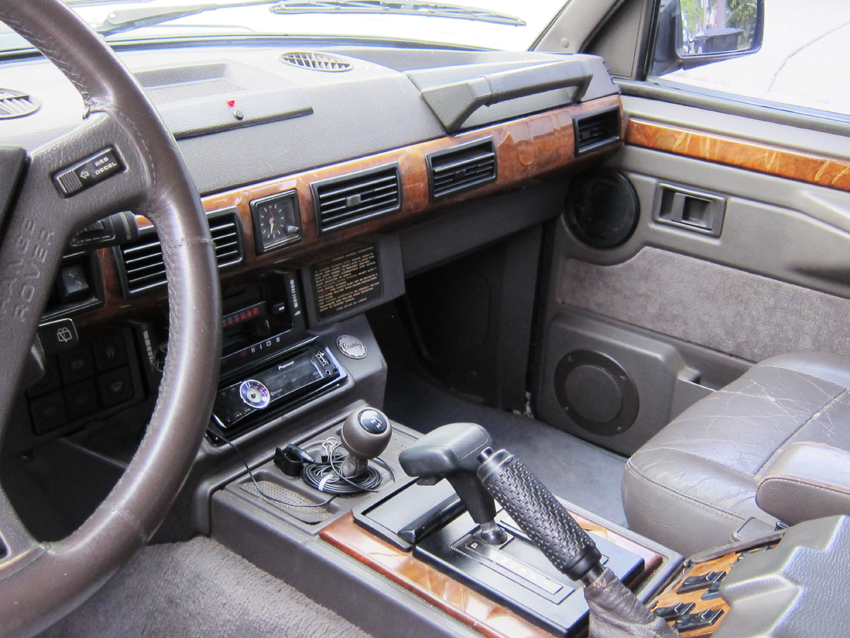
To be honest, I was really set on buying a station wagon. Those that felt a bit special and that were on my list did however all have the racing attributes of my old E63 AMG that I didn’t want. I’d also point out that I haven’t changed my mind on the “M” or “AMG”-like SUV’s out there, they really don’t make much sense. Finally I also decided not to break the bank this time, at least not at the point of purchase. As all enthusiasts know running costs are less painful, and also less visible to those that may have differing opinions on how family money is to be spent… So within those parameters, I finally found something that felt very special indeed. It’s not a station wagon but rather the most famous SUV of them all. It’s also not built in Stuttgart but rather in Solihull, in the middle of the UK. Since a couple of months, I’m the happy owner of a Range Rover L405, more exactly a 2015 5.0 V8 SC Autobiography in black on black. And so far, I absolutely love it!

It’s big, black and bloody nice!

I’ve never really had Range on my real list of candidates but every time I experienced one (and I’ve actually driven all generations of the Range), I remember it to this day as something quite unique and special, with many positive memories and associations. As things happen, it was by coincidence that I saw a big Range on the road and realized I didn’t know what they were trading at (which is rare for this writer). The very same day the snow fell heavily and my son landed a job as ski instructor in the Alps, meaning I would need to drive him there with a bed and some other stuff. After all we do live in Switzerland, so maybe an SUV wasn’t too bad after all, and maybe, just maybe, it could be a Range? The plan took shape as I realized that budget-wise, it would be possible to find “the” car within what I had set as limit.

In terms of models it could never be anything else than the big Range for me, meaning the L405, built since 2012 and not replaced by a new model until this year (the new Range being rolled out as I write this but the waiting list is apparently at least two years because of the delivery issues of components we all know of by now). I guess a good testament to the design of the L405 is that although the new model is a brand new car, it’s also immediately recognizable. The L405 only received some very minor face-lifts through its life, the most important being the introduction of a more digital cockpit in 2017 and the new engine line-up with a hybrid solution a couple of years later. I didn’t feel the premium these model years command were worth it, and the hybrid solution around a four-cylinder petrol engine didn’t feel very convincing. Speaking to people who know, it also didn’t sound like it was the right engine for the car. 2015 was a good compromise as initial hickups had been sorted by then without any price premium over previous model years.

Those turbine wheels are 22″ and nothing for the handyman…

The design has thus held for more than a decade and is both elegant and timeless with a presence like few other cars (and none of its smaller siblings), and the engines have also been around a while. I disregarded the petrol-six straight away as everyone with experience seem to agree it’s too small for the car and because of that is the most issue-prone, notably with a cambelt rather than a chain as on the larger engines. That left the 8-cylinder, 4.4 litre diesel with 340 hp and all the torque you could wish for, and the 5-litre petrol, supercharged V8 with 510 hp. In Europe the diesel probably makes up around 70-80% of production with the petrol V8 taking perhaps 10%. Of course that petrol V8 is also a representative of the club of fabulous engines that will never be built again…

I drove both and although the diesel certainly makes sense for the car type, and especially for those towing regularly, the petrol makes the car feel much lighter and dynamic. Its instantaneous response is much more attractive than the inevitable initial lag of the diesel and if you push it, the petrol exhibits quite a sporty character. Obviously that’s not the proper way to drive a Range, and this is also why this is not another 500 hp sporty SUV. The car basically incites you to proceed with grace, meaning the engine will most of the time the engine humm between 2′-2.5′ rpm and not be pushing you to floor it. The power is always there should you need it and when you do, both the sound and the acceleration are all you could ever ask for. To me, that’s the perfect combination and exactly what I was looking for. And yes, you pay a price for this at the pump but not as high as some would have you believe. In a mix of city, country and motorway at legal speed + inflation, I’m currently averaging around 13 litres. It wasn’t less in my E63 AMG.

A wonderful engine of a type we’ll never see again!

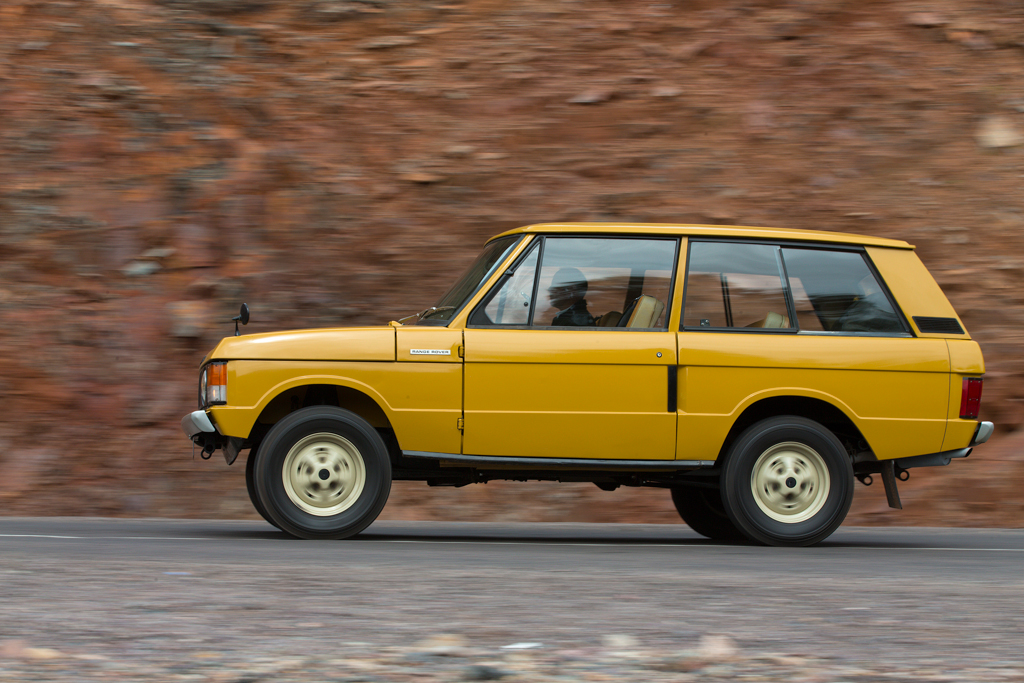
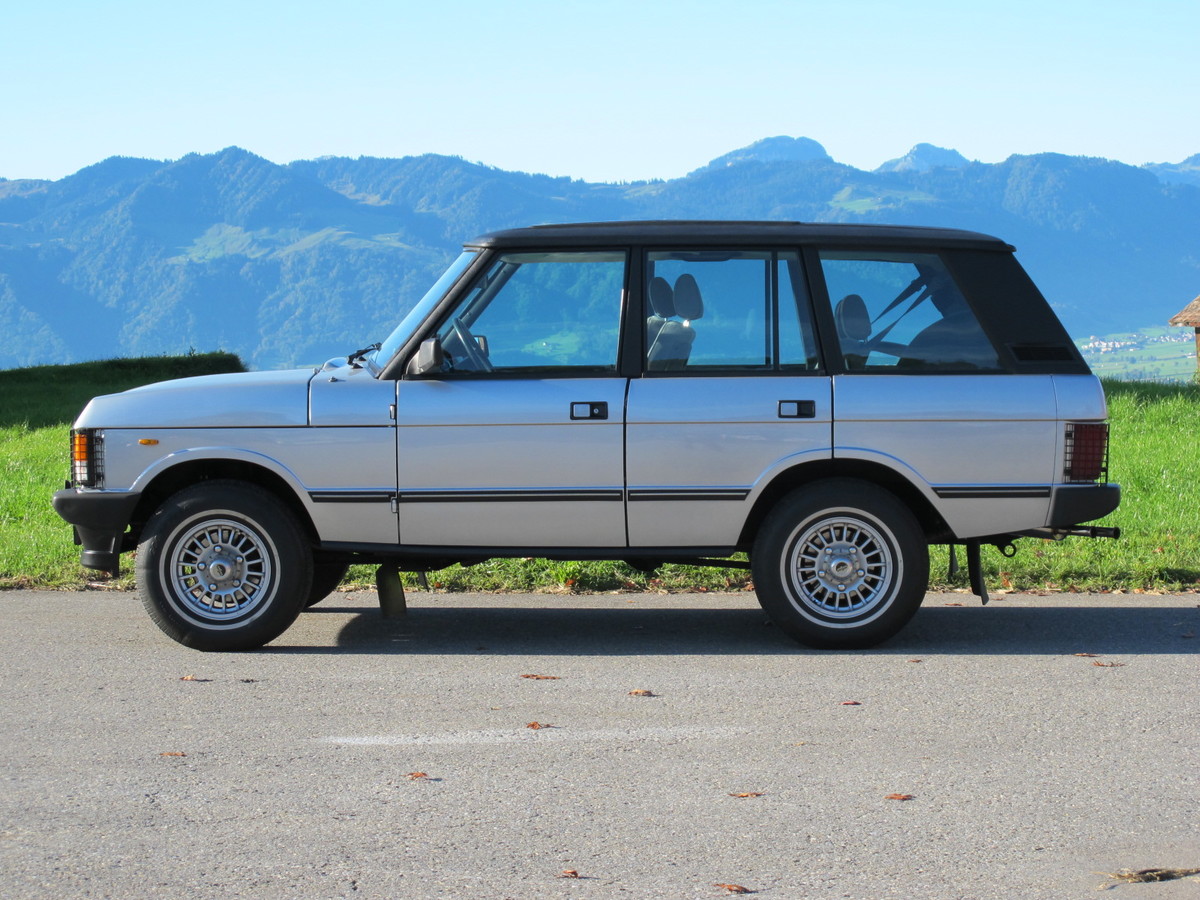
Size of engine is one thing, size of the whole car another. No doubt the Range is a big car, but appearances are also treacherous. At just under 5 metres it’s not longer than most full-sized SUV’s, and it’s not more than 3-4 cms wider. The difference is in the height of 183 cm which also makes it look big. The flip side of that is of course next to space also the unequalled seating position and visibility. The inside also illustrates quite well that the priority has been put on passenger comfort over maximum luggage space. Sure, the car has a large boot, but the emphasis has clearly been on cabin space and creating a luxury transport for four. The space up front is great, the comfort in the electrically-adjustable back seats even better. Range Rover have perfectioned this art ever since the first Range in the early 70’s, and today’s result is nothing but sensational.

The higher seating position combined with large glass areas means your visibility is unequalled. The suspension comfort is sublime, as is the 29-loudspeaker Meridien sound system. And then there’s the materials which make it very clear that plastic isn’t something the guys up in Solihull think should be used in the interior of a car unless strictly necessary. I’ve driven most and probably sat in all premium SUV’s on the market and without exagerrating I can say that the quality of materials and solidity in every detail puts a Range somewhere between the Germans and the other “RR” brand over in Crewe. It really is that good.

The best interior I’ve been in this side of Crewe!

Driving-wise I was also positively surprised. The handling, without being sporty in any way, is more neutral and less understeered than many other SUV’s around corners and sublime on longer stretches. The steering is a tad too light but surprisingly precise. And then there’s obviously the off-road capabilities that I won’t be using, but where as a small example the virgin drive to the Alps with my son’s stuff happened in the middle of a heavy snowfall with people parked on the roadside putting on chains. Of course the Range couldn’t be bothered less. On the downside, it’s clear that if a modern infotainment unit and 37.000 nuances of interior lightning is your thing, you should look elsehwere. I find Google Maps on my phone all I need in terms of navigation, and the Range still offers five interior colours which in my book is plenty.

Slightly suprisingly, finding the right car was complicated by many candidates not having some options I didn’t want to live without, like an adaptive cruise control and head-up display which apparently isn’t stuff most Range owners find useful. The colour was also important to me, the car is elegant in many colours but I wanted a bit of a sporty feel which in my view only comes in grey or black. With this in mind I managed to locate the car you see in the pictures, a 2015 model with one previous owner, a perfect service history and a 2-year warranty from a garage really specializing in supercars and with a very strong reputation. That I think is the right way to go about it.

On this day early December, only a G-wagon and me didn’t use chains

What I also noticed during the buying process was firstly that most cars are in really good condition even with high mileage, a testament both the quality but also to the fact that first-time buyers of these usually are a bit elder (no comments here please) with enough money to service the cars properly. Secondly it’s really nice to see that there are a number of owners’ clubs that you can turn to and where you find very engaged and dedicated people who know far more about Ranges than I do and are very happy to help. It was such an owners’ club that helped me in choosing the engine option and, given the car’s somewhat mixed quality reputation, it was also the owners of Range Rovers that convinced me that this seems to be more an issue for people who actually don’t own a Range. I can of course only hope I’m right here, but a 2-year warranty is very helpful in this regard.

A diesel or petrol Range in perfect condition from model years 2014-2016 (to me the sweet spot) and with a mileage of 50.000-100.000 km will be yours for EUR 60′-70′ in Europe, a bit less than half the price as new. The problem can be finding a low mileage car as these tend to be driven long distances, but with a proper service history and a guarantee, a higher mileage isn’t really a worry. From 2017 onwards there’s at least an EUR 20′ jump in price which I don’t think is warranted all else equal (although it does get you a more modern infotainment unit). As you’ve understood by now, so far I’m really happy with my choice and it feels like the Range is the perfect complement to my 650 convertible and will stay with me a long time. Could it be that I’ve found the perfect combination? Time will tell!

The world’s best…. car?

There was a time when Mercedes-Benz was led by engineers as opposed to accountants. This notably meant that a car’s price would be determined by what it cost to build and not by what accountants and even more suspect marketing people would say it should cost. Interestingly, this period which lasted until some time around the mid-90’s (a bit of an argument here) is also when MB’reached the summit of car build quality. Stepping into an MB from this period even today is impressive and conveys a feeling of something that is truly unbreakable. Unfortunately the engineers lost out to the accountants in the end and ever since Mercedes, although good, has never rached the same level of unbreakable quality as in the golden period around the 80’s.

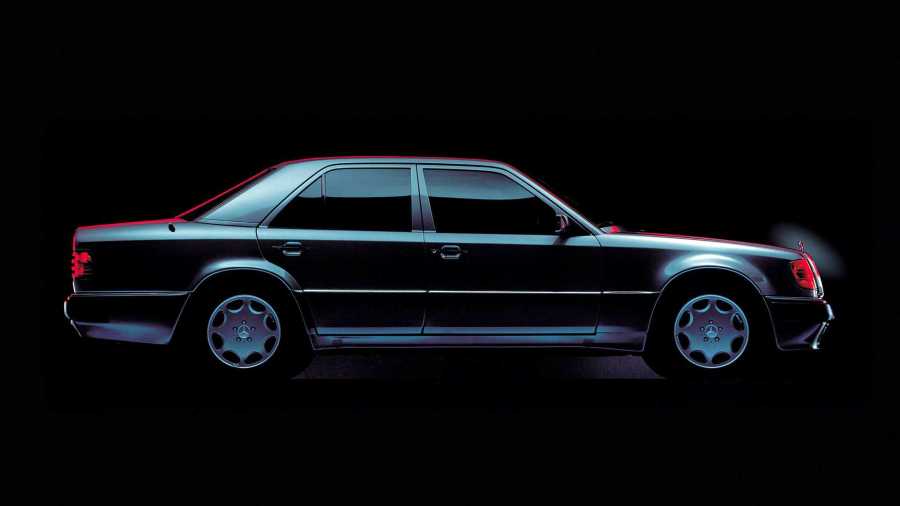
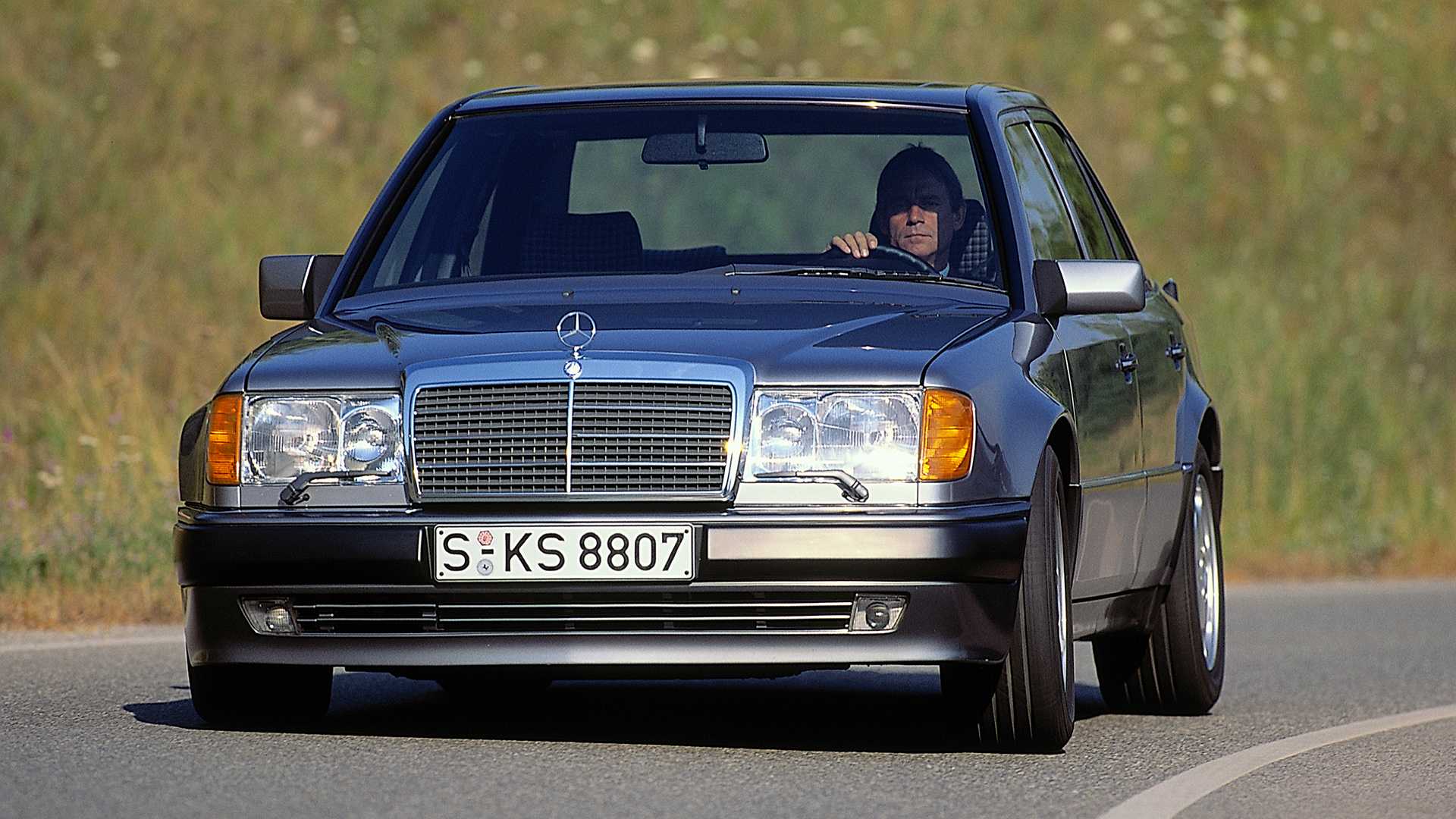
At the time the Stuttgart-based brand was however not only well-known for build quality but also for being especially appreciated by elderly men wearing hats. Elegant, luxurious and as said with perfect quality, sure, but nowhere on the fun-to-drive radar. So if I say W124 to you (or if you prefer early 90’s E-class), chances are that you picture an owner who has very little to do with the picture that pops up in your head when I say BMW M5 from the same period. This was a true problem for Mercedes – until the engineers decided to do something about it. The end product was called the Mercedes-Benz 500 E and is still considered by some as the best car ever built.

To understand the context we need to go back to the 70’s oil crises and the fact that Mercedes had walked right into these with the big S-class equipped with two massive V8 petrol engines at 6.3 and 6.9 litres. There was an urgent need to downsize meaning smaller engines but also building a smaller car, or as it turned out actually two, the W201 and the W124. It would have been surprising for an engineer-led company to appoint a flashy Italian to design their new car, but they did. Or at least he was Italian. Bruno Sacco was at the time working in Mercedes’s safety department and most probably had no clue how legendary he would be considered as a designer a couple of decades and a few design projects later, but those that cared to look a bit closer could already in the W124 see the genius of an engineer-safety-designer at work. How exactly? Well consider the following.

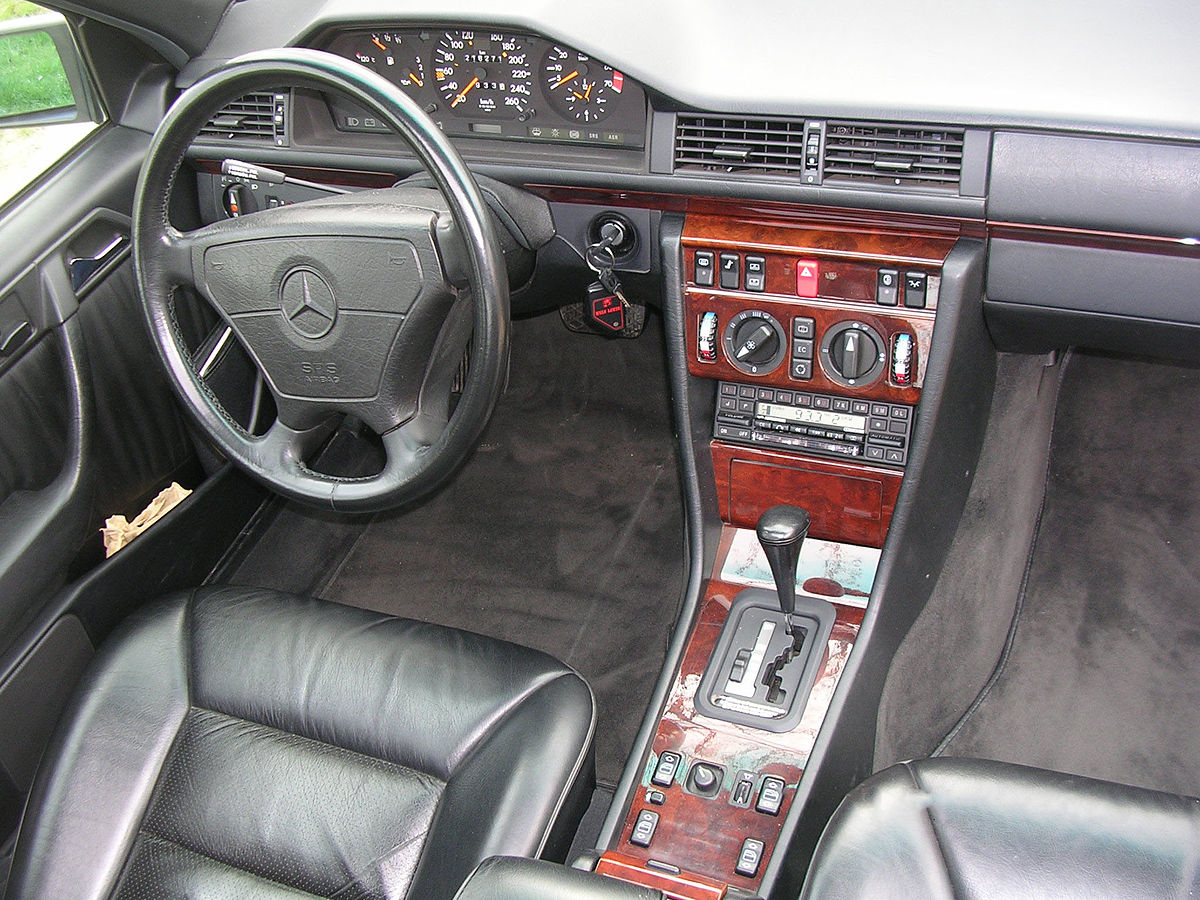
It may have looked a bit boxy but with a wind drag factor of 0.26, the W124 was one of the most aerodynamic cars ever built at the time. The back lights had ribs such as to avoid snow clogging in winter. The single-arm windshield wiper covered 83% of the windscreen and its movement meant it was never lifted off the screen by the wind at high autobahn speeds. And the two side mirrors had a different shape, not enough to disturb the overall design but just enough to ensure an optimal angle and captured area on both sides. If that isn’t good design at work, then I don’t know what is. Sure, the interior was perhaps not the most inspired ever imagined, but it was oh so solid, and everything was intuitively where you expected it to be. And on the 500 E, the squared textile used for the standard seats looked even better than the optional leather.

The W124 (and the W201) thus brought the required downsizing in an attractive and almost revolutionary design. What the new cars didn’t bring initially was however something that allowed Mercedes to compete with the BMW M5 in its home market and with the new kid on the block in the US – Lexus and its smooth V8. The solution was to be found in a heavily modified and modernized version of the inhouse V8 also used in the SL. With a power output of 320-326 hp however, it also meant that many other components had to be re-inforced, and many of these were also taken from the SL. The end result was a 500 E that was wider than a normal E-class, so wide that it no longer fitted on the production band in Mercedes’ Stuttgart factory. And that in turn meant the start of one of the most bizarre production routines of any car in any brand’s history.

Notably thanks to the new cars, Mercedes stood on pretty solid financial footing at the time, something Porsche in nearby Zuffenhausen could only dream of. With an ageing 911 and massive problems to find an accepted replacement, Porsche was on the brink of bankruptcy and looking to make money wherever they could, and since production of the 959 had ended, its production band was at a standstill. Therefore, when Mercedes called (and rumour has it some local politiciants may have lifted the phone as well) to see if Porsche could possibly help putting together the 500 E, they didn’t have to wait long for a positive answer. But this was not the case of Mercedes sending an E-class to Porsche and getting a 500 E back, far from it. It’s also not the case that Porsche helped on the development of the 500 E as they did with the Audi RS2 in the same period, and as some 500 E ads today screaming “Porsche!!” would have you believe. The 500 E was a true Mercedes car, built with Mercedes parts, that Porsche helped put together – at least partly.

A regular E-class with body and drivetrain would be delivered to Porsche who would put it together, including widening the fenders ever so discretly a couple of cm on each side. The car would then be returned to Mercedes to be painted. It would then be sent back to Porsche for fitting of all the remaining parts, and after that be returned to again Mercedes for a final quality control. Sounds overly complicated and expensive? Yes on both accounts and the process took about three weeks for each car. It also contributed to the 500 E being about 1/4 more expensive than a BMW M5. The engineers at Mercedes just shrug their shoulders and pointed to the fact that this was the true cost of building the car. In a way they were right, but luckily efficiency has improved since. Quality-wise however, those who know claim that the 500 E was even more solid than a regular E-class, as if that was possible…

I haven’t had the pleasure to drive a 500 E but speaking to people who have and having indeed heard the V8 roar, I have no problem at all believing what tests at the time also said, namely that this was a true high-performance sedan that not only looked right but also drove right, thus not only beating an M5 in outright speed. It thus brought not only what people expected of a Mercedes, but also what they didn’t and which until then had only been found in Munich.

The W124 in all its different iterations was built during 13 years between 1984 and 1997, with the 500 E as part of the production between 1990 and 1995 (called 500 E until 1993 and E 500 therafter). Two other eight-cylinder siblings are worth mentioning, the slightly de-tuned 400 E, mainly intended to compete with Lexus in the US market and built in parallel to the 500 E, and the E 60 AMG, built in 1993-1994 as a more powerful version of the 500 E. Back in the day the 400 E was the bargain of the lot, producing 40 hp and 80 Nm less but also costing DM 40.000 less. Today that’s still the case as good 400 E’s can be had for as little as EUR 15.000. The E 60 AMG was much more expensive than the 500 E as new, but also had 60 hp and 110 Nm more. Should you be lucky to find one today it will cost you far more than EUR 100.000. The 500 E comes in in between, with nice cars costing EUR 35-45.000. Interestingly the pre-facelift models until 1993 are typically more expensive than the in my view nicer looking (and arguably slightly better) post-facelift ones.

Facelift or not is obviously not where you should focus but rather on the quality of the car. Yes, they are built to last an eternity, but many have also been driven a good way towards that eternity so a complete documents and a regular service history are essential. Bringing a Mercedes expert (an engineer perhaps?) to check the car is certainly not a bad idea. After all, the engineers who built this masterpiece wouldn’t expect any less. And of course they would also assume that the car had been regularly serviced in an approved garage. If that’s indeed the case, the 500 E is a car it’s really difficult to go wrong with. It’s also the last real power sedan from Mercedes own factory, as these would be built by AMG going forward. Not more than 10.469 (out of 2.5 million W124!) 500 E / E 500 were built and irrespective of their underlying quality, many have obviously disappeared since. Is it the best car in the world? That’s as always impossible to answer, but to me it’s clearly the best performance sedan of its era. Do I want one? Jawohl!!

PS. A couple of hours ago, Max Verstappen became the new and the first Dutch F1 world champion after a very intense and in the last part, completely crazy season. Congrats Max, I’ll come back with a season summary next week!

Range Rover Classic – the grand daddy of SUV’s !

Last week I wrote about the popular trend of re-creating classic cars in their former beauty but with modern technology beneath, what is also known as restomods. One of the examples I gave was the UK firm Kingsley that does this kind of work on the first series of the Range Rover, also referred to as the Range Rover Classic. This 50-year old creation that rightfully counts as the grand daddy of all modern, luxury SUV’s is getting rare on our streets, which given its age isn’t surprising. I was however lucky not only to see one last week but also to strike up a discussion with the owner who opened my eyes to the fascinating story of this marvelous piece of UK automobile technology, that we’ll look closer at this week!

The first version of the Range Rover (hereinafter RR or Classic) was produced for almost 40 years, from 1969 to 1996. That’s remarkable in itself and among the longest production runs of any car model, but it’s also remarkable as the US market entry didn’t happen until 1987, by which time the car was 17 years old! Less known is also that during the first 11 years of existance the RR was only available in a 3-door version. The 5-door car didn’t appear until 1981 with the 3-door version being phased out in the years thereafter. It does however remain the favourite version of restorers and restomod builders, including Kingsley.

The earliest cars were all 3-door and were without c-pillar vinyl.

The Range Rover story and subsequently brand starts with the Land Rover that had been built by the Rover Group since 1948. it was a pure utalitarian car with no luxury or comfort whatsoever. As it evolved, it dawned on the Rover Group that there was appetite for a terrain-capable car that was more comfortable and a bit later in the 60’s, the first SUV-like jeeps from Ford (the Bronco) and Jeep (the Wagoneer) started appearing in the US. After having tried to develop the concept on some other models without much success in the 50’s, Rover finally bought a Bronco which served as development car for what was to become the first Range Rover, presented to the public in 1970.

The split tailgate is a feature of all RR’s since the very first.

The first RR may have been a wonder of comfort compared to a Land Rover but was obviously far from being so by any modern standard – or for that matter compared to the luxury cars of the time. It did however have something they didn’t, namely outstanding offroad capabilities, and it was of course that combination that made its success. The four-wheel drive system along with the long suspension and ground clearance made it almost as capable as a Land Rover offroad, and onroad, the Rover V8 helped it to a top speed of over 150 km/h and a 0-100 km/h time of less than 15 seconds (both considered fast at the time…) while also being able to tow up to 3.5 tons. Rover referred to the RR as “a car for all reasons” and the public seemed to agree.

Luxury is certainly relative, but it was much better than a Land Rover!

There weren’t many changes to the RR during its first ten years of existance but a vinyl coverage of the c-pillars that was introduced around the mid-70’s made it easier to distinguish the really early cars. What all the 70’s cars had in common was the complicated access to the back seats given the car only had two doors. This was solved by the four-door version in 1981, with further updates in the mid-80’s including the quality of the interior, updated transmission and the front design. Moving into the 90’s the Range was getting old but still kept popular by further improvements to the suspension, the engine, and also through a long-wheel based version. As production of the Range Rover MK II started in 1994, the first generation was given the name “Classic” and remained in production for another couple of years.

A 1986, four-door car, still very recognizable as a Range Rover!

Most SUV’s sold today in Europe are of course diesel-powered but Rover had great difficulty finding a diesel engine that suited the RR. A diesel option didn’t come until 1986 and even then, although the engine was quite advanced for the time, it was seen as inferior to the petrol V8. Most Classics thus have a petrol V8 under the bonnet, something that remained the case well into the MK III. This certainly didn’t help the RR during the 70’s oil crises but even as consumption generally became more important, the Classic retained its loyal fans who wouldn’t really consider any alternatives to petrol- and still don’t!

The feeling of entering, or rather stepping up into a Range Rover is something truly special and perhaps conveyed best by the Classic. Given the old construction the pillars are very thin and the glass areas enormous, providing a brilliant view all around. You obviously sit high and although the car is large it’s not difficult to see where it starts and ends. Cars from the first years didn’t have power-assisted steering which is a bad idea, but cars after that provide a truly special driving experience, but obviously one that is far less exact and more floating than a modern SUV. It doesn’t matter as much as for some other types of oldtimers though since a RR is not one to be stressed – never was, never will be.

The interior of a 1990 car – a nice place to be!

If you want to get the genuine British tweed countrylife feel, I would claim no car does it better than a Range Rover Classic. There is a bunch of people out there who will look upon you as a complete maniac if you say you’re considering one, claiming it will fall apart the minute you’ve handed over the money. I would say sure, things can break as they can do on any old car, but the best proof of an RR’s inherent quality is that Range drivers are among the most loyal owners out there. Many of them would never consider another car, they’ve stayed with the different models through the decades and often have more than one RR. I find it very hard to believe they would do that if the car was as bad as those (who typically have never owned one) claim. In any case, there’s is no RR that has less things that can break than the first series!

The good news is that getting a good RR Classic is still quite affordable. What’s even more affordable is the MK II that came out in 1994, but would claim it’s very doubful if that car will ever claim the same classics status as the MK I, and I would definitely pick a late MK I car over a MK II. Somewhere around EUR 25.000-30.000 is where you find the really nice ones. I’d go for a later one from 1986 and onwards, but in terms of collectibles it’s clearly a three-door RR you should go for, but then again one of the later production years. If you can find one Britannia will surely rule all the way and you will just have stepped up a level in your car experience!

Winter may be here, but you won’t care!

Restomods – best of both worlds?

When I wrote about the Zurich Auto Show last week (see here if you missed it), I mentioned that a whole floor had been dedicated to the classics, mostly restored to their former glory by experts in the field either belonging to the marks, such as Mercedes-Benz Classics, or being individual outfits. I also mentioned that this floor was one of the most visited on the show, and typically so by men in their 50’s and 60’s which I guess are the typical clients for this kind of automobiles – and lucky they are!

A beautifully restored Mercedes or Ferrari from the 60’s is difficult to beat in looks, but not very hard in driving experience, at least if you’re after the relative perfection of a modern car. What I mean is that although driving a classic is a special feeling, it means driving something with inexact steering, pretty useless suspension and breaks that require a bit of planning to stop the car before it’s too late. That’s no wonder considering the cars are several decades old. In other words the driving experience hasn’t really stood the test of time, but the looks definitely have. And it’s in that junction that the concept of restomods saw the light of day.

The E-type is a popular restomod base

Restomods (the word combining “restoration” with “modern”) have been around on a somewhat larger scale for the last 4-5 years or so, but whereas they used to be confined to a barn on a yard somewhere and only be known to the real enthusiasts, their popularity has grown tremendously lately. Obviously this has also led to a multitude of manufacturers, typically focusing on different sportscars – but not only. The basic concept of a restomod is that of taking a classical design and modernizing everything below it, but quite often the design itself is also changed a bit on the way, notably with larger wheel arches and – especially – larger wheels. Most body panels may still look old but are usually new and quite often made out of carbon. Restomod builders are small outfits, in many cases building cars with unique parts as basis, which obviously means they aren’t cheap. What they provide is however a car that can be a true one of a kind, as even the largest restomod outfits only produce a few dozen cars per year.

Of all the possible candidates I’ve picked three builders as examples of the various iterations of the restomod world. The first is the most legendary of them all, specializing in the most legendary sports car of all. The second is a bunch of UK-based, Italian racing enthusiasts, and the third specializes in creating a modern driving experience for the world’s first luxury SUV. Three different cars, three different approaches, but also three different visions of what a restomod can be.

California-based Singer Vehicle Design, founded by ex-rock star Rob Dickinson, focuses on optimizing 911’s (964) according to the firm’s motto “everything is important” and the principles of “Restored – Re-imagined – Reborn”. To Singer this means starting with a 911/964 that can be transformed however the owner wants it, within the limits of the classic 911 design. Singer offers a multitude of options for the chassis, engine, suspension and body, including manufacturing specific parts in very small runs. In collaboration both with Williams and Cosworth the result is absolutely outstanding as a work of art, and journalists that have had the honour of driving the unique cars usually talk about it as allowing the 911 to reach new levels of perfection. It’s important to note that it’s not about raw power as Singers are usually around 300-350 hp. As we all know however, a great drive is about so much more than straight-line speed, and no one does it better than Singer. Also, no one does it more expensive, as prices start somewhere around USD 500′ + a 964 delivered by the client, and obviously have no upper limit – Singers have been sold for more than USD 1.5m.

Alfaholics, based in Bristol may be far from California, but is without doubt the world’s leading specialist on the Alfa 105 series. Founded by Richard Banks and today run by his two sons Mark and Andrew, the racing inspired family with a true love for the Italian brand renovate 105’s to very high standards, sell standard as well as custom-made racing parts for the 105 and some other models – and then they build the GTA-R, which can be described as the modern iteration of the 105. Just like with Singer the specification of each car is largely up to the client, but the basis is usually the classic 2-litre twin spark engine, developed to produce 240 hp. The rest of the car is completely reworked and notably through extensive use of carbon, the end result is a car that weighs 800 kg and thus can be said to have all the power anyone can ask for. It also produces all of the sound anyone could ask for, and it’s a wonderful one. Costing from around GBP 250′ and upwards, the GTA-R is a very driver-focused car, clearly better in every way than the original 105, but also very much a racing car.

Finally, something completely different. We’re now up in Warwickshire in central UK where as a child Damon Oorloff (yes, written with two oo’s) didn’t have a playground and therefore spent his time in the Land Rover factory yard. He thus grew up with what was built at the time, meaning the Defender and the first generation Range Rover, and fell in love especially with the latter. He went on to found Kingsley and has today built a business of restoring the Range Rover Classic and bringing it into the modern world in terms of technology and driving experience. This is no small achievement since the Classic is a construction from the 1950’s, so it basically means rebuilding the whole car. The extent of the work, updates and modifications is individual, however always staying within the original design and thus being the purest form of restomod, according to the original concept. The result is of course magnificent: the ultra-coolness of the original RR, combined with modern comfort and an updated driving experience. Kingsley’s start around GBP 50′ and GBP 100′ pretty much gives you the full experience.

So there we are – three different interpretations of the broad restomod concept, and three that have different objectives in mind. Singer is all about 911 perfection, but also about creating unlimited cars for unlimited budgets. Alfaholics has a clear racing focus in their builds that they share with many other restomod builders (but where most are not a the same level), and that take in this case a 60’s car to the modern racing standard. Finally Kingsley gives you a pure, classic design with modern features and an up to date driving experience.

Should you really mess with something as good as the 964?

Looking at these but also at the concept of restomods in general, I admit I’m split. Taking Singer as example, the first thing to note is that a fraction of the total budget buys you a pretty perfect 964, and at least I would be more than slightly reluctant to start re-working the original build. And if you still decide that’s the way you want to go, then you have other types of specialist such as Ruf that we looked at a while ago (see here), the provide another interpretation of the 911 concept which is also highly attractive and almost as exclusive. In the other ring corner, Kingsley transforms the RR Classic and from many angles make it a modern car – but not from all. The general body design with its overhangs, wind resistance and thereby wind noise, old-fashioned exploitation of the interior space and obviously things such as modern security thinking – all that can be improved on the margin, but essentially remains the same, as in the original, which is to say very far from a modern car.

An original 105, not as performing – but still as beautiful!

You thus need to put up with a bit if you want to make a Kingsley you daily driver. Not to mention a GT-R from Alfaholics, that in many aspects is a true race car. Of course you can drive a Singer as a daily driver if your budget is right, but for most it will probably be a Sunday car – but what a car! If a Singer is the best Sunday driver, the Alfa is clearly the best race car, whilst still not on the level of modern race cars. And the Kingsley classic RR is far better than the original car, but not as good as a modern Range Rover, making you wonder on what day of the week you should use it. My conclusion is therefore that whilst restomods are beautiful and technologically fantastic creations and I fully understand if you fall for them, I would probably rather stick to the original 964 as a daily driver and an original RR Classic for the Sunday family drive, with all its original imperfection and charm. And if I had a race track somewhere near, I sure wouldn’t mind having a GTA-R in the garage!

The other 80’s supercar legend!

A few weeks ago I wrote about the original Lamborghini Countach, one of the biggest dream cars of my generation of which a fair number of us had posters on the wall (I may have mentioned those posters often sitting alongside Samantha Fox or Sabrina…). Obviously most of us had more than one wall in our rooms and it certainly happened that on one of the others, there would be a poster of another supercar legend from the same period: the Ferrari Testarossa. The Testarossa was no doubt the Countach’s main competitor and a car that even influenced its later iterations, notably in forcing the development of a more powerful engine. And whilst referring to a Ferrari as the “other” supercar will not go down well with the Ferraristis, it just so happens that the Countach was around before the Testarossa – which doesn’t in any way make the story of the latter any less interesting, as we’ll see today!

An unmistakeable line until this day!

The Testarossa saw the light of day the first time at the Paris auto show in 1984. It was designed by Pininfarina and it’s difficult to think of a single item from the 80’s that is more representative of the era than this car. This is of course especially true for the giant, grille-covered air intakes on the sides and the fat, wide, grill-covered back, but also for the front with the typical pop-up headlights. It certainly looked the piece then and today it remains a brilliant representative of its time period. Luckily it wasn’t just about the looks though as the Testarossa was also quite a car, as we’ll come back to. Staying with the design slightly longer, another thing to remark is obviously that it’s a less dramatic car than the Countach but also that the Countach somewhat surprisingly is actually the wider car, including over the rear. At 197 cm the Testarossa is certainly not slim, but Pininfarina’s masterful design makes it look even wider than it actually is.

Early cars had a single rear view mirror high on the a-pillar, as here.

If the rear was all about design, the side air intakes actually had an important function as the radiators had been moved back and sat next to the mid-mounted engine. And the engine was of course nothing less than the Ferrari 4.9 litre, flat 12-cylinder putting out 390 hp, enough for a top speed of 290 km/h and a 0-100 km/h time of 5.2 seconds. The engine certainly looks the part and the red top of the valves is also what gave the car the name Testarossa (“red head”), a name Ferrari has used before in its history. It sits slightly higher than you would expect as the gearbox is located underneath it. Everything was in other words concentrated between the cabin and the rear axle in a relatively small space. This complicates one of the more frequent jobs on the car, namely the need to change the cambelt regularly. To do this, the bad news is that you need to remove the whole engine from the car. The good news is that Ferrari actually though of making this relatively easy, but according to good sources you’re still talking about around 20 man hours of work, and that’s by a guy who knows what he’s doing. That all fades into the background though when you see the fantastic engine, presented to your eyes in the same masterful way Ferrari always does. And when you turn the key…
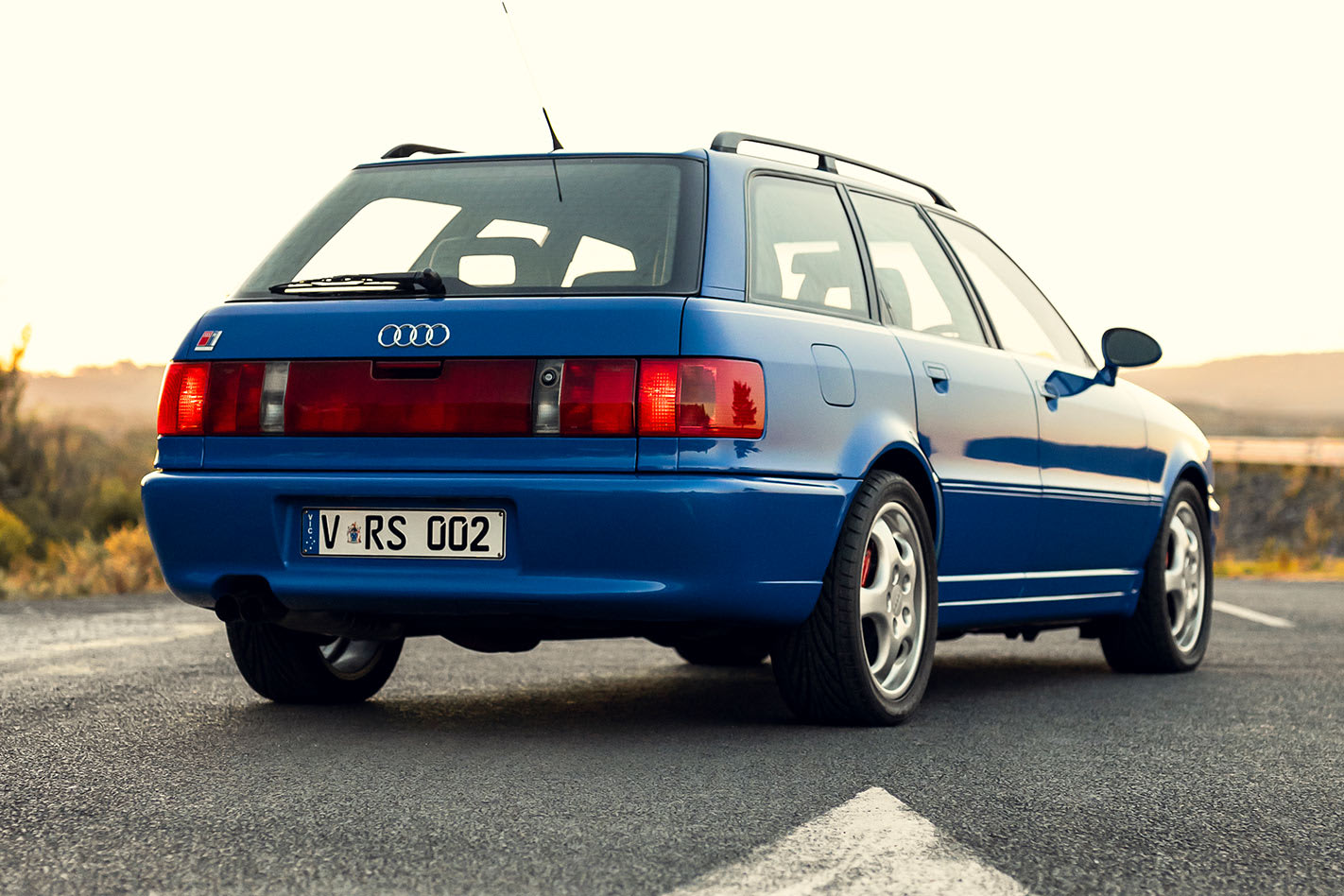
It doesn’t get much better!

Move to the inside, which in most cars was black or tan, and you’re again taken back to the 80’s. Certainly not an interior worthy of the price Testarossas trade at today but well of the 80’s, meaning angular forms and as in many Ferraris from back then, switches and buttons sometimes in places you wouldn’t expect them. Given how few of them there were however, that doesn’t really matter, and the poor sound isolation certainly has the benefit of letting you hear the full drama of the 12-cylinder! The car is much more modern than its predecessor, the 512 BB, and not in any way complicated to drive. It received some early criticism for being a bit light in the front at higher speeds, but that will hardly be an issue today as you probably won’t drive your 35-year old Testarossa north of 200 km/h (you certainly don’t need to go that fast to enjoy the engine!), In other words, except for the cambelt, the Redhead doesn’t have to be the nightmare to drive or maintain that many believe.

Comparing to today’s interiors, it’s amazing people got to their destination, and in one piece!

The Testarossa in its original form lived until 1991, but its life was then extended by the slightly modified and 428 hp strong 512 TR until 1994, and after that another two years through the at 440 hp even more powerful F512 M (Modificata). The TR is distinguishable form the side where it has a design close to the 348, and the F512 M is from both the front (no more pop-up headlights) and from the rear as well (see below). When production of the F512 ended in 1996 it also meant the end of the Ferrari flat 12-cylinder engine, and the Testarossa was also the last unlimited (in production numbers) mid-engined Ferrari. As for the numbers almost exactly 10.000 cars were built of the three versions, split as around 7.200 Testarossas, 2.300 512 TR’s, and only 500 F512 M. That is also reflected in the prices they go for today. A Testarossa will be yours for around EUR 100′ and upwards, the TR for around EUR 50′ more, and the Modificata for more than three times an original Testarossa – if you can find one. If you buy it to drive, which I would dare hope, those that have tried all three say the price difference isn’t worth it as the “base” Testarossa conveys both enough power and even more of the original Ferrari spirit from the golden 80’s. Also, you’ll probably want to make sure that cambelt was replaced not too long ago!

The F512 M is rare – and expensive!

Street finds: the Canadian Alfa Romeo!

The sun has been out in Zurich lately which makes for a nice change, given it was very far away during most of summer. This obviously means that some classic car owners have used the occasion to get their machines before winter kicks in, so in that spirit, it was a nice surprise to walk out of the office door last week and see… an Alfa Romeo Montreal! It certainly doesn’t happen often, and as can be seen below, it was also a Montreal in very nice condition.

To start with the not very Italian name, why on earth did Alfa name the car after a town in Québec? The simple explanation is that it was first shown at the world exhibition in 1967 in, you guessed it, Montreal, and Alfa apparently had no better name in mind than that. Production started three years later in 1970, ending in 1977. The beautiful coupé was designed by our old friend Marcello Gandini of Bertone, and the most striking feature is certainly the headlight covers that flip back when you turn them on.

Sleak lines with characteristic headlights and side air intakes

After the headlights, it’s really the side air intakes that catch your attention and makes you think the Montreal has a mid-mounted engine. Perhaps strangely, it never did so and whereas there were indeed plans for it when the original design was developed, when the project moved on, Alfa settled on a more conventional front engine. The air intakes were however kept to help cool the cabin, and probably also because they look cool.

Ample space for two on the way to the Côte d’Azur!

The engine may be in the front, but it clearly remains the highlight of the car. The four-cam, eight-cylinder motor had been developed for the Tipo 33, a previous Alfa racing car. At 2.6 litres it was quite small but still developed 200 hp, but did so using quite a lot of fuel which wasn’t ideal in the early 70’s, as we’ll come back to. As for the rest of the car, as so often over the years, Alfa was a bit short on cash, so the chassis and brakes both come from the Giulia GT, meaning they were a bit under-dimensioned, especially given the potent engine. In other words acceleration was better than braking, so staying up in front was a good idea!

Even though the Montreal interior doesn’t reach the heights of some other Italian legends from Modena or Sant’Agata from the period, it’s nice enough and ties back to the GT car tradition from the 70’s. But just like many others among those, the Montreal also drove straight into the 1973-1974 oil crisis, which certainly didn’t help sales numbers. In seven years of production, Alfa would only build around 4.000 Montreals in total, certainly much less than the company had initially hoped for.

Many cars had leather seats rather than cloth

For some reason, Montreals survived corrosion better than many other 70’s cars, and certainly better than most other Alfas. This in turn means that finding a nice one today isn’t as difficult as you would have thought. As in so many cases, buying one five-six years ago had been far cheaper, with nice cars now trading around EUR 60-80.000. Although it’s easy to love the design and even more so with a V8 under the hood, at that price level there are a bit too many interesting competitors for me to be swayed by the Canadian Alfa, but that’s only me!

Celebrating the real legend!

You may have seen that Lamborghini has re-introduced the Countach. Yes, you read that right, the most legendary of all sports cars of the 80’s – scrap that, of all times! The one a fair number of us born in the early 70’s with a head full of petrol dreamt about and put a poster of on our bedroom wall, next to Samantha Fox, Sabrina or Miami Vice. Just hearing the news, I imagine I wasn’t the only one filled with not just a little excitement. It didn’t last long though. The fall back to reality was heavy a few moments later as I learnt more about the new car.

You see, what Lambo dares calling the new Countach, under the official name LPI 800-4, has precious little to do with Marcelo Gandini’s jawdropping design from back then – nor is it a modern interpretation of the same theme. Nope, visually the new Countach is nothing more than a relatively modestly re-designed Aventador with some clumsy Countach references, of which 112 will be built (that’s good as it reduces the risk of being disappointed seeing it “live”). They’re of course extremely expensive (price not known at this point but probably around USD 3m), atrociously fast with 814 hp leading to a 0-100 time of below 3 seconds, naturally hybrid with a small electric engine making up 45 of those 814 hp, supporting the V12 and, it goes without saying, all sold, presumably to buyers of which a majority will park them in a garage and never drive them. Disappointed? Me?

The new Avent… sorry, Countach.
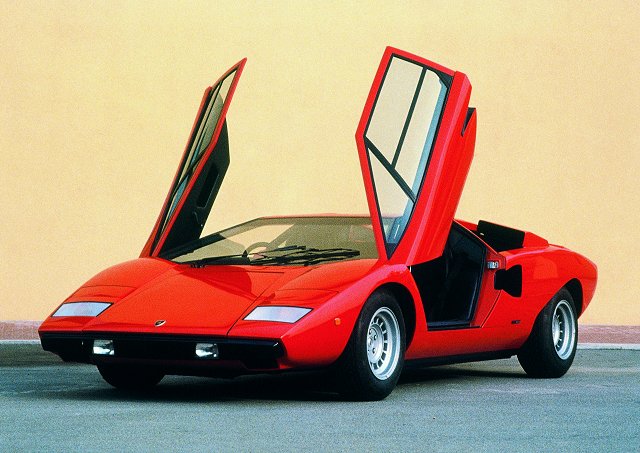
That is however all I’ll say about the new Countach and I also promise not to make this a long rant about how much modern supercars lack the heart and soul of the true legends. Instead we’ll do something much more fun: we’ll travel back to our younger years when our jeans were stone-washed, our socks white and our shoulders impossibly wide. For a few minutes, we’ll return to that poster on the bedroom wall (no, not Samantha) and have a good look at the original, REAL Countach! Interestingly, doing so also involves coming back to some legendary Italian car builders that have been featured on this blog earlier and only serve to highlight the true legend that the original Countach is.

The story begins in the early 70’s with Bertone being commissioned by Lamborghini to come up with a replacement for the Miura, which had only been on sale for a few years but already faced strong competition from the new Ferrari Daytona, introduced in 1969. Marcello Gandini, lead designer at Bertone, had a few years earlier started to experiment with a new design language as notably shown in the Lancia Stratos: a much more wedge-like, angular shape, and he took on the new Lambo project in the same spirit while the engineers were working on the engine. It was clear that the new car would remain rear-wheel drive with a rear-mid 12-cylinder engine as on the Miura, but for weight distribution along with some mechanical reasons, not transversally mounted as on the latter.

The true legends – from left to right, Giotto Bizzarrini, Ferruccio Lamborghini and Gian Paolo Dallara in 1963, admiring a prototype of the coming Lamborghini V12, designed by Bizzarrini!

The name Countach has always been a bit of a riddle and is a story in itself. Countach doesn’t mean anything in Italian and is also not following Lambo’s tradition of naming cars after bulls or bullfights. The story goes that one of the mechanics in the Sant’Agata factory only spoke Piedmontese, a regional language closer to French than to Italian in which there is the word “contacc”, an expression showing astonishment. The unnamed mechanic used it quite frequently when working on the car and Marcello Gandini therefore half jokingly sugested it as a possible name to Bob Wallace, Lambo test driver at the time, who confirmed it worked in English with a minor adaptation. The most spectacular supercar of all times was thus named on the factory floor and not in a board room! The first prototype was presented to the public at the Paris Auto Show in 1971 with sales starting three years later in 1974. They wouldn’t stop until 16 years later, in 1990.

A 1974 Countach, with 14″ inch wheels and lovely rear wheelarches!

Next to the long production time itself, it’s impressive how well the new design held up (and still holds up if you’re lucky to see one!). If you remove the increasing amount of spoilers and skirts that were added over the years, the basic design of the car remained unchanged throughout the 16 years of production. I guess I wasn’t the only one who in my youth found things like the giant spoiler on some later cars ultra-cool, but looking back with (slightly) more mature eyes today, it’s pretty clear the the first iteration was the cleanest and best-looking. I’m not sure beautiful is the right word, but spectacular definitely is. The wedge shape, the side air intakes, the forward movement created by the cutting of the rear wheelarches – and of course the scissor doors. The doors did not only come about for show though, as given how wide the Countach is and especially how massive its doorsills are, fitting conventional doors would have been both unpractical and complicated. Owners of later Countaches with the dome on the engine are especially thankful for that given for them, sitting on the doorsill with the door open and turning your head backwards is the only way to have any kind of rear-view visibility. If the Countach was wide (almost 2 metres) with poor rear visibility, it certainly wasn’t long. At 4.15 metres it’s far smaller than you would imagine, and actually shorter than a Lotus Evora!

As long as your garage is high enough, you’ll never have issues getting in!

If the design was spectacular, the engine was of course not less so. The V12 came from the Miura and as shown in the first picture, had its origins back in 1963, having been designed by Giotto Bizzarrini, whom you can read an earlier post of here. Also as mentioned it was longitudinally mounted such as to improve notably weight distribution and solve some other issues, with the 5-speed manual transmission being placed in front of the engine. The initial Countach LP-400 had the same 3.9 litre volume as the Miura, with a power output of 375 hp. It was later increased first to 4.7 litres in the LP5000S in 1982, and then 5 litres in the LP5000 QV (Quattrovalvole, four valves per cylinder) version from 1985 with 440 hp. It’s noticeable that until the end in 1990, the engine retained carburettors when everyone else had switched to fuel injection (for emission reasons the Countaches going to the US had to be injected). Having originally been side-mounted, the carburettors moved to the top of the engine on later cars, explaining the dome over the engine. This wonderful machine would outlive the Countach over the Diablo all the way to the Murcielago, meaning a production time of almost 50 years! Contrary to what you would maybe think, it also has a reputation of not being very primadonna-like, but rather very reliable.

Except for in my dreams I’ve never been in a Countach, much less driven one, but this is very high on the bucket list (you wouldn’t happen to own one, would you?). I have however peaked in to several of them and as anyone who does so, you may not realize that the window you look through only opens 5cm or so, but definitely that the money had run out before the time had come to design the interior. Not that it’s worse than on many other 80’s cars but the grand plans Lambo had for notably digital instruments never materialized and the interior is thus very conventional compared to the spectacular body. The seats are however a wonder of comfort compared to modern bucket seats, but they can only be adjusted in length. If you’re taller than 180 cm you should also be prepared to have contact with the roof lining (here, the later cars helped, giving another 3cm of head space in the “high” versions). And when it comes to driving, taking it from multiple reviews, it’s all hard work with an unassisted steering, a heavy clutch (those six carburettors are partly to be thanked for that, but you can’t have it all!) and a general experience of needing to work hard to get the most out of the car. Then again, isn’t that the way it should be in a true supercar?

Initial plans for a singe-spoke, Citroën-style steering wheel were also dropped

Production of the Countach came to an end in 1990, with the 25th anniversary edition introduced in 1988 with a certain Horacio Pagani (on whom you can read more here) being responsible for a lot of the restyling. The final iteration wasn’t loved by everyone given it departed from some of the most classical design features on previous Countaches and had a bit too many skirts, even for the late 80’s. It was however the fastest version of the Countach, capable of a top speed of 295 km/h and a 0-100 km/h time of 4.7 seconds. Remember this is 30 years ago on a car that was equipped by 345 mm rear tires, however only 15″ in wheel size! At the time, those were the biggest tires on the market.

The Anniversary edition was also the most popular version in production numbers, built 657 times and thus making up a third of the total production of around 1970 Countachs ever built. That’s right, the most legendary supercar of all times was built less than 2.000 times, to be compared for example with the over 7.000 Testarossas (not counting the 512’s). Not only that, a third of all Countaches were sold when it had already been on the market for 14 years! Another third was made up of the Quattrovalvole version (610 cars), thus leaving just a third of the early Countachs. Good luck finding one of those today… The easiest one to find today is the QV with prices starting around EUR 300′, with real jewels going for up to EUR 700′. That’s a lot of money, and a lot more than you would have paid ten years ago. Having said that, it’s still a couple of million less that you would pay for the new 2022 version if you were on the list of the selected 112 owners, and seen in that light, probably one of the greatest bargains out there! Junior may have more power and features, but in the Countach world, there’s no doubt that Daddy still rules big time!

One year with the 650i convertible!

As we all know time flies and it’s already a year since I bought my 650i convertible that I told you about in a post at the time, that you can view here if you missed it. It’s in other words time to make a brief pit stop to tell you how the first year has been, what the suprises, if any, have been and perhaps also if my initial statement from a year ago on the 650i being pretty sensational value for money still holds true. Given this is not a thriller movie I’ll allow myself to take that last piece of excitement away right here: the 650i is for all intents an purposes a bargain as has been confirmed many times over the last 12 months!

Given it’s a converible, the big Bavarian of course didn’t move in in the right season, but I managed to have some really nice drives during Sept-Oct last year before it got cold and wet and it was time to park it for the winter. You’ll tell me that given the four-wheel drive, the thickness of the hood and the quality of a BMW there was really little reason for this and you’d be right, except that as it happens we have a family SUV as well and if I don’t use it during the winter, when should I then use it… Also, the condition of the 650i being as good as it is, I would feel physically bad if I drove it on salty roads. So for the 4-5 months between November and March, the only thing that happened were a few drives long enough to get the engine warm and make sure the tires stay round.

It’s helps living in a country where a nice drive is never far away!

Spring came and was nice and it was then time to put the car a bit more to the test. As I noted in my last post, the 650 is much more of a GT than a sports car, also given its length of almost five meters and its weight of around two tons. Given that it’s pretty amazing how BMW managed to create an interior space that is so limited. There are absolutely no complaints up front where supreme comfort reigns, and sure, the back seats work for adults for shorter trips, but I wouldn’t take the kids for more than a couple of hours given how cramped the seats are. Then again I was well aware of that and the intention is to use the car for two. No doubt the long body adds a bit of elegance and I guess the point of a large convertible is also that you can be allowed to be a bit wasteful with space, even if it doesn’t make much sense. At least the boot is suprisingly large (even more so when the roof is up) which is definitely a plus in this family!

There are A LOT of positives I’ve noted during my first 12 months of owning the 650i so in order not to bore you, let me just focus on some of the main ones. The first thing I noticed was how precise and well weighted the steering was, especially in the sports setting. The comparison that jumped to mind was my previous E63 AMG, but I would say the 650i is marginally better, and the wheel is in BMW manner definitely thicker, but not too much so. Secondly, I was positively suprised that behind the elegant appearance lures quite a hooligan. Hit that Sport button and floor it in a tunnel, and if the roof is up, lower the back window (yes you can, and thank you very much whoever thought of that!), and if the resulting roar, pops and other guttural sounds don’t put a smile on your face, then do indeed buy an EV. The 450 hp double-turbo V8 delivers just the right amount of power and the double-clutch gearshift is so smooth you don’t even notice it.

Perfectly weighted steering and a nice thick wheel!

Thirdly, the suspension is superb and I’ll tie this to the overall quality of the build which is absolutely amazing. Take the roof off a car means removing a lot of the inherent rigidity of the body, usually leading to the odd squeek here and there. Not so in the 650i, which remains as silent as a Bavarian forest. I made a point on this in my initial post, namely the logic of buying a heavily depreciated luxury car rather than a less depreciated middle class one, as so much more effort has been invested in the original build. Finally, at least for a middle-aged man, the level of infotainment is exactly right. BMW’s solution from 2013-2014 was pretty much on the edge of what was done then, and it works absolutely fine to this day with nice physical buttons to press rather than a flimsy screen with fatty marks where you desperately try to aim for a word in the upper corner.

What I don’t like? To be honest not a lot, but then again the initial brief was quite clear and didn’t leave room for mant surprises. What you definitely need to be aware of is that it’s a big car, which is to your advantage for the long trips on open roads but obviously less so in tight cities or garages. There are of course cameras and warning sounds all around, but you do need to be careful especially towards the front where the sloping hood is very difficult to estimate. In the section of minor complaints I would also question BMW’s decision in a convertible to only put a lock on the compartment under the center armrest but not on the glovebox, that you can thus not lock if you park the car with the hood down? That’s probably it though, and it sure isn’t a lot. Most importantly I haven’t had a single issue with the car so far, and now that the one year warranty has run out, I do hope that remains the case!

In the small segment of unpractical four-seat convertibles, the 650i thus shines as much now as it did 12 months ago. I love it and plan to keep it for a long time. It’s also nice to see that prices seem to have bottomed out, with cars currently being in the market being a few thousand more than what I paid. That confirms the saying that luxury cars fall like stones until they don’t do so anymore, and that seems to be the case for the 650i. If it corresponds to your brief and needs, I can thus only recommend that you join the club!

(Southern) street finds – SLS or SLR?

There haven’t been many outstanding street finds in Zurich lately, which hopefully means the owners have taken the really nice cars on a trips to sunnier locations than Switzerland has offered this summer. In such situations it helps having a son who last week happened to be in another city that is a rolling car Mecca, namely Monaco. He drove there with his friends from Nice in the morning, texted me in the first hour that there were more Brabuses on the streets than regular Merc’s, and then once they made it up to the Casino square, he sent me the top two pictures below.

The reason he didn’t send more was that the police came and told him it’s no longer allowed to photograph cars outside of the Hôtel de Paris, next to the Casino. Given this has been the favourite past-time of any car lover who’s ever been in Monaco for as long as anyone can remember and that car owners certainly didn’t mind, this is indeed very strange. Then again it’s still mandatory in Monaco to wear face masks everywhere, including outside, so Covid seems to have left some traces that this is maybe a consequence of. Leaving that aside however, the picture brings about the interesting question: which one of these highly competent but also highly collectable supercars would you go for, if you were fortunate enough to have the choice?

The SLR not only precedes the SLS by a letter but also by seven years as it was introduced in 2003 as its direct predecessor. It was built until 2009 by McLaren in Woking, having been developed jointly by the two manufacturers. The production was limited to 3500 cars but in the end only 2157 were built and of these, around 25% were roadsters. The engine was developed by AMG and was a compressor-charged V8 mounted behind the front axle and producing 626 hp in the first version until 2006, and 650 hp in the so called 722 update available from 2006 onwards (722 being Stirling Moss’s start number back in the day in the Mille Miglia race with the car the SLR takes its inspiration from, the original 300 SLR). Both SLR versions have a top speed of over 330 km/h which is truly sensational for a 15-year old car, and are paired to Mercedes’s 5-speed automatic from the time, which is far less sensational and probably the biggest drawback with the whole car, simply being too slow for a true supercar.

The SLR is to me a beautiful creation, a combination of an original and aggressive design and a slightly “old school” supercar construction, unfortunately with an interior that is not at all as spectacular as the exterior. Today these beauties cost from EUR 250.000 upwards for the coupé and from EUR 350.000 for the roadster as shown on the piture, with the 722 coupé as well as really low-mileage cars being more expensive and the 722 roadster, of which only 150 were built, far higher, if you can find one. There is currently one for sale in Switzerland at CHF 850.000.

The SLS was introduced the same year production of the SLR ended in 2009 and around 5.000 cars were built over the coming five years until 2014. Its official name is Mercedes-Benz SLS 63 AMG but even if AMG comes at the end, this was the first car that was completely developed by the company, although the car was put together at Mercedes in Sindelfingen. The engines were of course hand-built in Affalterbach. The SLS had true gullwing doors rather than the butterfly doors of the SLR, by far the most distinctive characteristic of the car (the roadster version obviouysly has conventional doors). Another far more important difference to the SLR is the SLS’s naturally-aspirated V8, the legendary 6.2 litre AMG engine developing 571 hp initally, 20 hp more in the GT versions from 2012, and 631 hp in the Black Series version in 2013. It also had a more modern, 7-speed, double-clutch speedshift box in all versions.

Finding an SLS is both easier and cheaper than finding an SLR. Both the first version and the GT start at or even slightly below EUR 200.000, going up to around EUR 250.000 for low-mileage cars. The Black Series is a different story, starting at twice that price and going all the way up towards EUR 700.000.

So to come back to the initial question, which one would you choose? If you’re in the market for these cars then the initial price difference is probably not decisive. Design-wise my vote goes to the SLR (just look at it!). It brings much more drama than the more restrained SLS, but clearly both cars are beautiful creations. Engine-wise however, a 6.2 litre, naturally aspirated AMG V8 will always beat a supercharged engine if you ask me, especially when it’s paired to a much better gearbox. Finally, if reason is to play any role at all here, whereas the SLR will be truly horrendously expensive to maintain, the SLS will just be very expensive.

Both these cars are true collectables but they are also and above all, true driving machines. If you’re lucky enough to consider either one of them, please don’t just park them in front of a nice hotel for others to see, even if they’re not allowed to take pictures of them anymore!

The last real Citroën (sort of…)

When you speak to fans of the French automaker Citroën (something which unfortunately happens less and less often as most of the true enthusiasts are getting old!), one of the most sensitive topics is no doubt which model of the legendary brand constitutes the last real Citroën. To a real “citroënniste”, nothing in today’s line-up is even close to fitting the bill. Some say it all ended with the legendary DS that I wrote about a while ago (see here). Others are more progressive and would draw the line at the 90’s XM, a strange, space-ship like creation and certainly a true Citroën in terms of quirkiness, but to me a car that lacked both looks and innovation. I’m rather in the camp in between the two. To me, the last real Citroën is the CX launched in 1974, notably as it was the last Citroën designed and developed before Citroën was bought by Peugeot and became a part of the PSA group the same year. Next to that however, the CX can be described as the every day version of the SM that I wrote about in January (see here), but also taking the best of the DS and modernizing the rest in a packaging that was truly Citroën. It thus forms the last chapter in the trilogy of the DS-SM-CX, reason why we’ll look closer at it this week!

An aerodynamic design with (today sough after) TRX wheels.

It’s never easy to succeed a true legend and with very few exceptions, there’s really no greater legends than the DS and SM. The CX however did a great job, being built during 15 years until 1989 (the estate all the way to 1991) and selling more than 1.1 million times. Given that it’s surprising how few have survived until today, something that also goes for its two predecessors. Then again, quality is not the first word you think about when talking about cars from the 70’s and it didn’t prevent people from being amazed when the CX was first shown to the world in 1974. The name makes reference to the wind resistance coefficient in French which for the CX was 0.37, not as good as the SM but still much better than most cars at the time.

When the development of the CX started in 1969 as an “inofficial” successor to the DS, a clear objective was to make the car easier and thereby cheaper to build than its complicated predecessor. That goal was achieved in a Citroën kind of way, meaning that everything except the bodyparts was fixed onto the chassis, with the body being screwed onto it at the very end of the production process and fixed with six rubber-metal fixings. No one but Citroën would probably think of this construction as a good way to save costs, but it worked well in terms of rigidity and also in isolating passengers from vibrations. Here, the legendary hydro-pneumatic suspension that the CX inherited from the DS was obviously a great help as well.

The cavernous CX station wagon, here in the first series

Another arbuably less glamorous thing the CX inherited from its predecessor was the engine. Not that Citroën didn’t have grand plans here as well. The original idea was to fit the car with a Wankel engine which with a planned 170 hp would have given the car sportscar like performance, and also suited it well given the Wankel construction’s lack of vibrations. That plan had to be scrapped for cost reasons though and instead, the CX inherited the 2-litre and 2.2-litre engines from the DS, developing 102 and 112 hp respectively, a bit later complemented by a diesel with 66 tired horses. These engines helped sell more than 100.000 CX’s in the first year of production, more than the DS had sold in any year but one. In 1975 Citroën also introduced the CX station wagon, a 25cm longer version of the car with a cavernous luggage space in the back. It was that same extended chassis that would also be used for the Prestige model that appeared shortly thereafter but where the extra 25cm instead benefitted the back seat passengers, making it a favourite car for many heads of state. Interestingly though, it wouldn’t be so for the French president until Jacques Chirac in 1995, when the CX was no longer manufactured.

An ocean of 70’s plastic around a bathroom scale!

If the CX was a revelation on the outside, it was no less so once you entered it. Once you’ve taken place in the extremely soft seats, you look out over, or rather through the one-spoke steering wheel at something which at first looks like a bathroom scale, but is in fact the speedomoter and rev counter. You then notice the lack of levers on the sides of the wheel, as the CX instead had two satellites with all necessary functions that you are supposed to operate with your left and right hand finger tips. The right satellite includes the horn, but any need for it will probably have passed by the time you find the right switch. The turn signal on the left is no less surprising since you have to actively turn it off – it doesn’t reset automatically when you straighten the steering wheel. Better? Not really. Different? Bien sûr! And by the way, if you think the CX is a hatchback, think again. In fact the concave and thereby self-cleaning rear window doesn’t open, meaning it has a traditional boot below it which is quite low and small. This was one example of the CX’s success becoming its enemy: it was well known that CX owners wanted Citroën to make the car a hatchback, something that could easily have been done, but the responsible people at PSA just looked at the strong sales numbers, shrug their shoulders and put that budget somehwere else in the large group.

Not a hatchback – that would have been too… logical.

The first series of the CX was built until 1984 and luckily the strong sales numbers didn’t prevent PSA from improving the engines on offer with more powerful versions. The 138 hp GTI was introduced in 1983 and the most powerful CX in the line-up, the 2.5 litre turbo developing 168 hp came a year later. The turbo had an impressive top speed of 220 km/h, of course thanks to the excellent aerodynamics. When the second series was presented in 1985 the most notable difference were the plastic front and rear bumpers which replaced the previous metal ones and helped further lower wind resistance to a quite astonishing 0.28, in line with the SM. A turbo was now fitted also to the diesel engines but the most powerful version remained the petrol 25 GTI Turbo II, the “II” coming from it now having an intercooler. The interior of the second series was modernized and for the Turbo II even quite sporty with red piping on the seats and dash in some countries, but not necessarily more logical. As an example the radio was moved from the dashboard to down between the seats, next to the handbrake. Changing radio station had just become something you needed to look away from the road for a couple of seconds to do…

A turbo II with optional leather seats – note the radio’s position…

If the above all sounds irrestistible and owning the – perhaps – last real Citroën is something you cannot go through life without having done, the good news is that the CX remains and under-apprecitated car to this day. It’s not easy to find a good one but when you do, it will still be cheap – we’re usually talking EUR 15-20.000. That means it’s much cheaper than either a good DS or a good SM, and much cheaper to own, while still giving you a good piece of the real Citroën experience! The second series looks more modern but the first has all the coolness of the original car, and the metal bumpers resist sunlight better than the 80’s plastic. Most CX’s were sold as manual which was a good thing. It’s also good to know that cars after 1981 have better rust protection, a big issue with earlier cars. As someone who grew up in the 80’s, the thought of a Turbo II is hard to resist. Objectively though, the best one to go for would probably be a late first series GTI – less prone to issues than the turbo, and with all of the Citroën genius intact!

Note the T for turbo in the wheels!

3 budgets – 3 naturally-aspirated legends!

Will our automotive future be completely electric? The political will of making it so is certainly there and although a number of questions haven’t been answered (where all the electricity in the Western world is supposed to come from if at the same time we close down base-power providing nuclear energy is one, what to do with all the millions of existing cars is another) at least right now, the signs all point in one direction. Reinforcing that is clearly also the important advances that are made in battery technology, examplified by the brand new Mercedes EQS that has a real life range of 700 km. And although e-fuels such as the solutions Porsche is exploring off Chile’s coast (see here a recent post on it) could present an alternative for making combustion engines “clean” and thus part of the future, they are still far from mass production.

This and other charging stations will not be empty for much longer

Whatever direction the world takes, it’s clear that downsizing is here to stay. All new combustion engines we see from here on will be smaller, supercharged versions of their predecessors. No one in their right mind would today build a new 10 or 12-cylinder naturally aspirated engine, and thus the large cylinder engines we have on the road today will be the last of their kind. If a big, naturally aspirated engine is your thing (and if you read this blog, I guess there’s a good probability of that!), it’s probably time to act and make that old dream of owning a naturally aspirated 10 or 12-cylinder car come true!

To help you on the way I’ve therefore taken the liberty of selecting three candidates in the price categories up to 30′ EUR, from 30-50′ EUR, and up to 100′ EUR. My logic doing so has been that they should be at least 10 years old such as to be out of the depreciation “J-curve”, and also have no more than 100.000 km on the clock. engine should be a 10- or 12-cylinder naturally aspirated one, sporty in nature and together with the car it’s fitted in, also have the potential for some value appreciation over the coming years. Doing this has been a fun exercise that I can recommend, You could of course have picked different cars across the three price segments, but here is what I came up with!

Up to 30′ EUR – BMW M5 E60/61

507 hp in a rear-wheel drive car means… smoke!

You can now find nice E60 sedans for as little as 30′ EUR, which is a true bargain in view of what the car and its fabulous engine offers. The latter, a 10-cylinder, 40-valve, 5 litre naturally aspirated engine developing 507 hp was also used as basis for the M6 of the E63 generation and was BMW’s only 10-cylinder engine. In the M5 it was coupled with an early 7-speed SMG box (i.e. single-clutch, automatic manual) that won’t shoot the lights out today but does the job. There was even a manual version which was however only sold in the US. That’s a shame, then again rumour has it that even the manual isn’t that great. Another rumour also has it that you need a bit more than the initial 30′ EUR as the 10-cylinder isn’t the most reliable engine, certainly a reason for being thorough when selecting the car. The E60 was built between 2005-2010 with a face lift in the first half of 2007, to a total of around 20.000 cars, making it the most popular M5 series.

Still a nice place to be!

Interestingly the E60 is so far the only M5 that has been offered as an estate/combi. From 2007 around 1.000 M5 Tourings were built and these are today even more desirable than the sedan. They are however also more expensive at around 50′ EUR, so that would move you to the next price class. In both cases, this generation of the M5 is a great car and the 10-cylinder engine one of the true legends of the naturally-aspirated world!

Between 30′ and 50′ EUR – Dodge Viper RT/10

It certainly looks the part on the outside

The Viper is quite a rare car in Europe and in many ways a true American muscle car with a massive, 8-litre 10-cylinder engine developing 408 hp (394 hp in Europe) and an even more impressive torque of 664 Nm! It was hereby an odd bird in Europe from the start and is so even more today. It was built during 15 years between 1992-2007 and later cars also had other engines, but the RT/10 is the first generation which was in production until 2002.

…but you’ll have to apply for example some carbon (as here) to help it do so on the inside.

The Viper and especially the first generation was really a car built around the engine, meant as a modern day Cobra. That’s to say that a very minor part of the budget was spent on things like the interior, which is basic, to put it mildly. Other standard items in other cars such as door windows, door handles and airbags were also not prioritized. You have to reach inside the door to open it and the door windows were delivered in a separate bag, to be stuck into the door if you wanted them. Not many did. The Viper also doesn’t have any kind of driving aids, so in many ways it is indeed a true muscle car, something that becomes very clear when you turn the key and are greeted by the sound of the giant engine. Any thoughts on the crappy interior will vanish quickly and as long as you’re slightly careful with applying the power, you’re set to enjoy every meter in this American legend!

Up to 100′ EUR – Ferrari F550 / F575

Looks are a matter of taste, but you cannot not like the F550!

Long-term readers of this blog may remember my post on the F550 from back in 2015. I speculated then that it may start appreciating soon which so far hasn’t happened. Depreciation has however stopped and prices have been stable ever since, meaning you can get a fabulous, mechanical 12-cylinder Ferrari for a bit less than EUR 100′. That is as much a bargain today as in 2015 and I’ll stick my head out again and say prices may well be starting to climb soon. I’ll ask you to go back to the 2015 post for full details on the car, but at its heart is the fantastic, 5.5 litre 12-cylinder engine producing around 485 hp, which is paired to a six-speed manual box (the F575 had a slightly bigger and more powerful engine). I wouldn’t bother with the F575 as the very limited facelift and increased power don’t warrant it, especially since most F575’s came with one of those semi-automatic boxes. A good F550 with a full history is a buy you will never regret!

The world’s most famous gear change!

There you go – three budgets, three cars. Grab them now and enjoy them while you can, and I promise you won’t regret it. And if Porsche or someone else is successful with an alternative fuel solution that allows our combustion cars to stay on the road, you’ll definitely be a long time winner!

The beautiful Dino from Torino!

it’s time to leave the world of over-powered and over-priced SUV’s and return to a more traditional, and dare I say classy thrill of driving, which after all is what this blog is all about. We’ll do so by going back to a theme that I explored almost two years ago in a post entitled “The best Ferrari is a Maserati”. The reference here was the Maserati Coupé from the early 00’s, equipped with the brilliant 4.2 litre, Ferrari V8. The coupé is however not the only way to profit from a Ferrari engine in a car of a different – and usually cheaper – brand. Another example of that was the breathtakingly beautifful Fiat Dino Coupe from the mid-60’s, one of the highlights of that decade and a car we’ll look closer at today!

Classic 60’s, sweeping GT lines!

It’s the early 60’s, the Vietnam war rages, the mini skirt is the latest fashion and Americans are told smoking is dangerous through warning labels on cigarette packages (Europe wouldn’t get these for another few years). Our American friends however also had the Mustang whereas in Europe the English drive Minis and the French the eternal 2CV and the clever but not very beautiful Renault 4. Design-wise therefore, you had to go to Italy to find the true masterpieces (yep, some things don’t change!), and south of the Alps, Fiat is planning for an upmarket GT coupé and convertible, without having a suitable engine to power it.

Further east in Maranello, Ferrari’s world is a little less rosy. Enzo is still deploring the loss of his son Alfredo (“Dino”) in 1956, only 24 years old. Dino was credited with the development of the Ferrari 2-litre V6 engine that over a few years had been used in various racing cars. Ferrari now needs precisely this kind of engine, i.e. no more than 2 litres and 6 cylinders for its Formula 2 cars, but the engine needs to be homologated through serial production of at least 500 units. At the time this was too much for a small manufacturer like Ferrari and it was therefore agreed with Fiat that they would build the homologated engine and also be free to use it in future Fiat cars. Contrary to what Enzo Ferrari had wanted, Fiat insisted on the engine being built in its Turin factory and not in Maranello, meaning that the Dino engines in cars like the Ferrari Dino 206 and 246 will have the Fiat logo casted somewhere on the motor block. Fiat now also gives the green light to Bertone to design the coupé and to Pininfarina to design the convertible. This was of course not very logical and led to the two cars looking rather different with most people (including me) agreeing that Bertone did a better job – judge for yourself. The convertible was introduced in 1966 and the coupé a few months later, in 1967.

The Dino engine was indeed quite special. A 2-litre V6 with an alloy block, it’s most famous for its unusual, 65 degree angle but also features quad cams and triple Weber carburettors, bringing the output to 158 hp (and also the need for a specialist to make sure those Webers are aligned as they should be!). The face-lifted engine that came in 1969 when homologation was no longer an issue was increased to 2.4 litres and was the world’s first serial engine with electronic injection. Power increased to 180 hp with notably improved torque, and all this was fitted in a magnificent coupé body with flowing lines, an aggressive front with a big grill, and a sweeping, lower rear. I owned a Fiat 124 Coupé from 1965 a few years ago which was also designed by Bertone and the similarities are clearly there but the Dino is a larger, more elegant car. The interior matches the exterior in a plush combination of leather (one of few options but a feature on many cars) and wood with a thin, large steering wheel. The gearbox is five-speed, there are dual-circuit disc brakes all around and even electric windows (still quite rare in Europe at the time). Even though the later 2.4 litre engine has more power and greater torque, enthusiasts will often tell you the smaller 2-litre is actually the sweeter one to drive. The later car was however also updated notably with independent rear suspension, improved brakes and some othe features making it a more modern car.

Leather was one of few options, switches and gauges standard!

Around 5800 2-litre and 2.4 litre Dino coupés were built between 1967 and 1974, with latter cars being assembled not in Turin but at Ferrari’s plant in Maranello. Of all these, few remain today and although only around 2000 convertibles were built, these are easier to find than the coupé. That hasn’t meant they haven’t gone ballistic price-wise though, with good convertibles today costing at least EUR 150.000, and the 2.4 litre being even more expensive as only 400 were built. A good coupé will still be yours for somewhere around EUR 50-60.000. Unless you have a very firm idea of what you want, the individual condition of the car is probably more important than which engine it has. One of the few available options was metallic paint and the dark grey metallic you can still find some cars in is to me the colour which really highlights the car’s beauty!

The Ferrari logo in the grill wasn’t a factory option…

The most beautiful Dino in my eyes indeed carries the Fiat badge (except the one in the picture above…) and to finish where we started, even though they’ve gone up in price in the last years, a Fiat Dino Coupé is still more than EUR 300.000 (!) cheaper than a Ferrari Dino 246 with the same engine! That’s of course an even more legendary car but it’s not a GT and it also doesn’t have the elegance of the Fiat Dino, one of the most beautiful cars of the 60’s. Good design never goes out of style so if there’s still room in your garage, get one while you still can!